Table of Contents

Volume 52, Number 7 · April 28, 2005

Freeman Dyson, The Bitter End

Armageddon: The Battle for Germany, 1944–1945 by Max Hastings

The End: Hamburg 1943 by Hans Erich Nossack, translated from the German and with a foreword by Joel Agee, and with photographs by Erich Andres

Andrew O'Hagan, The Pritchett Sound

V.S. Pritchett: A Working Life by Jeremy Treglown

Max Rodenbeck, A New Lebanon?

Russell Baker, Fathers and Son

Omaha Blues: A Memory Loop by Joseph Lelyveld

Sue M. Halpern, The Moment of Truth?

Blink: The Power of Thinking Without Thinking by Malcolm Gladwell

The Wisdom Paradox: How Your Mind Can Grow Stronger as Your Brain Grows Older by Elkhonon Goldberg

John Lanchester, Where the Fun Starts

Magic Seeds by V.S. Naipaul

Sanford Schwartz, A World of His Own

Manny Farber: About Face

Negative Space: Manny Farber on the Movies by Manny Farber

Timothy Garton Ash, Timothy Snyder, The Orange Revolution

Gordon S. Wood, The Making of a Disaster

Iron Tears: America's Battle for Freedom, Britain's Quagmire: 1775–1783 by Stanley Weintraub

Alan Ryan, The Magic of 'I'

The Ethics of Identity by Kwame Anthony Appiah

Christopher Benfey, The Art of Consolation

Poets Thinking: Pope, Whitman, Dickinson, Yeats by Helen Vendler
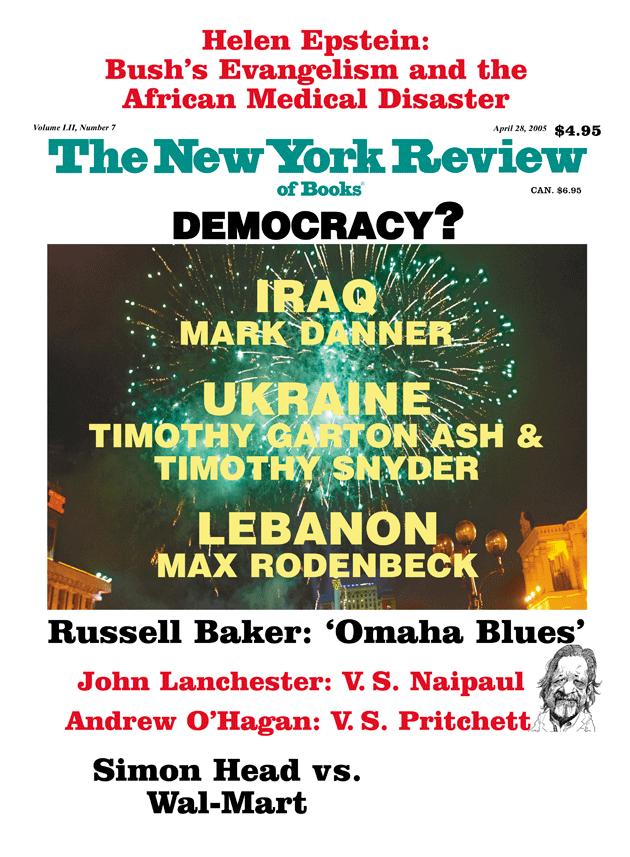
Mark Danner, Iraq: The Real Election

Joseph Kerman, Mystery Man

The Life of Bach by Peter Williams

Helen Epstein, God and the Fight Against AIDS

Jeremy Bernstein, Social Insecurity

Merick Chaffee, John Day, Gene Epstein, et al. Working for Wal-Mart: An Exchange


Letters

Larry McMurtry, The Death of Wild Bill Hickok


Contributors

Russell Baker is a former columnist and correspondent for The New York Times and The Baltimore Sun. His books include The Good Times, Growing Up, and Looking Back.

Christopher Benfey is Mellon Professor of English at Mount Holyoke. His edition of Lafcadio Hearn: American Writings has just been published by the Library of America. (May 2009)

Jeremy Bernstein is a physicist who worked at Los Alamos. His Plutonium: A History of the World's Most Dangerous Element was published in paperback in March. (April 2009)

Mark Danner, longtime staff writer at The New Yorker and contributor to The New York Review of Books, is the author of three books: The Massacre at El Mozote: A Parable of the Cold War; The Road to Illegitimacy: One Reporter's Travels Through the 2000 Florida Recount; and Torture and Truth. Danner's work has been honored with many awards, including a National Magazine Award, three Overseas Press Awards, and an Emmy. In June 1999, he was named a MacArthur Fellow. He is Professor of Journalism at the University of California at Berkeley and Henry R. Luce Professor of Human Rights and Journalism at Bard College. He divides his time between Berkeley and New York. His work is archived at markdanner.com.

Freeman Dyson has spent most of his life as a professor of physics at the Institute for Advanced Study in Princeton, taking time off to advise the US government and write books for the general public. He was born in England and worked as a civilian scientist for the Royal Air Force during World War II. He came to Cornell University as a graduate student in 1947 and worked with Hans Bethe and Richard Feynman, producing a user-friendly way to calculate the behavior of atoms and radiation. He also worked on nuclear reactors, solid-state physics, ferromagnetism, astrophysics, and biology, looking for problems where elegant mathematics could be usefully applied.

Dyson's books include Disturbing the Universe (1979), Weapons and Hope (1984), Infinite in All Directions (1988), Origins of Life (1986, second edition 1999), and The Sun, the Genome and the Internet (1999). He is a fellow of the American Physical Society, a member of the National Academy of Sciences, and a fellow of the Royal Society of London. In 2000 he was awarded the Templeton Prize for Progress in Religion.

Helen Epstein is the author of The Invisible Cure: Why We Are Losing the Fight Against AIDS.
 (June 2009)

Timothy Garton Ash is Professor of European Studies and Isaiah Berlin Professorial Fellow at St. Antony’s College, Oxford, and a Senior Fellow at the Hoover Institution, Stanford. His most recent book is Free World. (November 2008)

Sue Halpern is a scholar in residence at Middlebury College. Her most recent book is Can't Remember What I Forgot: The Good News from the Front Lines of Memory Research.
 (May 2009)

Joseph Kerman is emeritus professor of music at the University of California, Berkeley. He began writing music criticism for The Hudson Review in the 1950s, and is a longtime contributor to The New York Review of Books and many other journals. His books include Opera as Drama (1956; new and revised edition 1988), The Beethoven Quartets (1967), Contemplating Music (1986), Concerto Conversations (1999), and The Art of Fugue (2005).

John Lanchester's most recent book is a memoir, Family Romance. (March 2007)

Andrew O'Hagan iis a recipient of the E.M. Forster Prize from the American Academy of Arts and Letters. His latest novel is Be Near Me.
 (May 2009)

Max Rodenbeck is The Economist's Mideast Correspondent. He is based in Cairo. (January 2009)

Alan Ryan is Warden of New College, Oxford, and the author of biographies of John Stuart Mill, Bertrand Russell, and John Dewey. (October 2008)

Sanford Schwartz is the author of Christen Købke and William Nicholson. (March 2009)

Timothy Snyder is Professor of History at Yale. His most recent book is The Red Prince: The Secret Lives of a Habsburg Archduke. He is at work on Bloodlands: Europe Between Hitler and Stalin, which will be published in October 2010. This text is based on a lecture delivered on May 9, 2009, in Vilnius at the 22nd annual Eurozine conference. (July 2009)

Gordon Wood is the Alva O. Way University Professor and Professor of History at Brown. A collection of his essays, The Purpose of the Past: Reflections on the Uses of History, was published in March. (May 2008)


Search the Review
Advanced search