Table of Contents
Volume 52, Number 12 · July 14, 2005
Anthony Lewis, Privilege & the Press
Speaking Freely: Trials of the First Amendment by Floyd Abrams
Freeman Dyson, The Tragic Tale of a Genius
Dark Hero of the Information Age: In Search of Norbert Wiener, the Father of Cybernetics by Flo Conway and Jim Siegelman
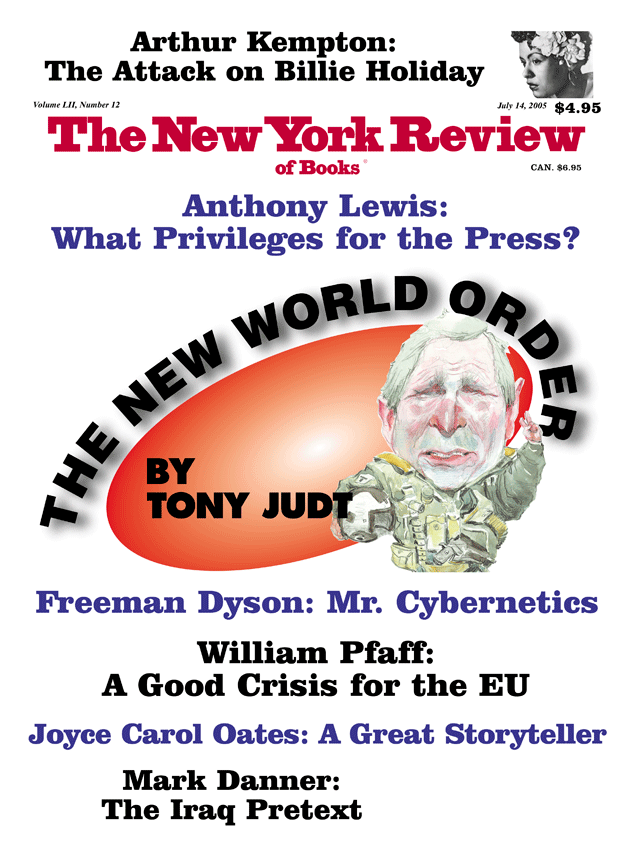
Tony Judt, The New World Order
At the Point of a Gun: Democratic Dreams and Armed Intervention by David Rieff
The New American Militarism: How Americans Are Seduced by War by Andrew J. Bacevich
A More Secure World: Our Shared Responsibility Report of the Secretary-General's High-level Panel on Threats, Challenges and Change
Guantánamo and Beyond: The Continuing Pursuit of Unchecked Executive Power by Amnesty International
Arthur Kempton, Street Diva
With Billie by Julia Blackburn
Larry McMurtry, On Rereading
Benjamin Moser, Small Wonder
Carel Fabritius 1622–1654 Young Master Painter
Carel Fabritius 1622–1654 by Frederik J. Duparc, with contributions by Gero Seelig and Ariane van Suchteren
William Pfaff, What's Left of the Union?
Joyce Carol Oates, The Great Heap of Days
Last Night by James Salter
Dusk and Other Stories by James Salter
Light Years by James Salter
Burning the Days: Recollection by James Salter
A Sport and a Pastime by James Salter
Solo Faces by James Salter
The Hunters by James Salter
Gods of Tin: The Flying Years by James Salter, edited and with an introduction by Jessica Benton and William Benton
Gordon S. Wood, Founders & Keepers
A Great Improvisation: Franklin, France, and the Birth of America by Stacy Schiff
John Adams: Party of One by James Grant
John Jay: Founding Father by Walter Stahr
Tim Parks, On 'The Garden of the Finzi-Continis'
George M. Fredrickson, The Long Trek to Freedom
Though the Heavens May Fall: The Landmark Trial That Led to the End of Human Slavery by Steven M. Wise
Slave Country: American Expansion and the Origins of the Deep South by Adam Rothman
The First Emancipator: The Forgotten Story of Robert Carter, the Founding Father Who Freed His Slaves by Andrew Levy
Bound for Canaan: The Underground Railroad and the War for the Soul of America by Fergus M. Bordewich
Christopher de Bellaigue, Left Out in Turkey
John Walcott, Mark Danner, 'The Secret Way to War': An Exchange
Letters
Regina Bringolf, Theodore John Kaczynski, et al. Giants at Heart
Michael S. McPherson, Benjamin DeMott, 'Reclaiming the Game'
Contributors
Freeman Dyson has spent most of his life as a professor of physics at the Institute for Advanced Study in Princeton, taking time off to advise the US government and write books for the general public. He was born in England and worked as a civilian scientist for the Royal Air Force during World War II. He came to Cornell University as a graduate student in 1947 and worked with Hans Bethe and Richard Feynman, producing a user-friendly way to calculate the behavior of atoms and radiation. He also worked on nuclear reactors, solid-state physics, ferromagnetism, astrophysics, and biology, looking for problems where elegant mathematics could be usefully applied.
Dyson's books include Disturbing the Universe (1979), Weapons and Hope (1984), Infinite in All Directions (1988), Origins of Life (1986, second edition 1999), and The Sun, the Genome and the Internet (1999). He is a fellow of the American Physical Society, a member of the National Academy of Sciences, and a fellow of the Royal Society of London. In 2000 he was awarded the Templeton Prize for Progress in Religion.
George M. Fredrickson is Edgar E. Robinson Professor of US History Emeritus at Stanford. His most recent books are Racism: A Short History and Not Just Black and White, a collection co-edited with Nancy Foner. (August 2006)
Tony Judt is University Professor at NYU. His new book, Reappraisals: Reflections on the Forgotten Twentieth Century, will be published in April. (May 2008)
Arthur Kempton, the author of Boogaloo: The Quintessence of American Popular Music, is a fellow at the Institute for African-American Research at the University of North Carolina, Chapel Hill. (March 2006)
Anthony Lewis, a former columnist for The New York Times, has twice won the Pulitzer Prize. His book Freedom for the Thought We Hate: A Biography of the First Amendment was published this year. (May 2008)
Larry McMurtry is the author of twenty-four novels, including The Last Picture Show, Terms of Endearment, Lonesome Dove, winner of the 1986 Pulitzer Prize for Fiction, and, most recently, Folly and Glory. His nonfiction works include a biography of Crazy Horse, Walter Benjamin at the Dairy Queen, Paradise, and Sacagawea’s Nickname: Essays on the American West (published by New York Review Books). He lives in Archer City, Texas.
Benjamin Moser lives in the Netherlands. (April 2006)
Joyce Carol Oates is the Roger S. Berlind Professor of Humanities at Princeton. Her collection of short novellas Wild Nights! Stories About the Last Days of Poe, Dickinson, Twain, James, and Hemingway has just been published and her novel My Sister, My Love: The Intimate Story of Skyler Rampike will be published this summer. (May 2008)
Tim Parks, a novelist, essayist, and translator, is Associate Professor of English Literature at IULM University in Milan. His novel Cleaver was published in February. (April 2008)
William Pfaff is an American author and syndicated columnist in Paris. His most recent book is The Bullet’s Song. (December 2007)
Gordon Wood is the Alva O. Way University Professor and Professor of History at Brown. A collection of his essays, The Purpose of the Past: Reflections on the Uses of History, was published in March. (May 2008)
Christopher de Bellaigue was born in London in 1971 and has worked as a journalist in the Middle East and South Asia since 1994. His first book, In the Rose Garden of the Martyrs: A Memoir of Iran, was shortlisted for the Royal Society of Literature's Ondaatje Prize. He lives in Tehran with his wife and two children.