Table of Contents

Volume 53, Number 16 · October 19, 2006

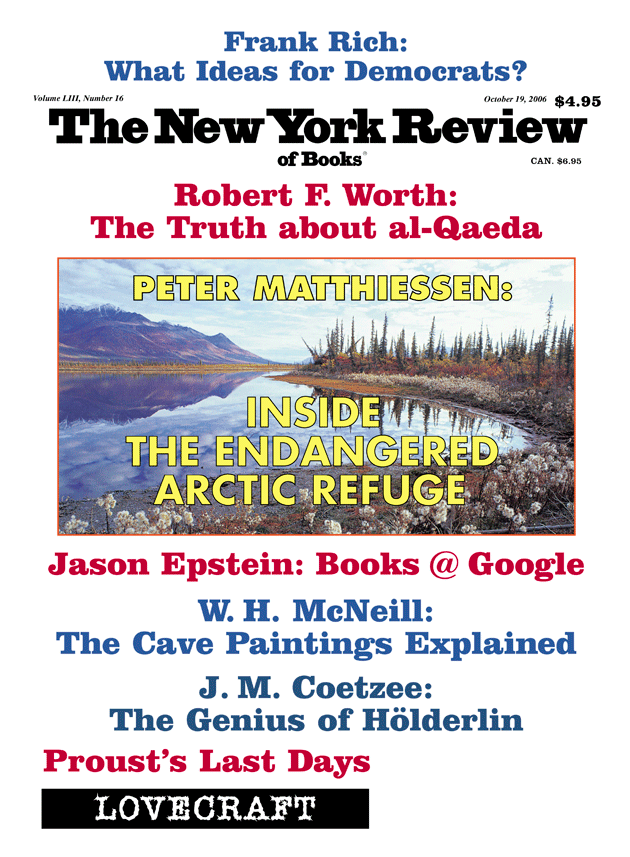
Frank Rich, Ideas for Democrats?

The Good Fight: Why Liberals—and Only Liberals— Can Win the War on Terror and Make America Great Again by Peter Beinart

The Plan: Big Ideas for America by Rahm Emanuel and Bruce Reed

The Courage of Our Convictions: A Manifesto for Democrats by Gary Hart

America Back on Track by Senator Edward M. Kennedy

William Pfaff, A Disaster by Any Measure

Robert F. Worth, Al-Qaeda's Inner Circle

The Looming Tower: Al-Qaeda and the Road to 9/11 by Lawrence Wright

Jennifer Schuessler, The Terrified Copyist

The Dissident by Nell Freudenberger

William H. McNeill, Secrets of the Cave Paintings

The Nature of Paleolithic Art by R. Dale Guthrie

The Cave Painters: Probing the Mysteries of the World's First Artists by Gregory Curtis

Jason Epstein, Books@Google

Google and the Myth of Universal Knowledge: A View from Europe by Jean-Noël Jeanneney,translated from the French by Teresa Lavender Fagan

The Search: How Google and Its Rivals Rewrote the Rules of Business and Transformed Our Culture by John Battelle

The Long Tail: Why the Future of Business Is Selling Less of More by Chris Anderson

Libraries and Google edited by William Millerand Rita M. Pellen

The Google Story: Inside the Hottest Business, Media, and Technology Success of Our Time by David A. Vise and Mark Malseed

Amos Elon, The Triumph of a Double Life

Five Germanys I Have Known by Fritz Stern

Graham Robb, Proust: The Race Against Death

Proust at the Majestic: The Last Days of the Author Whose Book Changed Paris by Richard Davenport-Hines

Brad Leithauser, Lorenz (poem)

Peter Matthiessen, Inside the Endangered Arctic Refuge

Luc Sante, The Heroic Nerd

Tales by H.P. Lovecraft, edited by Peter Straub

H.P. Lovecraft: Against the World, Against Life by Michel Houellebecq, translated from the French by Dorna Khazeni, with an introduction by Stephen King

Eamon Duffy, The Holy Terror

God's War: A New History of the Crusades by Christopher Tyerman

David Bromwich, How Lincoln Won

Lincoln: A Life of Purpose and Power by Richard Carwardine

Team of Rivals: The Political Genius of Abraham Lincoln by Doris Kearns Goodwin

Julian Bell, British Art: The Showcase

School of Genius: A History of the Royal Academy of Arts by James Fenton

Candidates for Fame: The Society of Artists of Great Britain, 1760–1791 by Matthew Hargraves

Freeman Dyson, Writing Nature's Greatest Book

The Best of All Possible Worlds: Mathematics and Destiny by Ivar Ekeland

Jonathan Mirsky, Court Favorite

Operation Yao Ming: The Chinese Sports Empire, American Big Business, and the Making of an NBA Superstar by Brook Larmer

Istvan Deak, Scandal in Budapest

Denis Donoghue, Coming in from the Cold

The Discomfort Zone: A Personal History by Jonathan Franzen

Tim Judah, Serbia: The Coming Storm

J.M. Coetzee, The Poet in the Tower

Poems and Fragments by Friedrich Hölderlin, translated from the German by Michael Hamburger

Letters

Morton Mintz, Elizabeth Drew, 'Power Grab'
Bruce Ackerman, David Cole, An 'Emergency Constitution'?
Gregor Dallas, Robert Skidelsky, 'The War That Never Ended'
Arnold S. Relman, What to Do about Health Care
Peter M. Smith, Daniel Mendelsohn, Death at Marathon
Edward Jay Epstein, The New Hollywood?


Contributors

Julian Bell is a painter and writer living in Lewes, England. He is the author of What Is Painting? and of Mirror of the World: A New History of Art, which was published last autumn. (March 2008)

David Bromwich is Sterling Professor of English at Yale. He is the author of Hazlitt: The Mind of a Critic and editor of a selection of Edmund Burke’s speeches, On Empire, Liberty, and Reform. (April 2008)

J. M. Coetzee, who was awarded the Nobel Prize for literature in 2003, is currently Visiting Professor of Humanities at the University of Adelaide. His latest novel, Diary of a Bad Year, was published in December. (March 2008)

Istvan Deak has written books on Weimar Germany’s left-wing intellectuals, the 1848 revolution in Hungary, the Habsburg army officer corps, and Europe during World War II. (March 2007)

Denis Donoghue is University Professor at NYU, where he holds the Henry James Chair of English and American Letters. He is the author of The Practice of Reading, Words Alone: The Poet T.S. Eliot, and, most recently, The American Classics. (October 2006)

Eamon Duffy is Professor of the History of Christianity at the University of Cambridge and a fellow of Magdalene College. His latest book is Marking the Hours: English People and Their Prayers, 1240–1570. (May 2008)

Freeman Dyson has spent most of his life as a professor of physics at the Institute for Advanced Study in Princeton, taking time off to advise the US government and write books for the general public. He was born in England and worked as a civilian scientist for the Royal Air Force during World War II. He came to Cornell University as a graduate student in 1947 and worked with Hans Bethe and Richard Feynman, producing a user-friendly way to calculate the behavior of atoms and radiation. He also worked on nuclear reactors, solid-state physics, ferromagnetism, astrophysics, and biology, looking for problems where elegant mathematics could be usefully applied.

Dyson's books include Disturbing the Universe (1979), Weapons and Hope (1984), Infinite in All Directions (1988), Origins of Life (1986, second edition 1999), and The Sun, the Genome and the Internet (1999). He is a fellow of the American Physical Society, a member of the National Academy of Sciences, and a fellow of the Royal Society of London. In 2000 he was awarded the Templeton Prize for Progress in Religion.

Amos Elon's most recent book is The Pity of It All: German Jews Before Hitler. He is a Fellow at the Center for Law and Security at NYU. (February 2008)

Jason Epstein was for many years editorial director of Random House and has written on food for various publications. (March 2008)

Tim Judah is the author of Kosovo: War and Revenge and The Serbs: History, Myth and the Destruction of Yugoslavia. He has reported on the Balkans, Afghanistan, Kurdistan, Iraq, and Sudan for The New York Review. (October 2006)

Brad Leithauser is a novelist, poet, and essayist. He lives in Massachusetts.

Peter Matthiessen’s most recent book is End of the Earth: Voyages to Antarctica. His novel Shadow Country will be published in the spring. The Nation Institute Investigative Fund provided assistance for his article in this issue. (November 2007)

William H. McNeill is Professor Emeritus of History at the University of Chicago. His most recent books are The Pursuit of Truth: A Historian’s Memoir and A Boyhood Memory: Long Ago on Grandfather’s Farm, which is currently in search of a publisher. (April 2008)

Jonathan Mirsky is a journalist and historian specializing in Chinese affairs. (May 2008)

William Pfaff is an American author and syndicated columnist in Paris. His most recent book is The Bullet’s Song. (December 2007)

Frank Rich is a columnist for The New York Times. His latest book is The Greatest Story Ever Sold: The Decline and Fall of Truth from 9/11 to Katrina.

Graham Robb has written biographies of Balzac, Rimbaud, and Victor Hugo. His latest book is The Discovery of France: A Historical Geography from the Revolution to the First World War. (March 2008)

Luc Sante is the author of Low Life, Evidence, The Factory of Facts, and, most recently, Kill All Your Darlings: Pieces 1990–2005. He is a frequent contributor to The New York Review of Books and teaches writing and the history of photography at Bard College.

Jennifer Schuessler is on the staff of The New York Times Book Review. (March 2008)

Robert F. Worth a reporter for The New York Times, has been writing about the war in Iraq since 2003. (October 2006)


Search the Review
Advanced search