Table of Contents
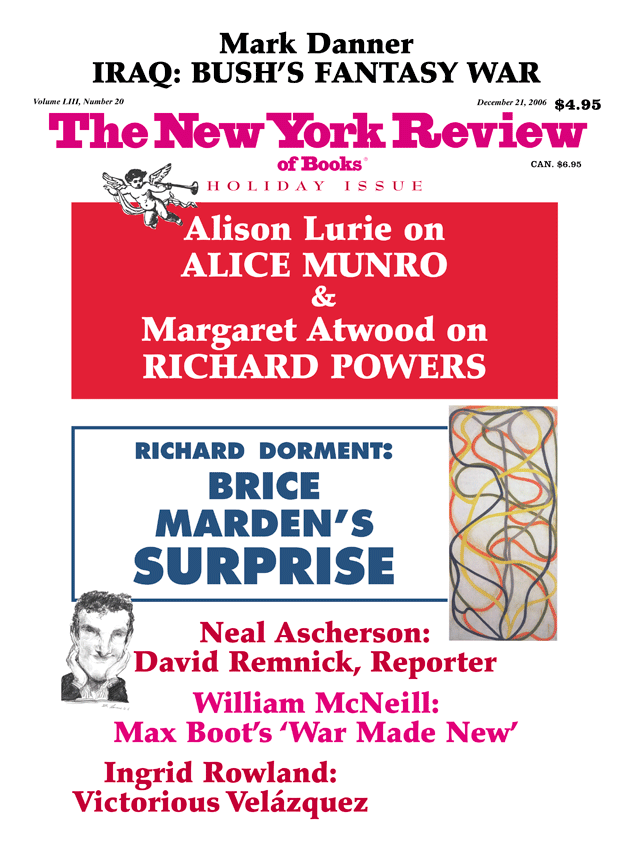
Volume 53, Number 20 · December 21, 2006
Richard Dorment, Journey from 'Nebraska'
Plane Image: A Brice Marden Retrospective Catalog of the exhibition by Gary Garrels
Plane Image: A Brice Marden Retrospective
William H. McNeill, Conspicuous Proliferation
War Made New: Technology, Warfare, and the Course of History, 1500 to Today by Max Boot
Alison Lurie, The Lamp in the Mausoleum
The View from Castle Rock: Stories by Alice Munro
Carried Away: A Selection of Stories by Alice Munro, with an introduction by Margaret Atwood
Alice Munro: Writing Her Lives: A Biography by Robert Thacker
Lives of Mothers and Daughters: Growing Up with Alice Munro by Sheila Munro
Anne Carson, O Ister
(poem)
Jonathan Freedland, The Enigma of Ariel Sharon
Ariel Sharon: A Life by Nir Hefez and Gadi Bloom, translated from the Hebrew by Mitch Ginsburg
Ariel Sharon: An Intimate Portrait by Uri Dan
Politicide: The Real Legacy of Ariel Sharon by Baruch Kimmerling
P.N. Furbank, The Love of a Pessimist
Leonard Woolf: A Biography by Victoria Glendinning
Neal Ascherson, A Far-Flung Correspondent
Reporting: Writings from The New Yorker by David Remnick
Ingrid D. Rowland, Master of the Natural
Velázquez
Velázquez Catalog of the exhibition by Dawson W. Carr, with essays by Xavier Bray, John H. Elliott, Larry Keith, and Javier Portús
Margaret Atwood, In the Heart of the Heartland
The Echo Maker by Richard Powers
John Banville, Letters from the Heights
Rainer Maria Rilke and Lou Andreas-Salomé: The Correspondence translated from the German by Edward Snow and Michael Winkler
Rainer Maria Rilke, Komm Du, Du Letzter...
(poem)
John Demos, Killed by the Panic
Witch Craze: Terror and Fantasy in Baroque Germany by Lyndal Roper
Alan Ryan, Is Capitalism Good for You?
The Bourgeois Virtues: Ethics for an Age of Commerce by Deirdre N. McCloskey
The Authentic Adam Smith: His Life and Ideas by James Buchan
Orlando Figes, Islam: The Russian Solution
For Prophet and Tsar: Islam and Empire in Russia and Central Asia by Robert D. Crews
Islam in Russia: The Politics of Identity and Security by Shireen T. Hunter with Jeffrey L. Thomas and Alexander Melikishvili, and with a foreword by Ambassador James F. Collins
Paul Schmidt, Translations of Akhmatova and Tsvetaeva
(poem)
Mark Ford, The Call of the Stallion
Horse Latitudes by Paul Muldoon
The End of the Poem: Oxford Lectures by Paul Muldoon
Mark Danner, Iraq: The War of the Imagination
State of Denial: Bush at War, Part III by Bob Woodward
The One Percent Doctrine: Deep Inside America's Pursuit of Its Enemies Since 9/11 by Ron Suskind
State of War: The Secret History of the CIA and the Bush Administration by James Risen
Seymour Feshbach, Aryeh Neier, Human Rights Watch and Israel: An Exchange
Letters
Jeffrey D. Sachs, How Aid Can Work
Franklin Foer, Leon Wieseltier, et al. Abraham Foxman and John Negroponte
Donald J. Boudreaux, Bill McKibben, How Close to Catastrophe?
Wolfgang Schoellkopf, Ian Buruma, Ernst Ludwig Kirchner's Case
Stephan Fuller, Peter Matthiessen, Canada and the Caribou
Aaron H. Esman, Sue M. Halpern, They Were in New York
The Editors, Correction
Contributors
Neal Ascherson is the author of The Struggles for Poland, The Black Sea, and Stone Voices: The Search for Scotland. He is the editor of the journal Public Archaeology at University College London. (November 2007)
Margaret Atwood is the author of eleven novels, among them The Handmaid’s Tale, Cat’s Eye, Alias Grace, and The Blind Assassin. Her most recent works of fiction are Oryx and Crake, The Tent, and Moral Disorder. (December 2006)
John Banville was born in Wexford, Ireland, in 1945. He is the author of many novels, including The Book of Evidence, The Untouchable, and Eclipse. Banville's novel The Sea was awarded the 2005 Man Booker Prize. On occasion he writes under the pen name Benjamin Black.
Anne Carson is professor of classics and comparative literature at the University of Michigan, Ann Arbor. She has been honored with the Lannan Award for Poetry and the Pushcart Prize for Poetry. In 2000, she received the MacArthur Genius fellowship. She was twice a finalist for the National Book Critics Circle Award.
Mark Danner, longtime staff writer at The New Yorker and contributor to The New York Review of Books, is the author of three books: The Massacre at El Mozote: A Parable of the Cold War; The Road to Illegitimacy: One Reporter's Travels Through the 2000 Florida Recount; and Torture and Truth. Danner's work has been honored with many awards, including a National Magazine Award, three Overseas Press Awards, and an Emmy. In June 1999, he was named a MacArthur Fellow. He is Professor of Journalism at the University of California at Berkeley and Henry R. Luce Professor of Human Rights and Journalism at Bard College. He divides his time between Berkeley and New York. His work is archived at markdanner.com.
John Demos, Professor of History at Yale, is completing a book on witch-hunts. His previous books include Entertaining Satan: Witchcraft and the Culture of Early New England. (December 2006)
Richard Dorment is the art critic of the Daily Telegraph. (April 2008)
Orlando Figes is Professor of History at Birkbeck College, London University. His new book, The Whisperers: Private Life in Stalin’s Russia, will be published this month. (November 2007)
Mark Ford teaches in the English Department at University College London. His edition of the poetry of Frank O’Hara was published in February. (April 2008)
Jonathan Freedland is an editorial-page columnist for The Guardian. (July 2008)
P. N. Furbank is the author of Diderot and, with W.R. Owens, A Political Biography of Daniel Defoe. (December 2007)
Alison Lurie is the author of two collections of essays on children’s literature, Don’t Tell the Grownups and Boys and Girls Forever. She is a former professor of English at Cornell and has published nine novels, of which the most recent is Truth and Consequences. (May 2008)
William H. McNeill is Professor Emeritus of History at the University of Chicago. His most recent books are The Pursuit of Truth: A Historian’s Memoir and A Boyhood Memory: Long Ago on Grandfather’s Farm, which is currently in search of a publisher. (April 2008)
Rainier Maria Rilke (1875-1926) achieved fame with his Duino Elegies and Letters to a Young Poet.
Ingrid D. Rowland is a professor, based in Rome, at the University of Notre Dame School of Architecture. A frequent contributor to The New York Review of Books, she is the author of The Culture of the High Renaissance: Ancients and Moderns in Sixteenth-Century Rome and The Scarith of Scornello: A Tale of Renaissance Forgery. She has published a translation of Vitruvius' Ten Books of Architecture. Her latest books are a biography of Giordano Bruno and a translation of Bruno's dialogue On the Heroic Frenzies.
Alan Ryan is Warden of New College, Oxford, and the author of intellectual biographies of John Stuart Mill, Bertrand Russell, and John Dewey. (November 2007)
Paul Schmidt (1934-1999), translator, poet, actor, librettist, playwright, and essayist, was born in Brooklyn, the oldest of seven children. He received a degree from Colgate University in Russian studies in 1955 and, after a year of graduate work at Harvard, he moved to Paris, where he studied mime with Marcel Marceau and acting with Jacques Charon of the Comédie Française. Drafted in 1958, he served in the US Army Intelligence and on his release resumed his Russian studies; his doctoral thesis on "the stylized theater of V.E. Mejerxol'd" was published as Meyerhold at Work. For eleven years, Schmidt was a professor of Slavic languages at the University of Texas at Austin, where he won the Bromberg Award for Teaching Excellence. His Arthur Rimbaud: Complete Works was published in 1975, and translations of Russian poets, notably Marina Tsvetaeva, followed. A commission from the Dia Foundation supported his translations of Velimir Khlebnikov (four volumes published between 1985 and 1997), allowing him to leave academia and move to New York City. Working with the Yale Repertory Theatre, the American Repertory Theatre, the Guthrie, and other companies, he translated Euripides, Chekhov, Brecht, Genet, Gogol, Marivaux, and Mayakovsky, and wrote three plays of his own, winning the Helen Hayes and Kesselring awards for best play for Black Sea Follies. Providing text and often performing, he collaborated with the Wooster Group and with the avant-garde directors Robert Wilson, JoAnne Akalaitis, David Schweitzer, and Peter Sellars. He also acted
in film and television, and in the 1970s devised "The Lost Art of Melodeclamation," a program of nineteenth-century works for voice and orchestra, which he toured and performed with the pianist Yvar Mikhashoff, who transposed the works for keyboard. The Plays of Anton Chekhov, Schmidt's translation of twelve of Chekhov's plays, was published in 1997. From 1993 until the end of his life, he taught translation and dramaturgy at the Yale School of Drama.