Table of Contents

Volume 54, Number 8 · May 10, 2007

Julian Bell, The Cunning of Francis Bacon

Francis Bacon in the 1950s catalog of the exhibition by Michael Peppiatt

Francis Bacon's Studio by Margarita Cappock

Francis Bacon: Commitment and Conflict by Wieland Schmied

Interviews with Francis Bacon by David Sylvester

Francis Bacon: The Violence of the Real catalog of the 2006 Düsseldorf exhibition edited by Armin Zweite, with Maria Müller

In Camera: Francis Bacon: Photography, Film and the Practice of Painting by Martin Harrison

Francis Bacon: Anatomy of an Enigma by Michael Peppiatt

Robert Gottlieb, The Drama of Sarah Bernhardt

Sarah Bernhardt by Henry Gidel

Sarah Bernhardt: The Art of High Drama by Carol Ockman and Kenneth E. Silver

Sarah Bernhardt's First American Theatrical Tour, 1880–1881 by Patricia Marks

My Double Life: The Memoirs of Sarah Bernhardt translated from the French by Victoria Tietze Larson

Being Divine: A Biography of Sarah Bernhardt by Ruth Brandon

The Divine Sarah: A Life of Sarah Bernhardt by Arthur Gold and Robert Fizdale

Dear Sarah Bernhardt by Françoise Sagan, translated from the French by Sabine Destrée

Sarah Bernhardt by Philippe Jullian

Sarah Bernhardt and Her World by Joanna Richardson

Sarah Bernhardt: The Art Within the Legend by Gerda Taranow

Madame Sarah by Cornelia Otis Skinner

The Idol of Paris by Sarah Bernhardt

Les Mémoires de Sarah Barnum by Marie Colombier, with a preface by Paul Bonnetain

Jeremy Waldron, Temperamental Justice

The Supreme Court: The Personalities and Rivalries that Defined America by Jeffrey Rosen

Supreme Conflict: The Inside Story of the Struggle for Control of the United States Supreme Court by Jan Crawford Greenburg

Vaclav Havel, Václav vs. Václav

David Kaiser, Jason DeParle, A Letter on Rape in Prisons

Fintan O'Toole, Howling from the Sidelines

John Osborne: The Many Lives of the Angry Young Man by John Heilpern

John Gray, Are We Born Moral?

Moral Minds: How Nature Designed Our Universal Sense of Right and Wrong by Marc D. Hauser

Primates and Philosophers: How Morality Evolved by Frans de Waal, edited by Stephen Macedo and Josiah Ober

Hermione Lee, Storms Over the Novel

The Curtain: An Essay in Seven Parts by Milan Kundera, translated from the French by Linda Asher

Thirteen Ways of Looking at the Novel by Jane Smiley

The Things That Matter: What Seven Classic Novels Have to Say About the Stages of Life by Edward Mendelson

How Novels Work by John Mullan

How to Read a Novel: A User's Guide by John Sutherland

The Novel, Volume 1: History, Geography and Culture edited by Franco Moretti

The Novel, Volume 2: Forms and Themes edited by Franco Moretti

Nation & Novel: The English Novel from Its Origins to the Present Day by Patrick Parrinder

Witold Rybczynski, Genius in Concrete

Ove Arup: Masterbuilder of the Twentieth Century by Peter Jones

Michael Oren, The Mass Murder They Still Deny

A Shameful Act: The Armenian Genocide and the Question of Turkish Responsibility by Taner Akçam, translated from the Turkish by Paul Bessemer

Orlando Figes, Prokofiev Makes His Moves

Sergey Prokofiev: Diaries, 1907–1914: Prodigious Youth translated from the Russian and annotated by Anthony Phillips, with a preface by Sviatoslav Prokofiev

Sergey Prokofiev: Dnevnik [Diaries] 1907–1933 edited by Sviatoslav Prokofiev

Hussein Agha, Robert Malley, The Road from Mecca

Freeman Dyson, The Dream of Scientific Brotherhood

The Fellowship: Gilbert, Bacon, Harvey, Wren, Newton, and the Story of a Scientific Revolution by John Gribbin
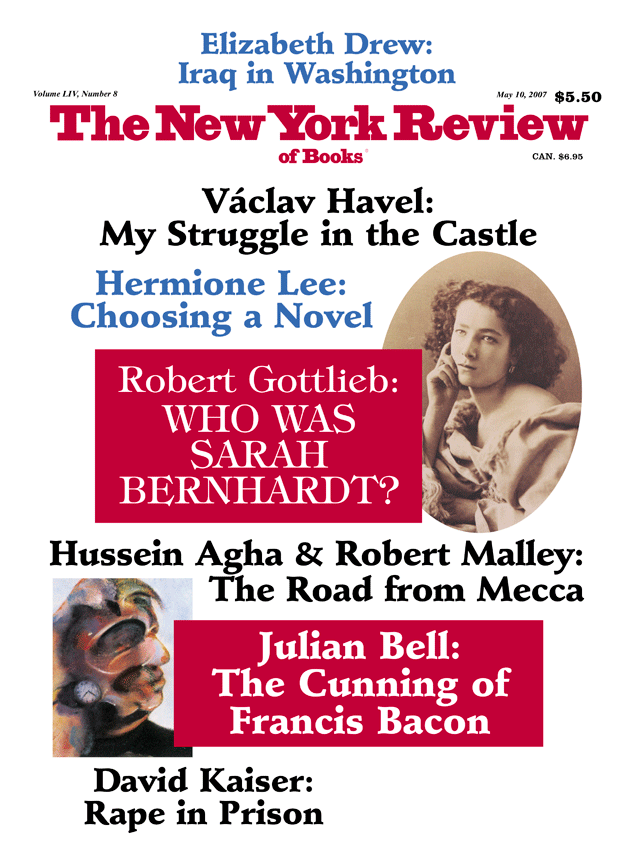
Elizabeth Drew, The War in Washington


Letters

Alvin H. Rosenfeld, George Soros, 'On Israel, America, and AIPAC'
The Editors, Corrections
Lisa Appignanesi, Sir Geoffrey Bindman, et al. 'Independent Jewish Voices'
Cornelius F. Murphy Jr., The UN to the Rescue?
Ron Rosenbaum, Anne Barton, 'The Shakespeare Wars'


Contributors

Hussein Agha is Senior Associate Member of St. Antony’s College, Oxford. He is the author, with A.S. Khalidi, of A Framework for a Palestinian National Security Doctrine. (May 2008)

Julian Bell is a painter and writer living in Lewes, England. He is the author of What Is Painting? and of Mirror of the World: A New History of Art, which was published last autumn. (March 2008)

Elizabeth Drew, who lives in Washington, is a regular contributor to The New York Review of Books. She is the author of twelve books.

Freeman Dyson has spent most of his life as a professor of physics at the Institute for Advanced Study in Princeton, taking time off to advise the US government and write books for the general public. He was born in England and worked as a civilian scientist for the Royal Air Force during World War II. He came to Cornell University as a graduate student in 1947 and worked with Hans Bethe and Richard Feynman, producing a user-friendly way to calculate the behavior of atoms and radiation. He also worked on nuclear reactors, solid-state physics, ferromagnetism, astrophysics, and biology, looking for problems where elegant mathematics could be usefully applied.

Dyson's books include Disturbing the Universe (1979), Weapons and Hope (1984), Infinite in All Directions (1988), Origins of Life (1986, second edition 1999), and The Sun, the Genome and the Internet (1999). He is a fellow of the American Physical Society, a member of the National Academy of Sciences, and a fellow of the Royal Society of London. In 2000 he was awarded the Templeton Prize for Progress in Religion.

Orlando Figes is Professor of History at Birkbeck College, London University. His new book, The Whisperers: Private Life in Stalin’s Russia, will be published this month. (November 2007)

Robert Gottlieb has been Editor in Chief of Simon and Schuster, Knopf, and The New Yorker. He is the author of George Balanchine: The Ballet Maker and is the dance critic of The New York Observer. (May 2008)

John Gray is Professor of European Thought at the London School of Economics. Among his most recent books are Straw Dogs: Thoughts on Humans and Other Animals, False Dawn: The Delusions of Global Capitalism, and Heresies: Against Progress and Other Illusions.

Vaclav Havel, one of the six signers of the statement “Tibet: The Peace of the Graveyard,” is former president of the Czech Republic. (May 2008)

David Kaiser, a former member of the staff of The New York Review, is president of Stop Prisoner Rape, a national human rights organization based in Los Angeles. (May 2007)

Hermione Lee is the author of a biography of Virginia Woolf and of Virginia Woolf’s Nose: Essays on Biography, which has recently appeared in paperback. Her new biography, Edith Wharton, has just been published. (May 2007)

Robert Malley was Special Assistant to President Clinton for Arab-Israeli Affairs and Director for Near East and South Asian Affairs on the National Security Council staff from September 1998 to January 2001. He is currently Middle East and North Africa Program Director at the International Crisis Group. (May 2008)

Fintan O'Toole is a columnist and critic with The Irish Times. He is the author of White Savage: William Johnson and the Invention of America. (November 2007)

Michael Oren is the author of Power, Faith and Fantasy: The United States in the Middle East, 1776 to the Present. He is a senior fellow at the Shalem Center in Jerusalem. (May 2007)

Witold Rybczynski is the Meyerson Professor of Urbanism at the University of Pennsylvania, and is architecture critic for Slate. His new book on American building, Last Harvest, has just been published. (May 2007)

Jeremy Waldron is the author of Law and Disagreement and The Dignity of Legislation. He is University Professor in the Law School at NYU. (May 2008)


Search the Review
Advanced search