Table of Contents
Volume 55, Number 10 · June 12, 2008
Michael Tomasky, Who Is John McCain?
Free Ride: John McCain and the Media by David Brock and Paul Waldman
The Real McCain: Why Conservatives Don't Trust Him—and Why Independents Shouldn't by Cliff Schecter
McCain: The Myth of a Maverick by Matt Welch
Jasper Griffin, Mad About the Boy
Alexander the Great: A Life in Legend
W.S. Merwin, To the Happy Few
(poem)
Ahmed Rashid, Jihadi Suicide Bombers: The New Wave
Inside the Jihad: My Life with Al Qaeda, A Spy's Story by Omar Nasiri
Architect of Global Jihad: The Life of al-Qaida Strategist Abu Mus'ab al-Suri by Brynjar Lia
Jihad in Islamic History: Doctrines and Practice by Michael Bonner
The Taliban and the Crisis of Afghanistan edited by Robert D. Crews and Amin Tarzi
Koran, Kalashnikov, and Laptop: The Neo-Taliban Insurgency in Afghanistan by Antonio Giustozzi
The Five Front War: The Better Way to Fight Global Jihad by Daniel Byman
Winning the Right War: The Path to Security for America and the World by Philip H. Gordon
Daniel Mendelsohn, The Truth Force at the Met
Satyagraha an opera in three acts by Philip Glass, directed by Phelim McDermott, with stage design by Julian Crouch
Satyagraha: M. K. Gandhi in South Africa, 1893-1914 by Constance Dejong and Philip Glass
Satyagraha an opera by Philip Glass, performed by Douglas Perry, Claudia Cummings, Rhonda Liss, Robert McFarland, Scott Reeve, Sheryl Woods, and the New York City Opera and Chorus, conducted by Christopher Keene
John Cassidy, Economics: Which Way for Obama?
Nudge: Improving Decisions About Health, Wealth, and Happiness by Richard H. Thaler and Cass R. Sunstein
Martin Filler, Flying High with Eero Saarinen
Eero Saarinen: Shaping the Future an exhibition at the National Building Museum, Washington, D.C.,May 3–August 23, 2008; the Minneapolis Institute of Art and Walker Art Center, September 14, 2008–January 4, 2009; the Mildred Lane Kemper Art Museum, Washington University, St. Louis, Missouri, January 31–April 26, 2009; and the Yale University Art Gallery and Yale University School of Architecture, New Haven, Connecticut, spring 2010.
Eero Saarinen: Buildings from the Balthazar Korab Archive edited by David G. De Long and C. Ford Peatross
The Gateway Arch: A Reflection of America a film directed by Scott Huegerich and Bob Miano, narrated by Kevin Kline
Istvan Deak, Did Hitler Plan to Kidnap the Pope?
A Special Mission: Hitler's Secret Plot to Seize the Vatican and Kidnap Pope Pius XII by Dan Kurzman
Freeman Dyson, The Question of Global Warming
A Question of Balance: Weighing the Options on Global Warming Policies by William Nordhaus
Global Warming: Looking Beyond Kyoto edited by Ernesto Zedillo
Joyce Carol Oates, In the Emperor's Dream House
The Enchantress of Florence by Salman Rushdie
Joseph Frank, Idealists on the Run
Lenin's Private War: The Voyage of the Philosophy Steamer and the Exile of the Intelligentsia by Lesley Chamberlain
Edward Mendelson, New York Everyman
Alfred Kazin: A Biography by Richard M. Cook
Pankaj Mishra, Sentimental Education in Shanghai
Fortress Besieged by Qian Zhongshu, translated from the Chinese by Jeanne Kelly and Nathan K. Mao, with a foreword by Jonathan Spence
Stephen Kinzer, Life Under the Ortegas
Helen Vendler, 'A Powerful, Strong Torrent'
Sea Change by Jorie Graham
David Cole, The Brits Do It Better
The Cost of Counterterrorism: Power, Politics, and Liberty by Laura K. Donohue
Executive Measures, Terrorism and National Security: Have the Rules of the Game Changed? by David Bonner
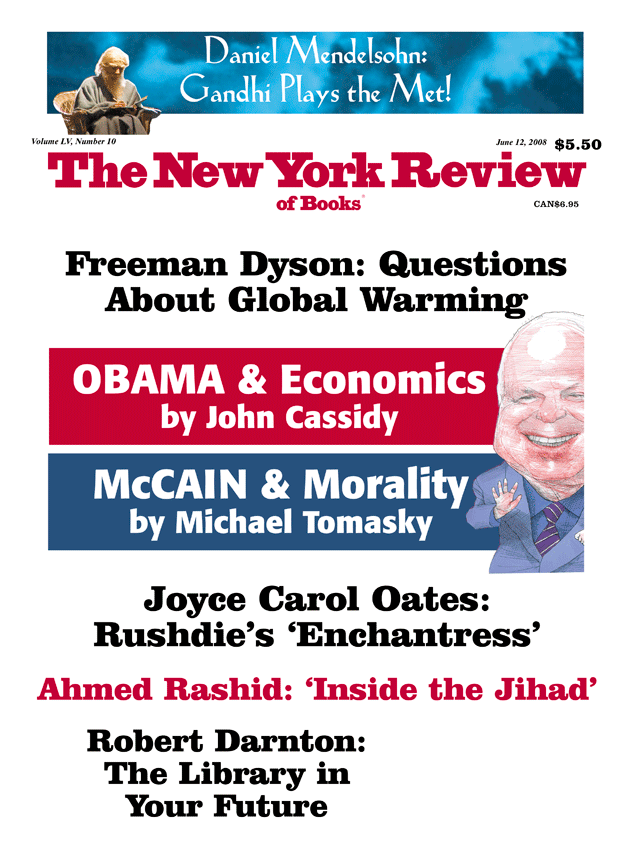
Robert Darnton, The Library in the New Age
David Little, Martha C. Nussbaum, Kent Greenawalt, 'Liberty of Conscience': An Exchange
Letters
Joseph Horowitz, Robert Gottlieb, 'Artists in Exile'
David Tipping, Robert Skidelsky, 'Gloomy About Globalization'
Contributors
John Cassidy, a staff writer at The New Yorker and a contributing editor at Conde Nast Portfolio, is the author of Dot.con: How America Lost Its Mind and Money in the Internet Era. (October 2008)
David Cole is Professor of Law at Georgetown University Law Center. He is the award-winning author of several books, including Less Safe, Less Free:Why America Is losing the War on Terror (with Jules Lobel, 2007) and Enemy Aliens: Double Standards and Constitutional Freedoms in the War on Terrorism (2003).
Robert Darnton is Carl H. Pforzheimer University Professor and Director of the University Library at Harvard. His latest book is George Washington’s False Teeth: An Unconventional Guide to the Eighteenth Century. (June 2008)
Istvan Deak is Seth Low Professor Emeritus at Columbia and the author most recently of Essays on Hitler’s Europe. (June 2008)
Freeman Dyson has spent most of his life as a professor of physics at the Institute for Advanced Study in Princeton, taking time off to advise the US government and write books for the general public. He was born in England and worked as a civilian scientist for the Royal Air Force during World War II. He came to Cornell University as a graduate student in 1947 and worked with Hans Bethe and Richard Feynman, producing a user-friendly way to calculate the behavior of atoms and radiation. He also worked on nuclear reactors, solid-state physics, ferromagnetism, astrophysics, and biology, looking for problems where elegant mathematics could be usefully applied.
Dyson's books include Disturbing the Universe (1979), Weapons and Hope (1984), Infinite in All Directions (1988), Origins of Life (1986, second edition 1999), and The Sun, the Genome and the Internet (1999). He is a fellow of the American Physical Society, a member of the National Academy of Sciences, and a fellow of the Royal Society of London. In 2000 he was awarded the Templeton Prize for Progress in Religion.
Martin Filler is the architecture critic of House & Garden and a frequent contributor to The New York Review of Books and The New Republic. He is the co-author, with Olivier Bossiere, of The Vitra Design Museum: Frank Gehry, Architect.
Joseph Frank is Professor Emeritus of Slavic and Comparative Literature at Stanford. He is the author of Dostoyevsky: The Mantle of the Prophet, 1871–1881. (June 2008)
Jasper Griffin is Emeritus Professor of Classical Literature and a Fellow of Balliol College. His books include Homer on Life and Death. (June 2008)
Stephen Kinzer, a former New York Times bureau chief in Managua, Berlin, and Istanbul, is the author of Overthrow: America’s Century of Regime Change from Hawaii to Iraq. He is writing a book about Rwanda. (June 2008)
Daniel Mendelsohn, a frequent contributor to The New York Review, is the author, most recently, of How Beautiful It Is and How Easily It Can Be Broken, a collection of essays mostly from these pages. His previous book, The Lost: A Search for Six of Six Million, won the National Book Critics Circle Award and the Prix Médicis Étranger in France. His translation, with commentary, of Constantine Cavafy’s Complete Works and Unfinished Poems will be published next year.
(October 2008)
Edward Mendelson is the literary executor of the Estate of W.H. Auden and professor of English and Comparative Literature at Columbia University. He is the author of Early Auden, Later Auden, and many essays on (and editions of) nineteenth- and twentieth-century writers, including George Meredith, Thomas Hardy, H.G. Wells, Arnold Bennett, Virginia Woolf, Samuel Beckett, and Thomas Pynchon.
W.S. Merwin was born in New York City in 1927 and grew up in Union City, New Jersey, and in Scranton, Pennsylvania. From 1949 to 1951 he worked as a tutor in France, Portugal, and Majorca. He has since lived in many parts of the world, most recently on Maui in the Hawaiian Islands. He is the author of many books of poems, prose, and translations and has received both the Pulitzer and the Bollingen Prizes for poetry, among numerous other awards.
Pankaj Mishra was born in North India in 1969 and now lives in London and India. He is the author of The Romantics, winner of the Los Angeles Times's Art Seidenbaum Award for First Fiction, and An End to Suffering: The Buddha in the World. He is a frequent contributor to The New York Review of Books and The Guardian. His most recent book is Temptations of the West: How to Be Modern in India, Pakistan, Tibet, and Beyond.
Joyce Carol Oates, the Roger S. Berlind Professor of Humanities at Princeton, is the author most recently of the novel My Sister, My Love: The Intimate Story of Skyler Rampike. (October 2008)
Ahmed Rashid is a Pakistani journalist and writer. He is the author of Taliban: Militant Islam, Oil and Fundamentalism in Central Asia and Descent into Chaos: The United States and the Failure of Nation Building in Pakistan, Afghanistan, and Central Asia, which is published this month. He is a BBC contributor and writes for the Daily Telegraph and the International Herald Tribune. (June 2008)
Michael Tomasky is Editor of Guardian America, The Guardian ’s American Web site. (November 2008)
Helen Vendler is the author, most recently, of Our Secret Discipline: Yeats and Lyric Form. She is preparing for publication her recent Mellon Lectures, entitled Last Looks, Last Books: Stevens, Plath, Lowell, Bishop, Merrill. (June 2008)