Contents

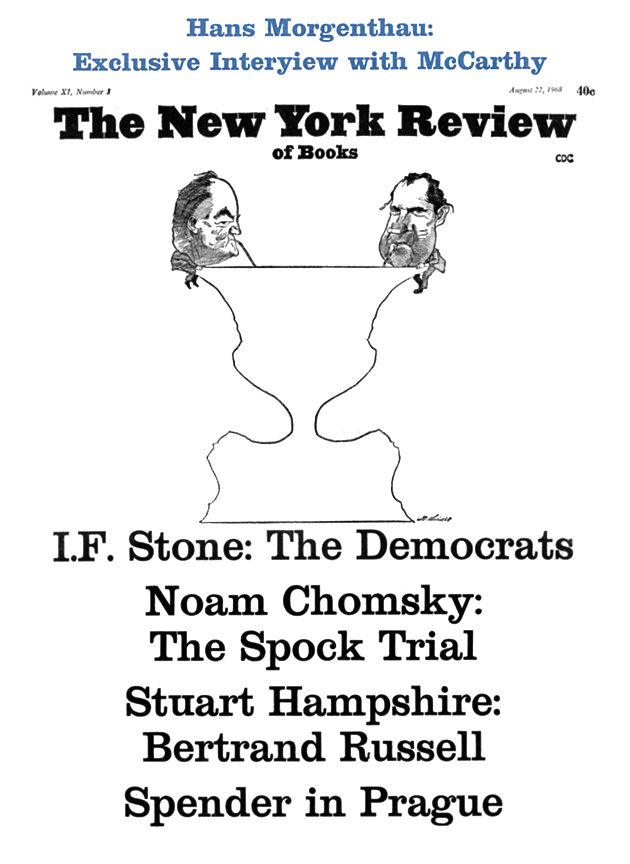
August 22, 1968 • Volume 11, Number 3

LETTERS

Contributors

Noam Chomsky is an Institute Professor and Professor Emeritus in the Department of Linguistics at MIT.

Dwight Macdonald (1906–1982) was born in New York City and educated at Exeter and Yale. On graduating from college, he enrolled in Macy’s executive training program, but soon left to work for Henry Luce at Time and Fortune, quitting in 1936 because of cuts that had been made to an article he had written criticizing U.S. Steel. From 1937 to 1943, Macdonald was an editor of Partisan Review and in 1944, he started a journal of his own, Politics, whose contributors included Albert Camus, Victor Serge, Simone Weil, Bruno Bettelheim, James Agee, John Berryman, Meyer Schapiro, and Mary McCarthy. In later years, Macdonald reviewed books for The New Yorker, movies for Esquire, and wrote frequently for The New York Review of Books.

William H. Gass is an American writer, critic and philosopher. He is the David May Distinguished University Professor in the Humanities at the Washington University in St. Louis. His novel Middle C was published in March 2013.

Stuart Hampshire (1914–2004) was an English philosopher. He taught at University College London, Princeton, Stanford and Oxford, where he was named Warden of Wadham College. His books include Thought and Action, Spinoza and Justice Is Conflict.

Anthony Hecht’sCollected Later Poems and Melodies Unheard: Essays on the Mysteries of Poetry were published in 2003. He died on October 20. (December 2004)

Allen Ginsberg (1926–1997) was a poet and one of most prominent figures of the Beat Generation. His epic poem “Howl,” which denounced bourgeois conformity and capitalistic greed, became the subject of a landmark obscenity trial in San Francisco. Known for his celebration of the marginalized and the downtrodden and his opposition to American militarism, Ginsberg drew inspiration from the long lines and anaphoric rhythms of Walt Whitman. His 1981 collection Plutonium Ode won the National Book Award; in 1993 Ginsberg was awarded the medal of Chevalier Des Arts et des Lettres by the French government.

Zbigniew Herbert’s Collected Poems 1956–1998 was published in English in 2007. The poem in this issue was prepared for a Polish edition of Herbert’s uncollected poems edited by Ryszard Krynicki. (June 2013)

Czesław Miłosz (1911–2004) was born in Szetejnie, Lithuania. Over the course of his long and prolific career he published works in many genres, including criticism (The Captive Mind), fiction (The Issa Valley), memoir (Native Realm), and poetry (New and Collected Poems, 1931-2001). He was a member of the American Academy and Institute of Arts and Letters and was awarded the Nobel Prize for Literature in 1980.

Stephen Spender (1909–1995) was an English poet and essayist. As a young man, he became friends with W.H. Auden, Louis MacNeice, Cecil Day-Lewis, and Christopher Isherwood, a loose collection often referred to as “the Auden Group” or “MacSpaunday.” He published many collections of poems, including The Still Centre and Ruins and Visions, and numerous volumes of nonfiction and other works, including Learning Laughterand Love-Hate Relations.

I.F. Stone (1907–1989) was an American journalist and publisher whose self-published newsletter, I.F. Stone’s Weekly, challenged the conservatism of American journalism in the midcentury. A Noncomformist History of Our Times (1989) is a six-volume anthology of Stone’s writings.

Lawrence Stone (1919–1999) was an English historian. He taught British history at Oxford and Princeton.

Neal Ascherson is the author of The Struggles for Poland, The Black Sea, and Stone Voices: The Search for Scotland. He is an Honorary Professor at the Institute of Archaeology, University College London.


H. R. Trevor-Roper (1914–2003) was a British historian and the author of The Last Days of Hitler. He taught at Oxford, where he was the Regius Professor Modern History.

Richard Wilbur’s book Mayflies: New Poems and Translations will be published in April. (November 2000)

Ernst Gombrich (1909–2001) was an Austrian art historian. Born in Vienna, Gombrich studied at the Theresianum and then at the University of Vienna under Julius von Schlosser. After graduating, he worked as a Research Assistant and collaborator with the museum curator and Freudian analyst Ernst Kris. He joined the Warburg Institute in London as a Research Assistant in 1936 and was named Director in 1959. His major works include The Story of Art, Art and Illusion: A Study in the Psychology of Pictorial Representation, Aby Warburg: An Intellectual Biography, The Sense of Order: A Study in the Psychology of Decorative Art.

Hans J. Morgenthau (1904–1980) was a legal scholar and theorist of international relations. Educated in Germany and Switzerland, Morgenthau taught for many years at the University of Chicago; later in life, he moved to The New School and The City University of New York. His books include In Defense of The National Interest, Politics Among Nations, and The Purpose of American Politics.