Contents

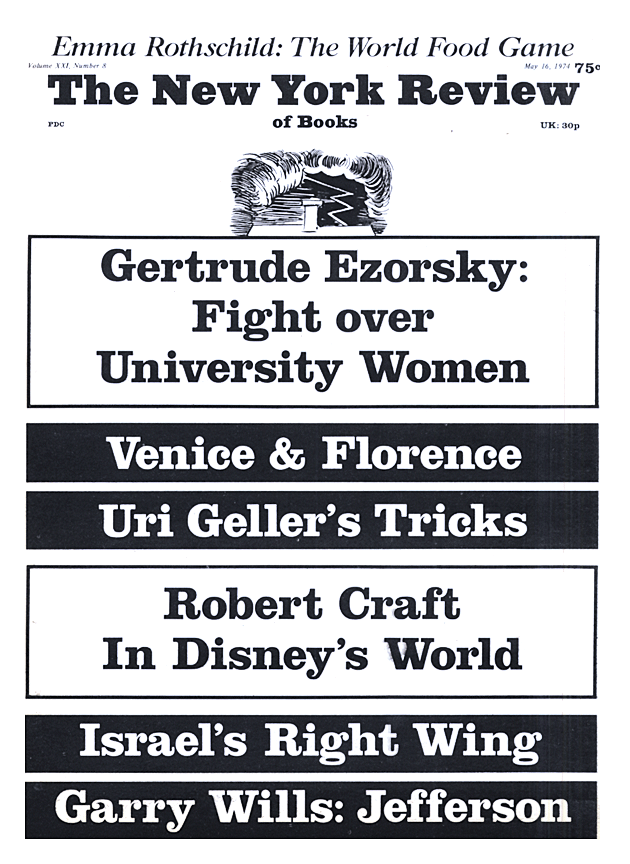
May 16, 1974 • Volume 21, Number 8
  • Robert Craft

    In the Mouse Trap e-edition

    The Art of Walt Disney by Christopher Finch

  • Garry Wills

    An Un-American Politician? e-edition

    Jefferson the President: Second Term, 1805-1809 (Volume Five of "Jefferson and His Time") Dumas Malone

  • Michael Wood

    Dazzling and Dizzying e-edition

    Children of the Mire: Modern Poetry from Romanticism to the Avant-Garde by Octavio Paz

    Conjunctions and Disjunctions by Octavio Paz, translated by Helen R. Lane

    The Bow and the Lyre by Octavio Paz, translated by Ruth L.C. Simms

    Early Poems 1935-1955 by Octavio Paz, translated by Muriel Rukeyser. others

  • Emma Rothschild

    The Politics of Food e-edition

    UN General Assembly: Study of the Problems of Raw Materials and Development: Note by the Secretary General

    UN Conference on Trade and Development: Problems of Raw Materials and Development: Note by the Secretary General of UNCTAD

  • Martin Gardner

    What Hath Hoova Wrought? e-edition

    Uri: A Journal of the Mystery of Uri Geller by Andrija Puharich

    Arigo: Surgeon of the Rusty Knife by John G. Fuller

  • J.H. Elliott

    Where We Started e-edition

    The Shape of European History by William H. McNeill

    Venice: The Hinge of Europe, 1081-1797 by William H. McNeill

    Venice, a Maritime Republic by Frederic C. Lane

    Florence in the Forgotten Centuries, 1527-1800 by Eric Cochrane

  • David Joravsky

    A Great Soviet Psychologist e-edition

    The Working Brain: An Introduction to Neuropsychology by A.R. Luria, translated by Basil Haigh

    The Man with a Shattered World: The History of a Brain Wound by A.R. Luria, translated by Lynn Solotaroff

    The Nature of Human Conflicts: or Emotion, Conflict and Will by A.R. Luria, translated by W. Horsley Gantt

    Soviet Psychology: Philosophical, Theoretical, and Experimental Issues by Levy Rahmani

  • Karl Miller

    A Novelist Worth Knowing e-edition

    Harriet Said by Beryl Bainbridge

    A Weekend with Claud by Beryl Bainbridge

    Another Part of the Wood by Beryl Bainbridge

    The Dressmaker by Beryl Bainbridge
  • Bernard Avishai

    Israel: The Threat from the Right e-edition

  • Gertrude Ezorsky

    The Fight Over University Women

LETTERS

Contributors

George M. Fredrickson is Edgar E. Robinson Professor of US History Emeritus at Stanford. His recent books include Racism: A Short History and Not Just Black and White, a collection co-edited with Nancy Foner.

Karl Miller is a British editor and critic. In 1979 he founded the London Review of Books.

Emma Rothschild is Director of the Joint Centre for History and Economics at King’s College, Cambridge and Harvard, and Professor of History at Harvard. She is the author of Economic Sentiments: Adam Smith, Condorcet and the Enlightenment.

Paul Schmidt (1934-1999), translator, poet, actor, librettist, playwright, and essayist, was born in Brooklyn, the oldest of seven children. He received a degree from Colgate University in Russian studies in 1955 and, after a year of graduate work at Harvard, he moved to Paris, where he studied mime with Marcel Marceau and acting with Jacques Charon of the Comédie Française. Drafted in 1958, he served in the US Army Intelligence and on his release resumed his Russian studies; his doctoral thesis on “the stylized theater of V.E. Mejerxol’d” was published as Meyerhold at Work. For eleven years, Schmidt was a professor of Slavic languages at the University of Texas at Austin, where he won the Bromberg Award for Teaching Excellence. His Arthur Rimbaud: Complete Works was published in 1975, and translations of Russian poets, notably Marina Tsvetaeva, followed. A commission from the Dia Foundation supported his translations of Velimir Khlebnikov (four volumes published between 1985 and 1997), allowing him to leave academia and move to New York City. Working with the Yale Repertory Theatre, the American Repertory Theatre, the Guthrie, and other companies, he translated Euripides, Chekhov, Brecht, Genet, Gogol, Marivaux, and Mayakovsky, and wrote three plays of his own, winning the Helen Hayes and Kesselring awards for best play for Black Sea Follies. Providing text and often performing, he collaborated with the Wooster Group and with the avant-garde directors Robert Wilson, JoAnne Akalaitis, David Schweitzer, and Peter Sellars. He also acted in film and television, and in the 1970s devised “The Lost Art of Melodeclamation,” a program of nineteenth-century works for voice and orchestra, which he toured and performed with the pianist Yvar Mikhashoff, who transposed the works for keyboard. The Plays of Anton Chekhov, Schmidt’s translation of twelve of Chekhov’s plays, was published in 1997. From 1993 until the end of his life, he taught translation and dramaturgy at the Yale School of Drama.

Garry Wills is Professor of History Emeritus at Northwestern. His study of Abraham Lincoln, Lincoln at Gettysburg: The Words That Remade America, was awarded the Pulitzer Prize in 1993. His latest book, Why Priests? A Failed Tradition, was published in February 2013.

Michael Wood is the Charles Barnwell Straut Class of 1923 Professor of English and Comparative Literature at Princeton. His books include Literature and the Taste of Knowledge and Yeats and Violence