Contents

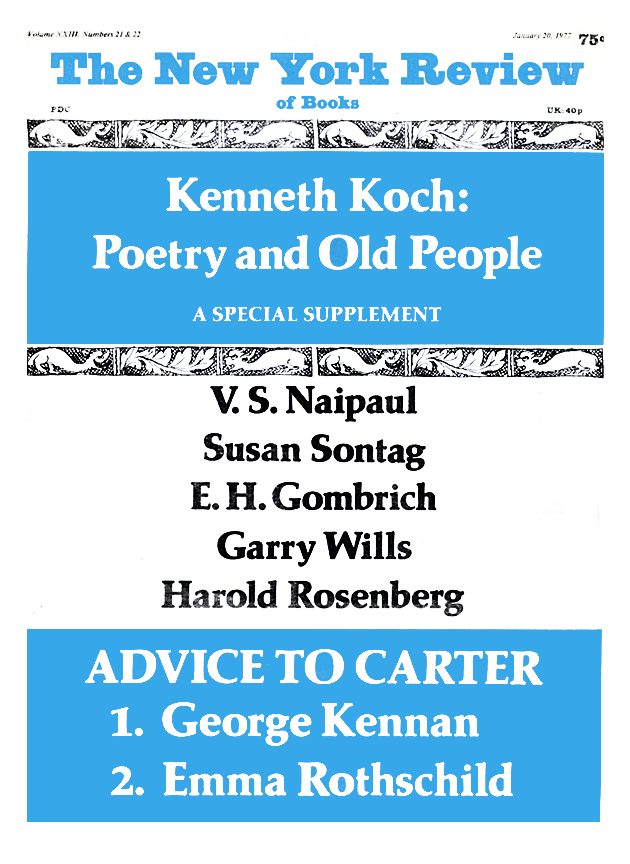
January 20, 1977 • Volume 23, Number 21 & 22

LETTERS

Contributors

Nigel Dennis (1912–1989) was an English writer, critic and editor. His books include Boys and Girls Come Out to Play and An Essay on Malta.

Ernst Gombrich (1909–2001) was an Austrian art historian. Born in Vienna, Gombrich studied at the Theresianum and then at the University of Vienna under Julius von Schlosser. After graduating, he worked as a Research Assistant and collaborator with the museum curator and Freudian analyst Ernst Kris. He joined the Warburg Institute in London as a Research Assistant in 1936 and was named Director in 1959. His major works include The Story of Art, Art and Illusion: A Study in the Psychology of Pictorial Representation, Aby Warburg: An Intellectual Biography, The Sense of Order: A Study in the Psychology of Decorative Art.

George F. Kennan (1904–2005) was an American diplomat, political scientist and historian. He is best known for his role in shaping US foreign policy during the Cold War and, in particular, for the doctrine of containment. Kennan was Professor Emeritus at the Institute for Advanced Study at Princeton and served as Ambassador to the USSR in 1952 and as Ambassador to Yugoslavia from 1961 to 1963. His books include At a Century’s Ending and An American Family.

Kenneth Koch (1925–2002) was Professor of English at Columbia. During his lifetime, Koch published at least thirty volumes of poetry and plays. He was also the author of a novel, The Red Robins; two books on teaching poetry writing to children, Wishes, Lies, and Dreams and Rose, Where Did You Get That Red?; and I Never Told Anybody: Teaching Poetry Writing in a Nursing Home.

Garry Wills is Professor of History Emeritus at Northwestern. His study of Abraham Lincoln, Lincoln at Gettysburg: The Words That Remade America, was awarded the Pulitzer Prize in 1993. His latest book, Why Priests? A Failed Tradition, was published in February 2013.

Michael Wood is the Charles Barnwell Straut Class of 1923 Professor of English and Comparative Literature at Princeton. His books include Literature and the Taste of Knowledge and Yeats and Violence

Robert Craft is a conductor and writer. Craft’s close working friendship with Igor Stravinsky is the subject of his memoir, An Improbable Life. In 2002 he was awarded the International Prix du Disque at the Cannes Music Festival.

Susan Sontag (1933–2004) was a novelist, playwright, filmmaker, and one of the most influential critics of her generation. Her books include Against Interpretation, On Photography, Illness as Metaphor, and The Volcano Lover.

Emma Rothschild is Director of the Joint Centre for History and Economics at King’s College, Cambridge and Harvard, and Professor of History at Harvard. She is the author of Economic Sentiments: Adam Smith, Condorcet and the Enlightenment.

Leszek Kołakowski was professor of philosophy at the University of Warsaw until March 1968 when he was formally expelled for political reasons. He was later a Senior Research Fellow at All Souls College, Oxford. He was the author of several books, including Main Currents in Marxism. The article in this issue will appear in the collection of essays Is God Happy?, to be published in February by Basic Books. He died in 2009. (December 2012)

Czesław Miłosz (1911–2004) was born in Szetejnie, Lithuania. Over the course of his long and prolific career he published works in many genres, including criticism (The Captive Mind), fiction (The Issa Valley), memoir (Native Realm), and poetry (New and Collected Poems, 1931-2001). He was a member of the American Academy and Institute of Arts and Letters and was awarded the Nobel Prize for Literature in 1980.

Mary McCarthy (1912-1989) was a novelist, essayist, and critic. Her political and social commentary, literary essays, and drama criticism appeared in magazines such as Partisan Review, The New Yorker, Harper’s, and The New York Review of Books, and were collected in On the Contrary (1961), Mary McCarthy’s Theatre Chronicles 1937-1962 (1963), The Writing on the Wall (1970), Ideas and the Novel (1980), and Occasional Prose (1985). Her novels include The Company She Keeps (1942), The Oasis (1949), The Groves of Academe (1952), A Charmed Life (1955), The Group (1963), Birds of America (1971), and Cannibals and Missionaries (1979). She was the author of three works of autobiography, Memories of a Catholic Girlhood (1957), How I Grew (1987), and the unfinished Intellectual Memoirs (1992), and two travel books about Italy, Venice Observed (1956) and The Stones of Florence (1959). Her essays on the Vietnam War were collected in The Seventeenth Degree (1974); her essays on Watergate were collected in The Mask of State (1974).

Robert Conquest, a Fellow of the Hoover Institution at Stanford University, is the author of The Great Terror. (March 1997)

Adam Michnik is Editor in Chief of the Warsaw daily newspaper Gazeta Wyborcza. His piece in this issue will appear in Andrei Sakharov and Human Rights, a collection of Sakharov’s writings that is being published by the Council of Europe this month. (January 2011)

V. S. Naipaul was born in Trinidad in 1932 and emigrated to England in 1950, when he won a scholarship to University College, Oxford. He is the author of many novels, including A House for Mr. Biswas, A Bend in the River, and In a Free State, which won the Booker Prize. He has also written several nonfiction works based on his travels, including India: A Million Mutinies Now and Beyond Belief: Islamic Excursions Among the Converted Peoples. He was knighted in 1990 and in 1993 was the first recipient of the David Cohen British Literature Prize.