Contents

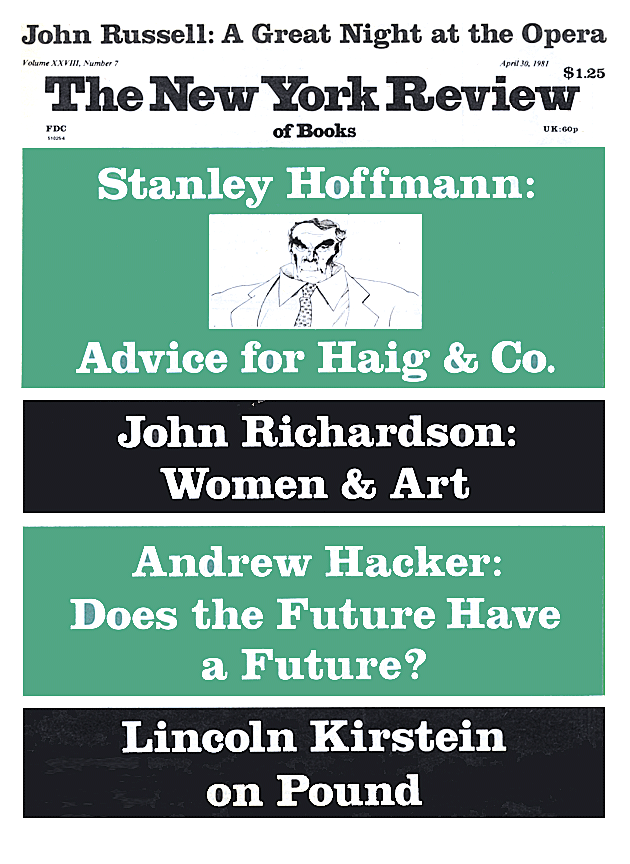
April 30, 1981 • Volume 28, Number 7
  • Lincoln Kirstein

    The Eyes of Ez e-edition

    Ezra Pound and the Visual Arts edited with an introduction by Harriet Zinnes

    Ezra Pound and His World by Peter Ackroyd

  • Andrew Hacker

    Up for Grabs e-edition

    The United States in the 1980s edited by Peter Duignan, edited by Alvin Rabushka

    Setting National Priorities: Agenda for the 1980s edited by Joseph A. Pechman

    Human Scale by Kirkpatrick Sale

    The Third Wave by Alvin Toffler

    The Microelectronics Revolution edited by Tom Forester

    The 1980’s: Countdown to Armageddon by Hal Lindsey

    A National Agenda for the Eighties: Report of the President’s Commission for a National Agenda for the Eighties

    Life After ‘80: Environmental Choices We Can Live With edited by Kathleen Courrier

  • John Richardson

    Strictly from Hunger e-edition

    The Dinner Party: A Symbol of Our Heritage by Judy Chicago

    Embroidering Our Heritage: The Dinner Party Needlework by Judy Chicago, by Susan Hill

    The Complete Dinner Party: The Dinner Party and Embroidering Our Heritage

  • Darryl Pinckney

    Every Which Way e-edition

    Tar Baby by Toni Morrison

  • Lester K. Little

    The Greyhound Saint e-edition

    Le saint lévrier: Guinefort, guérisseur d’enfants depuis le XIIIe siècle by Jean-Claude Schmitt

  • Stanley Hoffmann

    Foreign Policy: What’s to Be Done? e-edition

  • John Russell

    The Spirit of 1917 e-edition

    Parade: An Evening of French Music Theatre”: Parade by Erik Satie, choreography by Gray Veredon

    Les Mamelles de Tirésias by Francis Poulenc, libretto by Guillaume Apollinaire

    L’Enfant et les Sortilèges by Maurice Ravel, libretto by Colette, conducted by Manuel Rosenthal, produced by John Dexter, sets and costumes by David Hockney, lighting by Gil Wechsler

  • Freeman Dyson

    Winner e-edition

  • Norman Stone

    The Gambler e-edition

    The Foreign Policy of Hitler’s Germany: Starting World War II, 1937-1939 by Gerhard L. Weinberg

    Germany and the Two World Wars by Andreas Hillgruber, translated by William C. Kirby

  • Keith Thomas

    The Beast in Man e-edition

    Animals’ Rights Considered in Relation to Social Progress Pennsylvania 18411 by Henry S. Salt, revised edition with a preface by Peter Singer

    Reckoning with the Beast: Animals, Pain, and Humanity in the Victorian Mind by James Turner

  • Michael Wood

    Comedy of Ignorance e-edition

    Rockaby and Other Short Pieces by Samuel Beckett

    Company by Samuel Beckett

    Just Play: Beckett’s Theater by Ruby Cohn

    Frescoes of the Skull: The Later Prose and Drama of Samuel Beckett by James Knowlson, by John Pilling

    Beckett and the Voice of Species: A Study of the Prose Fiction by Eric P. Levy

  • Jonathan D. Spence

    Take Back Your Ming e-edition

    1587, A Year of No Significance: The Ming Dynasty in Decline by Ray Huang

    Li Zhi, philosophe maudit (1527-1602) Volume I by Jean-François Billeter

    The Peony Pavilion (Mudan Ding) by Tang Xianzu, translated by Cyril Birch

    The Chinese Vernacular Story by Patrick Hanan
LETTERS

Contributors

Lawrence Stone (1919–1999) was an English historian. He taught British history at Oxford and Princeton.

Freeman Dyson has spent most of his life as a professor of physics at the Institute for Advanced Study in Princeton, taking time off to advise the US government and write books for the general public. He was born in England and worked as a civilian scientist for the Royal Air Force during World War II. He came to Cornell University as a graduate student in 1947 and worked with Hans Bethe and Richard Feynman, producing a user-friendly way to calculate the behavior of atoms and radiation. He also worked on nuclear reactors, solid-state physics, ferromagnetism, astrophysics, and biology, looking for problems where elegant mathematics could be usefully applied.

Dyson’s books include Disturbing the Universe (1979), Weapons and Hope (1984), Infinite in All Directions (1988), Origins of Life (1986, second edition 1999), The Sun, the Genome and the Internet (1999), and A Many-Colored Glass: Reflections on the Place of Life in the Universe (2010). He is a fellow of the American Physical Society, a member of the National Academy of Sciences, and a fellow of the Royal Society of London. In 2000 he was awarded the Templeton Prize for Progress in Religion.

Stanley Hoffmann is Paul and Catherine Buttenwieser University Professor at Harvard. His most recent books are Chaos and Violence: What Globalization, Failed States, and Terrorism Mean for US Foreign Policy and Rousseau and Freedom, coedited with Christie McDonald.


Robert Brustein is a playwright, director, critic, teacher, and founder of the Yale Repertory and American Repertory Theatres. His play The Last Will opens in New York in April at Abingdon’s June Havoc Theater, and then goes to the Wuzhen Festival in China. In 2010 he was awarded the National Medal of Arts. (April 2013)

Henri Zerner, Professor of History of Art and Architecture at Harvard, is the author of Renaissance Art in France: The Invention of Classicism and Écrire l’histoire de l’art: Figures d’une discipline.

Lincoln Kirstein (1907–1996) was a writer and ballet critic. In 1946, together with George Balanchine, Kirstein founded the Ballet Society, which would soon be renamed The New York City Ballet. In 1984 he was awarded the Presidential Medal of Freedom.

Andrew Hacker teaches political science at Queens College. He is currently working on a book on mathematics with Claudia Dreifus.
 (January 2013)