Contents

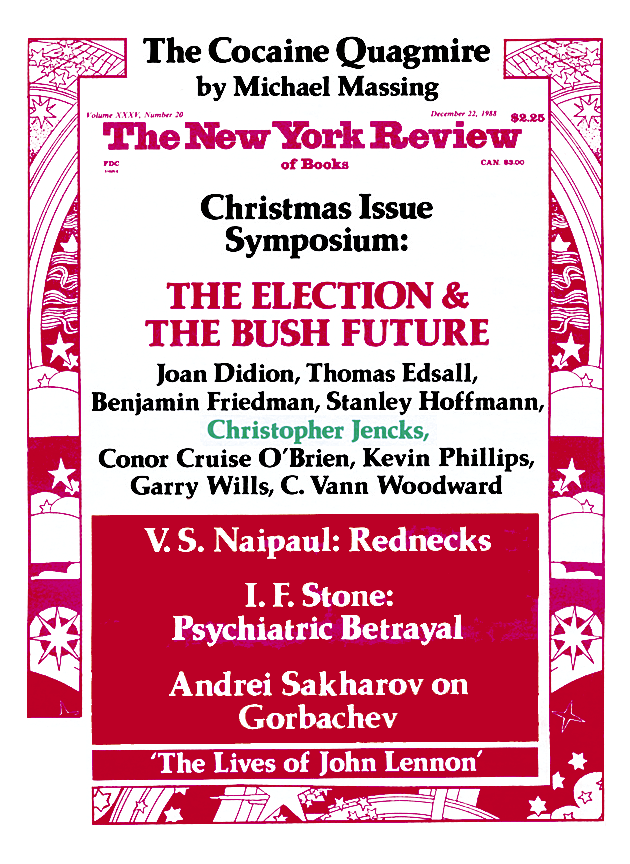
December 22, 1988 • Volume 35, Number 20

LETTERS

Contributors

Robert M. Adams (1915-1996) was a founding editor of the Norton Anthology of English Literature. He taught at the University of Wisconsin, Rutgers, Cornell and U.C.L.A. His scholarly interested ranged from Milton to Joyce, and his translations of many classic works of French literature continue to be read to this day.

Gabriele Annan is a book and film critic living in London. (March 2006)

Timothy Garton Ash is Professor of European Studies and Isaiah Berlin Professorial Fellow at St. Antony’s College, Oxford, and a Senior Fellow at the Hoover Institution, Stanford. He is the author of many books, including The Magic Lantern, an eyewitness account of the velvet revolutions of 1989. His most recent book is Facts Are Subversive: Political Writing from a Decade Without a Name. He is currently leading an Oxford University 
research project for the discussion of global free speech norms (www.freespeechdebate.com) and working on a book about free speech.

Ian Buruma is the Henry R. Luce Professor at Bard. His books include Murderer in Amsterdam: The Death of Theo Van Gogh and the Limits of Tolerance, Taming the Gods: Religion and Democracy on Three Continents, and the novel The China Lover. His book Year Zero: A History of 1945 will be published in September 2013.

Denis Donoghue is University Professor at New York University, where he holds the Henry James Chair of English and American Letters. His works include The Practice of Reading, Words Alone: The Poet T.S. Eliot, and The American Classics.

James Joll (1936–2011) was a British historian. His books include The Origins of the First World War and Europe Since 1870.

Mary McCarthy (1912-1989) was a novelist, essayist, and critic. Her political and social commentary, literary essays, and drama criticism appeared in magazines such as Partisan Review, The New Yorker, Harper’s, and The New York Review of Books, and were collected in On the Contrary (1961), Mary McCarthy’s Theatre Chronicles 1937-1962 (1963), The Writing on the Wall (1970), Ideas and the Novel (1980), and Occasional Prose (1985). Her novels include The Company She Keeps (1942), The Oasis (1949), The Groves of Academe (1952), A Charmed Life (1955), The Group (1963), Birds of America (1971), and Cannibals and Missionaries (1979). She was the author of three works of autobiography, Memories of a Catholic Girlhood (1957), How I Grew (1987), and the unfinished Intellectual Memoirs (1992), and two travel books about Italy, Venice Observed (1956) and The Stones of Florence (1959). Her essays on the Vietnam War were collected in The Seventeenth Degree (1974); her essays on Watergate were collected in The Mask of State (1974).

Robert Craft is a conductor and writer. Craft’s close working friendship with Igor Stravinsky is the subject of his memoir, An Improbable Life. In 2002 he was awarded the International Prix du Disque at the Cannes Music Festival.

Michael Massing, a contributing editor of the Columbia Journalism Review, writes frequently on the press and foreign affairs.

V. S. Naipaul was born in Trinidad in 1932 and emigrated to England in 1950, when he won a scholarship to University College, Oxford. He is the author of many novels, including A House for Mr. Biswas, A Bend in the River, and In a Free State, which won the Booker Prize. He has also written several nonfiction works based on his travels, including India: A Million Mutinies Now and Beyond Belief: Islamic Excursions Among the Converted Peoples. He was knighted in 1990 and in 1993 was the first recipient of the David Cohen British Literature Prize.

Luc Sante is the author of Low Life, Evidence, The Factory of Facts, Kill All Your Darlings, and Folk Photography. He has translated Félix Fénéon’s Novels in Three Lines and written the introduction to George Simenon’s The Man Who Watched Trains Go By (both available as NYRB Classics). He is a frequent contributor to The New York Review of Books and teaches writing and the history of photography at Bard College.

Andrew Hacker teaches political science at Queens College. He is currently working on a book on mathematics with Claudia Dreifus.
 (January 2013)

I.F. Stone (1907–1989) was an American journalist and publisher whose self-published newsletter, I.F. Stone’s Weekly, challenged the conservatism of American journalism in the midcentury. A Noncomformist History of Our Times (1989) is a six-volume anthology of Stone’s writings.

Patricia Storace is the author of Heredity, a book of poems, Dinner with Persephone, a travel memoir about Greece, and Sugar Cane, a children’s book. She lives in New York.

C. Vann Woodward (1908–1999) was a historian of the American South. He taught at Johns Hopkins and at Yale, where he was named the Sterling Professor of History. His books include Mary Chesnut’s Civil War and The Old World’s New World.

Garry Wills is Professor of History Emeritus at Northwestern. His study of Abraham Lincoln, Lincoln at Gettysburg: The Words That Remade America, was awarded the Pulitzer Prize in 1993. His latest book, Why Priests? A Failed Tradition, was published in February 2013.

Benjamin M. Friedman is the William Joseph Maier Professor of Political Economy at Harvard. His most recent book is The Moral Consequences of Economic Growth.
 (October 2012)

Stanley Hoffmann is Paul and Catherine Buttenwieser University Professor at Harvard. His most recent books are Chaos and Violence: What Globalization, Failed States, and Terrorism Mean for US Foreign Policy and Rousseau and Freedom, coedited with Christie McDonald.


Christopher Jencks is the Malcolm Wiener Professor of Social Policy at Harvard. He is working on a book about the social and political consequences of growing inequality. (September 2007)

Joan Didion is the author of The Year of Magical Thinking and We Tell Ourselves Stories in Order to Live: Collected Nonfiction.

Conor Cruise O’Brien (1917–2009) was an Irish historian and politician. He was elected to the Irish parliament in 1969 and served as a Minister from 1973 until 1977. His works include States of Ireland, The Great Melody and Memoir: My Life and Themes.

Charles Hope was Director of the Warburg Institute, London, from 2001 to 2010. He is the author of Titian.