Contents

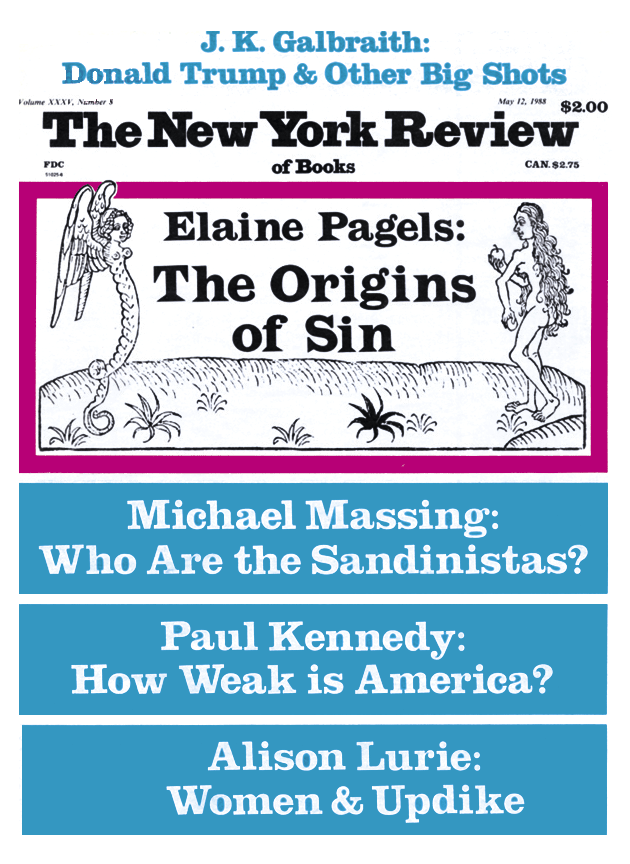
May 12, 1988 • Volume 35, Number 8

LETTERS

Contributors

Denis Donoghue is University Professor at New York University, where he holds the Henry James Chair of English and American Letters. His works include The Practice of Reading, Words Alone: The Poet T.S. Eliot, and The American Classics.

Gordon A. Craig (1913–2005) was a Scottish-American historian of Germany. He taught at both Princeton and Stanford, where he was named the J.E. Wallace Sterling Professor of Humanities in 1979.

John Kenneth Galbraith (1908–2006) was a Canadian economist and politician. He taught at Princeton and Harvard. His works include The Affluent Society, The Age of Uncertainty and Economics and the Public Purpose. Galbraith’s many honors include the Presidential Medal of Freedom, the Lomonosov Gold Medal, the Order of Canada, and the Padma Vibhushan, India’s second highest civilian award.

Jasper Griffin is Emeritus Professor of Classical Literature and a Fellow of Balliol College, Oxford. His books include Homer on Life and Death.

Stanley Hoffmann is Paul and Catherine Buttenwieser University Professor at Harvard. His most recent books are Chaos and Violence: What Globalization, Failed States, and Terrorism Mean for US Foreign Policy and Rousseau and Freedom, coedited with Christie McDonald.


E. J. Hobsbawm (1918–1987) was a British historian. Born in Egypt, he was educated at Cambridge; he taught at Birkbeck College and The New School. His works include The Age of Extremes; Globalisation, Democracy and Terrorism; and On Empire.

Murray Kempton (1917-1997) was a columnist for Newsday, as well as a regular contributor to The New York Review of Books. His books include Rebellions, Perversities, and Main Events and The Briar Patch, as well as Part of Our Time. He won the Pulitzer Prize in 1985.

Alison Lurie is a former Professor of English at Cornell. She is the author of two collections of essays on children’s literature, Don’t Tell the Grownups and Boys and Girls Forever, and the editor of The Oxford Book of Fairy Tales. Her most recent novel is Truth and Consequences.


Michael Massing, a contributing editor of the Columbia Journalism Review, writes frequently on the press and foreign affairs.

M. F. Perutz (1914–2002) was an Austrian molecular biologist. He was awarded the Nobel Prize for Chemistry in 1962. He is the author of Is Science Necessary?, Protein Structure, and I Wish I’d Made You Angry Earlier.

Felix Rohatyn is an investment banker and has been a governor of the New York Stock Exchange, Chairman of the New York Municipal Assistance Corporation, and US Ambassador to France. (October 2008)

Paul Kennedy, the J. Richardson Dilworth Professor of History and Director of International Security Studies at Yale, is the author and editor of fifteen books, including The Rise and Fall of the Great Powers. His latest book is The Parliament of Man: The Past, Present, and Future of the United Nations. (November 2006)

C. Vann Woodward (1908–1999) was a historian of the American South. He taught at Johns Hopkins and at Yale, where he was named the Sterling Professor of History. His books include Mary Chesnut’s Civil War and The Old World’s New World.

M.F. Burnyeat is Senior Research Fellow in Philosophy at All Souls College, Oxford. He is the author of The Theaetetus of Plato and A Map of Metaphysics Zeta. (November 2001)

Martin Gardner (1914–2010) was a science writer and novelist. He was the author of The New Ambidextrous Universe, Fractal Music, Hypercards and More, The Night is Large and Visitors from Oz.