Contents

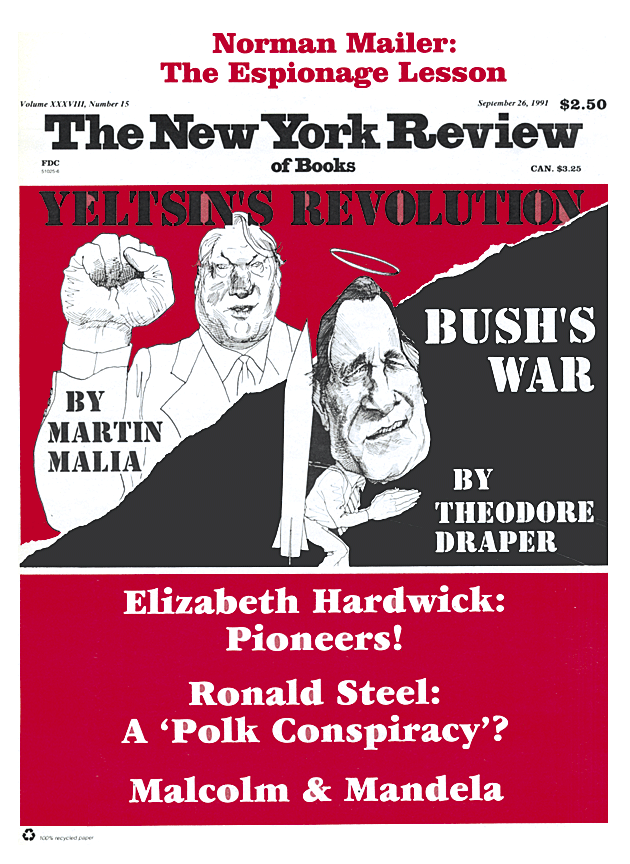
September 26, 1991 • Volume 38, Number 15

LETTERS

Contributors

Willibald Sauerländer is a former director of the Central Institute for Art History in Munich. His book on Rubens’s altarpieces has been just published. (November 2011)

Martin Malia is Professor of History Emeritus at the University of California, Berkeley. He is the author, most recently, of Russia Under Western Eyes, from the Bronze Horseman to the Lenin Mausoleum. (November 2001)

Gabriele Annan is a book and film critic living in London. (March 2006)

Shaul Bakhash is Robinson Professor of History at George Mason University and the author of The Reign of the Ayatollahs: Iran and the Islamic Revolution. (September 2005)

Theodore Draper’s books include The Roots of American Communism and A Struggle for Power: The American Revolution. He is at work on a book about the nineteenth century in the US. (September 1999)

George M. Fredrickson is Edgar E. Robinson Professor of US History Emeritus at Stanford. His most recent books are Racism: A Short History and Not Just Black and White, a collection co-edited with Nancy Foner. (August 2006)

C. Vann Woodward is Sterling Professor of History Emeritus at Yale. His many books include Mary Chesnut’s Civil War and The Old World’s New World. (February 1998)

Jamey Gambrell is a writer on Russian art and culture. Her translations include Marina Tsvetaeva’s Earthly Signs: Moscow Diaries, 1917–1922, a volume of Aleksandr Rodchenko’s writings, Experiments for the Future; and Tatyana Tolstaya’s novel, The Slynx. Her translation of Vladimir Sorokin’s Day of the Oprichnik will be published in 2011.

John Banville was born in Wexford, Ireland, in 1945. He is the author of many novels, including The Book of Evidence, The Untouchable, and Eclipse. Banville’s novel The Sea was awarded the 2005 Man Booker Prize. A Death in Summer, a novel written under the pseudonym Benjamin Black, was published in July 2011.


Jeremy Bernstein’s books include Plutonium: A History of the World’s Most Dangerous Element and Nuclear Weapons: What You Need to Know, which was published in paperback in February. (May 2010)

Ian Buruma is the Henry R. Luce Professor at Bard and a Cullman Fellow at the New York Public Library. His latest book is Taming the Gods: Religion and Democracy on Three Continents.


Elizabeth Hardwick (1916-2007) was born in Lexington, Kentucky, and educated at the University of Kentucky and Columbia University. A recipient of a Gold Medal from the American Academy of Arts and Letters, she is the author of three novels, a biography of Herman Melville, and four collections of essays. She was a co-founder and advisory editor of The New York Review of Books and contributed more than one hundred reviews, articles, reflections, and letters to the magazine. NYRB Classics publishes Sleepless Nights, a novel, and Seduction and Betrayal, a study of women in literature.

Gordon A. Craig is J.E. Wallace Sterling Professor Emeritus of Humanities at Stanford. His latest book is Politics and Culture in Modern Germany. (December 2003)

Norman Mailer (1923-2007) was born in Long Branch, New Jersey, and grew up in Brooklyn, New York. In 1955 he co-founded The Village Voice. He is the author of more than thirty books, including The Naked and the Dead; The Armies of the Night, for which he won a National Book Award and the Pulitzer Prize; The Executioner’s Song, for which he won his second Pulitzer Prize; Harlot’s Ghost; Oswald’s Tale; The Gospel According to the Son; and The Castle in the Forest.

Ronald Steel is Professor of International Relations at the University of Southern California, a recent fellow at the American Academy in Berlin, and the author of biographies of Walter Lippmann and Robert Kennedy. (June 2006)

Roderick Macfarquhar is Leroy B. Williams Professor of History and Political Science at Harvard. His most recent book, Mao’s Last Revolution, written with Michael Schoenhals, was published in French and Spanish translations last year. (February 2011)