Contents

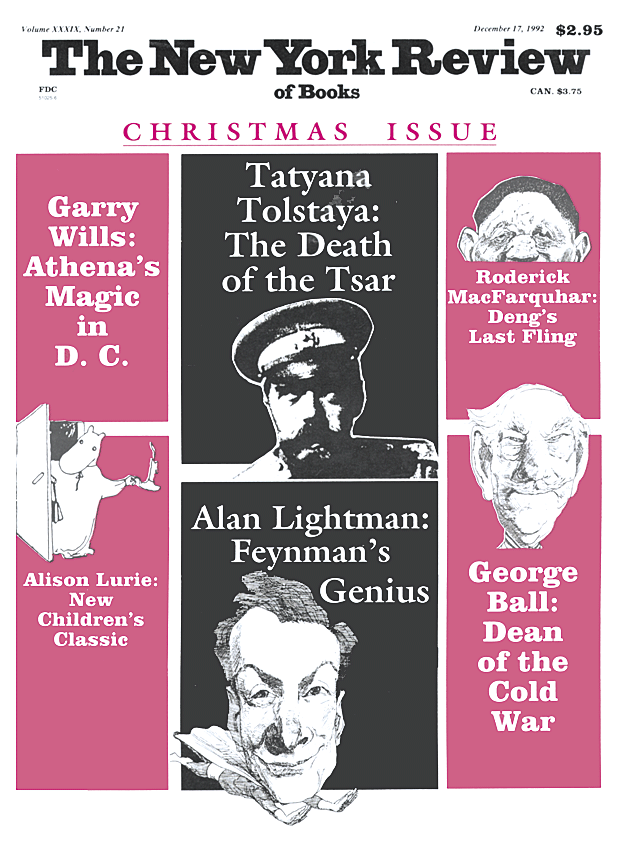
December 17, 1992 • Volume 39, Number 21
  • Tatyana Tolstaya,
    Jamey Gambrell

    The Golden Age e-edition

    The Last Tsar: The Life and Death of Nicholas II by Edvard Radzinsky, translated by Marian Schwartz

    Nicholas and Alexandra: The Family Albums by Prince Michael of Greece

  • Boris Pasternak,
    Mark Rudman,
    Bohdan Boychuk

    Spring Rainstorm (poem)

  • George W. Ball

    Present After the Creation e-edition

    Dean Acheson: The Cold War Years, 1953–71 by Douglas Brinkley

  • Alison Lurie

    Undiscovered Country e-edition

    Comet in Moominland by Tove Jansson, translated by Elizabeth Portch

    Finn Family Moomintroll by Tove Jansson, translated by Elizabeth Portch

    Moominsummer Madness by Tove Jansson, translated by Thomas Warburton

    Moominland Midwinter by Tove Jansson, translated by Thomas Warburton

  • Roderick MacFarquhar

    Deng’s Last Campaign e-edition

  • John Bayley

    Time of Indifference e-edition

    The Porcupine by Julian Barnes

  • Alan Lightman

    The One and Only e-edition

    Genius: The Life and Science of Richard Feynman by James Gleick

  • Gordon A. Craig

    Good Germans e-edition

    Fatherland by Robert Harris

    Contending with Hitler: Varieties of German Resistance in the Third Reich edited by David Clay Large

    For the Soul of the People: Protestant Protest against Hitler by Victoria Barnett

    German Resistance Against Hitler: The Search for Allies Abroad, 1938–1945 by Klemens von Klemperer

    A Good German: Adam von Trott zu Solz by Giles MacDonogh

  • Alfred Kazin

    The Middle Way e-edition

    Memories of the Ford Administration by John Updike

  • Garry Wills

    Athena’s Magic e-edition

    The Greek Miracle: Classical Sculpture from the Dawn of Democracy, The Fifth Century BC November 22, 1992–February 7, 1993; The Metropolitan Museum of Art, New York March 11–May 23, 1993 an exhibition at the National Gallery of Art, Washington, DC

    The Greek Miracle: Classical Sculpture from the Dawn of Democracy, The Fifth Century BC catalog of the exhibition, edited by Diana Buitron-Oliver

    The Ancient Americas: Art from Sacred Landscapes 1992–January 3, 1993 an exhibition at the Art Institute of Chicago October 10,

    The Ancient Americas: Art from Sacred Landscapes catalog of the exhibition, edited by Richard F. Townsend

    Talismans and Trojan Horses: Guardian Statues in Ancient Greek Myth and Ritual by Christopher A. Faraone

  • David Cannadine

    Cutting Classes e-edition

    Class Formation and Urban-Industrial Society: Bradford, 1750–1850 by Theodore Koditschek

    Class, Sect and Party: The Making of the British Middle Class, Leeds 1820–1850 by R.J. Morris

    Visions of the People: Industrial England and the Question of Class, 1840–1914 by Patrick Joyce

    The Ideologies of Class: Social Relations in Britain, 1880–1950 by Ross McKibbin

  • Joseph Connors

    Playing the Palace e-edition

    Seventeenth-Century Roman Palaces: Use and the Art of the Plan by Patricia Waddy

    Images of Nepotism: The Painted Ceilings of Palazzo Barberini by John Beldon Scott

  • Benedetta Craveri,
    Patrick Creagh

    Conqueror of Paris e-edition

    A Woman, a Man, and Two Kingdoms: The Story of Madame d’Epinay and the Abbæ Galiani by Francis Steegmuller

    Ferdinando Galiani, Louise d’Epinay Correspondance Vol. I (1769–1770) by (The Correspondance will comprise five volumes to appear annually.), edited by Georges Dulac, by Daniel Maggetti

    Eagle in a Gauze Cage: Louise d’Epinay, femme de lettres by Ruth Plaut Weinreb
  • Paul Wilson

    Czechoslovakia: The Pain of Divorce e-edition

LETTERS

Contributors

John Bayley is a critic and novelist. His books include Elegy for Iris and The Power of Delight: A Lifetime in Literature.

Joseph Connors, the Director of the Harvard Center for Italian Renaissance Studies, Villa I Tatti, Florence, writes on Italian Renaissance and Baroque architecture. He was formerly Director of the American Academy in Rome and professor of art history at Columbia.

Alison Lurie is a former Professor of English at Cornell. She is the author of two collections of essays on children’s literature, Don’t Tell the Grownups and Boys and Girls Forever, and the editor of The Oxford Book of Fairy Tales. Her most recent novel is Truth and Consequences.


Roderick Macfarquhar is Leroy B. Williams Research Professor of History and Political Science at Harvard. His most recent book is the edited volume The Politics of China: Sixty Years of the People’s Republic of China. (April 2013)

Robert Craft is a conductor and writer. Craft’s close working friendship with Igor Stravinsky is the subject of his memoir, An Improbable Life. In 2002 he was awarded the International Prix du Disque at the Cannes Music Festival.

Tatyana Tolstaya was born in Leningrad in 1951 to an aristocratic family that includes the writers Leo and Alexei Tolstoy. After completing a degree in classics at Leningrad State University, Tolstaya worked for several years at a Moscow publishing house. In the mid-1980s, she began publishing short stories in literary magazines and her first story collection established her as one of the foremost writers of the Gorbachev era. She spent much of the late Eighties and Nineties living in the United States and teaching at several universities. Known for her acerbic essays on contemporary Russian life, Tolstaya has also been the co-host of the Russian cultural interview television program School for Scandal. Both her novel, The Slynx and her collection of stories, White Walls, are published by NYRB Classics.

Jamey Gambrell is a writer on Russian art and culture. Her translations include Marina Tsvetaeva’s Earthly Signs: Moscow Diaries, 1917–1922, a volume of Aleksandr Rodchenko’s writings, Experiments for the Future; and Tatyana Tolstaya’s novel, The Slynx. Her translation of Vladimir Sorokin’s Day of the Oprichnik will be published in 2011.

David Cannadine is the Dodge Professor of History at Princeton.

Gordon A. Craig (1913–2005) was a Scottish-American historian of Germany. He taught at both Princeton and Stanford, where he was named the J.E. Wallace Sterling Professor of Humanities in 1979.

Paul Wilson is a writer based in Toronto. He has translated major works by Josef Škvorecký, Ivan Klíma, Bohumil Hrabal, and Václav Havel. (May 2013)

Benedetta Craveri is a professor of French literature at the University of Tuscia, Viterbo, and the Istituto Universitario Suor Orsola Benincasa, Naples. She regularly contributes to The New York Review of Books and to the cultural pages of the Italian newspaper La Repubblica. Her books include Madame du Deffand and Her World, La Vie privée du Maréchal de Richelieu, and Amanti e regine: Il potere delle donne. She is married to a French diplomat.

Garry Wills is Professor of History Emeritus at Northwestern. His study of Abraham Lincoln, Lincoln at Gettysburg: The Words That Remade America, was awarded the Pulitzer Prize in 1993. His latest book, Why Priests? A Failed Tradition, was published in February 2013.

Boris Pasternak (1890-1960), the poet and author of Doctor Zhivago, was awarded the Nobel Prize for Literature in 1958.

Mark Rudman is the author of seven books of poetry and three books of prose. His poetic trilogy The Millennium Hotel, Provoked in Venice, and Rider received the National Book Critics Circle Award. The Couple is his most recent collection of poems.

Robert L. Heilbroner (1919–2005) was an American economist. He taught economic history at the New School, where he was appointed Norman Thomas Professor of Economics in 1971.

Alfred Kazin (1915–1998) was a writer and teacher. Among his books are On Native Grounds, a study of American literature from Howells to Faulkner, and the memoirs A Walker in the Cityand New York Jew. In 1996, he received the first Lifetime Award in Literary Criticism from the Truman Capote Literary Trust.

Alan Lightman, a physicist, teaches at MIT. His latest book is The Diagnosis. (May 2002)