Contents

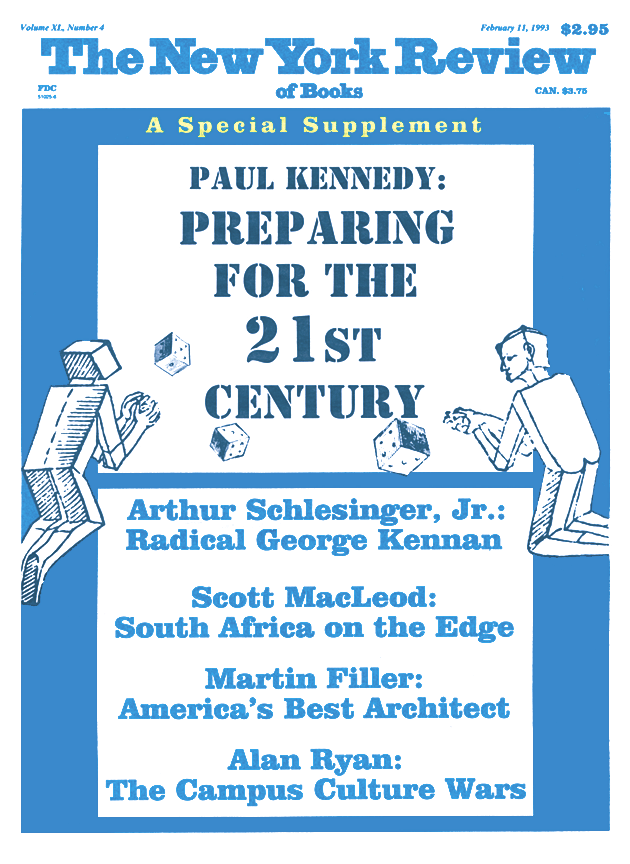
February 11, 1993 • Volume 40, Number 4
  • Arthur Schlesinger Jr.

    The Radical e-edition

    Around the Cragged Hill: A Personal and Political Philosophy by George F. Kennan

  • Timothy Garton Ash,
    Ivo Banac,
    Stanisław Barańczak,
    Norberto Bobbio, et al.

    An Appeal e-edition

  • John Weightman

    Fatal Attraction e-edition

    Past Imperfect: French Intellectuals, 1944–1956 by Tony Judt

  • Alan Ryan

    Invasion of the Mind Snatchers e-edition

    Politics by Other Means: Higher Education and Group Thinking by David Bromwich

    Beyond the Culture Wars: How Teaching the Conflicts Can Revitalize American Education by Gerald Graff

    Community of Learning: The American College and the Liberal Arts Tradition by Francis Oakley

  • Martin Filler

    He’s the Top e-edition

    The Paintings and Sketches of Louis I. Kahn by Jan Hochstim, Introduction by Vincent Scully

    Louis I. Kahn: Writings, Lectures, Interviews edited and with an introduction by Alessandra Latour

    Louis I. Kahn: In the Realm of Architecture 1991–January 5, 1992), Centre Georges Pompidou, Paris (March 5–May 4, 1992), the Museum of Modern Art, New York (June 14–August 18, 1992), the Museum of Modern Art, Gunma, Japan (September 26–November 3, 1992), an exhibition at the Philadelphia Museum of Art

    Louis I. Kahn: In the Realm of Architecture catalog of the exhibition by David B. Brownlee, by David G. De Long

    The Art Museums of Louis I. Kahn University Museum of Art by catalog of an exhibition at the Duke Patricia Cummings Loud, foreword by Michael P. Mezzatesta

  • James Joll

    Nietzsche vs. Nietzsche e-edition

    The Nietzsche Legacy in Germany, 1890–1990 by Steven E. Aschheim

    Forgotten Fatherland: The Search for Elisabeth Nietzsche by Ben Macintyre

    When Nietzsche Wept by Irvin D. Yalom

  • Scott MacLeod

    South Africa on the Edge e-edition

  • Garry Wills

    Popes and Pagans e-edition

    Rome Reborn: The Vatican Library and Renaissance Culture DC, January 6–April 30, 1993 catalog of the exhibition at the Library of Congress, Washington,, edited by Anthony Grafton

    From Byzantium to Italy: Greek Studies in the Italian Renaissance by N.G. Wilson

    Piero della Francesca by Carlo Bertelli, translated by Edward Farrelly
  • Murray Kempton

    The Jumper e-edition

    Hoffa a film directed by Danny De Vito, written by David Mamet

  • Paul Kennedy

    Preparing for the 21st Century: Winners and Losers e-edition

LETTERS

Contributors

Timothy Garton Ash is Professor of European Studies and Isaiah Berlin Professorial Fellow at St. Antony’s College, Oxford, and a Senior Fellow at the Hoover Institution, Stanford. He is the author of many books, including The Magic Lantern, an eyewitness account of the velvet revolutions of 1989. His most recent book is Facts Are Subversive: Political Writing from a Decade Without a Name. He is currently leading an Oxford University 
research project for the discussion of global free speech norms (www.freespeechdebate.com) and working on a book about free speech.

Stanisław Barańczak is a poet, translator, and literary critic. He won the 2007 Nike Award for the best work of Polish literature published in the previous year and the 2009 Silesius Poetry Award for lifetime achievement. He is a professor of Polish language and literature at Harvard University.

Péter Esterházy was born in Budapest in 1950. He is one of Hungary’s most prominent writers, and his short stories, novels, and essays have been published in more than twenty languages.

Stanley Hoffmann is Paul and Catherine Buttenwieser University Professor at Harvard. His most recent books are Chaos and Violence: What Globalization, Failed States, and Terrorism Mean for US Foreign Policy and Rousseau and Freedom, coedited with Christie McDonald.


Irving Howe (1920–1993) was an American literary and social critic. His history of Eastern-European Jews in America, World of Our Fathers, won the 1977 National Book Award in History.

Paul Kennedy, the J. Richardson Dilworth Professor of History and Director of International Security Studies at Yale, is the author and editor of fifteen books, including The Rise and Fall of the Great Powers. His latest book is The Parliament of Man: The Past, Present, and Future of the United Nations. (November 2006)

Jamaica Kincaid is a Caribbean novelist, gardener, and gardening writer. Her short fiction has appeared in *The Paris Review* and *The New Yorker*, where her novel *Lucy* was originally serialized. Her first book, *At the Bottom of the River*, was nominated for the PEN/Faulkner Award for Fiction, and she has gone on to write more than fifteen books, including *A Small Place*, *Annie John*, and *Mr. Potter*. She has received the Lannan Literary Award for Fiction, the Prix Femina Étranger, the Anisfield-Wolf Book Award, and the Lila Wallace–Reader’s Digest Writers’ Award. Kincaid lives in North Bennington, Vermont, during the summers and teaches at Claremont McKenna College in Claremont, California. Her latest novel, *See Now Then*, was published by Farrar, Straus and Giroux in February 2013.

Janos Kis, who teaches philosophy at Central European University in Budapest, was a leading member of the Hungarian democratic opposition to the Communist regime and co-founder and first chairman of Hungary’s liberal party. His latest book is Politics as a Moral Problem, which will be published in November. (July 2008)

Adam Michnik is Editor in Chief of the Warsaw daily newspaper Gazeta Wyborcza. His piece in this issue will appear in Andrei Sakharov and Human Rights, a collection of Sakharov’s writings that is being published by the Council of Europe this month. (January 2011)

Arthur Miller (1915–2005) was an American playwright and essayist. His 1949 play, Death of A Salesman, received a Tony Award for Best Author, The New York Drama Circle Critics’ Award, and the Pulitzer Prize for Drama.

Simon Schama‘s most recent book is A History of Britain, Volume II: The Wars of the British, 1603–1776, the companion volume to his ongoing BBC/History Channel television series. (February 2002)

Murray Kempton (1917-1997) was a columnist for Newsday, as well as a regular contributor to The New York Review of Books. His books include Rebellions, Perversities, and Main Events and The Briar Patch, as well as Part of Our Time. He won the Pulitzer Prize in 1985.

Michael Massing, a contributing editor of the Columbia Journalism Review, writes frequently on the press and foreign affairs.

Thomas Sheehan is Professor of Religious Studies at Stanford University. (December 2001)

James Joll (1936–2011) was a British historian. His books include The Origins of the First World War and Europe Since 1870.

Alan Ryan teaches at Princeton. His recent works include The Making of Modern Liberalism and On Politics: A History of Political Thought.

M. F. Perutz (1914–2002) was an Austrian molecular biologist. He was awarded the Nobel Prize for Chemistry in 1962. He is the author of Is Science Necessary?, Protein Structure, and I Wish I’d Made You Angry Earlier.

John Weightman (1915–2004) was a critic and literary scholar. After working as a translator and announcer for the BBC French service, Weightman turned to the study of French literature. He taught at King’s College London and the University of London. His books include The Concept of the Avant-Gardeand The Cat Sat on the Mat: Language and the Absurd.

Larry McMurtry lives in Archer City, Texas. His novels include The Last Picture Show, Terms of Endearment, Lonesome Dove (winner of the 1986 Pulitzer Prize for Fiction), Folly and Gloryand Rhino Ranch. His nonfiction works include a biography of Crazy Horse, Walter Benjamin at the Dairy Queen, Paradise, Sacagawea’s Nickname: Essays on the American West and, most recently, Custer.

Robert Stone was born in Brooklyn in 1937. He is the author of seven novels: A Hall of Mirrors, the National Book Award–winning Dog Soldiers, A Flag for Sunrise, Children of Light, Outerbridge Reach, Damascus Gate, and Bay of Souls. He has also written short stories, essays, and screenplays, and published a short story collection, Bear and His Daughter, which was nominated for the Pulitzer Prize. He lives in New York City and in Key West, Florida.

Norman Mailer (1923-2007) was born in Long Branch, New Jersey, and grew up in Brooklyn, New York. In 1955 he co-founded The Village Voice. He is the author of more than thirty books, including The Naked and the Dead; The Armies of the Night, for which he won a National Book Award and the Pulitzer Prize; The Executioner’s Song, for which he won his second Pulitzer Prize; Harlot’s Ghost; Oswald’s Tale; The Gospel According to the Son; and The Castle in the Forest.

Susan Sontag (1933–2004) was a novelist, playwright, filmmaker, and one of the most influential critics of her generation. Her books include Against Interpretation, On Photography, Illness as Metaphor, and The Volcano Lover.

Edmund Keeley is Charles Barnwell Straut Professor of English Emeritus at Princeton. His latest books are Borderlines: A Memoir and the novel Some Wine for Remembrance. (November 2007)

Arthur Schlesinger, Jr. (1917–2007) was an American historian and social critic. He served as adviser to Presidents Kennedy and Johnson. His Journals: 1952– 2000 were published in 2007.

James Chace is the Paul W. Williams Professor of Government and Public Law at Bard College. He is the author of Acheson and, most recently, 1912: The Election That Changed the Country. He is now working on a biography of Lafayette. (October 2004)

Garry Wills is Professor of History Emeritus at Northwestern. His study of Abraham Lincoln, Lincoln at Gettysburg: The Words That Remade America, was awarded the Pulitzer Prize in 1993. His latest book, Why Priests? A Failed Tradition, was published in February 2013.

Martin Filler was the longtime architecture critic of House & Garden, until it ceased publication in 2007. He is the co-author, with Olivier Bossiere, of The Vitra Design Museum: Frank Gehry, Architect, and author of Makers of Modern Architecture, which is based on essays from The New York Review. A second volume of his writings on architecture is forthcoming from New York Review Books.