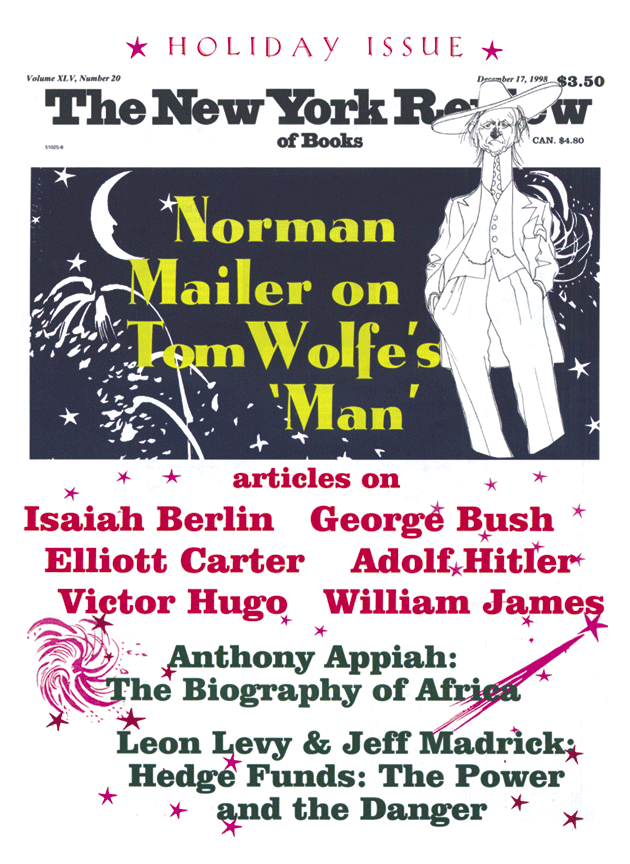
Contents

December 17, 1998 • Volume 45, Number 20

LETTERS

Contributors

Kwame Anthony Appiah teaches philosophy at Princeton. His latest book is The Honor Code: How Moral Revolutions Happen.

 (November 2012)

Malcolm Gladwell is the author of The Tipping Point: How Little Things Make a Big Difference. An archive of his articles for The New Yorker is available at www.gladwell.com. (February 2000)

John Gross (1935–2011) was an English editor and critic. From 1974 to 1981, he was editor of The Times Literary Supplement; he also served as senior book editor and critic at The New York Times. His memoir, A Double Thread, was published in 2001.

Christopher Hitchens (1949–2011) was a British-American journalist and social critic. Known for his confrontational style and contrarian views on a range of social issues, Hitchens was a frequent contributor to The Nation, The Atlantic, The Times Literary Supplement and Vanity Fair. Hitchens recounts his struggle with esophageal cancer in Mortality, which was published in 2012.

Leon Levy is currently the chairman of the board of trustees of the New York—based Oppenheimer Funds. He is president of the Institute for Advanced Study in Princeton, and vice-chairman of the Jerome Levy Institute for Economic Research at Bard College. (December 1998)

Jeff Madrick writes an economics column for Harper’s Magazine, is editor of Challenge Magazine, and is director of the Rediscovering Government Initiative at the Roo­sevelt Institute. His most recent book is Age of Greed: The Triumph of Finance and the Decline of America.

Simon Leys is the pen name of the literary critic, essayist, historical novelist, and eminent sinologist Pierre Ryckmans. Born in Belgium in 1935, he settled in Australia in 1970 and was a professor of Chinese studies at the University of Sydney from 1987 to 1993. His works include Chinese Shadows (1977), The Death of Napoleon (1991), a new translation of the Analects of Confucius (1997), and The Angel and the Octopus (1999). A fellow of the Australian Academy of Humanities and a member of the Académie Royale de Littérature Française (Belgium), he was awarded the Prix mondial Cino del Duca in 2004.

Norman Mailer (1923-2007) was born in Long Branch, New Jersey, and grew up in Brooklyn, New York. In 1955 he co-founded The Village Voice. He is the author of more than thirty books, including The Naked and the Dead; The Armies of the Night, for which he won a National Book Award and the Pulitzer Prize; The Executioner’s Song, for which he won his second Pulitzer Prize; Harlot’s Ghost; Oswald’s Tale; The Gospel According to the Son; and The Castle in the Forest.

Louis Menand is the Anne T. and Robert M. Bass Professor of English at Harvard. His books include The Marketplace of Ideas, American Studies and The Metaphysical Club.

Geoffrey O’Brien is Editor in Chief of the Library of America. His recent works include Early Autumn and The Fall of the House of Walworth. His new book Stolen Glimpses, Captive Shadows: Writing on Film 2002–2012 will be published in 2013.


James Chace is the Paul W. Williams Professor of Government and Public Law at Bard College. He is the author of Acheson and, most recently, 1912: The Election That Changed the Country. He is now working on a biography of Lafayette. (October 2004)

James Fenton is a British poet and literary critic. From 1994 until 1999, Fenton was Oxford Professor of Poetry; in 2007 he was awarded the Queen’s Gold Medal for Poetry.

John Russell (1919–2008) was Chief Art Critic at The New York Times from 1982 until 1990. He was the author of many art-historical studies, including Matisse, Father & Son and The Meanings of Modern Art.

A. O. Scott is a film critic at The New York Times and the former Sunday book critic for Newsday. His writing has appeared in The New York Review of Books, Slate, and many other publications.

Keith Thomas is a Fellow of All Souls College, Oxford. He is the author The Ends of Life: Roads to Fulfillment in Early Modern England.

Alan Ryan teaches at Princeton. His recent works include The Making of Modern Liberalism and On Politics: A History of Political Thought.