Contents

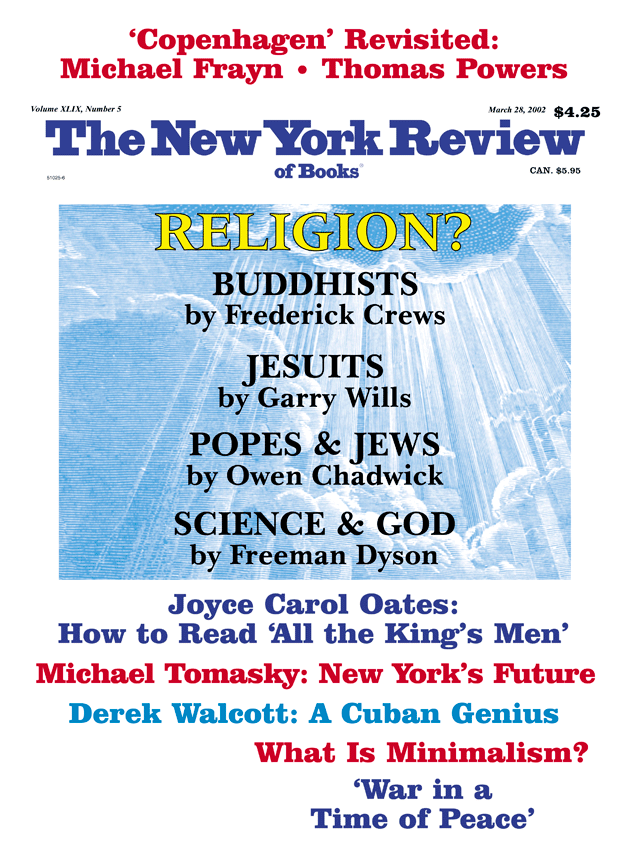
March 28, 2002 • Volume 49, Number 5

LETTERS

Contributors

Freeman Dyson has spent most of his life as a professor of physics at the Institute for Advanced Study in Princeton, taking time off to advise the US government and write books for the general public. He was born in England and worked as a civilian scientist for the Royal Air Force during World War II. He came to Cornell University as a graduate student in 1947 and worked with Hans Bethe and Richard Feynman, producing a user-friendly way to calculate the behavior of atoms and radiation. He also worked on nuclear reactors, solid-state physics, ferromagnetism, astrophysics, and biology, looking for problems where elegant mathematics could be usefully applied.

Dyson’s books include Disturbing the Universe (1979), Weapons and Hope (1984), Infinite in All Directions (1988), Origins of Life (1986, second edition 1999), The Sun, the Genome and the Internet (1999), and A Many-Colored Glass: Reflections on the Place of Life in the Universe (2010). He is a fellow of the American Physical Society, a member of the National Academy of Sciences, and a fellow of the Royal Society of London. In 2000 he was awarded the Templeton Prize for Progress in Religion.

Frederick C. Crews is Professor Emeritus of English at the University of California, Berkeley. He is the author of Follies of the Wise: Dissenting Essays.

Garry Wills is Professor of History Emeritus at Northwestern. His study of Abraham Lincoln, Lincoln at Gettysburg: The Words That Remade America, was awarded the Pulitzer Prize in 1993. His latest book, Why Priests? A Failed Tradition, was published in February 2013.

Owen Chadwick is the former Regius Professor of Modern History at Cambridge and the author of The Reformation, The Victorian Church, The Secularization of the European Mind in the Nineteenth Century, and The Popes and European Revolution. (March 2002)

Michael Frayn is a playwright and novelist. His new novel, Spies, will be published in April. (March 2002)

Thomas Powers is the author of The Man Who Kept the Secrets: Richard Helms and the CIA (1979), Heisenberg’s War: The Secret History of the German Bomb (1993), Intelligence Wars: American Secret History from Hitler to al-Qaeda (2002; revised and expanded edition, 2004), and The Confirmation (2000), a novel. He won a Pulitzer Prize for National Reporting in 1971 and has contributed to The New York Review of Books, The New York Times Book Review, Harper’s, The Nation, The Atlantic, and Rolling Stone. His latest book, The Killing of Crazy Horse, won the 2011 Los Angeles Times Book Prize for History. He is currently writing a memoir of his father, who once told him that the last time he met Clare Boothe Luce was in the office of Allen Dulles.


W.S. Merwin was born in New York City in 1927 and grew up in Union City, New Jersey, and in Scranton, Pennsylvania. From 1949 to 1951 he worked as a tutor in France, Portugal, and Majorca. He has since lived in many parts of the world, most recently on Maui in the Hawaiian Islands. He is the author of many books of poems, prose, and translations and has received both the Pulitzer and the Bollingen Prizes for poetry, among numerous other awards.

Michael Tomasky is Special Correspondent for Newsweek/
The Daily Beast and Editor of Democracy: A Journal of Ideas.
 (April 2013)

James Fenton is a British poet and literary critic. From 1994 until 1999, Fenton was Oxford Professor of Poetry; in 2007 he was awarded the Queen’s Gold Medal for Poetry.

John Russell (1919–2008) was Chief Art Critic at The New York Times from 1982 until 1990. He was the author of many art-historical studies, including Matisse, Father & Son and The Meanings of Modern Art.

Derek Walcott is a poet, playwright, essayist, and visual artist. Born in Castries, St. Lucia, he won the Nobel Prize in Literature in 1992. His epic poem Omerosis a reworking of the Homeric story and tradition into a journey around the Caribbean and beyond to the American West and London.

Daniel Mendelsohn’s reviews and essays on literary and cultural subjects appear frequently in The New York Review of Books and The New Yorker. He is the author, most recently, of the collection Waiting for the Barbarians: Essays from the Classics to Pop Culture, which was a finalist for the 2012 National Book Critics Circle Award. His other books include two memoirs, a translation of the complete works of C.P. Cavafy, and a study of Greek tragedy, Gender and the City in Euripides’ Political Plays. He teaches at Bard College.

Jack Flam is Distinguished Professor of Art History at Brooklyn College and at the Graduate Center of the City University of New York. His new book, Matisse and Picasso: The Story of Their Rivalry and Friendship, has just been published. (March 2003)

Joyce Carol Oates is the author most recently of the novel The Accursed. She is Roger S. Berlind Professor in the Arts and the Humanities at Princeton.


Steven Weinberg holds the Josey Regental Chair in Science at the University of Texas at Austin. He has been awarded the Nobel Prize in physics and the National Medal of Science. His latest book for general readers is Lake Views: This World and the Universe.

Michael Hofmann is a poet and translator. He has translated nine books by Joseph Roth and was awarded the PEN translation prize for String of Pearls. He lives in London.

James Chace is the Paul W. Williams Professor of Government and Public Law at Bard College. He is the author of Acheson and, most recently, 1912: The Election That Changed the Country. He is now working on a biography of Lafayette. (October 2004)