Contents

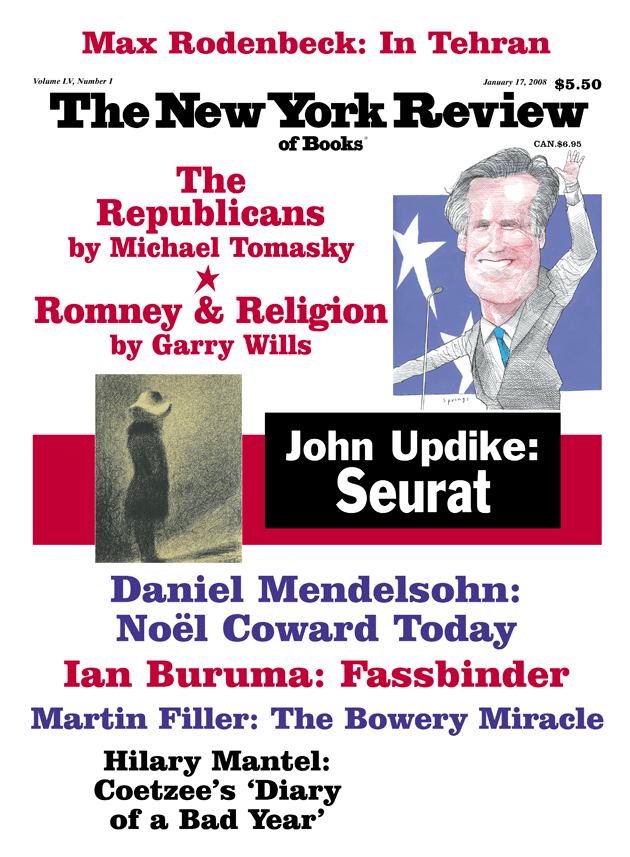
January 17, 2008 • Volume 55, Number 1
  • Max Rodenbeck

    An American in Iran e-edition

  • Freeman Dyson

    Rocket Man e-edition

    Von Braun: Dreamer of Space, Engineer of War by Michael J. Neufeld

  • John Updike

    Nocturnes e-edition

    Georges Seurat: The Drawings Catalog of the exhibition by Jodi Hauptman, with essays by Karl Buchberg, Hubert Damisch, Bridget Riley, Richard Shiff, and Richard Thomson

  • Michael Massing

    As Iraqis See It e-edition

  • Martin Filler

    Miracle on the Bowery

  • Hilary Mantel

    The Shadow Line e-edition

    Diary of a Bad Year by J.M. Coetzee

  • Michael Tomasky

    They’d Rather Be Right e-edition

    Comeback: Conservatism That Can Win Again by David Frum

    They Knew They Were Right: The Rise of the Neocons by Jacob Heilbrunn

  • Colin Thubron

    A Prince of the Road

    A Time to Keep Silence by Patrick Leigh Fermor, with an introduction by Karen Armstrong

    Mani: Travels in the Southern Peloponnese by Patrick Leigh Fermor, with an introduction by Michael Gorra

    Roumeli: Travels in Northern Greece by Patrick Leigh Fermor, with an introduction by Patricia Storace

    A Time of Gifts by Patrick Leigh Fermor, with an introduction by Jan Morris

    Between the Woods and the Water by Patrick Leigh Fermor, with an introduction by Jan Morris

  • Garry Wills

    Romney and JFK: The Difference e-edition

  • Charles Simic

    The Muses’ Darling e-edition

    Tamburlaine a play by Christopher Marlowe, adapted and directed by Michael Kahn, produced by the Shakespeare Theatre Company

    Edward II a play by Christopher Marlowe, directed by Gale Edwards, produced by the Shakespeare Theatre Company

  • Mark Ford

    A Master of Noir e-edition

    Voyage Along the Horizon by Javier Marìas, translated from the Spanish by Kristina Cordero

    The Man of Feeling by Javier Marìas, translated from the Spanish by Margaret Jull Costa

    All Souls by Javier Marìas, translated from the Spanish by Margaret Jull Costa

    A Heart So White by Javier Marìas, translated from the Spanish by Margaret Jull Costa

    Tomorrow in the Battle Think on Me by Javier Marìas, translated from the Spanish by Margaret Jull Costa

    Dark Back of Time by Javier Marìas, translated from the Spanish by Esther Allen

    Your Face Tomorrow, Volume 1: Fever and Spear by Javier Marìas, translated from the Spanish by Margaret Jull Costa

    Your Face Tomorrow, Volume 2: Dance and Dream by Javier Marìas, translated from the Spanish by Margaret Jull Costa

  • Pankaj Mishra

    The Quiet Heroes of Tibet e-edition

  • Bill McKibben

    Taking the Gospels Seriously

    The Scandalous Gospel of Jesus: What’s So Good About the Good News? by Peter J. Gomes

    unChristian: What a New Generation Really Thinks about Christianity…and Why It Matters by David Kinnaman and Gabe Lyons

  • Ian Buruma

    The Genius of Berlin

    Berlin Alexanderplatz directed by Rainer Werner Fassbinder

    Fassbinder: Berlin Alexanderplatz Catalog of the exhibition edited by Klaus Biesenbach

  • Daniel Mendelsohn

    His Design for Living e-edition

    The Letters of Noël Coward edited and with commentary by Barry Day

  • Tim Parks

    Family Secrets e-edition

    ABC: A Novel by David Plante

    The Francoeur Family: The Family, The Woods, The Country by David Plante

    Difficult Women: A Memoir of Three by David Plante

    Annunciation by David Plante

  • Anthony Grafton

    The Wonders of the Loom e-edition

    Tapestry in the Baroque: Threads of Splendor Catalog of the exhibition edited by Thomas P. Campbell
  • Robert B. Reich,
    Tony Judt

    Supercapitalism’: An Exchange

LETTERS

Contributors

Max Rodenbeck is The Economist’s Mideast Correspondent. He lives in Cairo. (May 2013)

Derek Walcott is a poet, playwright, essayist, and visual artist. Born in Castries, St. Lucia, he won the Nobel Prize in Literature in 1992. His epic poem Omerosis a reworking of the Homeric story and tradition into a journey around the Caribbean and beyond to the American West and London.

Freeman Dyson has spent most of his life as a professor of physics at the Institute for Advanced Study in Princeton, taking time off to advise the US government and write books for the general public. He was born in England and worked as a civilian scientist for the Royal Air Force during World War II. He came to Cornell University as a graduate student in 1947 and worked with Hans Bethe and Richard Feynman, producing a user-friendly way to calculate the behavior of atoms and radiation. He also worked on nuclear reactors, solid-state physics, ferromagnetism, astrophysics, and biology, looking for problems where elegant mathematics could be usefully applied.

Dyson’s books include Disturbing the Universe (1979), Weapons and Hope (1984), Infinite in All Directions (1988), Origins of Life (1986, second edition 1999), The Sun, the Genome and the Internet (1999), and A Many-Colored Glass: Reflections on the Place of Life in the Universe (2010). He is a fellow of the American Physical Society, a member of the National Academy of Sciences, and a fellow of the Royal Society of London. In 2000 he was awarded the Templeton Prize for Progress in Religion.

John Updike (1932–2009) was born in Shillington, Pennsylvania. In 1954 he began to publish in The New Yorker, where he continued to contribute short stories, poems, and criticism until his death. His major work was the set of four novels chronicling the life of Harry “Rabbit: Angstrom, he two of which, Rabbit is Richand Rabbit at Rest, won the Pulitzer Prize for Fiction. His last books were the novel The Widows of Eastwick and Due Considerations, a collection of his essays and criticism.

Michael Massing, a contributing editor of the Columbia Journalism Review, writes frequently on the press and foreign affairs.

Martin Filler was the longtime architecture critic of House & Garden, until it ceased publication in 2007. He is the co-author, with Olivier Bossiere, of The Vitra Design Museum: Frank Gehry, Architect, and author of Makers of Modern Architecture, which is based on essays from The New York Review. A second volume of his writings on architecture is forthcoming from New York Review Books.


Hilary Mantel is an English novelist, short story writer, and critic. Her novel, Wolf Hall, won the Man Booker Prize in 2009.

Michael Tomasky is Special Correspondent for Newsweek/
The Daily Beast and Editor of Democracy: A Journal of Ideas.
 (April 2013)

Colin Thubron is the president of the Royal Society of Literature. Among his books are Mirror to Damascus, The Hills of Adonis: A Quest in Lebanon, Jerusalem, In Siberia, and, most recently, To a Mountain in Tibet. 
 (January 2012)

Garry Wills is Professor of History Emeritus at Northwestern. His study of Abraham Lincoln, Lincoln at Gettysburg: The Words That Remade America, was awarded the Pulitzer Prize in 1993. His latest book, Why Priests? A Failed Tradition, was published in February 2013.

Charles Simic is a poet, essayist, and translator. He has published some twenty collections of poetry, six books of essays, a memoir, and numerous translations. He is the recipient of many awards, including the Pulitzer Prize, the Griffin Prize, and a MacArthur Fellowship. Simic’s recent works include Voice at 3 a.m., a selection of later and new poems; Master of Disguises, new poems; and Confessions of a Poet Laureate, a collection of short essays that was published by New York Review Books as an e-book original. In 2007 Simic was appointed the fifteenth Poet Laureate Consultant in Poetry to the Library of Congress. His New and Selected Poems: 1962–2012 was published in March 2013.

Mark Ford teaches in the English Department at University College London. His anthology London: A History in Verse was published last July.
 (June 2013)

Pankaj Mishra lives in London and India. He is the author of The Romantics, winner of the Los Angeles Times’s Art Seidenbaum Award for First Fiction, and An End to Suffering: The Buddha in the World. He is a frequent contributor to The New York Review of Books and The Guardian. Mishra’s recent books include Temptations of the West: How to Be Modern in India, Pakistan, Tibet, and Beyond and From the Ruins of Empire: The Intellectuals Who Remade Asia.

Bill McKibben is Schumann Distinguished Scholar at Middlebury College, and the author of The End of Nature, Deep Economy: The Wealth of Communities and the Durable Future, Eaarth: Making a Life on a Tough New Planet and of the forthcoming Oil and Honey: The Education of an Unlikely Activist.. He is also the founder of 350.org, the global climate campaign that has been actively involved in the fight against natural gas fracking.

Ian Buruma is the Henry R. Luce Professor at Bard. His books include Murderer in Amsterdam: The Death of Theo Van Gogh and the Limits of Tolerance, Taming the Gods: Religion and Democracy on Three Continents, and the novel The China Lover. His book Year Zero: A History of 1945 will be published in September 2013.

Daniel Mendelsohn’s reviews and essays on literary and cultural subjects appear frequently in The New York Review of Books and The New Yorker. He is the author, most recently, of the collection Waiting for the Barbarians: Essays from the Classics to Pop Culture, which was a finalist for the 2012 National Book Critics Circle Award. His other books include two memoirs, a translation of the complete works of C.P. Cavafy, and a study of Greek tragedy, Gender and the City in Euripides’ Political Plays. He teaches at Bard College.

Tim Parks, a novelist, essayist, and translator, is Associate Professor of Literature and Translation at IULM University in Milan. His books include Teach Us to Sit Still: A Skeptic’s Search for Health and Healing and The Server.

Anthony Grafton is Henry Putnam University Professor of History and the Humanities at Princeton University. His most recent book is The Culture of Correction in Renaissance Europe.


Tony Judt (1948–2010) was the founder and director of the Remarque Institute at NYU and the author of Postwar: A History of Europe Since 1945, Ill Fares the Land, and The Burden of Responsibility: Blum, Camus, Aron, and the French Twentieth Century, among other books.

Jane Smiley, winner of the 1992 Pulitzer Prize for Fiction, is the author of many novels and other works. In 2010 she published Private Life, a novel; A Good Horse, a book for young adults; and The Man Who Invented the Computer, the first volume of the Sloane American Inventors series.

David Bromwich is Sterling Professor of English at Yale. He is the editor of a selection of Edmund Burke’s speeches and the author of Hazlitt: The Mind of a Critic.
 (January 2013)