Contents

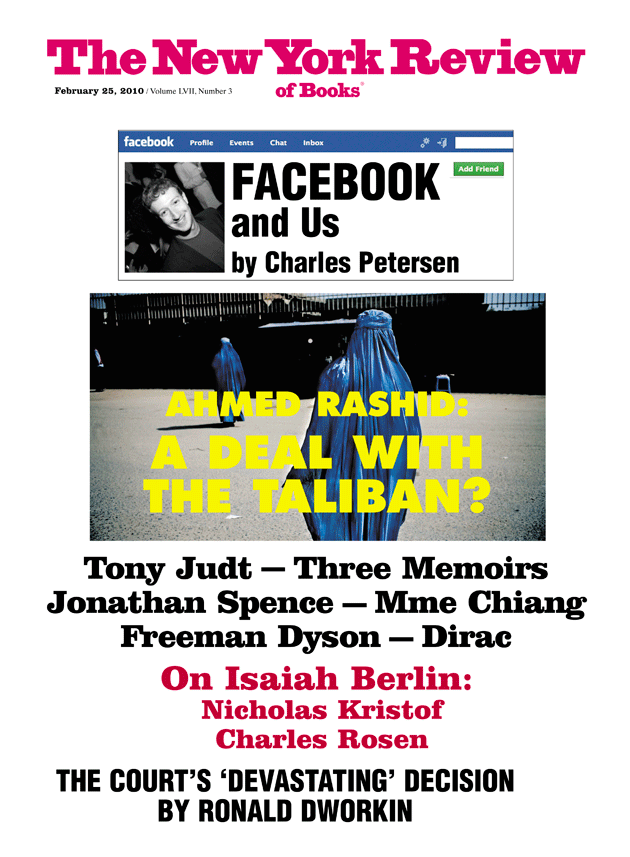
February 25, 2010 • Volume 57, Number 3

LETTERS

Contributors

Ahmed Rashid is the author of Pakistan on the Brink: The Future of America, Pakistan, and Afghanistan. (September 2012)

Jonathan Spence is Professor of History Emeritus at Yale. Among his books are The Death of Woman Wang, Treason by the Book, The Question of Hu, and The Search for Modern China.

Charles Petersen, an associate editor at n + 1, has written for The Village Voice, The San Francisco Chronicle, and The Wall Street Journal. (December 2010)

Nazila Fathi is a reporter for The New York Times, formerly based in Tehran.
 (February 2010)

Francine Prose is a Distinguished Visiting Writer at Bard. Her novel, The Blue Angel, was nominated for the National Book Award. Her most recent novel is My New American Life.

Tony Judt (1948–2010) was the founder and director of the Remarque Institute at NYU and the author of Postwar: A History of Europe Since 1945, Ill Fares the Land, and The Burden of Responsibility: Blum, Camus, Aron, and the French Twentieth Century, among other books.

Freeman Dyson has spent most of his life as a professor of physics at the Institute for Advanced Study in Princeton, taking time off to advise the US government and write books for the general public. He was born in England and worked as a civilian scientist for the Royal Air Force during World War II. He came to Cornell University as a graduate student in 1947 and worked with Hans Bethe and Richard Feynman, producing a user-friendly way to calculate the behavior of atoms and radiation. He also worked on nuclear reactors, solid-state physics, ferromagnetism, astrophysics, and biology, looking for problems where elegant mathematics could be usefully applied.

Dyson’s books include Disturbing the Universe (1979), Weapons and Hope (1984), Infinite in All Directions (1988), Origins of Life (1986, second edition 1999), The Sun, the Genome and the Internet (1999), and A Many-Colored Glass: Reflections on the Place of Life in the Universe (2010). He is a fellow of the American Physical Society, a member of the National Academy of Sciences, and a fellow of the Royal Society of London. In 2000 he was awarded the Templeton Prize for Progress in Religion.

Mark Ford teaches in the English Department at University College London. His anthology London: A History in Verse was published last July.
 (June 2013)

Mischa Berlinski is the author of Fieldwork: A Novel. He lived in Haiti between 2007 and 2011. (June 2013)

Nicholas D. Kristof is a columnist for The New York Times and the coauthor, with his wife, Sheryl WuDunn, of Half the Sky: Turning Oppression into Opportunity for Women Worldwide, forthcoming in September.

Charles Rosen is a pianist and music critic. In 2011 he was awarded a National Humanities Medal.

Steve Coll is President of the New America Foundation and a staff writer at The New Yorker. His most recent book is Private Empire: ExxonMobil and American Power.
 In July he will become Dean of the Graduate School of Journalism at Columbia University. (February 2013)

Charles Baxter is the Edelstein-Keller Professor in Creative Writing at the University of Minnesota. His latest book, Gryphon: New and Selected Stories, was published in paperback in February. (December 2012)

Walter Kaiser was Director of Villa I Tatti, the Harvard Center for Italian Renaissance Studies, in Florence from 1988 to 2002. He is Francis Lee Higginson Professor of English and Professor of Comparative Literature Emeritus at Harvard.
 
(March 2013)

Ronald Dworkin (1931–2013) was Professor of Philosophy and Frank Henry Sommer Professor of Law at NYU. His books include Is Democracy Possible Here?, Justice in Robes, Freedom’s Law, and Justice for Hedgehogs. He was the 2007 winner of the Ludvig Holberg International Memorial Prize for “his pioneering scholarly work” of “worldwide impact” and he was recently awarded the Balzan Prize for his “fundamental contributions to Jurisprudence.”


Richard Dorment is the art critic of the Daily Telegraph. Among the exhibitions he has organized is “James McNeill Whistler,” seen at the Tate Gallery, London, the Musée d’Orsay, Paris, and the National Gallery of Art, Washington, D.C. 
(June 2013)