

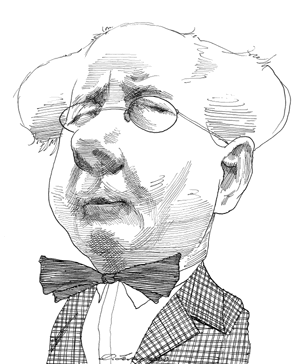
The 1930s now seem so far away that many members of the younger generation outside France, and even in France, may never have come across the works of Roger Martin du Gard. Yet, in his day, he was famous enough to be awarded the Nobel Prize for Literature, but even that international accolade is no guarantee of survival. Witness the case of René-François Sully-Prudhomme, the very first winner in 1901, who is now no more than a name in the reference books. But Iremember how eagerly we read Martin du Gard’s novels before the war. Now, having looked at them again, together with this unfinished, posthumous volume, which has taken so long to appear in English, I feel that they have a permanent quality. They may seem rather staid and old-fashioned compared to the overpowering intellectual and emotional fluency of Proust, but they have the merit of defining a certain kind of average Frenchness—that is, bourgeois anti-bourgeoisism—which existed strongly at the time, although it may have evaporated to some extent since then, just as Englishness is no longer what it was in those days.
Martin du Gard’s major work, Les Thibault, which came out in eight volumes between 1922 and 1940, belongs to the genre that was dubbed le roman-fleuve—along with Jean-Christophe by Romain Rolland, La Vie et aventures de Salavin and La Chronique des Pasquier by Georges Duhamel, and Les Hommes de bonne volonté by Jules Romains. The theme common to these multivolume sagas, which of course owe a lot to the example of Balzac and Zola, is the search for the good, or at least the significant, life on the part of individuals or groups who no longer accept religion and are in revolt, to a greater or lesser degree, against the entrenched bourgeoisism of French society. Martin du Gard, in particular, was fascinated by the tension between social convention and rebellion, and between belief and disbelief.
Already in 1913, before starting on Les Thibault, he had published a novel, Jean Barois, in which the hero is a polemical journalist, a Dreyfusard on the same side as Zola in the battle against the military and religious establishments. However, the struggle proves too much for him. When he becomes fatally ill, his spirit is broken, and he returns to die in the bosom of the Church. The secular profession de foi that he had drawn up as a precaution before the onset of his illness is burned with the approval of the priest who administers the last rites.
Yet it would be wrong to think of Martin du Gard as a rabid anti-Catholic. One of his distinguishing features is his keen sense of the complexities of human nature and his reluctance to make absolute judgments. In various parts of his books, he draws some detailed and sympathetic portraits of priests. In real life, it was a priest, one of his teachers, who first introduced him to Tolstoy, and it was the Russian writer, more perhaps than any French one, who was to remain a lifelong inspiration. Also, in his description of French secular circles in the earlier part of the century, he admirably conveys the metaphysical and spiritual intensity that prevailed there, and that I remember as being so different in their intellectual excitement from the contemporary English atmosphere.
The Thibault saga, at the same time as it paints a rich fresco of French bourgeois life, with some happy or bracing episodes, is, like Jean Barois, tragic in its final implications. The two heroes, Antoine and Jacques, the sons of a conventional, overbearing, bourgeois Catholic father, are both allergic to religion, and rebel in their different ways. Antoine, the elder, finds satisfaction in medical science, and leads a fairly sober life as a distinguished doctor. Jacques, an intellectual with a romantic temperament, becomes involved in international schemes for human betterment. Both brothers are destroyed by the First World War. Jacques is injured in a plane crash while attempting to scatter pacifist leaflets and, in the general panic, is shot as a spy by a French soldier. Antoine, serving as a medical officer, is caught in a gas attack, and his health deteriorates until, in the end, he relieves his sufferings with a fatal dose of drugs, just as the armistice is declared.
Les Thibault, with its numerous characters and its broad depiction of both civilian and military life (the author served as a sergeant in a transport unit during the 1914-1918 war), is—one might say—Martin du Gard’s War and Peace, although it is a purely bourgeois epic, without the aristocratic dimension of Tolstoy’s novel. Martin du Gard belonged to a family traditionally associated with the legal profession, and if the du in his nom à particule has any social significance, it must indicate noblesse de robe rather than noblesse d’épée.
Advertisement
He himself chose to train as a paleontologist at the École des Chartes, but he seems to have had no need to enter a profession. He must always have lived on a private income, because, from the outset of his career, he was able to devote himself entirely to literature, without any regard for success or failure. He was, then, like his close friend André Gide, to whose memory Maumort is dedicated, a rentier and a grand bourgeois; that is, he enjoyed the freedom bestowed by financial security without the constraints that are often imposed by an aristocratic inheritance. Consequently, his writing, at its best, has a solidity and a finish that come from complete independence of mind.
After publishing the last volume of Les Thibault in 1940, he began almost immediately on another ambitious project, Le Journal du Lieutenant-Colonel de Maumort, as if he felt that he still had a lot to say. He worked on this intermittently until his death in 1958, but it seems to have caused him more trouble than any of his previous works, because he changed the plan of the book several times. In the end, he left an unfinished manuscript with different variants of certain episodes, and a mass of notes not yet incorporated into any continuous text. What we have here in English translation is a volume that was carefully pieced together over a period of five years by André Daspre, a professor of literature at the University of Nice. It was published in the original French in 1983 with an ample critical apparatus. The translators have devoted no less than seven years to the preparation of their version, and they are to be congratulated on the excellence of their achievement. The translation is accurate, and reads as smoothly as if it had been written directly in English.
However, the critical problem is to decide whether this final novel by Martin du Gard, on which so much care has been lavished by three devoted admirers of the author, is the totally successful masterpiece the translators claim it to be. They see a virtue in its unfinished, fragmentary character:
What might have detracted from the book ends up heightening its artistic value. The repetitions, the disunities, the mixture of different literary forms, combine to give the novel an invigorating rawness, and make the reader feel as if he were an intruder peering into private papers he was never meant to see. Whether or not this was intentional on the author’s part is finally beside the point. What matters is the miraculous vividness of the end result.
I cannot quite agree with this, just as I cannot accept that it was in any sense inevitable or an advantage, as they suggest, that Proust didn’t complete a definitive version of À la recherche du temps perdu because his universe was “illimitable.” Much as one may admire Proust, it seems clear that he sometimes wrote below his best through physical weakness or a lack of time for revision. Similarly, in Martin du Gard’s case, there are parts of Maumort which are beautifully realized and others which remain sketchy, or are just missing, although they would have been essential for a proper understanding of the whole.
All the early sections—Maumort’s upbringing in the relative solitude of a provincial château between a widowed father and a devoted elder sister, his experiences in the sexually charged atmosphere of a Catholic boarding school, his early manhood in Paris just before the turn of the century, his discovery of intellectual freedom in the household of a non-Catholic uncle, a friend of Ernest Renan, and of heterosexual love with a mature, West Indian woman—are fully worked out, and have a ripeness and a stylistic polish which fully justify the publication of the book for their own sake.
I quote a typical paragraph about his intellectual awakening in Paris. Although this is from the English translation, the feeling of his style comes through.
Everything contributed to my being intoxicated, to feeding a sort of great uninterrupted blaze in me: the exploration of the capital, the freedom given me by my uncle and my aunt, their Sunday at-homes where I immediately found myself with everyone who had a name in art and literature, the contact with the professors at the Sorbonne and with the other students, with whom Ispent some time at the end of classes or in the Sorbonne’s library—everything, even the physical blossoming of my eighteenth year, and the endless discoveries that I made around me, and my nascent ambitions taking wing. I lived in a state of perpetual inner joy. My curiosity, open to all subjects, was inexhaustible. The influence of my Uncle Éric, his table talk, his friends, the dazzling exchanges and clashes of ideas that I witnessed nearly every day—all this gave birth to a new and passionate being in the little provincial that Ihad been the year before. My aunt’s presence added to this the charm of a feminine intimacy that put grace, gaiety, playfulness, and also the warmth of an understanding affinity into that intensely intellectual existence.
Also, inserted as an incident in the text, is a moving short story about the tragedy of a homosexual infatuation on the part of one of Maumort’s intellectual acquaintances with a working-class boy, a baker’s apprentice. There is genuine feeling between the man and the boy, but through a misunderstanding they arrive at an assignment on opposite banks of a river. The boy tries to swim across and is carried off by the current.
Advertisement
Then again, later, in a series of letters that Maumort exchanges with a friend, there is a vivid account of what it was like to have to maintain one’s dignity in a château occupied by the Germans during the Second World War. But after that, the last 150 pages of the volume consist of disjointed thoughts and aphorisms that Martin du Gard had assembled in a separate file for possible inclusion in the novel.
What is obviously missing from the center of the book is an adequate account of Maumort’s career as a soldier and of his relations with his wife and his two sons. There is not quite a total blank between his entry into the military academy of Saint-Cyr and his eventual retirement to his country estate, but in a volume 778 pages long, only 58 pages are devoted to this middle period of his life, as if, for some inhibiting reason, Martin du Gard had indefinitely postponed dealing with Maumort qua soldier and family man.
In the original plans quoted by André Daspre, there is mention of Maumort’s participation, along with Marshal Lyautey, in the French colonial expeditions in North Africa from 1904 to 1914, and later of his activities during the First World War, but in the existing text, the military theme is reduced to a few incidental references. One might have expected a twentieth-century equivalent of Alfred de Vigny’s brilliant description of the early-nineteenth-century aristocratic military ethos in Servitude et grandeur militaires, but it is not there. The rights and wrongs of colonialism are not discussed, Martin du Gard gives no extended portrait of Lyautey, the famous military leader, as he does of Ernest Renan, the famous skeptical humanist, and he leaves no clue to why he chose an aristocrat and a professional soldier as his last fictional hero.
André Daspre, in his preface to the French edition, mentions—but is unable to explain—this curious choice on the part of an author who had given such a hostile account of war in Les Thibault, and had used his Nobel Prize speech to utter an eloquent plea for pacifism. I can make a suggestion, but it is admittedly a long shot. Perhaps Martin du Gard, as a humanist rendered still more pessimistic than he was before by the double catastrophe of the German invasion and the ensuing cold war in Europe, was trying the experiment of projecting himself into the character of a professional soldier, that is, someone who, by definition, accepts the evil of war as a permanent, and indeed normal, feature of human society.
But, whatever the reason, the choice was clearly not a happy one, because, as is obvious from the numerous creative hesitations listed by Daspre, Martin du Gard never succeeded in fully objectifying Maumort as a character distinct from himself. In the completed sections of the book, the fact that the narrator is supposed to be a professional soldier is, to all intents and purposes, imperceptible; he might be any observant, reflective person, apart from one or two touches of aristocratic hauteur (Martin du Gard may have been likening him to Tolstoy, who had the social assurance of a Russian aristocrat and for a period of his life served as a professional soldier).
In the long concluding section of disjoined “thoughts,” even when Martin du Gard adds the indication “Maumort thinks that…,” more often than not one suspects that he is speaking in his own name. And, in this connection, it is rather sad to note that, while he doesn’t, in old age, fall back onto religion as Tolstoy did, his humanism is going very sour, and is evolving in fact into a sort of tetchy, unorganized Absurdism, marked by some unexpected lapses into misogyny, misanthropy, and bourgeois class prejudice. Iquote:
If Gévresin were here, he would not miss a chance to repeat how beautiful life on earth would be on the day when biologists learn how to produce children in their laboratories, when only males are created, when the female species disappears from the globe, and when liberated men organize an exclusively male world. On days when he is inclined to leniency, he is willing to concede that, for the sake of scientific curiosity, a few specimens of the female sex might be kept in zoos…
Hell is the constant contact with others, with their rules and their “infernal” din; one of the tortures of hell will be the uninterrupted cacophony of the radio, an invention of Satan.
One can love the people and not be able to stand their ongoing company. One can love the populace and not like to live with the individuals who compose it. Their ways of being and of thinking, their ways of being happy or unhappy, their desires, their welfare, their joys, their emotions, their sensitivity, their reactions are not my own; and I am a foreigner among them. My climate is not theirs. Whenever circumstances have forced me into contact with them, I have suffered from it.
Nevertheless, despite this reservation, the book, incomplete though it is, has great qualities as a novel in its finished parts, and is fascinating as the final statement of an exceptionally talented and thoughtful writer.
This Issue
April 27, 2000

This Issue
April 27, 2000