

1.
During the past few months, many nations have reached a consensus on the threat that Iran’s nuclear program poses to international security. A similar consensus eluded the same nations in the debate over invading Saddam Hussein’s Iraq three years ago. On March 8, the International Atomic Energy Agency in Vienna referred Iran’s case to the Security Council. In public or private, but increasingly in public, senior officials from a wide range of countries—including the US, the EU states that vociferously opposed the invasion of Iraq, as well as India and Japan—speak of Iran’s alleged pursuit of nuclear weapons with a conviction that suggests they regard it as an incontestable fact. Citing a series of deplorably anti-Israel statements by Iran’s president, Mahmoud Ahmadinejad, officials from some of the same countries express the fear that once Iran has the bombs it is assumed to be seeking, it will threaten Israel with a new and reckless vigor.
There is less agreement on the US contention that citizens of the Islamic Republic are captives of the country’s clerical elite, and that other countries should strengthen Iran’s pro-democracy organizations so that Iranians can enjoy, in George Bush’s words, the “right to choose [their] own future.” But this view may be spreading. In a recent speech, Jack Straw, the British foreign secretary, declared his support for Iranians’ “aspirations for a freer and more democratic…future.”1
As the Security Council debates what to do about Iran in closed sessions during the coming months, Iran’s relations with many countries will continue to worsen unless its leaders give in to international pressure and abandon their plans to become producers of nuclear fuel by enriching uranium, which they could use to make bombs. Between October 23, 2004, and January of this year, Iran had suspended work aimed at achieving a nuclear fuel cycle using enriched uranium. Then it started work on enrichment once again, and reacted to the IAEA’s strong condemnation of this move by telling the agency that it could no longer inspect sites other than those that Iran had declared to be nuclear sites. On March 29, the Security Council issued a statement repeating the recent demand of the IAEA that Iran again suspend its work on uranium enrichment and allow the IAEA to inspect installations where nuclear work is suspected of going on.
If Iran refuses to comply with such demands, as it has vowed to do, and continues the uranium enrichment program that it started in January, a senior British official expects it to have acquired “the technology to enable it to develop a nuclear weapon” by the end of this year.2 If the Iranians do not back down, the US, Britain, and France are expected to try to persuade the Russians and Chinese to support a subsequent resolution declaring Iran in violation of international law.
Having agreed that the Security Council discuss Iran’s behavior, Russia and China, however, have indicated that they oppose putting heavy political pressure on the Iranians. In the Security Council they will most likely insist that the IAEA must have the main responsibility for dealing with Iran’s program, and that other UN action be delayed, if it is taken at all. Russia and China have large interests in Iran. The Chinese recently agreed to purchase a large amount of Iranian oil and gas during the next three decades. Russia considers the Islamic Republic an ally in its efforts to counter America’s influence in the Middle East. It has also sold Iran civilian nuclear technology, a new air defense system, and civilian aircraft.
It is true that Russian officials were irritated by Iran’s policy of prevarication while responding to their proposal that it transfer uranium-enrichment activities to Russian soil.3 Nonetheless, they maintain that excessive pressure on Iran may impel it to opt out of the Nuclear Non-Proliferation Treaty (NPT) altogether, and end even the much-reduced access that inspectors now have to Iranian sites. The Iranians have not discouraged such speculation. Russia and China seem unlikely to join in the policy of sanctions against Iran that the US, Britain, and France hope that a coalition of countries will adopt should Iran refuse to comply with a putative resolution demanding that it stop its uranium enrichment program and accept more intrusive inspections.4
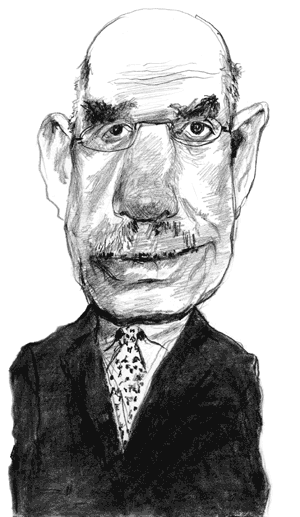
To judge from his comments during a press conference on March 8, it seems that Mohamed ElBaradei, the IAEA’s director general, has some sympathy for the Russian and Chinese positions. He called on the parties to avoid an “escalation” and engage in more talks. ElBaradei is said by diplomats to be deeply disappointed that after three years of intensive inspections and correspondence with the Iranian authorities, he can’t say that the Iranian program is peaceful.5 In his most recent report, on February 27, he acknowledged that the IAEA has not seen in Iran “any diversion of nuclear material to nuclear weapons or other nuclear explosive devices.” But he was troubled that Iran had provided inadequate information about its program to develop centrifuges to enrich uranium. He was, he said, concerned about the ambiguous “role of the military” in the program. He mentioned a document sent to the Iranians from a supplier of nuclear technology described as suitable for the “fabrication of nuclear weapons components.” The Iranians said the document was unsolicited.
Advertisement
ElBaradei’s agency has much to lose if Iran achieves a fuel cycle and the ability to build a bomb at short notice. The Nuclear Non-Proliferation Treaty, signed by 188 nations, has been undermined by countries such as India, Pakistan, and Israel, which refused to sign it and have nuclear devices. North Korea withdrew from the treaty in 2003 and then claimed to have a nuclear device. The NPT would lose what little credibility it still has if Iran were to quit or were allowed to stay a member of the group of signers while remaining elusive about its nuclear program. If the NPT collapses, the result could well be a nuclear arms race involving Saudi Arabia and other nations in the Middle East. ElBaradei’s extensive dealings with Iranian leaders, and particularly with its top nuclear officials, who answer to the supreme leader, Ayatollah Ali Khamenei, seem to have convinced him that the only solution is to negotiate a deal with Iran that will involve the US. On March 8, he called on the US to negotiate with Iran and stressed the need for “a comprehensive political settlement that takes account of all underlying issues.”6
As the Bush administration sees it, the main “underlying issue” is that Iran’s fanatical and unpopular regime is secretly trying to build a bomb with which to threaten Israel and other countries. Only by asserting the possibility of sanctions or preventive war—the “meaningful consequences” to which Dick Cheney has referred—can the US and other influential nations stop this from happening. This reading of the Islamic Republic’s position is misleading, however. First, it ascribes to a fractured and secretive state a transparency of intent and an ideological rigidity that it does not have. Second, it absolves the US of any responsibility for Iran’s refusal to abandon its ambitions to have a fuel cycle, and of any obligation to use diplomatic means to persuade its leaders to change their mind.7
The Iranians’ ability to behave with startling pragmatism was first displayed during the Iran-contra scandal of 1986, when they were found to be cooperating with their American enemies to buy arms from Israel, whose right to exist they contested. After the death three years later of the Ayatollah Ruhollah Khomeini, the Iranians developed relations with Saudi Arabia, a kingdom that Khomeini himself had loathed. The Iranians also indicated that they would take no action to implement the death sentence that Khomeini had passed on Salman Rushdie. After the attacks on America of September 11, Iran provided valuable support for the US-led invasion of Afghanistan and for the new Afghan government.
Iran’s enmity toward Israel is more nuanced than Ahmadinejad’s statements suggest. The President’s declarations that Israel should be “wiped off the map,” and that the Holocaust is a “myth,” understandably aroused fears that Iran might be considering an attack on Israel. But Iran’s senior civilian and military officials have insisted that Iran will strike Israel only if Israel strikes first.8 More significantly, the President and supreme leader have both reiterated Iran’s longstanding demand for a referendum on the status of Israel that would involve all Palestinian refugees. This official position would not seem to be consistent with an ambition to destroy Israel by force, least of all by using nuclear arms, which would endanger the very Palestinians whom the Iranians claim to be protecting. Several senior Iranian officials, including Akbar Hashemi Rafsanjani, a former president who heads a powerful arbitration council in Tehran, have not disguised their irritation with the President’s comments. But Ahmadinejad has benefited from the furor. By raising his prestige among hard-line Islamists around the world, the President has made it harder for his domestic opponents, who include Rafsanjani, to undermine him.
Iran’s nuclear crisis centers on the Islamic Republic’s ambitions and fears, and these are hard to identify when we consider the largely hidden decision-making process in Iran, where an elected president and parliament are subservient to an unelected supreme leader and other appointed bodies. All are in competition with one another and it is hard to know exactly how decisions are made. Seeking clues, one could do worse than review the deterioration in relations between Iran and the US since early 2002, when Bush included the Islamic Republic in his “axis of evil.” At the time, I was told by Iranians connected to the clerical elite that this speech had convinced Iran’s leaders that Bush intended to bring down the Islamic Republic. Iranian insecurities were subsequently heightened by the American invasion of Iraq, even though it got rid of one of Iran’s worst enemies—and by the US’s stated ambition to democratize the Middle East.
Advertisement
Unsurprisingly, Iran has obstructed George Bush’s mission of regional transformation. The Iranians have been asserting their influence over neighboring Iraq, while doing nothing to help the US out of its predicament there. Iran has been channeling cash and arms to Iraqi Shiite groups, and it encourages commercial and philanthropic work in Iraq by Iranian citizens. In spite of Western pressure, the Iranians have not changed their support for other regional adversaries of the US, including Syria and such groups as Hezbollah (which Iran co-founded with Syria) and Hamas. Some Iranian leaders went out of their way to whip up religious anger against the West during the recent controversy over caricatures of the Prophet Muhammad that were published in a Danish newspaper. “Iran’s aim,” observes an experienced analyst in Tehran, “is to ensure that the Americans are too harassed to be able to threaten it.”
Achieving a nuclear fuel cycle and the ability to build a bomb would give Iran’s leaders a different degree of protection altogether. It would be in a position to deter attacks by any hostile power. Acquiring a fuel cycle, however, is a perilous undertaking. In a speech that he delivered to senior officials at the end of 2004, whose contents were recently made public, Hassan Rohani, then Iran’s chief nuclear negotiator, spoke of the intense diplomatic pressure being felt by Iran. “If we can one day complete this [uranium enrichment] cycle and present the world with a fait accompli,” he said,
the situation will change. The world didn’t want Pakistan to get an atom bomb or Brazil to get a fuel cycle, but Brazil achieved a fuel cycle and Pakistan a bomb, and the world came to an accommodation with them…but we haven’t yet achieved a full fuel cycle, and that, as it happens, is our main problem.
Iran’s leaders are unlikely to abandon their plans to achieve a fuel cycle unless they believe that they will be more secure as a result. On February 15, after Condoleezza Rice asked Congress to allocate $75 million to promote democracy in Iran, a senior US official, briefing journalists anonymously, predicted that the money would help Iranians “who wish to see a different type of Iran.” Another official referred to Iranians’ desire to live in “a different system.” For Iran’s leaders, the two main “underlying issues” that ElBaradei says should be discussed are their own security and America’s readiness to coexist with an Islamic theocracy that it finds repugnant. The Bush administration has apparently adopted a policy of regime change toward Iran, although there seems no way it could accomplish this by military force. At the same time, the administration has been talking about possible meetings with Iranians concerning cooperation on achieving stability in Iraq—meetings that have yet to take place. When it comes to Iran, the administration doesn’t appear to have a coherent idea of what it is doing.
2.
Congress allocated $19 million less than Rice asked for to promote Iranian democracy. If we count the $10 million that had already been budgeted for this fiscal year but not yet spent, the administration has $36 million available for improving and increasing the propaganda it transmits to Iran, and $20 million to give to human rights organizations, NGOs, and labor unions, and to help Iranians who want to study in the US. This is a big increase over the $3.5 million that was allocated last year for similar purposes. The State Department is also greatly increasing the number of officers who work on Iran. For the first time during his administration, Bush is devoting much attention to Iran.
That is good news for exiled Iranian opposition groups, many of which are based in the US. According to Connie Bruck’s comprehensive report on these groups, which was published in The New Yorker on March 2, a potential recipient of funds is Reza Pahlavi, the forty-five-year-old son of the former shah and the proponent of a referendum that would let Iranians set up a constitutional monarchy, with him as shah, or a secular republic. The twenty-five Persian-language TV and radio stations that broadcast to Iran from Los Angeles, home to 600,000 Iranian exiles, may also apply to the US government for funds.9 Supporters of another group, the People’s Mujahedin Organization of Iran, are pressing the State Department to lift its designation of the Mujahedin as a foreign terrorist organization. If that happens, the Bush administration will be free to consider giving it money.10
It is hard for American organizations, even private ones, to have direct relations with Iranians inside the country. That was shown by the trial in 2002 in Tehran of Abbas Abdi, a prominent reformist, on charges of espionage. Abdi’s crime was to organize opinion polls on behalf of the Gallup organization, one of which indicated that 74 percent of people living in Tehran wanted Iran to start an official dialogue with the US. (Abdi recanted in court, in response, it is now known, to judicial threats against his wife. He was jailed.) According to one of the Iranian officials who spoke on March 12, the Bush administration intends to use international NGOs and other organizations as go-betweens. This frank admission is likely both to make life harder for non-Iranian NGOs that have links to Iran and to increase the dangers facing Iranians who are in contact with them.
Before the invasion of Iraq, US government officials were misled by some Iraqi opposition groups and their American supporters into thinking that these groups had popular support at home, and that they had good information about the country. Similar claims are now being made about the Iranian groups. For her New Yorker piece, Connie Bruck spoke to Raymond Tanter, a former member of the US National Security Council and a visiting professor at Georgetown University. Tanter is urging the administration to lift the Mujahedin’s designation as a terrorist organization. He believes, in Bruck’s paraphrase, that the Mujahedin is “the only opposition group capable of overthrowing the regime.”
That would be news to the regime. The Mujahedin lost its credibility as a military force when its Iraq-based militants launched a suicidal attack on Iran at the end of the Iran–Iraq war in 1988; they expected to provoke popular rebellion but were crushed by Iran’s forces. The organization’s 3,500 remaining members have been disarmed by the US and live in a camp near the Iranian border. The Mujahedin’s alliance with Saddam Hussein turned most Iranians against it. Indeed, in more than five years of living in Iran, I have yet to hear an Iranian praise it.11
Reza Pahlavi is less easy to dismiss. Some Iranians feel nostalgia for the prosperity and carefree hedonism of the time of the Shah, and they have a reflexive allegiance to his son. However, these sentiments do not seem widespread among the young people who make up most of the population; I have met plenty of young Iranians who favor a secular republic, but few who want a restoration of the monarchy. Pahlavi’s association with some of his father’s most reviled former allies, and his reliance on American largesse, have not enhanced his reputation. His main handicap is that of the exiled opposition as a whole; he has not seen Iran in twenty-seven years, and Iran has changed enormously in that time.
The exiles’ understanding of their own country is occasionally delusional. Take, for example, Pahlavi’s chief adviser, an Iranian businessman called Shahriar Ahy. He expects Iranians to begin a campaign of civil disobedience after a “national congress” of opposition groups that is being planned this summer in the US. “All have to cooperate to bring the regime down,” Ahy told Bruck. “We would have five, six, seven clusters inside, coordinated for unity of action. So, at the same time, the Kurds would be doing this! The oil workers striking over here! So the wolves are not running after different zebras.”
Ahy’s fantasy illustrates the gulf between perceptions of Iranians in the US, where many believe that conditions for regime change have never been more propitious, and the reality in Iran. In the words of a leading literary dissident in Tehran, “For the first time since the last shah’s accession, in 1941, Iran is bereft of any effective opposition, legal or illegal.”
Eight months after Khatami stepped down as president and his reform movement came to an end, there is no progressive political movement to take its place. This is not surprising, for the reform movement attracted a generation of brilliant public figures—officials who worked for Khatami, writers, editors, student leaders—who have since, for the most part, been silenced. They have been jailed, driven into exile, or intimidated into staying quiet. The once-active student movement is moribund.
Bush has contributed to the sense of torpor and pessimism that now afflicts many politically imaginative Iranians. By including Iran in his “axis of evil” and repeatedly praising pro-democracy activists during periods of unrest, Bush gave conservative judges and their hard-line supporters in the press and television a pretext to label all reformists as traitors and the lackeys of America. Abbas Abdi’s trial is only one example among many.12 Khatami has made it clear that he regards George Bush as partly responsible for his failure to reform Iran. Since Ahmadinejad’s election and the subsequent worsening of Iran’s diplomatic relations with many countries, it has become even harder for Iranians to express views in favor of more freedom of expression.13
US officials have portrayed the Islamic Republic and its citizens as being monolithically opposed to one another. Again, this view is inaccurate. Iran’s conservative leaders have presented their refusal to give up a fuel cycle program as an act of resistance against foreigners’ efforts to deprive Iran of its rights. The success of this approach was apparent on February 11, when President Ahmadinejad addressed a huge crowd, estimated by foreign news agencies to number several hundred thousand people, that had gathered to celebrate the anniversary of revolution. It was the biggest such crowd in years. Sentiments in favor of the regime and strongly opposed to the US are stronger now than at any time since I first visited Iran, in 1999.
3.
If Iran’s leaders do not change their nuclear plans, some countries, including EU member states, will probably impose sanctions on the Islamic Republic later this year. At first, these will try to block help to Iran’s civilian nuclear program—partly with the aim of preventing Iran’s single, Russian-built, nuclear reactor from becoming active—and to stop Iranian officials from traveling abroad. European restrictions on investment may follow.
The threat of sanctions is already deterring investors in Iran, especially in the oil and gas industries on which the country’s economy depends. Some foreign energy companies have postponed plans to develop Iran’s liquid natural gas. Oil ministry officials fear that a lack of foreign investment in the oil industry may hinder Iran’s chances of meeting its OPEC quota; they will soon launch a scheme to cut wasteful gasoline consumption.
The Iranian authorities reassure the public that sanctions will not threaten the high economic growth that the economy has enjoyed since the big oil price rise of 1999. Ahmadinejad’s budget for the coming Iranian year, which parliament ratified on March 14, has been criticized as extravagant and inflationary in its handouts to the poor, especially in the provinces. Khamenei has reminded Iranians that the sanctions that were formerly imposed on Iran, which included an oil embargo, stimulated the country to achieve self-sufficiency in many fields.
If that embargo were repeated, the inevitable collapse in revenues would threaten the Islamic Republic’s survival. World oil prices would also soar, with threatening consequences for many of the world’s economies. Iran has hinted that in response to sanctions it might block tanker traffic through the Strait of Hormuz, off its southern coast, further destabilizing the international economy.
The anticipated reluctance of many nations, including Russia and China, to impose such an embargo, and Iran’s continuing progress toward a fuel cycle, increase the likelihood of attacks by the US or Israel on Iran’s known and suspected nuclear sites. According to several recent analyses, including one by the International Crisis Group (ICG), only a major air campaign, entailing many civilian casualties, could do lasting damage to Iran’s nuclear facilities.14 Iran might retaliate using its missiles, which can probably reach Israel, and it would certainly encourage its regional allies, including Shiite leaders in Iraq and its friends in Syria and Lebanon, to cause trouble in Iraq and Israel. (Hezbollah and Hamas have both pledged to retaliate on Iran’s behalf in case it is attacked.) If Iran’s leaders feel that the US is determined to destroy the Islamic Republic, they will not hesitate to cause chaos.
It is not unthinkable that an imaginative solution will be found to the immediate diplomatic impasse. (The ICG, for instance, proposes that the Iranians be permitted to have a small and heavily monitored enrichment facility, but to commission it only after several years of building confidence with the IAEA and the EU countries, among others.) That would be good news, but the underlying issue would still need to be addressed. That issue is what Iran’s conservative leaders need to do to save themselves from being overwhelmed by George Bush’s administration, whose plan to transform the Middle East has no room for undemocratic ayatollahs.
—March 29, 2006
This Issue
April 27, 2006

This Issue
April 27, 2006
-
1
According to a British official, Straw’s speech showed that Britain’s former policy of “critical engagement” with Iran was being replaced by a more militant approach. ↩
-
2
The official, who spoke anonymously to British newspapers following Iran’s referral to the Security Council, was referring to Iran’s impending mastery of the nuclear fuel cycle, a prerequisite both to generating electricity and building a bomb. But he acknowledged that even with this technology, it would still take several years for Iran to build a serviceable weapon. ↩
-
3
Talks on this deal, which would deny Iran the opportunity to enrich uranium to the level needed for use in bombs, and prevent it from keeping spent reactor fuel that could itself be reprocessed for military use, have dragged on since last autumn, amid American and European accusations that the Iranians are negotiating in bad faith. On March 12, apparently in response to Russia’s support for the referral of Iran’s case to the Security Council, the Iranians ruled out the Russian proposal, only for the Russians to call for a new round of negotiations, apparently not started, a few days later. But the Iranians have not abandoned their insistence that they retain a working uranium enrichment facility on Iranian soil; and that, European and American officials say, would render the Russian deal meaningless. ↩
-
4
At the beginning of March, Sergei Lavrov, the Russian foreign minister, warned against endangering “the ability of the IAEA to continue its work in Iran…. I don’t think that sanctions as a means to solve a crisis have ever achieved a goal in the recent history.” A few days later, in what was interpreted as a hint that Iran may opt out of the NPT, Iran’s foreign minister said, “If we reach a point that the existing rules don’t meet the right of the Iranian nation, the Islamic Republic of Iran may reconsider policies.” ↩
-
5
The IAEA inspections and correspondence with the regime revealed that Iran had spent many years concealing sensitive information about its nuclear research and procurements. The Iranians argue that America’s policy of persuading nuclear suppliers not to sell Iran technology forced them to use clandestine channels. But this is not incompatible with another, more widespread explanation, that Iran concealed aspects of its program in order to conceal the fact that it aimed to build a bomb. ↩
-
6
According to Flynt Leverett, a former director for Middle East affairs at the National Security Council, as recently as 2003, Iran showed that it was receptive to the idea of such a settlement. In an Op-Ed that he wrote for the January 24 New York Times, Leverett regretted the Bush administration’s hostile reaction to a “detailed [Iranian] proposal,” delivered in that year, “for comprehensive negotiations to resolve bilateral differences.” ↩
-
7
Other countries, particularly Britain, France, and Germany, which have spent the past three years in negotiations aimed at persuading the Iranians to abandon their fuel cycle ambitions, have repeatedly and futilely urged the Americans to negotiate directly with Iran. The proposed meeting concerning Iraq would be limited, both sides insist, to discussion of Iraq. ↩
-
8
Last November, Khamenei, who controls Iran’s foreign policy, declared that Iran “will not commit aggression toward any nations.” ↩
-
9
The broadcasts are viewed by many Iranian city dwellers who have access to satellite dishes. Programs range from Persian pop videos to hostile political analysis of the Islamic Republic and pre-revolutionary films about cabaret artistes being wooed by lovable rogues. During Khatami’s presidency, when popular dissatisfaction sometimes led to demonstrations in Tehran, television hosts and their guests, including Reza Pahlavi, called on people to take to the streets. But no serious protests have taken place in Tehran since mid-2003, and my impression is that viewers increasingly favor light entertainment over political programs. The authorities generally tolerate ownership of satellite dishes, although they are illegal. State TV tries to counter the effects of the L.A. stations by making programs that mock dissident presenters. ↩
-
10
According to a European official who recently briefed US officials about Iran, the Americans do not plan to exploit discontent among Iran’s dissatisfied minorities. Over the past year, there have been riots, bomb blasts, and attacks on the security forces in Iran’s Arab- and Kurd-inhabited border regions with Iraq. One explanation for the Americans’ reluctance to incite minorities is their fear that Iran would reply in kind in Iraq. Another is that the principal opposition groups stress the importance of Iran’s territorial integrity. ↩
-
11
After the revolution, when it waged civil war against Khomeini’s supporters, the Mujahedin advocated a mix of Marxism and Islamism. Its founder, Massoud Rajavi, has now disappeared from view, and his wife, Maryam, who advocates democracy, has been put forward as the group’s spokesman. The Mujahedin does not seem to be run on democratic lines; former members describe it as a personality cult centering on Rajavi. Its political wing, the National Council of Resistance of Iran, came to prominence in 2002 when it revealed sensitive information about Iran’s nuclear program, information said to have been supplied by Israeli intelligence. The administration has not made clear if it would consider lifting the Mujahedin’s designation as a terrorist organization if it renounces violence, which Maryam Rajavi has so far refused to do. ↩
-
12
Another was the student protests of June 2003. Abdullah Momeni, a student leader, told me that Bush’s expression of support for the protesters provided the security forces with “an excuse for repression.” The protests were crushed and the government and parliament, despite being dominated by relatively pro-Western reformists at the time, felt obliged to condemn Bush’s interference. ↩
-
13
The election results, flawed though they were, illustrated the level of popular dissatisfaction with the reformists, who fielded three candidates, and the attractions of Ahmadinejad, who presented himself as a pious man of the people. Foreign relations did not feature as a campaign issue. See my “New Man in Iran,” The New York Review, August 11, 2005. ↩
-
14
See the ICG’s “Iran: Is There a Way Out of the Nuclear Impasse?” Middle East Report No. 51, February 23, 2006. ↩