

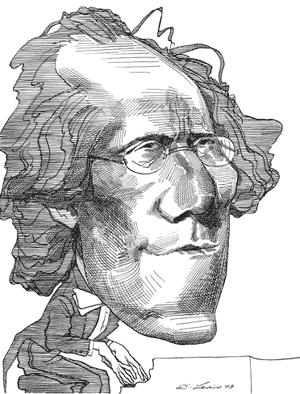
The two books entitled Mahler, by Henry-Louis de La Grange1 and Kurt Blaukopf2 respectively, represent decades of research. One question, then, in the minds of those who read both, is how it can be possible for so much dedicated scholarship to yield so many conflicting facts. According to Blaukopf, the composer was one of twelve children, five of whom died in infancy, while a sixth committed suicide at the age of twenty-five. But La Grange provides vital statistics for fourteen children, showing that seven of them died in infancy and that the suicide was in his twenty-first year. Blaukopf further states that the Lieder eines fahrenden Gesellen were inspired by “an actress,” although La Grange positively identifies the woman as the singer Johanna Richter. And where Blaukopf accepts a merely approximate dating for Mahler’s discovery of the Knaben Wunderhorn anthology, La Grange verifies both the year, 1887, and the circumstances, the home of Carl Maria von Weber’s grandson, during the period of Mahler’s infatuation with that gentleman’s wife.
But these discrepancies are too numerous to tabulate here. Sufficient to say that La Grange’s sources are more abundant, that he has read deeply in them, that his documentation and detail are encyclopedic, and that, thanks to him, a full image of Mahler’s personality has been drawn for the first time. On the strength of this mammoth volume one—the second is promised in two years, the time most readers will need to finish the first—the completed work is assured a place on the small shelf of permanently valuable biographies of composers.
All the same, it is unfair to compare the two books. Blaukopf’s is a brief survey of the whole life and works; La Grange’s, what we now have of it—and this first installment takes the story only as far as Mahler’s marriage—is a very long one, primarily of the life. An introduction by Karlheinz Stockhausen tells the reader that La Grange “has refrained from interpreting Mahler’s music.” Unless technical analysis is meant, however, this is misleading. La Grange offers valuable musical insights in passing but relegates his programnote musical discussions to an appendix, as if to emphasize that the symphonies and songs should be allowed to play and sing for themselves. As for the book’s length, this is due in part to extensive quotations of correspondence of a nearly extinct species—and a greatly-to-be-regretted one, for biography in the electronic age, compiled from tape-recorded and eyewitnessed “recollections,” will be a lot less literate, whatever else.
Blaukopf, for his part, bravely tries to meet the music head on, and with such novel suggestions as that the architecture of the concert halls of the 1870s and 1880s “demanded” blendings of sound in space on the Mahler scale; that the differences in texture and orchestral style between the first four symphonies and the later ones are attributable in some degree to Mahler’s renunciation of his habit of composing at the piano. “Rid yourself of the pianist,” he advised another composer, in 1896; “[your orchestral music] is conceived for the keyboard.” Mahler later maintained that certain “bold passages and figures” in his own Fifth Symphony had come to him “just because I do know the orchestra and its instruments so well.” Blaukopf’s or anyone else’s “new approaches” are welcome, it should be said; despite popularity polls, certain passages in the Sixth and Seventh symphonies are still formidably difficult for even the most acute ear to grasp and retain.
Since Mahler gave far more of his time to conducting than to composing, his career as a conductor inevitably occupies the larger part of both books. But this disproportion is frustrating, his place in today’s pantheon resting on his compositions, not at all on his concert life. Furthermore, since no written account can conjure more than an illusion of his performances (one of the better attempts, surprisingly enough, is by Mallarmé’s friend, Catulle Mendès), the biographer is obliged to devote a great deal of space to such peripheral subjects as the conductor’s repertory. Fortunately in Mahler’s case this brims with curiosities. He was inordinately fond of Rienzi (twenty-seven performances during his reign at the Vienna Opera!), and of Cornelius’s Barber and Humperdinck’s Hansel, while at one time his admiration for L’Amico Fritz (“there are many affinities between Mascagni and myself”) was practically boundless.
Mahler’s philosophy and technique of conducting are analyzed, his rehearsals and performances are described, the curtain calls counted and durations and decibels of applause measured. But as one concert or opera follows another, the story becomes repetitious. What does stand out is the contrast between the vast amount of experience and the slow recognition of a conductor in Mahler’s time and ours, when it is not unusual for a “music director” still in his twenties to have at least two major orchestras a continent or ocean apart, and to lead his first performance of a Mozart opera in Salzburg, his first of a Wagner in Bayreuth. Before attaining a fraction of such eminence, Mahler, in his mid-thirties, conducted fifty-four different operas in a single season, a hundred and thirty-five opera performances in a year, and twenty-one in a single month, all of these in addition to his concerts.
Advertisement
Throughout his book La Grange compares reviews of Mahler’s performances with the composer’s own reports of them in letters and in conversations. Condemned at first for his “exterior show of passion,” he is criticized first to last for his exaggerated nuances and eccentric and unsteady tempi. (That his tempi would have been highly flexible is obvious from the frequency of the verbal directions in his own music and the infrequency—nonexistence after the earliest works—of metronomes.) In Leonore No. 3, for instance, “Mahler always stated the first theme of the Allegro slowly and did not reach the main tempo until the forte repetition.” (That even so specific a comment as this fails to evoke a concrete impression of what the actual effect may have been proves that no performance can be truly “described.” Therefore the wisest explanation for Mahler’s phenomenal success as a conductor may be that of his last great witness: “You felt it couldn’t be otherwise.”3 )
One thing seems certain, however: Mahler’s own conducting would probably have displeased today’s audiences, and this notwithstanding the vogue for many of his interpretative licenses. To mention only one objection, he totally disregarded the historically correct. Treating the classics as sacred but far from sacrosanct, he had no qualms about revising their instrumentation according to
…the intentions of the composer as revealed by the score [allowing] not only for the changed construction and techniques of certain instruments but also for the historical growth of the orchestra. [Blaukopf]
In practice this meant that he would arrange Mozart’s secco-recitatives for strings and add a piccolo clarinet to the woodwinds in Beethoven’s Fifth Symphony (to strengthen a line rather than to change the sonority, except that the one result is inseparable from the other). But the argument is weak, the “intentions of the composer as revealed by the score” being sufficiently difficult to determine in the written notes, to say nothing of the unwritten. (Viz. the dotted rhythms in the Andante of Beethoven’s First Symphony: these should be played neither “as written,” nor mechanically double-dotted, nor exactly between the two, nor even in the same way in all sections of the movement; they are played according to some vaguely “instinctive”criteria of rhythmic feeling.)
Like Wagner, Mahler used chromatic brass in Beethoven’s Ninth Symphony because
…the…brass instruments in [Beethoven’s] time precluded certain tone sequences necessary to the melody. This very shortcoming ultimately led to the perfecting of these instruments, and it would seem outrageous not to use them now….
But this is dubious logic, and again, in practice, the losses often outweigh the gains. (Thus in an ascending line of the same Andante, the flute doubles the violins until they go beyond its register, rejoining them on their descent. Some new editions continue the doubling on the grounds that Beethoven would have done so too if he had had the larger-range modern flute. But this obliterates an antiphonal effect from the change in color, for Beethoven used the instrument that he did have with unimprovable art, being unaware of its limitations as such.) The Mahler thesis, tenable for him, perhaps, because he was a composer himself, has been partly responsible for many latter-day abominations in the name of Bach. (Whether Bach would have “used the resources of the symphony orchestra” is irrelevant since he would have done so in his own way.) So far from “keeping up” with the “historical growth of the orchestra” by renovations of the Mahler-type, we should cultivate the varieties of ensembles from all periods.
How much more engrossing is Mahler’s biography when it turns from the conductor to the composer! Here, first of all, we feel a power of self-analysis rare if not unparalleled among musicians. He observes, for instance, that “the artist represents the feminine element opposing the genius that fertilizes him”—which sounds like Tantrism and at the same time makes one regret that Mahler’s August, 1910, meeting with Freud was not “taped,” in the lamentable manner of contemporary election politics.
As in the case of other composers, Mahler sometimes had ideas for music that could not be used in the opus on which he was then engaged. Thus, “Instead of ideas in quadruple time, which I need for my finale, I now have only ideas in triple time.” He also speaks of having composed a sketch that would not “fit in,” then of recognizing it as the “most important passage of all.” Once “a voice in the night,” thought to be that of Beethoven (!) or Wagner (!), advises him to “bring the horns in three bars later,” which, the next day, he sees as the right solution. Statements such as these bring the reader close to the working composer, and, for anyone seeking to understand the processes of the creative musical imagination, few sources are as rich as Mahler.
Advertisement
“Mahler, with his genius for parody and the grotesque, is already a modern as compared with Wolf.” “Modern,” in Mahler’s case, must be defined by its qualities, which, in addition to the two that La Grange names, include several noted by the composer himself: “the farcical and tragic at the same time,” for one, and “humor that inspires fear rather than laughter.” In a more comprehensive sense, a “modern” is almost automatically an explorer, innovator, expander-of-means. And of course Mahler qualifies here, too, having discarded all conventional concepts of symphonic structures, materials, lengths, while at the same time enlarging the dimensions of his art—increasing volumes as well as intensifying colors and stretching tessituras. (He raised the ceiling of the orchestra in pitch, a probable consequence of having raised the roof.)
But Mahler considered himself a “modern.” In a letter that reads like a manifesto, he declared that “we moderns are in need of a large musical system to express our thoughts”; that a modern must possess not only as much art as an ancient, but “even finer, more subtle senses,” since his “eyes are learning to discover…an increasing number of colors and more and more beautiful and delicate modulations”; that the modern composer’s instrument is the orchestra. Furthermore, modern composers “are obliged to make a louder noise in order to make themselves heard by larger audiences”—i.e., his “Symphony of a Thousand” played for Woodstock-Watkins Glen multitudes—a statement that reveals some of the composer’s social as well as musical philosophy. Finally, implying that “the whole spiritual history of humanity” stands behind him, he reminds his correspondent: “We are what we are, we ‘moderns.’ ”
So much for Mahler’s professed “modernism.” That it involves more than this and is not confined to “pure music” should be evident. One of its features, in fact, is a mystical, supradenominational religiosity, expressed in the life no less than in the music and its texts. While composing the Resurrection Symphony he had searched “through the whole of world literature, including the Bible, in order to find the liberating word.” (Compare that to Hugo Wolf!) But with or without words, all of Mahler’s music has a “message,” to communicate being one of his highest aspirations. A prophet of the reach-out-and-touch generation, he deplored the “self-tormenting egotism which makes all men wretched; always I, I, never you, you my brother.” His nature-worshipping Weltanschauung is also close to that of today’s youth, however different the roots—for those of Mahler include Hölderlin, Jean Paul, E.T.A. Hoffmann, and the make-believe medievalism of Brentano and Von Arnim. It follows that Mahler identified himself with his music: “To anyone who knows how to listen, my whole life will become clear, for my creative works and my existence are interwoven.” Which is a long way from the indifference of the artist to his “handiwork” expressed in Stephen Dedalus’s manicuring image.
Mahler’s modernism is evident from the beginning, as he himself recognized on discovering the manuscript of Das klagende Lied thirteen years after composing it:
The essentials, all the “Mahler” whom [sic] you know was revealed at a single stroke…even in the instrumentation nothing has to be altered…. I see that the only progress I have made since then is technical…. Das klagende Lied is already “Mahlerian.”
These reflections are echoed by Pierre Boulez in a preface to the pocket score, reprinted as an album note for his CBS recording.4 But Boulez, going on to stress Mahler’s rejection of “formal frames in which, architectonically, one is obliged to repeat oneself,”5 arrives at this premise:
…if it is true…that musical form since Wagner has chosen an impulse toward the future…and if it is then true that a return backward, or confrontation with the past…has been abolished, Mahler has immediately faced up to this new historical situation, straining all his forces towards a musical continuum. The recall of a theme is not, properly speaking, a repeat, but a landmark dramatically placed at the important junction: it allows us to follow the work, as in a novel….
Apart from the analogy with the novel, purloined from Adorno, and the detour on the deterministic hobby horse, it is incontestable that Mahler’s “impulse toward the future” is more important than his traditionalism, and no less incontestable that he created new continuums by new means. The great opening movement of the Ninth Symphony, an extended song in three perfectly proportioned parts, does not even take sonata form into account. No “architectonic” obligations to the past here, certainly, however numerous the other kinds. Boulez’s argument is erroneous, therefore, only in suggesting that “impulses toward the future” and “confrontation[s] with the past” are mutually exclusive.
In fact, the case for Mahler as a sometime neo-classicist is surprisingly strong. “I am quite content to pour my message into traditional molds,” he remarked of his Fourth Symphony, adding that the first movement is constructed “in accordance with the academic rules of form.” But Mahler’s countless “confrontations with the past” resemble those of other great composers; the repeats in the Scherzo of the Ninth Symphony, for example, so far from being “landmarks dramatically placed,” are functionally the same as their models in Mozart and Beethoven. Finally, too, Mahler’s awareness of his “new historical situation” is manifest no less in his ironic use of the past (the double fughettas in the same Symphony) than it is in his rejection of “formal frames” in Das klagende Lied.
Of the “familiar” Mahler in the latter opus, Boulez singles out an “assured instrumental sense.” (The “orchestration,” however, he qualifies as “naturally, a tributary of the models achieved by his precursors.” Tributary of? Or outlet from? Something seems to be flowing in the wrong direction.) But among the many unmistakable features of the mature composer in this early work are marches (where would Mahler be without them?); fanfares; organ points and ostinati; the surprise noise (at 29); the numerous changes and modifications of tempo; the almost motionless string music near the end (anticipating the Adagietto and even the late adagios); the constant shifting between major and minor; the prevalence of the interval of the fourth; the successions of thirds in the horns—these, together with the parallel sixths in the same instrument, being so common in Mahler’s music that they almost turn the Nietzsche movement of the Third, and the first movement of the Ninth, into “Alpine” symphonies. Yet listeners hearing Das klagende Lied for the first time have identified not Mahler but Bartók as the composer of its most dramatic moment (at 26).
The superior role of the orchestra, however, a characteristic of Mahler’s lieder in general, is at least as significant in this early work as his “assured instrumental sense,” being central to his musical personality. He once admitted that “it was both difficult and strange for him to conduct any opera in which the voice predominates throughout while the orchestra merely accompanies,” and his comment on Melba was that he “would have preferred to listen to a clarinet.” On the other hand, he maintained that “each orchestral part should sound as though written for a human voice” and that “even the bass tuba and the kettledrum should sing.” He was concerned, too, as no composer before him had been, with color and other relationships between voices and instruments, and “the degree to which the word sustains the sound…when you pass from wordless music to text.” Mahler was a song composer in everything that he wrote. Add to this that two of his ideals were “power” and “grandeur” and it should surprise no one that the orchestra plays so large a part in his vocal music, or that the orchestra so often lifts the song from the singer’s throat, as it does in the dirge of Der Abschied, to continue the music in a more profound and powerful voice.
Mahler was obsessed with the pursuit of clarity. “Everything must be heard, everything must sound,” he said, and he boasted that “the aspect of instrumentation in which I consider, myself ahead of past and present composers can be summed up in a single word: clarity.” As we learn from the testimony of musicians, as well as from the composer’s letters, he was constantly revising his scores to correct instrumental balances and otherwise achieve the greatest possible precision. But Mahler meant more by the word than adjustments toward orchestral perfection. His deepest quest was for purification of the idea and its expression, a goal he attains to an unprecedented degree in the Eighth and Ninth symphonies, as well as in Der Abschied. In this last, in fact, his “ends” may even have diverted him from his normal “means” since he actually seems to have accepted the principle of economy. (Or was this composer of extremes simply on the rebound from the colossal expenditures in the Eighth Symphony?) For whatever reasons, not clarity alone but a unique simplicity enters his music in Der Abschied and the Ninth Symphony.
Yet it is the great density of Mahler’s music that counts as one of the most apparent elements of its modernism—as well as a chief reason behind his search for lucidity. The melange of noise and music at a country fair provoked him to say that that was true polyphony and “anything else…mere part-writing and disguised homophony…. Themes must come from a lot of different sources and differ from each other in rhythm and melody.” Mahler did not go as far as Charles Ives in this direction, yet the statement helps to explain those great climaxes of the principal melodies and motives together in the late symphonies. And also to explain the deliberate harmonic clashes (“We are what we are, we moderns”) which led to Mahler’s “emancipation of the dissonance”—to borrow Schoenberg’s words but not his sense, for, unlike Schoenberg, Mahler never attempted to “free” himself from tonality, but, rather, increased its importance as one of his principal construction tools.
The sense of contrasting key relationships in Mahler’s music is unerring, though not necessarily unusual: viz. the conventional use of the key of B flat in relation to the home key in the first movement of the Symphony in D major. (Mahler: “One is always building a new edifice with the same stones.”) A further and favorite device, the contrasting of a tonality in its purest and most polluted forms, is another expression of that taste for freakish juxtapositions evident from the first piece he ever wrote, “Polka with Introductory Funeral March.” Thus a passage in the first movement of the Ninth Symphony lilts along between tonic and dominant, then suddenly explodes into harmonic combinations resembling that country fair.
Mahler exulted in the creation of his Eighth Symphony. And at least one of the reasons was that the man who had spent his life conducting other people’s operas had found an opportunity to compose “operatically” himself, at least to the very limited extent that he wished to go; the Faust movement of the Eighth displays an absolute mastery of operatic scene-setting. But the clarity of the music is even more astonishing: of form, above all, no doubt because of the text which imposes it; of thematic and tonal structure, these being simple and clear in inverse proportion to the complexity of vocal and instrumental timbres; and of the orchestration, for nothing is lost in this immense apparatus, and even the thunderous organ does not blur. The vocal and instrumental music are very different in kind, incidentally, the latter, especially in the purely orchestral passages, being the newer. The first instrumental interlude in Part One contains the most modern rhythms that Mahler ever wrote, the last interlude in Part Two some of the most modern sonorities and spacings of sound.
The transparency and radiance of sound in Der Abschied, Mahler’s supreme song as well as his “Abschied” to Song, are unique. Here even the kettledrum—and every other instrument—does sing as Mahler said it should. He had predicted that “the future of music resides…in untried combinations of color…leading to unknown combinations of sound.” One such combination, in this song, is composed of a melody played by flutes in a low range (doubled by clarinets and supported by mandolin, harps, strings) and of another melody played by violins in a high one. The sound of flutes, as a rule scarcely audible in this register, is here extraordinarily translucent, partly because of careful dynamic shadings but largely because of the great space between the two principal lines. When other instruments and the solo voice join in, and the motives interweave (in a double canon), the clarity of the individual lines is reinforced by rhythmic means, groups of fours in three-meters, and of threes in the fours giving the maximum relief to each part.
Mahler knew that he was serving the future in other ways besides composing for it—and not only that special future once thought to be attainable strictly through his direct heirs, Schoenberg and Berg. True, Mahler, after Berg, can sound like a compendium of sources: the music at 11 in the first movement of the Ninth Symphony, for instance, would have been suitable for one of Wozzeck’s psychotic tailspins. Nor are Mahler’s Schoenbergian moments less abundant. (The flute part at 95 in the second movement of the Seventh Symphony is well within the world of Pierrot lunaire.) Schoenberg’s relationship with Mahler’s music is more elusive than Berg’s, however, and it is to be hoped that La Grange’s second volume will throw light on whether, for example, Schoenberg had seen the score of Part Two of the Eighth Symphony before composing Die glückliche Hand.
But Mahler’s universality has now transcended his family heirs. And Mahler’s standards, Mahler’s struggle, Mahler’s whole uncompromising existence in and out of music have helped to form the conscience of a younger generation. It is in this sense that his life may have had almost as much bearing as his work on the future of music, even if, as he believed, the two were inseparable.
This Issue
November 29, 1973
This Issue
November 29, 1973
-
1
Translated from the French by Herbert Weinstock, Mrs. Rudolf Bunzl, and the author. ↩
-
2
Translated from the German (not without solecisms: “In 1897 the journalists were not on the ball”) by Inge Goodwin. ↩
-
3
Conversations with Klemperer, edited by Peter Heyworth (Gollancz, 1973). ↩
-
4
M2 30061. La Grange, incidentally, defends Mahler’s decision to exclude the Waldmärchen movement which Boulez includes. ↩
-
5
Mahler had said this also, claiming that one of his “essential principles” was “the desire to compose without literal reprises.” ↩