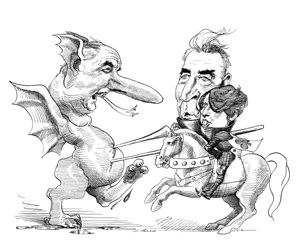
On January 11, 1968, John Gerassi, well-known as a militant opponent of the war in Vietnam, was dismissed from the faculty of San Francisco State College where he held the post of Visiting Lecturer in International Relations. As Acting Chairman of the Department of International Relations, I had joined with the other tenured members of the department in recommending his dismissal.
The firing of a professor is a serious matter which always sends shock-waves through the academic community. This case was especially upsetting, not only because it raised important questions about academic freedom, but because it was falsely linked with the issue of racism and with campus protest against the war in Vietnam. The events which led to the dismissal caused the college to be temporarily closed down, seriously damaged faculty and student morale, and increased right-wing political pressures on the college administration.
Interest in the Gerassi case is found not only among those who want to know why he was fired, but from many who wonder why he was hired in the first place. He was hired because the Department of International Relations wanted a Latin American specialist who would contribute to its efforts to build courses that are relevant to current international events, and who would not shrink from confronting the difficult intellectual and moral problems raised by American policy in Latin America.
Gerassi had wide experience in Latin America, had been an editor of Newsweek magazine, and had written a book called The Great Fear in Latin America which had been used in the department and found valuable. Gerassi has an M.A. in philosophy from Columbia, speaks fluent French and Spanish, taught at the New School, at Windham College, and was an Assistant Professor of Journalism at NYU when we invited him to come to San Francisco. He had published articles in The New York Review, Book Week, Commonweal, and Esquire, and he was Latin American Editor of Ramparts magazine. We checked with academic colleagues who knew him and they responded favorably, so we offered him a one-year appointment, which he accepted.
The members of the department were in general aware of Gerassi’s political views as they had been expressed in his articles and in The Great Fear. The latter was a critique of American policy in Latin America and a plea for “a policy of reconquest” of the area “with the arms of a new and lasting friendship.” It was critical of American economic exploitation and military intervention. It advised the United States to support Latin American nationalism or face the growth of Communism. We knew that Gerassi opposed the war in Vietnam, was sympathetic to the Cuban revolution, and believed that armed struggle was the only way that Latin America could free itself from United States domination. While these views were not shared by all of us, and were vigorously opposed by at least one, we thought they would enliven the dialogue among faculty and students and precipitate controversy of educational value. We had had similar aims when we sought and hired an extremely conservative colleague the previous year. In making our decision, we looked upon Gerassi as a “high-risk, high-gain” person, a term used by the Peace Corps to describe the livelier volunteers. Six members of the department, including myself, voted for the appointment; only one thought it was a bad risk.
By the time Gerassi arrived in San Francisco, his views had moved considerably beyond those expressed in The Great Fear. Between May, when we hired him, and September, when he began work, he had visited Cuba and had attended the OLAS conference. That meeting was also attended by Stokely Carmichael, who was lionized by the Cubans as an authentic American revolutionary. Gerassi returned fired up with revolutionary fervor and entranced by the romanticism surrounding Fidel, Che Guevara, and Régis Debray. In a formal lecture, sponsored by the International Relations Department, he told an enthusiastic student audience:
What it means…for the individual that goes to Cuba—what it means for an individual American that goes to Cuba—and sees the committedness, and sees the strength, and sees, therefore, because of that committedness, the incredible freedom, as I said, the complete and total relaxation of any kind of repressive measures, the lack of police, the lack of check-ups, the lack of all these things, because the youth is committed, and when you have the youth committed you don’t need it anyway; even from a practical point of view, there’s no need for any of it. When you see all that, and you consider yourself radical, or you consider yourself revolutionary, and you realize that it’s true that the example sets the tone; the example is what influences people—not the talk; not the theory; not even the writing of the books—ultimately it’s the example. You go to Cuba. Cuba, without trying to be nasty to you, puts you right on the spot. It makes you at all times while you are visiting there say “and what are you? Because if you’re a revolutionary, then put up or shut up!”
Gerassi’s revolutionary romanticism came to the campus at a time when it could have maximum impact. The Students for a Democratic Society were circulating nationwide an article by its Inter-Organizational Secretary, Carl Davidson, entitled “Toward Institutional Resistance.” Davidson described the American university as a “‘knowledge factory’ adjunct to the multinational corporations of American capitalism.” He said that “the social order we are rebelling against is totalitarian, manipulative, repressive, and anti-democratic. Furthermore, within this order of domination, to respect and operate within the realm of bourgeois civil liberties is to remain enslaved, since the legal apparatus is designed to sustain the dominant order, containing potential forces for change within its pre-established and ultimately castrating confines. As a result, it is the duty of a revolutionary not only to be intolerant of, but to actually suppress the anti-democratic activities of the dominant order.”
Advertisement
John Gerassi had returned from Cuba with its “incredible freedom” and “complete and total relaxation of any kind of repressive measures,” ready to do battle with the American Establishment. He gave an interview to the campus newspaper, Open Process, which was published on October 27: “The whole educational system in this country,” he said, “is really part of the Establishment, and it has to be challenged and confronted just as much as the military…. Of course, the risk involved is great. If you really accept this—if you’re going to have that kind of confrontation on campus—it means you’re risking bringing the whole thing to a standstill. But is that so bad?”
IN THE SAME INTERVIEW, Gerassi discussed the free speech issue that had arisen in connection with war recruiters. “You don’t have freedom of speech in this country with regard to whether you go fight or whether you don’t want to go fight…. You don’t have freedom of speech about the system under which you live. It can’t even be considered whether General Motors should be nationalized…. There is no free speech objectively. They have the loudspeakers. Let’s face it—we don’t.”
If Gerassi meant by this that minority opinion in the United States has less access to the mass media than majority opinion, then it would be hard to disagree with him. But the language he used is difficult to square with a statement he made elsewhere in the interview. “Any individual,” he said, “can get up and say what he wants to in this country and openly advocate sedition and have nothing happen to him, or at worse have to settle for a $50 honorarium instead of a $500 one.” He implied that a little repression would be a good thing because it would unite the Left. Unfortunately, as his post-suspension interview with Elsa Thompson of Pacifica Radio revealed, San Francisco State College had not produced that oppression:
THOMPSON: When you were invited to come to San Francisco State, both Marshall Windmiller and the other people involved in okaying your appointment were in fact thoroughly familiar with your background?
GERASSI: Oh, yes, they used my book, The Great Fear in Latin America, and have used it for a couple years right in the Center.
THOMPSON: And since you have been at San Francisco State, until this difficulty which has arisen within the last few days, has there in fact been any interference in anything you wanted to do with your students or with what you had to say in the classroom?
GERASSI: Well, I’ve been suspended.
THOMPSON: Yes, I understand that now…
GERASSI: Oh, prior…
THOMPSON: Yes…prior to…
GERASSI: No, none at all…
THOMPSON:…you were allowed—you were in fact doing what you wanted to do at San Francisco…
GERASSI: Exactly.
THOMPSON: Then really, insofar as one can tell, this suspension is in fact hinged around the events of the past few days.
GERASSI: That’s right, and in a way, if I may say so, I consider it really very unfair, not to me, but to my students.
The reason given by Gerassi for the suspension was correct. It, and the dismissal which it preceded, were both based on his actions on December 6, not on his teaching or other activities.
December 6 was the day when long-simmering campus tensions exploded. The tensions had many causes, but they were focused on the action of College President John Summerskill in suspending two groups of students. The first were nine black students who had allegedly beaten up the editor of the student newspaper, The Gater. (The paper had a history of insensitivity to the concerns of black students, and had published a column on world heavyweight champion Mohammed Ali which had racist overtones.) A subsequent hearing resulted in the lifting of five suspensions, but four remained in effect.
Advertisement
The other suspensions were directed against the white editor and a columnist for another campus paper, Open Process, for publishing a poem which described a bizarre act of masturbation in four-letter words and which the poet dedicated to a member of the faculty. When the ACLU threatened Summerskill with a lawsuit over the Open Process suspensions, he consulted attorneys, discovered he was on weak ground, and lifted the suspensions. The black students, who claimed that their due process and been impaired by the prehearing suspensions, then demanded that the four suspended black students also be reinstated. The two cases were not parallel, however, for violence had occurred in the black student affair and the student editor had been hospitalized. According to the ACLU News, the AGLU Staff Counsel told Summerskill that “considerations of immediate personal violence to members of the academic community might allow suspensions and expulsions before a hearing, but that the Open Process matter was not such an emergency.”
Summerskill refused to lift the suspension of the black students. Whether his decision was wise or not is debatable, but it was certainly legal and within the requirements of due process. The black students, however, attributed it to racism, and began to organize a confrontation. They were supported by the Progressive Labor Party, Students for a Democratic Society, and members of the Open Process staff. The white radicals organized the Movement Against Political Suspensions (MAPS) to join the Black Students Union in confronting Summerskill. Leaflets were issued that called him a “liberal racist” and compared San Francisco State with Mississippi.
It was on this basis that the BSU and MAPS planned for a demonstration on December 6. Jimmy Garrett, a BSU leader, said he would bring in 5,000 off-campus blacks. While some MAPS people said there would be no violence, the rhetoric of many suggested otherwise.
George Murray, a BSU member and part-time English instructor, was quoted by the Gater as telling a rally: “We must defend our rights by any means necessary, which means closing the school.”* Jimmy Garrett said: “If you are serious, then you had better act in a serious manner. That act should be in the fullest extent—close down the Ad building if you are serious. You should have no hassle about tearing it up.”
This was the kind of rhetoric that preceded December 6. It had been accompanied by rumors and fairly reliable information that some of the black students were armed with handguns. At the same time, some of the white athletes were spoiling for a fight. The administration and the faculty were greatly alarmed, for the situation had considerable potential for violence.
The events of December 6 began with a rally on the free speech platform 100 yards from the administration building. Gerassi was one of the speakers, as he had been on several previous occasions. Word reached the rally that Summerskill, fearing violence, had locked up the administration building. Some of the student speakers called it a victory. “It is a victory,” Gerassi told the rally, “no doubt about it. But I say it is not enough. Either we have to keep it closed down permanently or we have to go in.”
The rally subsequently moved across the lawn and approached the locked administration building. “The first act of violence,” Gerassi later told the San Francisco Chronicle, “was in locking the door against us. What we did was an act of self-defense and self-expression.” Gerassi expressed himself by boosting a student through an open window and then climbing in himself. As he described it in the December 23 National Guardian:
Someone spotted an open window. A student and I pulled ourselves up and we went in. My objective was to reach the door and unlock it but I was stopped by security guards. By the time I freed myself from them, students had smashed the main glass doors and had started streaming in. As we embraced on the inside, I realized they were all shaking. They were scared. They knew there were hundreds of cops nearly…. They came in anyway, willing to risk their way of life. They had become radical.
The Examiner next day carried a poignant photo of Gerassi standing at the shattered doorway extending a warm abrazo to a girl who was wearing an old army shirt complete with First Cavalry shoulder patch. It was the Moncada Barracks, the Sierra Maestra, and the battle of Santa Clara all together, with the liberal Summerskill presumably playing Batista.
If the students were “willing to risk their way of life,” as Gerassi asserts, what did he think that he was risking? Elsa Thompson raised this question in the Pacifica Radio interview:
THOMPSON:…I assume that you are not sufficiently naive so that you thought that this was going to be with impunity.
GERASSI: No, I realized of course that immediately a hearing would be set up, and as far as I am concerned personally, now, as a result of that hearing we could really begin to talk about the real causes for the unrest in general. They can get rid of me, they can rid themselves of other student leaders, they can get rid of Black Student Union leaders, the unrest will continue unless the causes are coped with in some way, tackled. I hoped, number one, that to a certain extent attention would be focused on me, and therefore there would be no reprisals against the students. That’s why I felt that as soon as I noticed that the students were going to go in no matter what, that I should immediately go in myself….
Whether Gerassi went into the building to help carry out his own instructions at the rally—that is, go in or close it down permanently—or whether he went in to sacrifice himself for the sake of the students as he told Elsa Thompson, is of psychological interest only. The fact is that he did go in and he expected to get in trouble for it. In so doing, he contributed to a dangerous situation which could have resulted in tragedy. By the end of the day several people had been roughed up, the bookstore had been entered, merchandise stolen and a small fire started, some classes had been invaded and dispersed by black students threatening violence, and the second floor of the administration building was ransacked. Summerskill remained cool, cancelled all classes, but didn’t call the uniformed police. It was an act of courage which may have saved lives.
Gerassi saw his own actions on December 6 as a great contribution to education, “much more beneficial than a year’s worth of classes,” he told Elsa Thompson. In the sense that a man who contracts cholera learns something profound about tropical disease, Gerassi may be right. But there are other questions.
Not long ago the college learned that one of its professors had passed around a marijuana cigarette to the students in his classroom. Like Gerassi, he believed that he was educating them, but his method made them technically liable to prosecution for a felony. Both men had used their professorial authority to encourage students to do things which might result in injury or jail sentences. Are such “pedagogical techniques” protected by academic freedom? Can a publicly financed college which wants to continue in operation retain such professors on its staff? It seems to me as a professional educator that the answer to both these questions is obviously no.
THE HIRING, RETENTION, AND TENURE (HRT) Committee of the Department of International Relations met on December 7 to consider what to do about Gerassi. They heard his side of the story, and then recommended to the President that he be suspended for thirty days with pay and charged with “unprofessional conduct,” an offense listed in the state education code as grounds for dismissal. An ad hoc committee of faculty members was appointed by the Academic Senate to make a recommendation. Its four members concluded unanimously that Gerassi’s conduct was unprofessional, but, in the words of the official announcement, the committee “was evenly divided in its recommendations to the President concerning disciplinary action.” All four tenured members of the International Relations Department, including myself, wrote the President recommending dismissal. Gerassi was fired, but before it was over faculty members and administration were forced to endure numerous meetings, conferences, and phone calls, as well as malicious propaganda attacks and threats to personal safety. It was not a pleasant experience, but there are certain issues that are illuminated by it.
A writer in the January issue of The Movement, an SDS and SNCC affiliated paper in San Francisco, described San Francisco State College as “generally more liberal than others.” “For a public supported school,” he said, “the college has been amazingly creative in its attitudes toward education and the role of the college in relation to the rest of society. Educational and political experimentation has been the rule rather than the exception over the past few years.”
If this is true, as I believe it is, then what measures should responsible professors take to protect such an institution from student militants and men like Gerassi who, wrapping themselves in the banners of racial justice and opposition to the Vietnam war, attempt to tear it apart? It seems to me clear that so long as there is war against Vietnam but no real war on poverty and racial injustice, educators will increasingly encounter the dilemma of choosing between calling the cops and seeing their institutions destroyed.
Some portent is contained in the article which the anti-war leader and former student, Jerry Rubin, wrote for the February 2-8, 1968, Berkeley Barb:
…I think the thing to do is to get a traveling yippee guerrilla theater band roaring through college campuses burning books, burning degrees and exams, burning school records, busting up classrooms, and freeing our brothers from the prison of the university. We’ll probably get beat up or arrested, because physical force is the final protector of law and authority in the classroom. The universities cannot be reformed. They must be abandoned or closed down. They should be used as bases for actions against society, but never taken seriously. The professors have nothing to teach; we learn in action confronting America. We can learn more from any jail than we can from any university.
The complicity of some universities with the military-industrial complex is a scandal that cries out for reform of the academy, but not its liquidation. If the colleges, with all their faults, keep alive some respect for reasoned discourse, afford some opportunity for the development of new political leadership, provide a base from which constructive work can be undertaken, as many of them do, then I believe they should be protected. Protecting them will not be painless, and it will expose the defenders to attacks as fascists, finks, racists, and warmongers. It will also cause those who believe in student protest and who oppose the war and racial injustice many agonizing hours of self-doubt as they wonder whether they have somehow gotten themselves aligned with the forces of the status quo. But there is no escape from this unless they are willing to allow the most insane and suicidal students to set the style of political deportment.
ANOTHER FACTOR illuminated by the travail of San Francisco State College is the extent to which the ethical and semantic environment fomented by Lyndon Johnson has corrupted even those who oppose his policies. Johnson’s misuse of the authority of his high office has rendered all authority illegitimate in the eyes of many young people, and his misuse of words (“unconditional discussions,” etc.) for purposes of deception has made it seem less outrageous for a college professor to refer to the locking of a door as an “act of violence,” or a black student leader to say that white people “are not part of humanity.”
The issue of Open Process for which the two students were suspended bore a cover which carried the thrice-repeated headline, “Beauty Is a Defiance of Authority,” and the poem which caused all the trouble was introduced by the author with these words: “Just to be inconsistent, I guess I’ll break my pledge against writing about sex.” If the President of the United States cares nothing about his pledges to the American electorate concerning Vietnam, does he set an example that influences the attitude of a student toward pledges he has made? And who is to say that the Johnsonian example is not also in some measure responsible for the ethical posture of John Gerassi, who on the one hand says that the Peace Corps is an instrument of American imperialism but on the other hires himself out to it as a consultant during the period of his suspension? If it is true, as Gerassi says, that “the example sets the tone; the example is what influences people,” then professors must be especially careful if they are to teach the young not to emulate the unethical example of Lyndon Johnson.
One of the components of the troubles at San Francisco State was the issue of “student power.” It is an issue which has legitimate origins in student rebellion against unfair and authoritarian controls existing on some campuses, and resentment against the depersonalized, assemblyline character of much higher education. While this feeling tends to be concentrated among New Left groups, it is shared by enough other students to cause a polarization of students and faculty on some campuses into two hostile camps. This did not appear to be happening at San Francisco State until the fall of 1967, when it seemed to be related to the issue of authority.
The faculty member is inevitably an authority figure. I mean this not in the psychological sense, but in the educational and legal sense. He derives his authority from his superior knowledge of the subject matter he teaches and from the institution which requires him to allocate grades and serve on committees that decide on scholarships, curriculum, and many other matters affecting the students’ academic careers. The inseparable companion of authority is responsibility. The faculty member has the authority to reward the student with good grades and letters of recommendation. He also has the responsibility to preserve the integrity of the institution by identifying and giving poor grades to those students who lack the ability or the initiative to do competent work.
Although there is a great deal of controversy about grades, in most institutions the professor is required to evaluate the performance of each of his students. It is always a painful process, for it invariably involves telling some students that they did less well than others. Many a professor has perceived a marked change in his rapport with a class immediately after the announcement of the midterm grades. The experience can be painful for student and professor alike. It is not surprising that there are many who would like to abolish the entire grading system.
One explanation of Gerassi’s popularity with his students was his understanding of their attitudes on this question. “My feeling,” he told Pacifica Radio, “has always been that a teacher must not separate himself from his students. There must be a relationship that’s direct. I must learn from them, and they must learn from me. And, as far as experience is concerned, they are perfectly my equal. Their experiences are just as meaningful for them as my experiences are meaningful for me. And if I’ve lived maybe five years more than they have [Gerassi is thirty-six], that doesn’t make me superior in any way.”
While there can be no quarrel with the assertion that the experiences of students are just as meaningful for them as those of faculty members are for them, the notion that a student is “perfectly my equal” and that the professor is not “superior in any way” requires more careful consideration. It received such consideration by the Study Commission on University Governance composed of students and faculty of the University of California, Berkeley. Their scholarly report, published in January, makes a persuasive case for increased student participation in all aspects of the governance of the university, and I am in general agreement with it. On educational policy matters, where the Commission felt that professional judgment is critical, the report pointed out that “by comparison with faculty and administrators, students are substantially disadvantaged in experience, professional judgment, and longterm responsibility to the institution.” But while granting authority to faculty and administrators in matters of educational policy, the report correctly cautioned against using this authority in other areas. “We think students today distinguish,” the report said, “intuitively at least, between the natural authority which stems from scholarship and the misuse of authority which stems from status. One cannot expect academic status of administrators or the claims of academic or administrative expertise to provide legitimacy for decisions in such areas as lock-out hours for a dormitory, the penalty for stealing a book from the library, or the size of a political poster allowed to be displayed on a plaza or bulletin board.”
But the question arises: if it is improper to use the authority which stems from scholarship to give legitimacy to decisions on lock-out hours, etc., is it not also improper to use that authority to give legitimacy to violent methods of protest on the campus? And when a professor who is a specialist on revolution tells an audience of students that they should close down the administration building, do all the students, intuitively or otherwise, dissociate the professor from the status he possesses? The Gerassi case provides little hard evidence on these difficult questions, for he declined to exercise the normal responsibility of academic authority. For example, he gave all his students “A’S.” In style, dress, associations, and deportment he made it clear that he regarded the students, and not the faculty, as his peer group. This may explain why his dismissal has caused concern primarily among students, and why no faculty defense committee was formed in his behalf.
While authoritarianism is as inimical to the academy as it is to democracy and must certainly be resisted, there can be no lasting social or political organization without some form of authority. It is one of the aspects of the unhealthy state of the American society that all authority is losing its legitimacy in the eyes of many young people. The way to restore society to health, however, is not simply to assert the importance of authority or merely to back it up with overwhelming force, although force at times may be necessary. The re-establishment of respected authority on college campuses requires something more. It requires the restoration of legitimacy, and that may not be possible as long as there is so little confidence in the integrity and legitimacy of the national government. So long as the Vietnam war continues, so long as young students must confront the terrible dilemmas caused by the draft, so long as some universities and many professors support the war or remain indifferent to it, it will be hard to arrest the disintegration of morale and the feeling of despair that gives rise to phenomena like John Gerassi.
One of the great ironies involved in the spread of the mindless notion that “Beauty Is a Defiance of Authority” is that it will hurt the student antiwar movement as much as it hurts the universities, for it breeds a mood in which the movement itself can have no authority—neither the authority of leadership nor the authority of ideology. Without authority the movement will have no structure or discipline, and without discipline its effectiveness will be ephemeral.
Department of International Relations
San Francisco State College
San Francisco
John Gerassi replies:
Professor Marshall Windmiller is a liberal, and like all liberals, he has problems reconciling his basic faith in the American system and his undoubtedly genuine revulsion at the crimes perpetrated by that system. As long as the battleground is outside academia, he can remain on the moral offensive—verbally—and condemn the war in Vietnam, the invasion of Santo Domingo, the Congo massacres, even racism in Oakland, Detroit, and Mississippi.
When, however, the battleground narrows onto the soft green commons below his academic window, the contradictions inevitably must reveal themselves. To soften them to his own conscience and to try to conceal them from his academic peers, he must wage an attack laden with “academic objectivity”—quotes out of context, innuendoes by association, even personal diatribes and attempts at character assassination. Thus, the real issue of the responsibility of the academic intellectual who profits from a system he would like to condemn becomes blurred by irrelevant arguments and statements. And, in this case, it forces me to counter these statements. But I shall broaden my case so as to draw more universal lessons from it.
Windmiller’s contention is that the academic dissenter should play a passive role on campus, limiting his dissent to legal opposition off campus. As a correlary he must defend the proposition that on campus the teacher should stick to teaching, and counseling students according to their individual scholarly (and, it turns out, career, i.e., employment) needs. To maintain this position, he must then differentiate between education and propaganda, and insist that anyone who propagandizes, who plays an active role in dissent on the campus, must be fired. Since this would lead him, were he to be consistent, to advocating the end of academic freedom (with officials having to check up on teachers in their classrooms and the ensuing witch-hunts), and since he personally played the principal role in my being fired, he must justify his position by contending that taking an active part in dissent on campus, as I did, necessarily leads to violence. The outside world is violent, he says, but the university must not be. The only way to accomplish this separation is to turn the academy into a sanctuary. And that can only be achieved by keeping all dissent passive.
My argument is that students are not bracketed off from the world when they are on campus, and neither should be teachers; that the academy produces the cogs which will keep our society violent precisely because the academy is a crucial institution in the fostering and strengthening of our system; and that this system is violent by its very nature. I further insist that the responsibility of teachers should be to the students and not to the administration or to some abstract concept of what the academy ought to be. That such responsibility entails the awareness that unless the system-academy is constantly challenged the average student graduated by it will inevitably end up fortifying the system and hence help increase violence. That, therefore, the politically aware teacher must play an active role in dissent, must confront the system at all levels and most specifically on campus—in the classroom, at the war recruiters’ booths, in the academic senates, in faculty meetings and so on. He must fight grade regulations, curriculum standards, administration edicts, entrance discriminations, as well as the arbitrary power of the trustees. Wherever and whenever the student demands involve not only campus restrictions but also their opposition to the system “outside,” it is the duty of that teacher to join the students in militant action—even at the risk of losing his job. What should guide that teacher in evaluating the risk is not abstract concepts but his own effectiveness (and that, inevitably, will sometimes lead to miscalculations) in contributing to the destruction of the violent system as a whole.
I further believe that those “dissenting” academicians who do not take such risks do so only because they do not want to lose their jobs, no matter how they rationalize it. For example, it is absolutely clear to me that Professor Windmiller saw a direct threat to his leadership status in the events at State. And so did all “faculty-ized” liberal faculty members. For so long as dissent is restricted to a passive verbal level, such “dissenters” as Windmiller can remain in the forefront. The events destroyed that. Hence in his article, Windmiller must try to discredit me personally.
LET ME POINT OUT, first, that Windmiller was fully aware of my political position long before I was “fired up,” as he says, by my trip to Cuba. In April, 1967, shortly after my return from North Vietnam, I spoke at San Francisco State College. Windmiller was in attendance when I described that trip and when I concluded by saying that genuine American patriots must not just be opposed to the War in Vietnam, but must work for the downfall of American imperialism even if this means joining international brigades should the Vietnamese request them. It was after that speaking tour that I was offered the job at San Francisco State, and I shall explain why in a moment.
(Incidentally, why does Windmiller stress the fact that also in attendance at the OLAS meeting was Stokely Carmichael, “who was lionized by the Cubans as an authentic American revolutionary,” and not the fact that correspondents from The Washington Post, Look, Life, The New York Review of Books, etc., were also present? Is he trying to associate me with Stokely and thus discredit me to New York Review readers who, by and large, tend to consider Stokely irresponsible? If so, fine, since there are very few men in America whom I respect more than him. But what relevance does this have to the issue at hand?)
Next, Windmiller quotes a long passage from an extemporaneous speech that I delivered on Cuba, in which I insisted that there was “incredible freedom” there. Of course, he does not mention the fact that I was talking about meaningful freedom, by which I clearly meant that in Cuba today criticism is seriously considered at the highest official levels, which is not the case in America. And that is so: there is nothing that Fidel and the other Cuban leaders take more seriously, debate more profoundly than the constructive criticism of the young. But again, what relevance does this have to the issue of protest on the campus?
Be that as it may, I did say and I do say that the power structure in America does profit from the kind of dissent that liberals like to voice; it reinforces the myth that America is an open society. That is why the Establishment (if not Johnson) encourages people like Windmiller to condemn the War in Vietnam on Pacifica radio stations. And that is why people like me are paid honorariums to address Establishment academic gatherings. So long as all we do is talk, we reinforce the myth. We thus function as cogs in the over-all structure, which, as everybody knows, defends freedom “at home and abroad.”
Windmiller then uses an exchange between radio interviewer Elsa Knight Thompson and me to claim that I admit that I was fired only for my activity in the demonstration of December 6. Please read that passage again. I made no such admission. I did say, correctly, that I was not suspended (now fired) for my teaching, but where “other activities” creeps in is puzzling. On the contrary, it is my conviction that I was fired for all my non-teaching activities. In fact, prior to December 6, Windmiller himself warned me that if I wanted to be rehired next year I should keep my political activities off-campus and should be “around” more often with my “peers,” i.e. fellow faculty members, not students. I point out these details because they are not characteristic only of Windmiller, but are typical of the academic mind.
In this respect, I must relate the following. During the October 16-21 Stop-the-Draft-Week confrontation at Oakland, two San Francisco State professors were arrested. Their names were listed in the local newspapers. At State, their pay was docked for their absences. I was also at Oakland, but was not arrested (nor were twenty-odd other San Francisco State teachers from other departments). My pay, however, was also docked. Why? Because Windmiller, who knew that I was at Oakland, reported it to the appropriate authorities “in the name of fairness.” Windmiller then explained that “members of the Department, including myself, who support the Anti-War Movement, then contributed to a fund designed to make up the financial loss to the faculty members involved.”
This, to me, is very revealing of the Liberal’s purism—and that is why I mention it. The Liberal believes in following the letter of the laws and regulations of a system he criticizes as unjust (which, hence, presumably enacts unjust laws and regulations), even to the extent of becoming its policeman or informer, and then tries to buy back justification to soothe his conscience. I know that most academics will approve of this highly—and that position, to me, is symptomatic of academic liberals’ inability to participate in the destruction of that injustice we all recognize.
The list of logical fallacies, motivated by the Liberal’s obsession with keeping his cause pure and his hands clean, is endless. Take, for example, this Windmiller statement: “When the ACLU threatened Summerskill with a lawsuit over the Open Process suspension, he consulted attorneys, discovered he was on weak ground, and lifted the suspension.” The implications of this apparently do not shock him. That Summerskill should have such arbitrary power in the first place is not even questioned.
And so on! There’s Windmiller’s attempt to discredit the Black Student Union leaders, Jimmy Garrett and George Murray, by quoting passages appearing in the Gater (which he admits was racist) and the Examiner (which is a Hearst scandal sheet) when both Garrett and Murray deny those statements (and Windmiller himself has often been outraged by the Gater’s inaccuracy in reporting his own statements); there’s that absurd reference to the army clothes worn by one demonstrator when Windmiller knows full well that many poor students wear such second-hand garb because it is cheap and lasting; there’s that outright distortion that the four-man committee of my peers hearing my case “was evenly divided in its recommendations…” when their official report said that three members “recommend that the suspension of Mr. Gerassi be lifted immediately,” while one recommended that I be dismissed.
Windmiller’s concern over my “ethical posture,” which is put into question because I spoke to Peace Corpsmen, is central to his case. Though meant to discredit me, it is an important issue since it reveals again the Liberals’ purism. Windmiller, who used to think the Peace Corps was “one of the most hopeful creations of the twentieth century” and a possible “instrument of change and enlightenment,” now has second thoughts. Under Johnson and Peace Corps Director Jack Vaughn, Windmiller says, it has become “not a revolutionary organization, but a counter-revolution organization. It is the advanced guard of the Marines—counter-insurgency in a velvet glove. Young people who sincerely want to see progressive change in the world would be best advised to stay out of it. The places where their efforts are really needed are right here at home.”
But how do you get those young people to stay “here at home?” You talk to them. Before they join? Yes, says Windmiller. After they join? No, says Windmiller. Why? Because to talk to them at their training camps means to become a paid consultant, accepting their dirty money. No matter how many crimes he could prevent by accepting such money, a good Liberal (one who never did accept CIA funds) must never do so. And yet the Movement is full of Peace Corps drop-outs. Why did they quit? Because radicals, people who are more concerned about stopping the crimes than accepting “dirty money,” people like Saul Landau, James O’Connor, Timothy Harding, and so forth, went to the Corps camps, sought out those volunteers who wanted to see progressive changes, and explained to them why there can never be meaningful changes in the underdeveloped world until the country that exploits that world is itself changed—the USA. To Liberals, neither the people of the underdeveloped world not the flesh-and-blood idealistic youths who join the Peace Corps really matter. What does matter, as Windmiller honestly says, is their own ethical posture.
This concern with abstract morality has peculiar consequences. Before December 6, for example, the students and faculty members of the International Relations Department met to discuss “important issues.” Some students presented this petition:
We, the undersigned, believe that the present administration by engaging in an unjust and illegal war has lost the right to represent us.
We feel that a condition of crisis exists and that the present policy of aggression in Vietnam constitutes a threat to national security by undermining our democratic values.
We believe that officials of the Department of Defense, Department of State, the Central Intelligence Agency, and the United States Information Agency are subversive who are acting against the interest of the American people by supporting the war.
Therefore, we ask that the Department of International Relations inform any officials of the above agencies who wish to speak in this department that they are not welcome until American involvement in the War in Vietnam is ended.
A vast majority of International Relations students present approved this petition. So did all department teachers, save two. One opposed it. The other, Windmiller, abstained, explaining in a long monologue that he could not vote in favor of the petition so long as any student sought his help in obtaining a job from these Federal agencies; he could not take the responsibility of stopping him from doing so, he said, He had to be open to all students. In other words, his argument was that if some student asks him how best can he go about killing Vietnamese, he considers it his duty, so long as he teaches International Relations, to give him such advice, even if he thinks the war is immoral.
WELL, WHAT DID HAPPEN at San Francisco State on December 6 and why? In the first place it is not true that the college is radical. In a lengthy and highly documented article, published both in Open Process (January 10, 1968) and in the Mid-Peninsula Observer (January 22-February 5, 1968), Professors Anatole Anton (Philosophy) and Richard Fitzgerald (History) insist that San Francisco State, “far from being a citadel of freedom, sorely reflects the complete capitulation of the academy in the United States to industry and government. In addition, its internal structure reflects the undemocratic paternal nature of outside American society, displaying no more than a shred of commitment to liberal values.”
And even if it once was radical (due to its student body, not its staff), it no longer is. As Professor Rudolf H. Weingartner, in his January 15, 1968 letter of resignation as Chairman of the Philosophy Department (he subsequently quit altogether), complained:
…the San Francisco State administration is rapidly becoming a “team” with an interest of its own. It is shaping itself into a technocracy that is rapidly losing touch with the best creative impulses in the faculty and the student body. The administration now is coming to serve the “silent majority” of the faculty for the sake of quiet and order…. Instead of being a bulwark against the desires of politicians, outside pressures have made out of our own administration a funnel as well…. Throughout this, the faculty has remained supine. It has been unable to deal with the pressures from the outside, nor does it seem able to face the demands of student groups on campus. The power has shifted from the faculty (whose grasp was never firm) to an administration intent upon keeping the wheels turning smoothly. I have no doubt that law and order will soon be restored; I only doubt that there will be a College in San Francisco, rather than merely a branch of the System.
It was precisely to offset this new image of reality that campus Liberals, including President Summerskill and Marshall Windmiller, had been shopping around for visible moves to offer as proof of their continuing liberalism. Thus did Windmiller hire me. Perhaps unconsciously, he saw in the act of bringing “a revolutionary” into his department a way of exhibiting, mostly to himself, the sincerity of his “ethical posture.” The expectation, of course, was that I would keep my “revolutionary” activity off campus.
But America’s youth can no longer be fooled by gestures. They judge institutions by their actions, and San Francisco State—by its racist daily newspaper (the Gater was controlled by the Journalism Department), by its policy of allowing war recruiters, Dow Chemical, ROTC, the CIA and so forth, on campus, by the simple statistical fact that fewer blacks were registered this year than last—was constantly proving itself to be a typical American institution. Liberals at State could well talk about their relatively free Experimental College, just as Washington Liberals talk about their War on Poverty; the fact is that life on campus was and is a microcosm of life in America.
LIKE ANY OTHER COLLEGE, State has a Business Administration School, but no Union Administration School, no Community Organizing School, no student court of appeals, no student board of supervisors on curricula, teachers or administrators, no student policy board, etc. In other words, students at San Francisco State, as on any other campus, are forced either to leave or adapt to the standards and policies of their elders, whose values they no longer respect. And when teachers take their side, teachers such as Dr. Juan Martinez, a Mexican-American who sided with the Black Students Union, or Richard Fitzgerald, who offered to sponsor BSU courses in the Experimental College, they are fired (in the case of Fitzgerald, the day after he had been rehired and taken his BSU stand; “a clerical mistake,” said the History Department).
The Administration at State, as in Washington, is authoritative and arbitrary. First it acts, against students or in the Gulf of Tonkin, then it offers vague explanations. And the System, with its elections every four years or a Free Speech area where any student can say what he feels, remains unaffected. For both the elections and the speeches are used to reinforce the System itself.
Against such domination, people inevitably, sooner or later, rebel. First the Vietnamese, then the Dominicans, then the blacks and finally the students. In the San Francisco area, this year, it began in earnest at Oakland during the October 16-21 Stop-the-Draft Week. On the first day the students were pacifists. On the second they were civil disobedients—and were beaten. On the third and fourth, they trained, planned, and learned. On the fifth, they fought—and held their own. They were jubilant and they were proud.
To campus liberals, this newly visible militancy became a threat. Brought back to campus, it could shatter their sinecures. Suppose the students understood that, as Professors Anton and Fitzgerald put it, “We simply do not have today (since the beginning, at least, of the cold war in 1945) the kinds of free choices to make that Windmiller assumes”? Suppose the students realize that American academia, for all its fostering of verbal dissent, is not a marketplace of ideas, but an essential institution in producing the cogs and technocrats and ideologues needed to run, justify and rationalize American imperialism? The Vietnamese know that their enemy is the American System, but to fight it they must stop ordinary soldiers. The blacks know that their enemy is the American System, but to fight it they must stop ordinary cops. Suppose the white students, who also realize that their enemy is the American System, concluded that to fight it they must confront their ordinary teachers, who, through liberal rhetoric about choices, pervert their goals and corrupt their ideals? It must not happen. Thus, to channel, sublimate, and co-opt their militancy, San Francisco State’s astute Liberals invented the Convocation.
A week-long affair in November, the Convocation was simply one mammoth bull session, run in academic orderliness. All teachers were requested to cancel their classes (with no dock in pay, naturally) so that students could all come to discuss the issues, in a neatly separated agenda. From the Convocation’s topics, resolutions were drawn and then put to a campus-wide vote. As expected, the keep-the-campus-open resolutions won. Thus Summerskill could now say—and he and campus liberals did say—that though the War was immoral, he was bound by the consensus: war recruiters would be invited on campus. It was like a German intellectual saying that though killing the Jews was immoral, the majority of Germans want to do so, hence my individual duty is to help. Strangely, the Liberals did not push their theory consistently: they did not say that since most white Americans are racists, it is their duty to encourage racism.
But to the black students at SF State, it was as if they had said it. Previously, on November 6, a group of them, fed up at the racist columns in the Gater, went to their immediate source, the Gater editor and staff (the ordinary soldier to the Vietnamese, the ordinary cop to the ghetto black) and a confrontation ensued. The editor was allegedly knocked out. Immediately, the campus liberals condemned the “violence,” and approved Summerskill’s suspensions of four black students involved in the incident. Windmiller agreed. The case of the Open Process suspensions and that of the blacks “were not parallel,” he says, “for violence had occurred in the black student affair.” This simply shows his inability to understand America. To whites, who do not suffer as directly as blacks, a put-down can be nothing more than censorship. But to the blacks, who suffer physically, psychologically, constantly and consistently from racism and its airect consequences—police repression and terror, unwarranted arrests and harassment, poverty and indignity—racist columns do constitute violence, for they reinforce, encourage, and broaden the physical and psychological oppressions. Thus, Windmiller and other liberals may call the BSU’s confrontation with the Gater editor “violence” if they wish; to the campus radicals, to the blacks and to me, their act was self-defense, perhaps a tactical mistake but as justifiable as a Vietnamese counter-attack or as Black Panther leader Huey Newton’s alleged gun-down of Oakland cops (which is probably a frame-up anyway).
To student radicals at State, the Convocation co-optation, the Gater incident, the reinstatement of the white staffers on Open Process, the firing of popular anti-war teachers, Oakland, the war recruiters, the War itself, the university’s role in that war, the lack of student voice in their own and in the college’s affairs were all interwoven. And the series of protest rallies which preceded December 6 directly related to all of them. But the students’ demands were specific: “(1) Drop the suspension of the six students [the four blacks and the two whites who had not yet been reinstated]; all trials in the future shall be conducted by a board of elected peers; (2) reinstate Open Process; (3) end political harassment of faculty, students, and administrators; (4) no outside police on campus; (5) student control of student affairs, specifically of student publications.”
These were reasonable demands. These were demands that liberals should have supported (and the American Federation of Teachers local did support them). These were demands continuously ignored by the administration (which publicly promised to enforce its rejection by threatening to call outside police if necessary). The demands amounted, perhaps, to a weak call for student power, and that was enough to be considered a threat to those on the faculty who view the academy as a sanctuary; for with even such a mild dose of power, the students, who do not live outside the nasty everyday world, would obviously bring it back onto the campus, from which it is now excluded.
Conversely, my support of these demands was also deemed a threat. Windmiller means just that when he says: “in style, dress, associations and deportment, he made it clear that he regarded the students and not the faculty as his peer group.” True enough, for I respect students, as a group, far more than the faculty-ized faculty (as opposed to the Antons, Fitzgeralds, Martinezes and other committed teachers). The reason is simple enough. The students genuinely try to understand the society in which they live. The teachers, however, try to justify it. The students have no awesome admiration for America’s institutions, nor do they profit from them. They are aware that those institutions lead to the criminal American foreign and internal repressive policies.
In any case, the students demands were not met. In fact, they were not even considered. Finally, a deadline was fixed: noon on December 6, or else the students would mill-in at the Administration Building. MAPS and BSU issued leaflet after leaflet calling for support, explaining their aims, promising a nonviolent demonstration. On December 6, as the noon hour approached, word came that the administration had sent most of its employees home—to avoid violence, it said—and had closed down the building. It was a lock-out.
I called it an act of violence. A factory look-out is considered an act of violence against workers. Why shouldn’t an Administration Building lock-out be considered an act of violence against students? Because liberal academics, who consider all university intellectual adults their peer group, look upon academia as belonging to them, not to students. Notice, for example, how Windmiller says that “educators will increasingly encounter the dilemma of choosing between calling the cops and seeing their institutions destroyed [italics mine].” Because of their financial, psychological, and political identification with the administration (and, therefore, the power structure), such academics necessarily end up viewing students as “the enemy.” Windmiller is intelligent enough to realize that this could lead to class distinctions, so instead he must create a weird relationship model of authority-respect-responsibility. But the result is a caste system.
Anyway, the students went in. So did I—through an open window. It did not take great courage for Summerskill not to call the uniformed police, waiting off campus—just shrewdness and an awareness of the dialectics of over-reaction. Meanwhile, as some students broke the glass doors to go in, others abandoned the cause. Respect for private property is hard to shake, even when that property is yours but is being used as a bastion against you. At stake, after all, is our whole American way of life, based on the greed of competition, evaluated in material possessions, justified by the concept of free enterprise, propagandized by the cult of the rich, ending in imperial domination.
Summerskill cooled it. With plainclothes police, photographers, reporters, TV cameramen, and a battery of administrators and “acceptable” faculty members on the inside, he simply waited. Of the 2,000 students who surrounded the Administration Building, only 300 went in. Not enough political work had been done, not enough of a base had been established. In that light, the student action was probably a mistake. I let the justness of the students’ cause carry me into losing my forum. I was suspended—not because I went in (other professors who felt strongly about the students’ demands had also gone in), not because a reactionary administration chose me as a scapegoat, but because Windmiller and other liberals in my department recommended that I be suspended. They did so as a warning to all other non-faculty-ized teachers not to dissent actively. Later, Liberal Summerskill signed criminal complaints against eleven students and against me. Were these eleven leaders in the demonstration? Had they perhaps been the ones who broke the door? No. They were radical student leaders: four members of Progressive Labor, the two co-chairmen of Students for a Democratic Society, members of the powerless student legislature, and Jimmy Garrett, the head of the BSU, who arrived at the Administration Building half an hour after it had been entered.
ON JANUARY 2, 1968, I had my hearing at San Francisco State. Windmiller testified, insisted that I be fired because I was a propagandist, not an educator. He was asked to define the difference. Propaganda leads to action, he said; education does not. And there is the crux of the liberals’ creed. Action must be avoided at all costs and the ethical posture of purity always maintained. (Although that too can be twisted, as when Windmiller made a formal request that my hearing be set aside on the grounds that it was open to students who, presumably, intimidated my hearers; but Summerskill, basing himself on the hearing chairman’s statement to him that “The Committee further recognizes that the ultimate decision must be yours,…”ignored the hearers’ 3 to 1 split in my favor and fired me anyway. Why the farce then? I was even billed for the transcript cost.)
What lessons are to be derived from all this? There are many. Radical students learned that a just cause cannot be explained and propagated just by rallies and leaflets; hard grass-roots work must precede action. Though talk of a base is often used in the Left, especially the old Left, as an excuse for inaction, and though it is often true that action itself can be an organizing tool, it is equally true that militant action without a strong base of support often results in failure.
Personally, I learned how easy it is to derive faulty consequences from accurate analysis; the only check against confusing objective and subjective conditions is to work within a collective. Such a collective might have reminded me that so long as the young continue to go to colleges, the role of the radical teacher is to work with them. Just as a radical must jump at the opportunity of politicizing Peace Corpsmen, so must he not sacrifice his possibility of politicizing students—unless the sacrifice itself leads to a major political breakthrough. Also, by its criticism, such a collective might have given me the distance necessary to deal with my own actions more objectively in print, in my National Guardian article which, though badly edited, repeated my mistake by stressing the faulty consequences rather than the accurate analysis.
Most important of all, however, was the students’ realization that they must never trust anyone who profits from the structure, even if he is objectively only a pawn. By analogy, therefore, many white radical students at State have now understood why black liberation leaders cannot and must not trust white radicals, for the white, by the simple fact of color, can survive and flourish materially within the white racist structure—unless, by his life-commitment, he is no longer reconcilable. That is why all talk of black-white alliances is just that—talk. Such alliances can exist only in practice, on the battlefield so to speak, and on the blacks’ terms. For, as blacks point out, they need a change, the whites only want one. That difference is crucial.
In academia, the analogy is between the liberal faculty-ized member and the radical student. The student needs a change to survive, not physically (though he faces death in Vietnam), but mentally, as he is. The teacher may like to see a change, but does not need it. On the contrary, he is really wary of changes lest they destroy his career, his sinecure, his rationale, his whole life-style. His objection to the system is that it is eating away at his authority, at his “legitimacy,” as Windmiller says. His concern is “to restore society to health.” What health? What garden of Eden? It is not just the restoration of the “legitimacy of the national government,” that liberals seek, but their own. Their world is meaningless without authority and they correctly understand that their authority is destroyed in a world based on collective humanism rather than on competition. This is implicit in Windmiller’s statement that giving of grades “is always a painful process, for it invariably involves telling some students that they did less well than others.” Only if that’s the way you think.
To others, who would not reject the system, a grade could mean telling the student how well he is doing, not in relation to others, but in relation to himself and his own potential. I tried an experiment this year: I told students they would all receive A’s and then asked them to do what they wanted—for themselves—whatever the course inspired them to really want to say. The result was revealing. Some didn’t do anything, true. But never before have I received such solid, thoughtful, meaningful work from not only registered students, but also auditors. Most illuminating, however, was the amount of work I received that was the product of a collective—including a twenty-page poem about Nicaraguan rebel “General of the People” Sandino, written by six students working together. Does it matter whether or not it was good? To Windmiller that’s all that would matter. To the future of mankind, what will matter will be the attitude of such students who can relate and correlate their egos to try to create together—that is if they are allowed to continue.
The American System cannot let them. For what would happen if such an attitude spread? Sooner or later workers would manage General Motors together, the distinction between foreman and lineman—a distinction imposed not by respect but by authority—would disappear, and then before you know it, there would be no academic department chairmen, no associate professors with tenure, holding literally life-power over instructors. No grades, no authority—except the authority willingly delegated because of respect earned not through knowledge and “objective” competitive accomplishments, but through the use of that knowledge in warmth and human consideration.
That is why the liberal, ingrained, faculty-ized academician has no choice but to defend the System as it is. He is no different than the conservative ingrained academician. He belongs to the same class, the sub-power-class.
Thus did liberals and social democrats, who have always talked of individual human values, inevitably betray these values when their own authority and that of their class were at stake. German social democrats voted for rearmament. Léon Blum stopped arms shipment to Spain. Guy Mollet shouted (February 9, 1956): “France will fight in Algeria and she will stay.” Two years later François Mitterand, now revered by American intellectuals as the greatest leader of France’s non-communist Left, added: “Algeria is France. From Flandres to the Congo, only one law, only one nation, only one parliament. That is the constitution and that is our will. The only negotiation is war.” A true inspiration to LBJ.
And here at home, American liberal intellectuals objected (usually privately) to Joe McCarthy’s tactics, not his goals. (Today they tell activists, as Henry Steele Commager points out in his eloquent New Republic article of February 24, 1968: “I may agree with you, but I disagree profoundly with the manner in which you say it.”) They heralded Diem. They praised the Alliance for Progress. Until Johnson took away its liberal rhetoric, they considered the Peace Corps “one of the most hopeful creations of the twentieth century.” They let America execute the Rosenbergs. They, the Liberals, the Harrimans, the Kennans, then the Schlesingers and Hilsmans, invented and propagated the whole Cold War. And now they will vote for Robert Kennedy—and make impotent speeches when the police of Oakland, Detroit, Carolina, and Newark unleash their systematic “final solution” to the black problem. Why? Because to do anything more than march, sit-in, and talk might challenge the whole “legitimacy”—and their own hard-earned authority.
And when their consciences cannot stand it anymore, when they can no longer claim that Vietnam, Detroit, Santo Domingo, Guatemala, the Congo, Brazil, etc., were inevitable but understandable mistakes of American “pluralism,” then, like Camus, their hero, perhaps a great writer but surely not a great man, they will withdraw even more into their search for the pure cause, putting down the activists’ mistakes (for all men who act do make mistakes) by concentrating their efforts on discrediting them—to placate their own frustrated consciences.
Finally, when the New Left will condemn them for supporting the whole System, with its legal machinery, its “free” press, its “right to dissent,” and, yes its educational apparatus, all designed, as Carl Davidson said, “to sustain the dominant order, containing potential forces for change within its pre-established, ultimately castrating, confines,” they will shout “romanticism” (heresy)—and resort to smears.
Academic liberals are the scholastics of the modern era, and like their medieval colleagues, the consequence of their actions in life is to keep God omnipotent. The only difference is that today God is Imperial America.
This Issue
April 11, 1968
This Issue
April 11, 1968
-
*
Murray was quoted by the San Francisco Examiner, December 13, 1967, as saying: “Black people cannot commit any crimes against white people . Anything we do to the ‘dog’ cannot be wrong . The only crimes we can commit are crimes against humanity. And white people aren’t part of humanity.” ↩