

I: EAU D’EVIAN
When I made the first incision [in the autopsy of a man who had drunk too much mineral water] the glitter of the stalactites in the poor fellow’s gastric cavity positively blinded me—I had to wear blue glasses for a month.
—George Meredith
NYR: It is a year since we heard from you, Mr. Stravinsky. You were recovering from an operation then.
I.S.: And allegedly still am. Meanwhile a crisis in another area was so portentously publicized that the sympathy mail has never ceased. The latest was a batch of letters from children in a Long Island school. “You’re a real cool guy,” one of the young correspondents said. “And if you feel like it you can write me back.” Another, foreseeing the boredom of the hospital but not that I would be watched to the point of harassment, advised me “to look at the nurses.” Still another, whose logical approach to morality was evidently suffering the first collision between what is and what ought to be, said he was “sorry a good composer like you is sick. P.S.: My father is a doctor.” And another, an incipient music critic probably, expressed the wish that I would “get better and compose another operetta.”
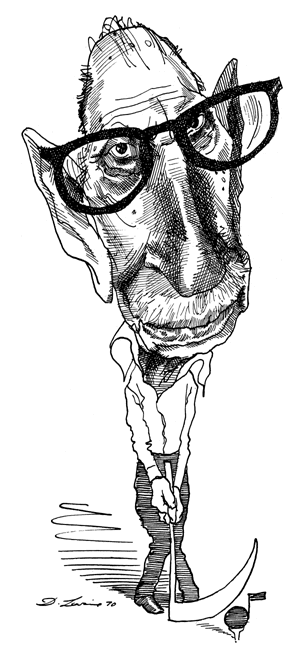
I am better, thank you. European friends said I seemed younger than when I was there two years ago—even if they were appraising the likelihood of events in the other direction. But at my age the compliment in “younger” depends on how much. A rejuvenation of eight decades, for example, would definitely be overdoing it.
NYR: Were you in Evian-les-Bains all summer?
I.S.: Evian-dans-la-pluie would be more like it. Except that “pluie” is too gentle. It is an elemental place, with storms dervishing down the lake almost every afternoon. Evian the town is another matter, a choice between a fast death in the casino and a slow one by mineral water. It is definitely not “where it’s at,” or ever likely to be, having kept pace with the times, in fact, only in that the lake is now polluted and the trout served mercury-poisoned à la carte. But perhaps even that is not so new. As early as 1400 the lakeside Château de Ripaille was renowned for distilling essences “contre les miasmes.”
NYR: Did you live near the lake?
I.S.: Just above it, in a hotel mainly for octogenarians. But in contrast to Auden’s friend in his “Old People’s Home,” none of the elderly guests was praying for a “speedy dormition,” I think, though possibly for a painless one. (Auden dislikes abeyances and as Director of the Voluntary Death Program would quickly clear out all God’s Waiting Room establishments.) In fact the only disease these venerables wanted to die of was more life. And, being French, more meals. Moribund as they might appear betweentimes, they would positively scamper into the restaurant, or be trundled there at a doubly fast lick. All of them ate like pregnant women, moreover, and though they invariably complained that the meat was “dure,” it almost invariably was, teething troubles apart. (Small wonder, in view of the time they devote to swallowing, that the French are virtually monoglottal; a larger wonder, to me, is the extent of their monarchism. Even the preferred pâtisseries were le désir du roi, caprice du roi, la couronne, rondure royale, etc., and no doubt busts of one Louis or another can be found in most of their bathrooms.)
If old people look dour and cantankerous, experience is probably a lesser cause (reasonable as that would be) than physiological degeneration—Circe’s terrible island of change. Thus the narrow pursing of lips—the lockjaw look—is due in greater measure to dental vacancies and instabilities, it seems to me, than to bitterness and enmity. Likewise the silence of the elderly must be attributed more to poor hearing than to critical disapproval; and their fitful speech to difficulties of enunciation, rather than to ill humor, for old age tongue-ties. So, too, if the aged are annoyingly finical, and complain of every perturbation, physiological weakness is the primary reason. Thus the two antediluvian spinsters at the next table who appeared to be greatly concerned with the beverages on mine, may not have been the Brothers Grim at all but quite genial (and thirsty) old souls, whose countenances—
Is thine own heart to thine own face affected?
—simply did not register any semblance of their “inner dynamics.” So I would like to believe, anyway, since I agree with Mme De Nino that, “after the age of eighty all contemporaries are friends.”
NYR: What did you do in Evian?
I.S.: Received visitors; one is less plausibly “not in” in an isolated hotel than in a city. Not receiving research academics took some time, too; in fact I could have filled the summer simply reading their inquiries. I myself “researched” for my old residences in Montreux, Clarens, Vevey, but they were hardly recognizable in their new, overbuilt neighborhoods. The views are superior from the Swiss side, incidentally, but I was so conditioned by the spectacle of my fellow guests at the hotel that even the Dents du Midi looked snaggle-toothed.
Advertisement
A new time-consuming menace has arisen with the realization that another round-number birthday is at least a possibility; the Elba Festival, for instance, has already written several times asking for a commitment. But an even greater nuisance is in the very lively business being done with one’s demise. I have been consulted about the contents of memorial concerts, record albums, posthumous TV programs; and offered good fees, too, though I would like to know how I am supposed to collect them. I have even had a bid for a monument (with marble Muse, of course) but decided to hold out for something better, perhaps by fanning the competition among newer, more avidly culture-climbing countries.
NYR: And the visitors?
I.S.: Some came simply out of curiosity, I suspect, since they regarded me as a phenomenon rather like a stone—still warm for a while after sundown; no doubt they were thinking that they themselves would be content to stop at fifty or sixty, as no doubt they would, until the time came. Others were on professional visits: a dentist from Geneva who, as it happened, knew every note of Les Noces; and Lord Snowden, who took photographs. (I was greatly relieved that he found me, a secretary having rung up the day before to ask, “Where exactly is Avignon?”)
But mostly they were old friends, and from as far away as Los Angeles and as near as the other side of the lake. One of them, I might add, was a Parisian “intellectual” of the older generation—meaning an all-but-extinct type of moral philosopher, well-grounded in mathematics and the arts, trained in and still conversant with a science, fluent in five modern and two classical languages. Which I say to distinguish him, first, from today’s endemic Parisian semiologist, who—like his transatlantic colleague, the “universal grammarian” (experiments so far limited to mice)—appears to know everything about language except how to use it; and, second, from a peculiarly American species of pilot-programmer, systems-analyst, futurologist.
But I have strayed. The most interesting visit was that of my niece from Leningrad. She said that my home in Ustilug has been restored and made a museum; that my letters in the USSR—now in the Pushkin House, the Russian Museum, the Institute of Russian Literature, the Rimsky-Korsakov Archives, the Leningrad Public Library, the Leningrad Institute of Theater and Music—have been published (presumably under Proudhon’s law that “property is theft,” and there to be stolen); and that a biography of my father has appeared—by Kutateladze and Gosenpoud (Hamlet’s student “friends,” in a garbled translation?). In short, prophets are unhonored in their own countries only if they fail to survive or turn out not to have been prophetic enough. Not ideological waywardness but true Russian-ness is all that matters. And in this regard it is safe to predict that the best-known romance by my compatriot across the lake will someday attain the status of a Soviet classic, the Russian nymphet herself enshrined in the national folk mythology. But it is nice to know that one is wanted back, as my niece assured me I am, and nice to learn of the new confidence the USSR is showing in my music, judging by this story in the Sunday Times:
Most of the West’s NATO and scientific secrets were passed to Moscow through Mrs. Lindner…and Mrs. Schultz, the personal assistant to two Bonn Ministers of Science. The third member of the espionage ring, Dr. Wiedermann, and the two women frequently dined out together in Bonn, and the last occasion when secret information is alleged to have been passed was just over a week ago, during a performance of Stravinsky’s ballet The Firebird.
NYR: Then why did you return to New York?
I.S.: To be able to leave all over again. And to keep in touch with the “now” scene—i.e., knowing which people are going up and which down, who may have “peaked” too soon, the latest PR jobs. And because I am now used to, hence to some extent dependent on, the toxic, pestilential air, the hundred-decibel noise-level, the coronary anxiety-level. In Evian, the ventilation was exaggeratedly pure, the quiet almost too perfect, the abatement of tension too total; such extreme changes cannot be very healthy. (My next withdrawal will have to be more gradual and include a week or so in, say, Chicago, en route.)
Advertisement
What with the impending breakdown of the technology (power failure, communication failure), the overgrowth (even the “holding patterns” over the airports are now permanently occupied), and the revival of casuistry (in lieu of any action)—will tomorrow’s photochemical smog-cloud be “dangerous” or merely “hazardous,” “acceptable” or “unacceptable” (and what then?)—the New Yorker is like the man tied to the railroad tracks in the silent film. He can only wait for the outcome of the race between a probably-too-late rescuer and an unstoppable locomotive. Which in more recent films would be called a “collision course.”
NYR: And New York’s cultural attractions? The theater? Opera?
I.S.: Really? You could have fooled me.
II: EAU DE VIE
NYR: You have shared some of your views on the Beethoven sonatas and quartets but not those on the symphonies.
I.S.: Because we have no perspective on music that popular. And while negative criticism does not interest me, the affirmative is too difficult—in the sense of Professor Popper’s argument that the hypotheses of science can be proved false but not true. And, finally, because the symphonies are public statements, the sonatas and quartets—especially the later examples—private or at least more intimate ones, to which I am more drawn.
Except the Adagio of the Ninth. Which I say because I have been so deeply moved by it lately, a confession that seems to make me guilty of the Affective Fallacy. But in fact I have always tried to distinguish between the musical object and the emotion it induces, partly on the grounds that the object is active, the emotion reactive, hence a translation. Not that I ever believed in separations of the sort; or believe now in those fashionable leucotomies of “sensibility” and “intellect,” the so-called “new” and “old” brains. My point was simply that your feelings and my feelings are much less interesting than Beethoven’s art. And that in the first place Beethoven was not conveying his “emotion” but his musical ideas; nor do these necessarily “translate” whatever emotions he may have had at the time, though they may have transferred them. In other words, I stood (and stand) exactly opposite Diderot, who asked that a painting “move” him, “break” his “heart,” let him “tremble” and “weep,” but only “delight” his “eyes afterward.” In short, never mind the art.
NYR: What constitutes an idea? What are you aware of first?
I.S.: Intervals, intervallic combinations. Rhythm, being design (and structure), tends, if not to come later, at least to be subject to change, which intervallic ideas rarely are. In my own case, both generally occur together. One indispensable attribute of the composer’s imagination, I might add, is the ability to recognize the potential of his idea; to see at once, for example, whether it is overcomplex and requires disentanglement, or too loose and requires concentration. Force of habit probably plays a larger part in this than the composer himself realizes.
I have never seen the sketches of the first movement of Beethoven’s Fifth Symphony but cannot believe that interval and rhythm were conceived separately; certainly they cannot be regarded as other than perfectly congruent in the finished composition. (Or as the “Two Natures” theologians maintained, “without separation or confusion.”) The most remarkable aspect of the movement, nevertheless, is the rhythmic. First of all, the irregular durations are confined to the unsounding music, the varying-in-length silences. Second, the sounding music is articulated by only three—and these even-multiple—rhythmic units: halves, quarters, and eighths (no iambs! no triplets!). And third—the most surprising delimitation of all—the movement is without syncopation.
Beethoven follows these conditions so strictly, moreover, that one almost suspects him of imposing them for the “game.” But far from restricting his invention, it is as prodigal as ever and more radical. In the wind and string dialogue from ms. 196, for instance, thirty-two half notes succeed each other with no rhythmic relief, whatever the other kinds (the melodicharmonic movement, the weight-shifting instrumentation, the changing phrase lengths). And not only is the passage not rhythmically monotonous, it has as much tension as any in Le Sacre du printemps.
The second movement, for comparison, falls so thumpingly on the beats in the wrong sense—inevitability—that rhythmic tension scarcely exists. Besides, Beethoven does not always resist the temptation to overextend (cf. the woodwind music ms. 129-143). After the first movement, the symphony is a little hard to take.
NYR: Which symphonies can you take all the way?
I.S.: Two, Four, Eight. But Six not at all; the music is always “beautiful,” of course, but no more than that. No doubt the tonal and metrical regularity suit the simplicity of the “scene”; but does the “scene” matter? The “brook,” though Danubian in length, lacks incident (rapids, whirlpools, falls), and to me few episodes in the great composer’s work are less welcome than the return of the second theme at ms. 113. Yet thematic structures of the Pastorale are found in earlier and later symphonies as well; in the Adagio of the Fourth (ms. 34), for example; and in the Andante of the Fifth (the theme itself, but most conspicuously in its thirty-second-note variation); and, most surprisingly, at the final climax of the Adagio of the Ninth (ms. 147).
The first movement of the Second Symphony is the most relentlessly brilliant in all the nine, besides which it establishes many of the features of Beethoven’s symphonic style: the hammer-blow upbeats, the sudden pauses, sudden harmonic turns, sudden extensions and truncations, and sudden reversals—or withholdings—of expected volumes. The other movements, too, are models for later symphonies, the Larghetto for the Andante of the Fifth (cf. from ms. 230, especially), the Scherzo and finale for their counter-parts in the Fourth. But apart from Haydn in Number One, the symphonies rarely disturb the ghosts of predecessors; at the same time one of these rarities is the episode at “A” in this finale; it might have occurred in a Mozart opera overture.
NYR: And the Eroica?
I.S.: The first movement is always so mangled by demigod conductors that I seldom get through it. And the same can be said of the Funeral March, which the conductor may have come to praise but usually only succeeds in burying. Finally, the let-down of the last movement—this not the conductor’s fault—is all the worse for following the most marvelous Scherzo Beethoven ever wrote.
The Fourth (together with the Eighth) is the most evenly sustained of the symphonies. Yet as a rule the first tempo is taken so slowly that an accelerando is needed to accommodate the chords at the end of the Introduction. Obviously one measure of the Introduction must approximate two measures of the Allegro (just as the sixteenths at the end of the Introduction to the First Symphony should equal the sixteenths of the Allegro—i.e., should be played as sixty-fourths). Weber’s incomprehension before this symphony is all the odder, incidentally, in that the clarinet cantabile in the second movement is so close to his music.
NYR: And the Ninth as an entity?
I.S.: The Allegro contains many new things (the Wagnerian bass at ms. 513, for one), but the principal theme ends with a bump, and the dotted-note figure is stiff-necked (cf. the eight fortissimo measures immediately before the da capo). The Scherzo, though the best part of the Huntley-Brinkley program, is—like the Scherzo of the Seventh—too long. Moreover, it is always wrongly played. The duple and triple measures should be approximately equal. If this were not already obvious from the stringendo lead-in, it would have to be from the Presto, which is a more reliable indicator than the metronome, and which, unlike it, could hardly be a misprint. In short, the relationship is roughly the same as the one obtaining between the duple and triple meters in the Scherzo of the Eroica.
But as for the great untouchable finale, one still hardly dares to tell the truth, and that though the composer himself seems to have recognized it (according to Sonmeithner and others). Part of the truth is that some of the music is very banal—the last Prestissimo, for one passage, and, for another, the first full-orchestra version of the theme, which is German-band music of the Kaisermarsch class. The banality weighs heavily, too, perhaps disproportionately so. Another part of the truth is that the voices and orchestra do not mix. The imbalances are a symptom. I have not heard a live performance since 1958, when I conducted a piece of my own on a program with it; but I have never heard a balanced one. The “wrong” notes stick out wrongly in the “apocalyptic” first chord despite recording engineers, nor can all of their periphonic faking rescue the string figuration in the “Seid umschlangen, Millionen!,” the failure not being electronic but musical. Yet the largest mistake is in the “message,” hence, if you will pardon the expression, in the “medium.” The message of the voices is a finitude greatly diminishing the message of the wordless music. And the first entrance of the voice is a shocking intrusion; the singer could hardly be more out of place if he were Pagliacci.
NYR: And the Adagio?
I.S.: I lack the wherewithal to argue “rightness,” as I said. Nor can I even affirm it so precisely as the deaf man’s nephew. “How well you have brought in the Andante, uncle,” he remarked in a conversation book, and with far wider meaning than he knew, for the shape of the Adagio and its counter-parts, and the lilt of the three-meter with its over-the-bar suspensions, were to become properties—sometimes stage properties—of the “old,” meaning a new Vienna. The so-called Viennese style, some part of a common language of composers as different as Brahms, Strauss, Wolf, and Mahler, was not merely forecast but invented in this movement. Mahler particularly; the evocation of him in the wind serenade centerpiece is truly uncanny—except that Beethoven was always the most observant messenger from the future, from the only future I care about anyway. But enough. Go and listen. The whole movement is a sublimely sustained melody by the composer who more than any other, “Doth refine and exalt Man to the height he would beare.”
This Issue
October 22, 1970

This Issue
October 22, 1970