

“Well now, would you like to hear of a race-course, that most people fancy they can get to the end of in two or three steps, while it really consists of an infinite number of distances, each one longer than the previous one?”
—Lewis Carroll
What the Tortoise Said to Achilles
During the nineteenth century, mathematics, the acknowledged foundation of all the sciences, began to turn its attention to its own foundations. With the work of Boole, De Morgan, Frege, Peano, Russell, and others, a great project began to take shape: mathematics would examine its own structure with all the rigor it had brought to other explorations. The goal was a system that would be unquestionable and secure; a mathematical language would be developed whose simplicity and clarity would dispel all doubts, reveal all mathematical truths.
The goal of the project was similar to the dream of many seventeenth-century thinkers who wished to create or discover a “universal language” in which a set of symbols would be used to describe all of man’s knowledge. Its structure would be so tied to the structure of the universe that the language itself could be used to discover truths. Its syntax would prevent falsity. There would be no ambiguous meanings. Leibniz, with his ideas of a precise symbolic language and a calculus of reasoning, was, in fact, a major influence on the nineteenth-century systemization of logic which was to provide the syntax of the new mathematical language.
In 1884, for example, Gottlob Frege claimed that arithmetic is “simply a development of logic,” and in the Principia Mathematica Russell and Whitehead attempted to show that all of “pure mathematics” might be derived from the propositions of logic. The full extent of the project was articulated in 1904 by David Hilbert: mathematics would be based upon a system of axioms similar to the one later elaborated in Principia Mathematica. New mathematical statements would be produced according to a set of rules; no two statements produced would contradict each other, making mathematics consistent. Moreover, the system would “fill” its chosen universe; it would be complete, producing every truth. Mathematical knowledge would then be secure. Just by manipulating signs of mathematics according to the rules of logic—its “grammar”—one could eventually discover all necessarily true statements, and one would never produce a falsehood.
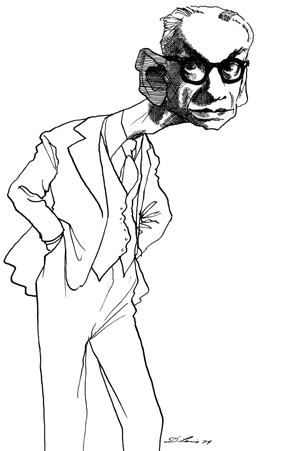
The dream of producing such a language was shattered in 1931 by a twenty-five-year-old Austrian mathematician, Kurt Gödel. In a paper entitled (in English translation) “On Formally Undecidable Propositions of Principia Mathematica and Related Systems I,” he showed that in sufficiently powerful mathematical systems, consistency could not be proven in the way Hilbert wished, and more importantly, that such systems were incomplete: there are true statements in mathematics that the system will not produce, true statements, that is, that cannot be proven. This result has since taken its place among the other metaphorically powerful scientific results of our century—the Theory of Relativity and the Uncertainty Principle. Gödel’s result is known as the Incompleteness Theorem.
The proof of the theorem is so shrouded in abstraction that it is impenetrable to an outsider; one can hardly read Gödel’s original paper without previous preparation.* Yet in the contemporary intellectual climate it has become almost essential to gain some understanding of Gödel’s theorem, it is not only called upon in discussions of philosophy of mathematics, but also in essays on science, music, and literature. There is, fortunately, an excellent book about the theorem by Ernest Nagel and James R. Newman that gives the historical background and a simplified exposition that is as direct and brief as its title: Gödel’s Proof. There is also a playful presentation of the theorem in Raymond Smullyan’s recent What Is the Name of This Book? Now Douglas Hofstadter has also written a welcome guide for the layman through the mathematical thickets, but his intentions are more grandiose.
“I began,” he writes, “intending to write an essay at the core of which would be Gödel’s Theorem. I imagined it would be a mere pamphlet.” What emerged instead is a large, expensive, eclectic, beautifully designed and lucidly written book that attempts to link Gödel’s theorem to the art of M.C. Escher and to the music of J.S. Bach. The text is punctuated with over 150 illustrations, ranging from Escher’s prints to a drawing of an arch constructed by termites. Hofstadter discusses cellular reproduction and Zen koans. Each chapter is preceded by playful dialogues between Achilles and the Tortoise from Zeno’s paradox, and assorted other characters, including the author himself. The dialogues are modeled on Bach’s musical compositions and bear titles like “Three-Part Invention,” “Chromatic Fantasy, and Feud,” and “The Magnificrab, Indeed.” The book, Hofstadter assures us, has “many levels of meaning”; it is meant to symbolize “at once Bach’s music, Escher’s drawings, and Gödel’s Theorem.” Hofstadter, an Assistant Professor of Computer Science at Indiana University, is also interested in arguing in this “metaphorical fugue on minds and machines” that someday it will be possible to create “Artificial Intelligence” in a computer.
Advertisement
If Gödel’s theorem shattered a sort of dream, it seems as if Hofstadter is intent on creating another one, a dream filled with wordplay and association in which Gödel plays a metaphorical role. Such a dream could have dissipated into chaos; but instead the book is exhilarating, challenging, valuable, and frustrating. Hofstadter writes directly and playfully for the lay reader, explaining the most abstract and wideranging arguments in short sections of great virtuosity. He is sophisticated in his understanding of the systems he explores and is adventurously speculative about their limits. But the book resists simple evaluation; it is at once surprisingly subtle and annoyingly naïve, exuberantly clever and embarrassingly silly. In order to understand Hofstadter’s project, we shall first have to understand the one that preceded Gödel.
It might seem, at first, that the mathematical project that Gödel shattered was a totally unrealistic one, particularly if it is seen as part of a continuing search for a “universal language.” But some such project was needed: the certainty of mathematical knowledge after the nineteenth century really was in doubt. Difficulties had arisen even in that most concrete field, geometry. The ancient “axiomatic method,” in which certain self-evident fundamental propositions are used as basic axioms from which the theorems may be derived, itself began to pose problems.
There had always been a problem with Euclid’s system, despite its longevity. The first four of Euclid’s five axioms from which he derived plane geometry had seemed indubitable (e.g., a straight line segment can be drawn joining any two points). But the fifth axiom (whose modern equivalent is: through a point outside a line only one line can be drawn parallel to the given line) had always seemed less than self-evident, and over the centuries there were numerous attempts to demonstrate its superfluity by deriving it from the first four. Finally, it was recognized that it could not be proven; it was, in fact, independent of the other axioms. Yet this independence is puzzling, for if the fifth axiom were contradicted, if, for example, one were to assert that through a point outside a line no line can be drawn parallel to a given line, and if this new axiom were added to the first four, the results seem absurd. One would find, for example, that the sum of the angles of a triangle would be more than 180 degrees.
Several mathematicians simultaneously realized that by reinterpreting certain undefined terms in Euclidean geometry, like “line,” sense could be made out of the absurdities of the system with a different fifth axiom. The system above, for example, could be modeled by a sphere in which “lines” are interpreted to be great circles (like longitudinal or equatorial circles). Not only do the first four axioms still hold, but so does the new fifth axiom: through a point outside a line (a great circle) no line (great circle) can be drawn parallel to it (since all great circles intersect). And on a sphere the sum of the angles of a triangle is indeed greater than 180 degrees. This new interpretation yielded a non-Euclidean geometry.
The discovery of non-Euclidean geometries raised serious questions about how mathematics was to be understood. Mathematicians tended to assume that the terms of mathematics, whether “point,” or “line,” or “numeral,” referred clearly to objects in our experience. This was no longer certain. In fact, by reinterpreting those terms, one could generate quite different systems, some of which might have nothing to do with out experience at all. As Nagel and Newman put it: “It came to be acknowledged that the validity of a mathematical inference in no sense depends upon any special meaning that may be associated with the terms.” The business of mathematics was not interpretation, or truth, but logical derivation.
But if it was difficult in a field as concrete as geometry to determine which statements could be proven and what the contradictions were, how much more difficult would it be in more abstract systems? All of mathematics was becoming more abstract in the nineteenth century; it was no longer tied to a description of our universe, its space, or its numbers. It was also, then, cut off from the confirmation experience might give to mathematics. How could one be certain that one was not producing contradictions in these unearthly realms?
David Hilbert, who did more than any other contemporary mathematician to refine and clarify the axiomatic foundations of geometry, believed that only the axiomatic method could guarantee the certainty of mathematical results. His dream, mentioned earlier, was nurtured by this belief. He proposed a radical “formalization” of mathematics; all mathematical signs would be drained of meaning in order to avoid such confusions as arose in geometry. Statements in mathematics would be no more than “strings” of such arbitrarily chosen signs as “strokes,” hyphens, and letters. Axioms would be strings that were given with the system. Then by using specified mechanical rules, these strings could be manipulated to produce other strings to be known as “theorems.” A “derivation” of a theorem would just be an “array” of strings, arranged according to the rules. Mathematics would become a mechanical, syntactical game.
Advertisement
The study of such mathematical systems, known as “meta-mathematics,” was also to be systematized. The questions of meta-mathematics were substantial. For example, how can we determine whether a particular string is a theorem, i.e., whether it can be proven? Given a particular interpretation of the system, are there any contradictions within it?
Hilbert’s formalist project has had enormous influence. By treating systems as if they were purely syntactic he focused attention upon the minute nuances in mathematical thought and helped make abstract rigor the measure of mathematical presentation. And by defining the realm of meta-mathematics, Hilbert explicitly raised questions about truth and provability in mathematics.
The most thorough attempt to ground mathematics in a system was made by Russell and Whitehead in Principia Mathematica: all of mathematics was to be developed out of the rules of a logical calculus. Given such a system, Hilbert asked, can we prove that it is both consistent and complete, that it contains no contradictions and yields every true statement? If we could, if just a formalized arithmetic would have these properties, we would be on our way toward the construction of a powerful mathematical language. Hilbert recognized that in accomplishing this dual task of proving both consistency and completeness, one could not appeal to ordinary mathematical methods, for it was just those methods whose legitimacy was in question. Nor could proofs in meta-mathematics make reference to infinite numbers of strings or operations since such infinite sets had created paradoxes and confusion in the mathematics of the time. Such proofs would have to construct any mathematical object they wished to make use of, demonstrating its existence clearly and concretely.
How did Gödel overturn Hilbert’s project? He proved that there can be no proof of consistency with Hilbert’s restrictions, and that powerful mathematical systems can never be made complete: there will always be some true statement which the system cannot prove. The irony is that in proving these results he remained within Hilbert’s restrictions upon meta-mathematical proofs. The Incompleteness Theorem, for example, is proven by an actual construction of a true nonprovable statement. In fact, the technique behind that construction is nearly as important as the result itself.
Gödel began with the formal system of Principia Mathematica, but as he noted, he could have chosen any formal system that represented arithmetic. In such a system familiar arithmetical facts, such as “1 + 1 = 2,” would be represented by signs in the system that could be manipulated as if they had no meaning. Hofstadter, in his fine presentation of Gödel’s proof, uses a formal system he calls “Typographical Number Theory” (TNT) because, like all formal systems, it can be said to manipulate non-numerical characters: meaningless signs are shifted around according to given mechanical rules. These signs, of course, can also be given precise interpretations. For example, one axiom of TNT, “∀ a: (a + 0) = a,” means “0 added to any number yields the original number”; and the string “(S0 + S0) = SS0” means “1 + 1 = 2.” But because TNT is a formal system the sign “0” should not be seen as a numeral, and the sign “+” not as the operation of addition; these are just signs that appear where they do because of certain syntactical rules:
Because such signs have no complicated meanings, Gödel was able to devise a “code” for the formal system that assigned a number to each formal sign. Each string was matched with a particular number determined by its signs, and, since a proof is nothing but an array of strings, it too could be represented in the code with its own “Gödel number.” Hofstadter, using a different code from Gödel’s, maps each sign of TNT onto a three-digit number. “S,” for example, is coded as “123,” and “+” is coded as “112.” The string “(S0 + S0) = SS0,” for example, has a Gödel number in Hofstadter’s coding of “362,123,666,112,123,666,323,111,123, 123,666.” If the statement appeared in a proof, this number would be surrounded by others.
Gödel’s code is quite similar to standard cryptograms. If one were to code letters of the alphabet into numbers, for example, one could code any message, and, conversely, given a string of numbers in code, one would be able to tell if they “made sense,” if they could be decoded, and what the message was. Such a coding would divide all strings of numbers into two classes: those that could be translated into a message and those that couldn’t, either because the numbers did not correspond to coded letters or because they did but made no sense. Similarly Gödel’s coding allowed one to characterize any number: a number would be a Gödel number if and only if it could be translated into a theorem or a proof in the formal system. In Hofstadter’s code, for example, one would be able to tell if a given number was a Gödel number by dividing it into groups of three digits; each of those groups would have to correspond to a sign in the system and the translated string of signs would not only have to “make sense” but also be a theorem or proof. One could similarly recover any string or proof given a Gödel number.
This entire procedure may seem, as it did to me when I first learned the proof, ridiculously frivolous. The code is a peculiar interpretation of the formal system that seems to accomplish nothing more than moving the signs even further away from the theoretical facts expressed in basic numerals, like “1 + 1 = 2.” Yet, as Hofstadter clearly explains, the importance of the coding is that the formal system which it “maps,” or encodes, into numbers is a formal system which represents statements about numbers. This makes the meta-mathematical system more accessible, for a statement in the meta-mathematical system is a statement about the strings of TNT—e.g. “‘(S0 + S0) = SS0’ is a theorem.” By using the code, such a statement can be translated into a statement about numbers—“The number ‘362,123,666,…,123,666’ [above] is a Gödel number [i.e., it corresponds to a string which is a theorem, produced by the formal system].” Meta-mathematical statements about theorems, then, may be considered statements about Gödel numbers. But there is still another twist: since one can define a Gödel number arithmetically, statements about Gödel numbers are statements in number theory which can be represented in the formal system TNT. So meta-mathematical statements can be represented within the system; statements about TNT can be represented within TNT: the formal system can, in a precise way, “talk” about itself.
This would hardly be an achievement in a “natural” language like English, but it is remarkable for a system as seemingly silent as arithmetic. In English difficulty arises from this reflective power; the statement “This statement is false” is the classic example. If it is false the statement is true, and if it is true it is false. Using his code, Gödel created a similar statement in the formal system, namely, a string G which could be interpreted as saying “G is not provable.” This is not, in a formal system, a mere paradox. G is either provable or not. If it is provable, then since arithmetic is consistent, G is true. But G “says” “G is not provable,” so if it were true, it would be false and we have a contradiction. G, then, is not provable. But that is exactly what it “says,” so it is true. And so, we have an actual example of a true statement that cannot be proven. Arithmetic and all equally powerful systems are thus incomplete. Moreover, Gödel showed that arithmetic is essentially incomplete—there is no way to add strings to the system as axioms that will make it complete.
This result may not, in our relativistic and uncertain age, have the same shattering effect upon us as it had upon mathematicians nearly fifty years ago, who believed that with axioms and logic one could reach, if not every philosophical truth, at least every mathematical one. But the gap between provability and truth has nevertheless taken on a larger metaphorical significance. Gödel’s theorem has been used, for example, to argue that the natural world will always elude our most powerful theories; man’s knowledge can never reach all of what is.
The theorem has also been used in controversies in computer science. For, as Hofstadter makes clear, formal systems, with their syntactic shuttling of signs, are at the source of all computer activity. In 1936, before the first modern computer was built, Alan Turing created a formal theory of how a computer would work. And a formal system also lies at the lowest level of the most advanced contemporary machines; one finds, in the “hardware,” a formal system in which “bits” of binary information—1s and 0s—are manipulated as mechanically as Hilbert’s laws of inference manipulate mathematical strings.
Gödel’s theorem would seem then to imply something quite precise about the limitations of computers. Hofstadter discusses an article by J.R. Lucas which had led to an excited interchange among philosophers and computer scientists. “Gödel’s theorem,” Lucas wrote, “seems to me to prove that Mechanism is false, that is, that minds cannot be explained as machines.” For a machine can easily be programmed to generate the theorems of a particular formal system, but it will fail to detect the Gödelian pitfalls latent in that system, which, while they can never be generated as theorems by the machine, still can be seen to be true by human minds. Lucas’s arguments are intricate, but the conclusion is that “the mind, being in fact ‘alive,’ can always go one better than any formal, ossified, dead system can.” As Michael Polanyi put it: “The powers of the mind exceed those of a logical inference machine.”
This argument, and other, similar ones, uses Gödel’s proof to elevate the mind but at the expense of a machine. Hofstadter will have none of this. He believes that what holds for the machine also holds for the brain. For it too is a formal system. It has a basic “hardware” composed of perhaps ten thousand million neurons, each one of which either fires or doesn’t fire, according to strict mechanical laws. Over thirty years ago, in his classic Cybernetics, Norbert Wiener wrote: “The all-or-none character of the discharge of the neuron is precisely analogous to the single choice made in determining a digit on the binary scale.” If the lower level of the brain is also a formal system, then it too should be subject to the limitations of “Gödelization” that Lucas and others argue machines are subject to. Hofstadter gives a convincing mathematical argument why the mind is as limited as a machine. But more importantly, it is one of the themes of Gödel, Escher, Bach that while there may be a formal system underlying all mental activity, the mind somehow transcends the formal system which supports it.
Once the underlying formal system is powerful enough to reflect itself, even on the most elementary levels, Hofstadter argues, a new dynamic enters into the brain. Hofstadter makes an extended comparison between the brain and an ant colony; the complex organization of the ant colony displays a strategy and awareness while the individual ants seem to play the parts of neurons. In the brain, too, clusters of activity are formed, interpretation begins, different levels begin to interact. Hofstadter writes: “Every aspect of thinking can be viewed as a high-level description of a system which, on a low level, is governed by simple, even formal rules.”
The method of argument used in Gödel’s proof becomes more important for Hofstadter than its limiting result. The proof’s usage of codes, its creation of mappings, its mixing of levels, and dizzying self-reference, all seem to Hofstadter to carry metaphorical implications for the activity of intelligence itself. The most important notion for Hofstadter is the “indirect self-reference” found in the Gödel string. He makes this idea central to his text in numerous playful allusions, and in serious and sustained analysis. “Indirect self-reference” is one of the richest and most vivid of his conceptions; it is, he argues, a crucial process of our minds when we correct ourselves, solve puzzles, engage in interpretations. Without some ability to refer back to our own mental activity, and to transform it, intelligence itself would be impossible.
The mind, Hofstadter writes, seems to act like the two hands drawing each other in one of Escher’s finest drawings. Such “strange loops,” he claims, may even be at the heart of life itself; in one of his more elaborate and daring metaphors, Hofstadter examines the transfer of information within the cell and finds the same formal complexities he found in mathematical logic and the human brain. DNA, for example, contains at once the program for the cell’s activity, the data which are manipulated by particular enzymes, and the language transcribed by RNA: it is a formal string which is interpreted on different levels. In fact, the entire cellular, mechanism, involving transcription and translation of the genetic code from a DNA strand that indirectly directs its own self-replication is mapped by Hofstadter in an elaborate chart onto the interpretations and codings of Gödel’s theorem, with its self-referring string. Hofstadter has, it turns out, chosen an idiosyncratic Gödel numbering system for his proof so he could set up a close identification between that code and the recently deciphered and equally arbitrary genetic code.
If life can grow out of the formal chemical substrate of the cell, if consciousness can emerge out of a formal system of firing neurons, then so too, Hofstadter seems to argue, will computers attain human intelligence. In a rudimentary way, the elementary formal systems of the computer already hint at the complexities of intelligence (perhaps because they have been designed intelligently). The basic strings of binary information are grouped into “words” and interpreted in a variety of ways: as numbers, addresses, commands. Higher-level computer languages hide the electronic clatter below, grouping the mechanical transfers of “bits” of information into patterns, aiming eventually at the high-level language of the programmer’s daily life. There is, Hofstadter acknowledges, a long way to go, but eventually, he thinks, a computer will be programmed to be indistinguishable from the human mind.
This is not the dream of a solitary crank. Within the last few decades, artificial intelligence has become a major field of research. Margaret Boden, in her recent survey, Artificial Intelligence and Natural Man, conveys the tremendous excitement and the stubborn perseverance of the researchers in the field. Much has already been achieved: there is a master program for playing checkers; computers can understand spoken English in specific contexts, engage in analogical thinking, read Chinese characters. These are hardly signs of a general intelligence, but Hofstadter is frequently persuasive about the potentials of AI if only because of his insights into the processes involved in solving problems. In fact, his own intelligence is so interesting and lively that one feels such a mind would succeed in mirroring itself in its activities in some way, even in attempting to do so literally in a computer program.
“Indirect self-reference,” a character called the Author says in one of Hofstadter’s dialogues, “is my favorite topic.” He does not only want to discuss it in its various forms—in Gödel’s proof, in intelligence, in the cell—he wants to create it in the text as well, create a literary model, turn the entire book into “one big self-referential loop.” Its end turns back to the beginning. The book claims to reveal many meanings, many hidden truths. Hofstadter quotes Hans David who writes of Bach’s Musical Offering, “the reader, performer, or listener is to search for the Royal Theme in all its forms. The entire work, therefore, is a ricercar in the original, literal sense of the word.” Hofstadter playfully and immodestly hints at similar “unending subtleties” that might appear in the “many levels of meaning” in his own work. “By seeking, you will discover,” he quotes Bach.
Much of what is to be discovered, however, has more to do with Escher than with Bach. Escher’s drawings are often amusing tricks or puzzles, exploiting self-reference, level interaction, and figure/ground play. They are coolly intriguing, unsettling at times, but are, for the most part, propositional tricks in picture form. Similarly, Hofstadter is attracted to verbal trickery; he hides acrostics, anagrams, puns, and self-referential jokes throughout the text. One of the dialogues is called “Crab Canon”; it attempts to imitate a musical crab canon in which a voice is played backward against itself. But the light-hearted “Crab Canon” later becomes the subject of a serious examination of multileveled meaning. Its “epigenesis” is shown to be a literary example of the phases of cell division, with discussions of its prophase, metaphase, anaphase, and telophase. And when Hofstadter studied a DNA strand that interested him in relation to the canon, “I saw that the ‘A,’ ‘T,’ ‘C’ of Adenine, Thymine, Cytosine coincided—mirabile dictu—with the ‘A,’ ‘T,’ ‘C’ of Achilles, Tortoise, Crab [the characters in the dialogue].” This type of wit becomes all too solemn.
Many of Hofstadter’s discussions also confuse profound insights with the most banal ones. He makes a useful analogy, for example, between the figure and ground in a drawing, and theoremhood and non-theoremhood in mathematics; one implication of Gödel’s theorem is that in certain formal systems, a figure and ground will not carry the same information. But there is no similar revelation to be gained in casually mentioning that, in music, melody is figure and harmony the ground. And again: Hofstadter indulges in a metaphorical consideration of the well-known theorem of the logician Alfred Tarski—which states that, there is no mechanical criterion for determining the truth of statements in certain mathematical systems, including arithmetic. Hofstadter says that there is no decision procedure for beauty in art either and he suggests some link with Tarski’s theorem, which hardly seems significant.
Such links become a serious problem because the book is concerned directly with the nature of links, or “maps,” between formal systems. The book is strongest in its explications of formal systems, in its discussions of Gödel, the brain, the computer, the cell. Hofstadter then uses various formal devices for connecting the systems he discusses. Texts and ideas are pared down to a syntax; maps and charts identify the most diverse objects through their shared structure. Such identifications, Hofstadter believes, contain suggestive meanings, as with the mapping showing the correspondence of the self-replication system of the cell and the self-referential system of Gödel’s code. But Hofstadter’s “maps” can also be outrageously silly, as when he has his characters discuss tests for the “genuineness” of Zen koans, as a parallel to tests for whether number theoretical statements are theorems. Similarly, in identifying characters’ initials with DNA’s bases, or his book with the Musical Offering, he is punning on the lowest “structural” or “syntactic” level, and it is difficult to imagine such mappings having the higher significance Hofstadter implies they have. Formalisms outside mathematics must be filled out with interpretations before they are cavalierly mapped; the mapping may touch only on the most trivial aspects of the structure.
The difficulty, then, lies not in creating formal parallels but in judging interpretations, not in the syntax but in the semantics. Curiously Hofstadter has no illusions about this. He discusses varying significances and the limitations of formalism quite clearly. But though he will talk generally about the complexities of language or music or beauty, he is much more at ease in expounding formalisms. He is drawn, for example, to the propositional in the visual arts: he discusses Escher and Magritte because they “illustrate” Hofstadter’s notions about levels and self-reference (often, it must be said, not at all subtly). And while Hofstadter loves Bach’s music, Bach’s presence in this book is based almost entirely upon his formal tricks in the canons and fugues. Hofstadter is particularly interested in a canon in the Musical Offering which, as it is played over and over, modulates up a key each time; this is Hofstadter’s prime example of “strange loops” in Bach’s music. But this is a “low level” fact, as Hofstadter might put it, and while he may recognize that music’s meaning lies in more complex relations, he still treats Bach on this trivial level, implying that the same self-reference that lies at the heart of Gödel’s and Escher’s work is also the source of Bach’s greatness. But every formal observation Hofstadter makes about Bach can be made of more contemporary composers who are explicitly formalists. Some of Stockhausen’s descriptions of his compositions are no more than formalist discussions of feed-back, loops, generation, etc. Yet Hofstadter in this book suggests no way of discussing the significant differences between such music and Bach’s.
Hofstadter, we come to see, does not have much to say about how musical meaning may arise from musical form, nor about how to approach similar problems of meaning in language or the arts. He has great insight into formal systems and procedures of intelligent reasoning, but he does not succeed in overcoming the limitations of his own formal inquiry, even though the transcendence of merely formal inquiry is one of the main concerns of his book.
Hofstadter hopes to demonstrate transcendence by establishing correspondences involving self-reference between Gödel’s proof, the cell, and the mind. He intends to reveal similar structures, to show that what holds in one system may well hold for another, to argue that unpredictable consequence may come into play when formal systems reach a certain level of complexity; Gödel’s string may be produced, life may emerge, and intelligence may be created. But these correspondences are rough and metaphorical, and are more assertive than convincing. In order to show how such systems might reach inventiveness Hofstadter himself would have to articulate a theory of meaning that he seems to be reaching for one that goes beyond a formalist notion of “exotic isomorphism.” He would have to move from syntactic, structural, and formal links of varying value and depth to a consideration of the semantics of language and art.
In one of Zeno’s paradoxes it is proven that in a race Achilles could never catch up with the Tortoise if the Tortoise had a head start, since Achilles would first have to cover half the distance between them, then a quarter, and an eighth, and so on ad infinitum. Lewis Carroll’s dialogue “What the Tortoise Said to Achilles,” which Hofstadter reprints and takes as a model, is a brilliant logical analogue to Zeno’s paradox, as the Tortoise shows how Achilles can never “catch up” with the conclusion of a simple syllogism. He takes a proposition Z from Euclid which follows logically from the premises A and B, and challenges Achilles to make him accept the conclusion Z. This means, however, that the Tortoise must accept another statement C, namely: “If A and B are true, then Z must be true.” The Tortoise still does not accept Z, so there is yet another statement D which the Tortoise must accept: “If A, B and C are true, then Z must be true.” And so on and on.
As Hofstadter points out, there is a confusion in the paradox: a rule of inference (A and B imply Z) is taken to be a proposition itself. But the question of the infinite regress remains and recalls Wittgenstein’s questioning: why should one be compelled to accept a logical conclusion? Hofstadter would answer that there is always an “inviolable substrate” in the cell, in the mind, in the computer—a formal system which is the limit of infinite regress, the end of all searches for grounding one’s knowledge.
I don’t see why we should accept this solution: a logical problem of infinite regress is not solved by reference to “hardware.” I prefer one of Hofstadter’s other formulations: “You can’t go on defending your patterns of reasoning forever. There comes a point where faith takes over.” And so, finally in this book, it does. Hofstadter has faith that AI will succeed in its quest, just as earlier Hilbert believed he would in his. For the achievement of AI’s program there may indeed be no obstacle comparable to the one that blocked Hilbert. But there is no clear way of knowing. Hofstadter does not minimize the difficulties, but they seem formidable. The brain itself may be more of a probabilistic system than a formal one, more of a cloud than a clock, to use Karl Popper’s metaphors, and its interaction with the rest of the body would also make it difficult to consider it as a different independent system. Researchers in AI hope they will never have to model the physiology of the brain; they concentrate upon the workings of the mind, attempting to mirror its features. But this project seems just as enormous. The achievement of AI’s project would mean that one would have a program, a finite set of instructions, that would give a literal structure of the human mind, a “string” of statements in which one could read a universal grammar of creativity. Such a project is probably of the same order of difficulty as the search for the secrets of life itself.
But in some sense this dream of AI is the archetypal dream of much of contemporary inquiry. It is not to find a “universal language” whose syntax would reveal the truth of the world—Gödel proved such a language to be impossible—but to find a “universal hermeneutics” that would reduce the fullness of the world to an underlying syntax, to basic “structures,” and that would, conversely, be able to read the complexity surrounding us in these basic strings. This is the dream not only of AI but of much contemporary genetics, linguistics, and advanced literary theory, all of which stress the importance of self-reference. One does not need to appeal to Gödel’s theorem to believe as I do in the validity and value of much of this search, without believing the mysteries will ever be solved.
“In a way,” Hofstadter confides at the beginning, “this book is a statement of my religion.” It clearly sets a transcendent goal which may always lie infinitely far away, but Hofstadter’s enthusiasm, boldness, and intelligence so engage us that if by the end we seem no closer to that goal, we have nevertheless been enriched by where we have been.
This Issue
December 6, 1979

This Issue
December 6, 1979
-
*
A translation of Gödel’s paper along with papers of Frege, Russell, Hilbert, and others is included in From Frege to Gödel: A Sourcebook in Mathematical Logic 1879-1931, edited by Jean van Heijenoort (Harvard University Press, 1967), an anthology of important papers in mathematical logic. ↩