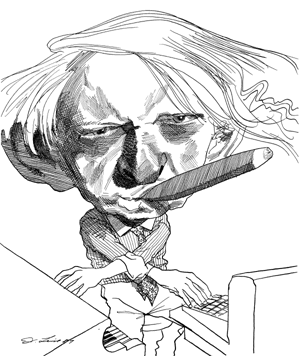
I saw them coming, an army of two with banners. He was tall, pale, eyes narrowed from cigarette smoke of his own making (an eighty-a-day man for years); she was small, round faced, somewhat bloated. In the gracious plywood-paneled room, the hard stuff was flowing, and the flower of British book-chat and publishing was on hand to drink it all up in honor, not quite the noun, of my return, after a decade’s absence, to Literature, with a long reflection on the origins of Christianity, novelly disguised as a novel. The year, 1964.
She said in a loud clear voice, “You,” and then I ceased to understand her, “chung cheers boog sightee Joyce yearsen roscoe conkling.” I am certain that I heard the name of the nineteenth-century New York senator, and I turned to the man—the senator’s biographer?—and saw, like infected buttonholes, eyes I dare not meet in dreams. “Tchess.” He took up the refrain. “Boog Joyce venially blind, too, bolder.” I had been drinking, but not that much, while the tall man appeared sober. Obviously, I was having my chronic problem with English voices: the low rapid mumble, the urgent wheeze, the imploding dipthong, vowels wrongly stressed, and consonants long since gone west with the thirteen colonies.
We were separated. I was told that I had been talking to Anthony Burgess and his wife Lynne. Burgess had written some comic novels about life east of Maugham—or Suez; now there was a new book called A Clockwork Orange. I knew nothing of him except for one splendid anecdote. Under another name, he had reviewed one of his own books in a British paper. The Brits were horrified. I was delighted: Whitman had done the same. Besides, I was stern, shouldn’t there be at least one review in all of England written by someone who had actually read the book?
Again the army approached, banners raised high. We worked out a common language. Lynne was pissed off that my novel Julian was a Book Society choice. She was even more annoyed when I wanted to know what the Book Society was. I had a vision of aged flappers reciting Dorothy Richardson over sugary tea. The society was like an American book club, she growled. I apologized. This was not enough. Truth crackled in the air. A novel by Burgess had finally been chosen, in 1961; yet he was eight years my senior. I was too young to be so honored. I mounted my high horse, tethered conveniently near. “I have written more books than Mr. Burgess,” I said, settling myself into the saddle. “And over a greater length of time.” Swift, suspicious adding and subtracting was done as we ate small but heavy sausages, diapered in a fried bread and speared with lethal plastic tooth picks. True, eighteen years had passed since my first book was published (at twenty) and a mere seven years since his first (at thirty-seven) but he was certain that he was well ahead in units of production. I was not. But before I could begin the long count, he said, “Anyway, I’m actually a composer.” This was superb; and I ceded the high ground to him. Lynne did not. She rounded on him: you are not a composer. Pussy-whipped, he winced and muttered, roscoe g conkling. As I rode off into the night, no boyish treble sounded, “Shane!”
Four years later Lynne was dead of the drink (cirrhosis of the liver). In due course, Burgess married an Italian, lived in Rome; and from time to time our paths crossed, cross. Now, twenty-three years after our first meeting, he is suddenly, astonishingly, seventy years old (I remain, throughout eternity, eight years his junior), and the author of twenty-eight novels and dozens of odd volumes on this and that as well as a part-time laborer in television and films and the theater, where he recently distinguished himself with an adaptation of Cyrano that changed everyone’s view of that familiar but not-so-high war horse.
Burgess has now published Little Wilson and Big God, “Being the First Part of the Autobiography” which, long as it is, takes him only to the age of forty-two in 1959 when he was told that he had an inoperable brain tumor, and a year to live. In order to provide for Lynne, he started turning out books at a prodigious rate, and now, twenty years after her death, he still, undead, goes on. Incomparable British medicine (“In point of fact, Dr. Butterfingers, that’s my scalpel you’re standing on”) is responsible for the existence of easily the most interesting English writer of the last half century. Like Meredith, Burgess does the best things best; he also does the worst things pretty well, too. There is no other writer like him, a cause of some alarm to others—him, too. Now, in the sad—the vain, I fear—hope that once we’ve known the trouble he’s seen we will forgive him his unfashionable originality and prodigiousness, he makes confession not to merciful God but to merciless us.
Advertisement
The subject of the first part of the autobiography bears, I should guess, very little resemblance to the man who wrote it, who, in turn, bears no resemblance at all to the John Wilson that he was born and continued to be until his relatively late blossoming as a novelist. It is not that he bears false witness; it is, simply, the problem of recalling past time as it occurs to someone in a present where “I have trouble with memory, especially of names.” Also, this testament is not extravagantly and carefully shaped like one of his novels; rather, it is doggedly improvised (from diaries? There is a single reference to a diary).
Burgess tells us that in 1985, he was in New York’s Plaza Hotel, waiting for a car to take him to the airport. Suddenly, like Gibbon on the steps of Santa Maria d’Aracoeli, he decided to tell this story. But when he started to write, I don’t think that he had a clue where he was going or how he was going to get there. Fortunately, he has not the gift of boredom. He can make just about anything interesting except on those occasions when he seems to be writing an encoded message to N. Chomsky, in celebration not so much of linguistics as of his own glossolalia, so triumphantly realized in his screenplay for Quest for Fire.
But the narrative itself is in order. Born John Wilson, February 25, 1927, in Manchester, England; father arrives home from World War I to find wife and daughter dead of the influenza epidemic; in the same room as the corpses, young Wilson lies, giggling, in his crib. I am not sure if every detail is meant to stand up in court, but certainly Burgess, as artist always on oath (as opposed to defendant in the dock), is keeping close to the essential facts of the case. The father is musical; plays piano in silent movie houses; marries a second time to a woman of some means who becomes a tobacconist. Young Wilson is solidly lower middle class and might have made it up to mid-middle class were it not for the fact that Celtic blood flows in his veins and so, as a Roman Catholic, he was literally set apart from the Protestant majority and was sent to Church schools where the good brothers, as is their wont, managed to detach him from his faith. When Burgess starts to question holy church, a priest remarks that this is plainly a case of Little Wilson and Big God; hence the book’s title, the author’s problem.
There is a great deal of carefully described sex. Although Burgess had had sex with girls at an early age, and once observed another boy masturbating, he himself did not know how to masturbate until late adolescence; even more traumatic and poignant, he was equally ignorant of lending libraries. For me, Burgess demonstrates, yet again, how uninteresting the sexual lives of others are when told by them. At one point, he remarks that most literature is about sex. If true, then, perhaps, that is why it is necessary for us to have literature. Once the imagination has, kinetically, translated the act from bed to page excitement begins. But nothing happens when a writer, or anyone, tells us what he himself has actually done in bed or on the floor or in the bushes, where Burgess was caught in the army. Nevertheless, from Frank Harris to Henry Miller to Tennessee Williams to Burgess, there is a weird desire to tell us all, and the rest of us (unless we lust for aged auctorial flesh) start to skip, looking for gossip, jokes, wisdom, or just a good sentence.
Of course, Burgess was brought up, as was I, before World War II. In those days, in most circles (not mine, happily) sex and guilt were one and the same, and a new religion was even based on the idea of universal sexual repression (the universe, as symbolized by a corner of bourgeois Vienna) which could only be raised through confession. It is not until mid-career that Burgess suspects that there may be other sources of big joy if little guilt, like the perfect bowel movement, which his eponymous hero-poet, the costive Enderby, pursues like a mad surfer waiting upon the perfect wave.
In youth, Burgess must have found bewildering the variety of his talents. He was, first, a musician entirely in thrall to that arithmetic muse. He could remember a thousand popular songs. Wistfully, he suggests that even to this day he could earn his living as a cocktail-bar pianist. But he was more ambitious than that. He set poems, wrote symphonies, attempted operas. He still does, he tells us, somewhat defensively because, parallel to his successful literary career, he has been a not-so-successful composer. Plainly, he is puzzled. Are they right? Is he any good? Currently, he is working on an opera about Freud (“Show Me Your Dream, I’ll Show You Mine”). So, perhaps, there is method to his recollections here of early sexual experiences.
Advertisement
Nevertheless, it is an article of faith (bad) in our dull categorizing time that no one may practice more than a single art; even worse, within the house of literature itself, the writer must keep to only one, preferably humble, room; yet a gift for any art is almost always accompanied by at least the ability to master one or more of the other arts. This is a secret of genius’s lodge that is kept from every faculty room lest there be nervous breakdowns and losses of faith and transfers from English studies to physics. But where Goethe, say, was allowed his universality, today’s artist is expected to remain cooped up in mediocrity’s vast columbarium. The reputation of our best short-story writer, Paul Bowles, has suffered because he is, equally, a fine composer: for musicians, he is a writer; for writers, a composer.
Along with music, Burgess had a talent for drawing; fortunately, he is also colorblind; otherwise he might have been pecked to death by angry crows at the Tate. Finally, he could write; but it was a long time before he allowed that old shoe of an art to bemuse him. I suspect that Burgess has been severely shaken by those music critics who have put him in his place, high in the gallery of Albert Hall; as a result, he believes that they are probably right because one person cannot be more than one thing. To a born-again atheist like myself, it is clear that each of us has multiple selves, talents, perceptions. But to the Roman Catholic, unity is all. At birth, each is handed One Immortal Soul, and that’s that. One god for each; one muse for each. Then, at the end, we all line up. Good to the right. Bad to the left. All right! Now let’s hear those voices raised in praise of HIM. Because—Heee-res De Lawd! Burgess! Less vibrato. This isn’t Heaven, you know.
Three themes emerge in the course of the autobiography. The first, religion. What it means to be lower-middle-class Roman Catholic in the English mid-Midlands; what it means to lose—or lapse from—one’s faith; what it means to be forever on the alert for another absolute system to provide one with certainty about everything. At one point, in South-east Asia, Burgess was tempted to convert to Islam. But Islamic bigotry distressed him; and he backed away. Now,
in old age I look back on various attempts to cancel my apostasy and become reconciled to the Church again. This is because I have found no metaphysical substitute for it. Marxism will not do, nor will the kind of skeptical humanism that Montaigne taught. I know of no other organization that can both explain evil and, theoretically at least, brandish arms against it.
This is bewildering to an American of the Enlightenment; but as the twig was bent…. Also, to the extent that Burgess has any political ideas at all, he’s deeply reactionary, and capable of such blimpisms as, “In February the Yalta Conference sold half of Europe to the Russians.”
The second theme is sex. After the glut of the salacious sexy Seventies and the hysteria of the anxious AIDSy Eighties, it is hard for those who grew up after the great divide—World War II—to realize that just about the only thing any of us ever thought about was getting laid. Burgess went into the British army at twenty-three in 1940. Three years later, at seventeen, I went into the American army. Each got out of the army in 1946; each with the neither-fish-nor-fowl rank of warrant officer. Although Burgess was for all practical purposes married to Lynne when he was scooped up by the army, he, too—like the rest of us—was introduced to a world of sex where every traditional barrier had fallen with a crash. There was a general availability unknown to previous generations of European—much less American—Christendom. Those of us who joined the orgy in our teens often failed, in later life, to acquire the gift of intimacy. Burgess himself had other problems; innocently—always innocently—he tells us about them, unaware that an autobiography is no place for truth as opposed to the true: Augustine’s sententious nonsense about those pears should have taught him that.
Because Burgess had no mother, he writes,
I was not encouraged to express tenderness. I was reared emotionally cold…. I regret the emotional coldness that was established then and which, apart from other faults, has marred my works.
At least one dull American book-chat writer thought that this was really insightful stuff; and moved Burgess several rungs down the literary ladder. He cannot love; ergo, he cannot write. He is not warm; ergo, he is not good. He is cold; ergo, he is bad. Burgess is very conscious of his reviewers but I do not think that he has ever quite grasped the deep ignorance of the average American book-chat writer, who is in place to celebrate obedience and conformity to that deadly second-rateness which has characterized our garrison state for the last third of a century.
Recently a television documentary on one of our public schools was screened for the local school board. The board was near rapture. But when the public saw the film, the board realized that what they had admired, the successful attempt to destroy individuality in the young, did not play so well with the TV. audience, hardly themselves nay-sayers. Since power not sex is true motor to human life, the powerless often prefer to die. That is why today’s young do not eat goldfish. They kill themselves.
Burgess’s thirty-year marriage is more harrowing to read about than, perhaps, to have lived. At first, he was obliged to share Lynne with a pair of well-off brothers, one of whom might bring her the money that he could not. Then Burgess attended the party that was World War II. Finally, Lynne and the brothers parted and the open marriage of the Burgesses gaped anew. Postwar, Burgess taught in Malaya and Brunei. He and she each drank a bottle of gin a day. She made love to a number of men; he to women. She fought with everyone; demanded a divorce; was reconciled by the publication of his first books. Fortunately, he enjoys being humiliated by women, a theme that runs through the novels, giving them their sexual edge (see the final Enderby volume). Fascinating; but mysterious—like Grace. Anyway, he loved her, he tells us, for thirty years.
Religion, sex, art—three themes that, unlike the Trinity, never become one. Finally, despite the distractions of the first two, it is the third that matters because that is all that’s ever left. Burgess himself does not seem quite to know what to make of his novels. Wistfully, he goes on and on about music and the structure of language but, in the end, he is a writer of prose, a novelist, a some-time movie and television writer. There was a time whenever a producer came to me for a script on Jesus or the Borgias, or even Jesus and the Borgias, I’d send them on to Burgess, who would oblige. Today, he is the best literary journalist alive, as V.S. Pritchett is the best literary critic. Pritchett, of course, modestly opts for the word “journalist,” aware that the high ground of criticism is currently occupied by academic Literary Theoreticians who have presided, during the last two decades, over an 80 percent drop in English studies. Well, if you can’t lick ’em, change the game.
This is not the place (nor does space afford, as Henry James would coyly note, having filled his review of some dim novel with a series of glittering false starts) to describe the twenty-eight novels of Anthony Burgess. So I shall stick to what he himself has to say about them in his memoir. One thing becomes clear: like so many highly serious brilliant men, he has no natural humor or comic sense as opposed to verbal wit. In thrall to Joyce’s Finnegans Wake, he dreamed of the marriage of high literature to high music. When he wrote his first novel, about wartime Gibraltar, he gave it to an editor at Heinemann. “It was, he said, funny. I had not, in fact, intended it to be funny, but I assumed the right posture of modesty on this revelation that I was a coming comic novelist.” Dutifully, seriously? he wrote several more novels set east of Suez; and each turned out comic, even though he was writing of sad exotic places, and people; but, of course, he was writing about the painful untidy lives of Anthony and Lynne in far-off places where, as Horace (no, not Greeley) so pithily put it, “People change their skies, not their feelings, when they rush overseas.” The “rush” is often funny while “overseas,” for the Brits, always is. Thus, tragedy turns out comedy.
Of Burgess’s fourth novel (The Right to an Answer) he writes, it “was almost entirely invention. That I could invent was the final proof, to me, that I had not mistaken my vocation.” For the Burgess reader, the great breakthrough came after his death sentence, when he was furiously writing and inventing. In 1944, the pregnant Lynne had been robbed and beaten up in a London street by four American soldiers. She aborted. Burgess turned this true story into a novel that he has small regard for because the world at large has such a high regard for the film version, done by another, of A Clockwork Orange. Burgess hurls the story into a future London where four local louts have been Sovietized and speak a new vulgate, part London prole, part Russian. The result is chilling; and entirely other. When Burgess moves away from his own immediate life, his books come most startlingly alive, if ink markings on mute paper can ever be called a life form or even its surrogate.
In the light of his three obsessions, Burgess wanted to bring God into the novel in a big way, with Berlitz-cum-Joyce symbolism, and resonating like a struck cymbal with atavistic Lorenzian blood myths. Happily, he failed. Of an early novel, he writes, “The realism over-came the symbolism. This usually happens when the novelist possesses, which Joyce did not, a genuine narrative urge.” One detects a regret here, an acknowledgement that the Wilsonian passion for Finnegans Wake has no place in the Burgessian novel. But then, “I see that the novel, an essentially comic and Protestant art form, is no place for the naked posturing of religious guilt.” He means of course the English novel in this century. A twentieth-century novel each of us admires, Doctor Faustus, has roots in the human bloodstream (spirochete-ridden as it is) in a way not allowed by our meager culture and overrich language.
If Burgess is obsessed with sex in his memoirs he uses sex judiciously in his novels and in the best (he will not agree), “The Enderby Four,” as I call them—Inside Mr. Enderby, Enderby Outside, The Clockwork Testament, or Enderby’s End, and Enderby’s Dark Lady—he uses his obsession much as Nabokov did in Lolita to make a thousand and one points about literature and life and their last human sanctuary, the motels of America. On the showing of the fugitive poems in the autobiography, Burgess himself is not much of a poet but his invention, the poet Enderby, on the showing of his poems is one of the finest of contemporary poets and ought to be anthologized as himself, with symposia devoted to his art, and no reference to either Wilson or Burgess as amanuensis. There is no invention quite so extraordinary as that which surpasses, at inventing, the original inventor. Baron Frankenstein’s creation just hangs out. But Enderby’s poems have the effect that only the best writing can have on a reader who also writes. They make him want to write poems, too; and surpass self.
The Burgess who doubts his comic sense or, rather, was slightly appalled that his “serious” works made others laugh must know by now that the highest art, which is comedy, is grounded in obsession. With a bit of luck (a Roman Catholic education?) Melville might have created a masterpiece in Moby-Dick. As it is, we laugh—though not enough—at Captain Ahab (Pierre is funnier). But Burgess was wise enough to allow his obsessions with religion, sex, language, to work themselves out as comedy. Also, he has been able to put to good use his passion, rather than obsession, for language and its forms, and his lively restless inventions have considerably brightened the culturally flat last years of our century. How he managed to do this is implicit, if not always explicit, in the pages of Little Wilson and Big God, which might better be called Little Wilson and Big Burgess, who did it his, if not His, way.
This Issue
May 7, 1987
This Issue
May 7, 1987