Before The Baltimore Sun turned into a branch of The Chicago Tribune and the Baltimore Orioles turned into a bush league ball team, Baltimoreans were a proud race of hometown chauvinists with many gods to adore. Among them were the enlightened capitalists Enoch Pratt and Johns Hopkins, Johnny Unitas, who was to professional football quarterbacking what Einstein was to the atomic bomb, the great civil rights champion and Supreme Court justice Thurgood Marshall, and Edgar Allan Poe. Typically, for Baltimoreans are still highly civilized as American urban people go nowadays, their football team is named the Ravens in homage to Poe’s famous poem. Though Baltimore’s rights to Poe are far from indisputable, as a former student at the Edgar Allan Poe Junior High School situated beside his grave in the middle of town, I am myself physical evidence of the insistence with which the city asserts its claim.
Of all its human monuments, however, the two most cherished have long been Babe Ruth and Henry Louis Mencken. Babe Ruth was one of those rare American men of the people—Al Capone was another—whose name resounded beyond the oceans. During World War II, Japanese soldiers seeking to demoralize American Marines shouted, “To hell with Babe Ruth!” Baltimore took pride in having begot him.
And yet its heart belonged to Mencken. This was probably because Mencken never left Baltimore. Babe Ruth went to New York and didn’t come back. Deep down, he was a cosmopolitan, at home wherever the beer was good and the women compliant. He was from Baltimore but not of it. By contrast, Mencken went to New York too, but never let it turn his head. Mencken was a hometown booster as hard-core middle-class as any prairie Rotarian extolling the wonders of his native ground.
In The Skeptic, Terry Teachout calls him a “bourgeois,” which may put too high-toned a gloss on matters. The reality verges on satire. In certain respects Mencken was one of the most extraordinary men in America; in others he was so ordinary that he might have been an easy target for ridicule by that other Mencken, who turned into the monstrous Assassin of the Booboisie when he sat down at the typewriter.
One of his lifelong joys was the beery Saturday night out with the boys. At the age of sixty-four he complained to his diary that “the Saturday Night Club missed its usual post-music beer-party for the first time in forty years” because saloons and restaurants all closed in sorrow for the death of President Roosevelt. Being music lovers, not bowlers or hot-rodders, the group passed forty years of Saturday nights playing Beethoven, Brahms, and such when not hoisting glasses. Mencken played piano.
As for sexual ethics, young Henry allowed himself romantic fornication but suffered the middle-class moralist’s revulsion upon learning that his married friend Theodore Dreiser sometimes committed up to three adulteries per day.
In family life he was material fit for a Hallmark Mother’s Day greeting, practicing absolute devotion to home and mother. When newsroom duty kept him up late into the night, Teachout says, Henry could count on his mother having sandwiches waiting for him at home. After infancy, except for five years of marriage, he lived all his life in the Hollins Street house his father had bought in the 1880s.
Offered a well-paying magazine job in his twenties, he declined because, he told a friend, “I couldn’t leave my mother in Baltimore.” Unlikely though it seems, writes Teachout, “the sharpest, cruelest, most self-assured wit in the history of American letters, the fearless scourge of puritanism in all its forms, was a mama’s boy.”
His attitude toward his father may make modern adolescents goggle and snort. On finishing high school he wanted to become a newspaper reporter; his father wanted him to go into the family cigar business. He went into the cigar business. He might have grown old in it had his father not died before Mencken turned nineteen.
He later confessed that while running to fetch a doctor the night his father collapsed, “I kept saying to myself that if my father died I’d be free at last.” His father was buried on a Sunday. “On the Monday evening immediately following,” Mencken wrote in his memoirs,
having shaved with care and put on my best suit of clothes, I presented myself in the city-room of the old Baltimore Morning Herald, and applied to Max Ways, the city editor, for a job on his staff.
The rest is oft-told history. Before he was thirty he had triumphed at the Herald, switched to the Sun, where he quickly became its star writer, and was lured to Manhattan to edit the magazine Smart Set. He was soon the most respected book critic in America. Manhattan was a place for enlarging reputation and enjoying bachelor sports, and he did both, but he refused to be transplanted. Finishing his magazine chores, he left hedonism behind and headed for Penn Station and the family nest on Hollins Street.
Advertisement
As Teachout suggests, the middle-class solidity of his personal character would have seemed bizarre to his legions of admirers in the century’s early years. To a generation that came of age between 1900 and the stock market crash and fancied itself enlightened, he was the fool killer smiting the “imbecilities” of a dying past with the most gloriously devastating language ever sent to battle against ignorance. Yet if the fact was known at all, it was universally overlooked that an old-fashioned homebody lay purring behind all that ferocious prose.
Mencken has been the subject of so many biographies, memoirs, and studies over the past half-century that one wonders how Teachout finds the heart to issue another. One of the earliest is William Manchester’s elegant Disturber of the Peace, published in 1951. Manchester, who knew the elderly Mencken well, captured a sense of gaiety that eludes later biographers. In 1956, for readers who like the warts-aplenty treatment, Charles Angoff, who had worked for Mencken at American Mercury, produced H.L. Mencken: A Portrait from Memory. For years the most thorough job was Carl Bode’s 1969 Mencken, but Fred Hobson’s exhaustive Mencken: A Life, published in 1994, now provides a lot of additional material that was unavailable when Bode wrote.
No one, however, wrote more exhaustively about Mencken’s life than Mencken himself. At his death he had put under seal at Baltimore’s Enoch Pratt Library perhaps 800,000 unpublished words in a diary and other biographical manuscripts not to be opened until he had been long dead. These provided a great deal of fresh fodder for Menckenians, some of it with scandal value, especially the revelation that he had a streak of blue-stocking anti-Semitism. The disclosure produced despairing cries of pained disappointment, as it was bound to in an age no longer indifferent to the dangers of such prejudice.
Nowhere was the disappointment more painful than in Baltimore. Anti-Semitism of Mencken’s sort was so shockingly drab, so ordinary, such a shamefully shabby imperfection. A man of Mencken’s stature should have only magnificent defects. In mythologizing him, Baltimore had come to think of him as superior to the common country-club bigot. And now here was this indisputable diary evidence. Carl Schoettler, an Evening Sun staff writer, captured the sense of disgusted disappointment in three deadly adjectives: “His prejudices are commonplace, casual and banal.” No one said, “Say it ain’t so, Henry.” Everybody thought it, though.
New scholarship kept unearthing other astonishments small and large. The depth of Mencken’s long love affair with Marion Bloom was widely unknown until the 1996 publication of letters which Marion and her sister Estelle had deposited with the Pratt and New York Public Libraries. Edited by Edward A. Martin in a book titled In Defense of Marion, they disclosed a frisky Mencken starting a casual affair with a country girl from rural Maryland, then discovering that it was more than casual, and finally being torn between the idea of marriage and fear that it would ruin his reputation.
“It’s damn silly your saying I was too chivalrous to grab Mencken,” Marion wrote her sister when it had ended. “What can you do when someone stands weak-eyed and weak-kneed before you begging for mercy? With the pull of vanity that the world knew him as a misogynist, and he was ashamed to be caught getting married like a regular human.” This was a Mencken utterly alien to the conventional image—a “dignified, Edwardian gentleman, striving to be proper,” as Martin put it.
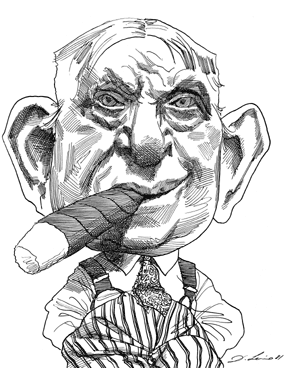
It is still shocking to think of Marion calling him “Hank.” They had known each other fourteen years when Marion, having seen Nikol Schattenstein’s recent portrait of Mencken tieless, in shirtsleeves and suspenders, wearing red pants and holding a cigar, wrote her sister:
Old Hank’s portrait is a blight on his escutcheon…. It’s disgusting. I can’t make Hank out. Surely you remember the days when he believed that a man of dignity could not afford to fraternize with every one—and now a painting resembling a cub studying art! Really he surprises me.
The letters describe the kind of long-term love affair that sometimes begins as an apparently absurd mismatch and ends in a long successful marriage. Hobson’s 1994 biography has a theory about why this one did not, and it brings us back to Mencken’s compulsive middle-class instincts:
A great part of the truth was that…quite simply, he believed Marion was not fine enough for him. She was not sufficiently well bred, not well educated, well dressed, financially well off: she was not sufficiently successful…. It came down, whether he admitted it or not, to a matter of class.
Teachout, noting that Mencken still lived with his mother, suggests he judged Marion “not quite respectable enough to bring home to Hollins Street.”
Advertisement
Someone called him “the sage of Baltimore,” and the name stuck, possibly because it was mindless fun to say, just as it was mindless fun to call Babe Ruth “the Sultan of Swat.” It pleased Baltimoreans to think they had begot a “sage,” though it was not sagacity or wisdom or intellectual brilliance that distinguished him, but his unique power to wield the American language. Here he is, for example, in a 1926 newspaper piece explaining why Aimee Semple McPherson, the evangelist who had been caught in a “love nest” that year, needed Los Angeles to succeed in her holy calling:
…[Los Angeles] was a pasture foreordained for evangelists, and she was the first comer to give it anything low enough for its taste and comprehension.
The osteopaths, chiropractors and other such quacks had long marked and occupied it. It swarmed with swamis, spiritualists, Christian Scientists, crystal-gazers and the allied necromancers. It offered brilliant pickings for real estate speculators, oil-stock brokers, wire- tappers and so on. But the town pastors were not up to its opportunities. They ranged from melancholy High Church Episcopalians, laboriously trying to interest retired Iowa alfalfa kings in ritualism, down to struggling Methodists and Baptists, as earnestly seeking to inflame the wives of the same monarchs with the crimes of the Pope. All this was over the heads of the trade. The Iowans longed for something they could get their teeth into. They wanted magic and noise. They wanted an excuse to whoop.
The notion of Mencken as a sage has made it hard to see him clearly. In old age it seemed to prevent him from seeing himself clearly. In those gloomy writings of his later life, he wonders what if anything of his work will survive, and thinks perhaps it may be his political writings. He seems to be thinking, alas, of work with philosophical weight.
It is sad to find a great American writer fretting and stewing about his own intellectual profundity. No one ever cared whether Mark Twain was profound or not, least of all Mark Twain. He towered above profundity. If Mencken was the lesser artist, his achievements were nevertheless not minor, and it is painful to think of them being judged by their philosophical value. “It is no crime not to be a philosopher,” Walter Lippmann observed, adding that in Mencken “the man is bigger than his ideas.”
A lot of his political writing does survive, but not because of its philosophical importance. It is hard to find any startling idea not already present in the works of Friedrich Nietzsche, Mencken’s intellectual beacon. Putting it somewhat crudely, with Nietzsche God is dead, religion a trick of tyrants to keep the masses subdued, and democracy a scheme for keeping the superior few under the power of the inferior many. These are the same themes that Mencken preaches over and over.
It is pointless to search Mencken for any political idea that might be useful to any American political movement, no matter how radical, for he was a deep-dyed pessimist, and American politics—maybe all politics—is founded on optimism. A lot of Mencken’s humor flows from his vision of American society pursuing the delusion that a change of politicians or a fresh onset of religious or social uplift will cure whatever ails us and make the sun come out tomorrow. Yet this is the faith every politician preaches in every election. A politics as pessimistic as Mencken’s would be suicidal for any American politician of any epoch.
Though his political pieces sometimes seem repetitious and occasionally silly, much in them is still a pleasure to read for the quality, even the beauty, of the prose. With words he had one of those gifts which miracle fanciers say are bestowed by the gods. That he was a prodigious reader of the finest literature may have counted for something too. Before he was fifteen, he says, he had read Thackeray, Addison, Shakespeare, Tennyson, Swinburne, and Kipling, and knew Pepys’s Diary, Boswell’s Life of Johnson, and the Spectator papers “backward and forward.”
His formal education, which ended with high school graduation at age fifteen, taught him nothing useful, he said. His love of music equaled his love of literature, and he might have become a composer if journalism had not worked out.
What is odd about the writing is its uniquely baroque quality in an age when American prose writers were moving toward plainness and understatement. Hemingway’s and Fitzgerald’s writings were filled with silences. A Mencken piece was filled with storm and clatter, with roars of outrage and insulting invective enriched with rare and astonishing five-dollar words, possibly with a few German jawbreakers thrown in. It was absolutely beyond imitating. Part of its strength, as Teachout notes, is that it was perfected in newsrooms.
Journalism is impatient with dullness and delicate writing. It rewards strong verbs, powerful images, wit, and the clearly made point. Impertinence must also be cultivated, as well as an insouciance that will release the journalist from the paralyzing delusion that he is in competition with Shakespeare and Macaulay, and so free him to put something on paper fast.
Most journalism must necessarily fail a literature test. The sheer volume of writing assures it. Mencken was a human writing machine. He wrote tirelessly, incessantly, almost effortlessly. Because he wrote too easily and too often when he had too little to say he left a wide trail of third-rate stuff. The constant repetition of boilerplate words like “moronic,” “idiotic,” and “imbecilic,” which must have seemed exhilarating to flaming youth of the 1920s when applied to their parents’ ideas, are likely to make the modern reader simply beg for mercy.
But then one stumbles on undiscovered passages that are sublime. Here he is in an old newspaper story, at age sixty-eight, covering the Progressive Party convention of 1948, and appraising Glen Taylor, a guitar-playing leftist from Idaho who is the party’s vice-presidential nominee:
As for Taylor, he has made it plain to all that there is nothing to him whatever save a third-rate mountebank from the great open spaces, a good deal closer to Pappy O’Daniel than to Savonarola. Soak a radio clown for ten days and ten nights in the rectified juices of all the cow-state Messiahs ever heard of and you have him to the life.
This paragraph adds nothing to our grasp of political philosophy, but wouldn’t we feel blessed nowadays to have even one solitary journalist capable of subjecting the world’s Bushes and Gores, Cheneys and Liebermans to frankly prejudiced prose as gorgeous as this? Here, as in much else, Mencken is rushing political journalism toward art, and the effect is exhilarating.
In Black Boy, Richard Wright speaks of this feeling when first reading Mencken’s prose in 1937:
I was jarred and shocked by the style, the clear, clean, sweeping sentences…. He was using words as a weapon, using them as one would use a club…. It frightened me. I read on and what amazed me was not what he said, but how on earth anybody had the courage to say it.
The quest for profundity in Mencken engages Teachout more perhaps than it should. This gives his biography something of the tone of an extended critical essay, tempting the reader to take an unduly solemn view of Mencken, who was, after all, a very fine humorist, if only in spite of himself.
Was Mencken truly one of the great literary critics? Teachout renders a mixed verdict, crediting him with encouraging some of the best young writers of his day, among them Dreiser and Sinclair Lewis, but suggesting serious failings. For example, says Teachout, though Mencken urged Americans to read Joseph Conrad, he failed to grasp what Conrad was really up to. In his unkindest cut, Teachout says Mencken’s early book on Nietzsche was “shallow.”
What about his magazines, Smart Set and American Mercury? Haven’t worn well, Teachout says. Smart Set, which never paid contributors much, published very little lasting literature, and Mencken edited American Mercury contributors to make them all read like Mencken.
Was Mencken really a political conservative, as some of the rightist persuasion now say? Impossible by today’s conservative standards, says Teachout: Mencken’s contempt for religion would outrage the Christian fundamentalists so vital to conservatism’s political success. Only libertarians might feel comfortable with his politics, he says. Whatever else libertarians may be, they are certainly a small minority.
The quest for profundity having turned up little of consequence, Teachout manages to end in a cheerful vein by concluding that Mencken was redeemed by journalism:
In his most clear-eyed moments, he saw himself as a journalist pure and simple…. His journalism, written in haste and without pretensions, continues to give pleasure to countless readers untroubled by its internal contradictions.
If his writing was indeed a “liberating force” for the generation that would reshape the twentieth century, the force “is less a function of his particular convictions than of the firmly balanced prose rhythms and vigorous diction in which they are couched,” says Teachout. “It is, in short, a triumph of style.”
His final judgment: “Something more than a memorable stylist, if something less than a truly wise man.” And his modified final judgment:
He was to the first part of the twentieth century what Mark Twain was to the last part of the nineteenth—the quintessential voice of American letters. Perhaps even a sage of sorts, too, though an altogether American one, not calm and reflective but as noisy as a tornado: witty and abrasive, self-confident and self-contradictory, sometimes maddening, often engaging, always inimitable.
Frequently befuddling too, it is tempting to add.
It is Mencken’s very lack of a coherent philosophy that makes his life a tangle of contradictions. He is the public crusader against conventional values but the private champion of home and mother. He speaks contemptibly of Jews, yet numbers them among his closest friends. He scorns America’s clubby boosterism, but joins Baltimore’s snooty Maryland Club, a haunt of the town’s supposedly superior men, which does not admit Jews.
He is too proud to accept medals like Pulitzer and Nobel Prizes and rails against other writers who take them. The Academy of Arts and Letters fears to offer him membership lest he ridicule it with a rejection denouncing the absurdity of such self-anointed elites. Yet when invited in 1934 to address the annual dinner of the Gridiron Club—a group of Washington journalists—he is delighted to don the white tie and write a speech for what would nowadays be called a “roast.”
Surely the young Mencken would have shunned a Gridiron dinner as beneath contempt, but he is now in his fifties, no longer Marion Bloom’s “old Hank” who taught her that “a man of dignity could not afford to fraternize with every one.” As he aged, the principles borrowed from Nietzsche no longer seemed enough to live on.
The traditional Gridiron “roastee” is the President, who is supposed to laugh along with his tormentors. (“About as much fun as throwing cowshit at the village idiot,” was said to be Lyndon Johnson’s private opinion.) Franklin Roosevelt was the guest in 1934. Mencken’s speech was not notably tart. It was Roosevelt’s response that made the house roar with laughter and made Mencken the fool of the evening. FDR did it by delivering a shockingly brutal denunciation of the press, then revealing that he had simply been reading an article written years before by Mencken.
Teachout thinks this humiliation helps to explain Mencken’s terrible hatred for FDR. With Roosevelt the Mencken problem becomes more than a contradiction; at times he seems to be coming unhinged. Even news of Roosevelt’s death cannot suppress the bile. “He had every quality that morons esteem in their heroes,” he wrote in his diary.
Mencken’s love of traditional German culture also figures in it. During Woodrow Wilson’s maneuvers toward entry into the First World War, Mencken had been appalled by the pro-British thrust of Wilson’s policy. Expressing German sympathies had brought him under scrutiny by government authorities, which angered and scared him, and left him with a powerful, lifelong case of Anglophobia.
By 1934 traditional German culture has given way to the radical new culture of Nazism—embodied in thuggish brown-shirted street fighters and Adolf Hitler. As events move toward war in the 1930s Mencken clearly sees that the new German culture produced by the Nazis is going to be indefensible. An act of “extraordinary imbecility” by German politicians has at one stroke ruined all the work done since 1918 to restore Germany’s reputation, he writes in declining honorary membership in a German-American society sympathetic to the Nazis. By
talking and acting in a completely lunatic manner, Hitler and his associates have thrown away the German case and given the enemies of their country enough ammunition to last for ten years.
Hating England, he inevitably hated Roosevelt for moving the United States toward England’s side. Mencken may have deplored Hitler but in none of his writing through the end of World War II or afterward did he write half so cruelly about Hitler as he wrote about Roosevelt. Here we have Mencken the rational man driven off his bearings by irrational passions of very primitive origins.
Yet, unable to bring himself to speak out against the Nazi atrocities, he can still roar with fury about the lynching of a black man on Maryland’s Eastern Shore. In an Evening Sun column he accuses the people on the shore of staging “a public obscenity worthy of cannibals,” and calls Salisbury, scene of the lynching, an “Alsatia of morons” and “low-grade political hacks who flourish in such swamps.” Noting that the victim’s toes were cut off, he writes,
No doubt they now adorn the parlor mantel piece of some humble and public-spirited Salisbury home, between the engrossed seashell from Ocean City and the family Peruna bottle.
Old age began early for Mencken. Although he produced some of his finest books, his story after 1930 is often melancholy. Until the market crash his world had been filled with gaiety, fame, and adulation. That world ended with the crash, and he was slower than Herbert Hoover to realize it.
In 1930 he turned fifty, not an easy age to start over psychologically. He finally brought himself to try marriage. The woman he chose was eighteen years younger than he, the handsome and well-educated Sara Haardt of Montgomery, Alabama. Sara was teaching at Goucher College when they met. Charming, gracious, a competent writer, Sara was a woman he could have brought home to Hollins Street when his mother was still alive. Yet Mencken had courted her for seven years before proposing, years during which he still saw Marion Bloom and had an affair with the silent-movie star Aileen Pringle.
He did not bring Sara to Hollins Street. The neighborhood was turning seedy by 1930; the old middle-class sensitivity to appearances was as strong as ever. The couple took an apartment on Cathedral Street, a neighborhood acceptable to the sort of people whose names appeared in the Sun’s society column.
Sara was already very ill when she married, terminally ill as soon became clear, and destined to die after only five years of marriage. Mencken’s diary of the 1930s, so depressing in so many passages, contains a beautiful passage about his love for Sara, conveying with great power how shattered he had been by her death:
May 30, 1945
Sara will be dead ten years tomorrow. It seems a long, long while, yet she still remains living to me, and seldom a waking hour passes that I do not think of her….
I went out to Loudon Park Cemetery this morning to visit her grave—my first trip there since Christmas. I laid some white carnations over the place where her ashes are buried…. They were very charming, and they seemed to me to be somehow more fitting than anything formal. I go to the cemetery so seldom because I can’t get rid of the feeling that it is a banality. I need no such reminder to make me remember her. I shall not forget her. My days with her made a beautiful episode in my life, perhaps the only one that deserves to be called romantic…. I think of her with tenderness and a kind of longing…. When I think of her, it is as she was in her days of relative good health, when she was gay, and amusing, and infinitely charming.
After Sara’s death he moved back to Hollins Street and there over the next dozen years produced an immense volume of work. In 1936 he published a 325,000-word revision of his scholarly study The American Language. Two supplementary volumes, each as big as the original, came out in 1945 and 1948. In 1942 came the 1,347 pages of A New Dictionary of Quotations. In the late 1930s and early 1940s, he published the trilogy of memoirs, Happy Days, Newspaper Days, and Heathen Days, perhaps his most popular books and certainly the ones that have proven the most durable. In 1948 a stroke ended his ability to read and write. Eight years afterward he died in his bed at Hollins Street.
This Issue
January 16, 2003

This Issue
January 16, 2003