
“Free societies in the Middle East will be hopeful societies, which no longer feed resentments and breed violence for export…. The terrorists are fighting freedom with all their cunning and cruelty because freedom is their greatest fear—and they should be afraid, because freedom is on the march.”
—President George W. Bush,
Republican National Convention, New York, September 2, 2004
“It was discovered that freedom in this land is not ours. It is the freedom of the occupying soldiers in doing what they like…abusing women, children, men, and the old men and women whom they arrested randomly and without any guilt. No one can ask them what they are doing, because they are protected by their freedom…. No one can punish them, whether in our country or their country. They expressed the freedom of rape, the freedom of nudity and the freedom of humiliation.”
—Sheik Mohammed Bashir,
Friday prayers, Um al-Oura, Baghdad, June 11, 20041
They have long since taken their place in the gallery of branded images, as readily recognizable in much of the world as Marilyn struggling with her billowing dress or Michael dunking his basketball: Hooded Man, a dark-caped figure tottering on a box, supplicant arms outstretched, wires trailing from his fingers; and Leashed Man, face convulsed in humiliation above his leather collar, naked body twisted at the feet of the American female in camouflage pants who gazes down at him without expression, holding the leash casually in hand. The ubiquity of these images in much of the world suggests not only their potency but their usefulness and their adaptability. For the first of the many realities illuminated by the Global War on Terror—or the GWOT, as the authors of the latest reports listed here designate it—is the indisputable fact that much of the world sees America rather differently from the way Americans see themselves.
Out of the interlocking scandals and controversies symbolized by Hooded Man and Leashed Man, the pyramids of naked bodies, the snarling dogs, and all the rest, and known to the world by the collective name of Abu Ghraib, one can extract two “master narratives,” both dependent on the power and mutability of the images themselves. The first is that of President Bush, who presented the photographs as depicting “disgraceful conduct by a few American troops, who dishonored our country and disregarded our values”—behavior that, the President insisted, “does not represent America.” And the aberrant, outlandish character of what the photographs show—the nudity, the sadism, the pornographic imagery—seemed to support this “few bad apples” argument, long the classic defense of states accused of torture.
The facts, however, almost from day one, did not: the Red Cross report, the Army’s own Taguba report, even the photographs themselves, some of which depicted military intelligence soldiers assisting in abuses they supposedly knew nothing about—all strongly suggested that the images were the brutal public face of behavior that involved many more people than the seven military police who were quickly charged. The new reports not only decisively prove what was long known, widening the circle of direct blame for what happened at Abu Ghraib to nearly fifty people, including military intelligence soldiers and officers—although subsequent disclosures suggest the number is at least twice that. More important, the reports suggest how procedures that “violated established interrogation procedures and applicable laws” in fact had their genesis not in Iraq but in interrogation rooms in Afghanistan and Guantánamo Bay, Cuba—and ultimately in decisions made by high officials in Washington.
As General George R. Fay writes, in a section of his report that was classified and kept from the public,
Policies and practices developed and approved for use on Al Qaeda and Taliban detainees [in Afghanistan and Guantánamo] who were not afforded the protection of the Geneva Conventions, now applied to detainees who did fall under the Geneva Conventions’ protections.
According to General Fay, these “policies and practices” included, among others, “removing clothing, isolating people for long periods of time, using stress positions, exploiting fear of dogs and implementing sleep and light deprivation.”
What we know as “the Abu Ghraib scandal” has in fact become an increasingly complex story about how Americans in Afghanistan and Cuba and Iraq came to commit acts, with the apparent approval of the highest officials, that clearly constitute torture. The images themselves, however, having helped force open the door to broader questions of how the Bush administration has treated prisoners in the War on Terror, are now helping as well to block that door; for the images, by virtue of their inherent grotesque power, strongly encourage the view that “acts of brutality and purposeless sadism,” which clearly did occur, lay at the heart of Abu Ghraib. Even public officials charged with investigating the scandal—these are the fourth and fifth full reports on the matter, with at least four more to come—at the same time seek to contain it by promoting the view that Abu Ghraib in its essence was about individual misbehavior and sadism: “Animal House on the night shift,” as former secretary of defense James Schlesinger characterized it, even as his own report showed in detail that it was a great deal more.
Advertisement
The second “master narrative” of Abu Ghraib is that of the Muslim preacher Sheik Mohammed Bashir, quoted above, and many other Arabs and Muslims who point to the scandal’s images as perfect symbols of the subjugation and degradation that the American occupiers have inflicted on Iraq and the rest of the Arab world. In this sense the Hooded Man and the Leashed Man fill a need, serving as powerful brand images advertising a preexisting product. Imagine, for a moment, an Islamic fundamentalist trying to build a transnational movement by arguing that today “nations are attacking Muslims like people attacking a plate of food,” and by exhorting young Muslims to rise up and follow the Prophet’s words:
And why should ye not fight in the cause of Allah and of those who, being weak, are ill-treated (and oppressed)?—women and children—whose cry is: “Oh Lord, rescue us from this town, whose people are oppressors; and raise for us from thee one who will help!”
For such an Islamic fundamentalist, quoting these words to give legitimacy to his call for jihad against the United States—as Osama bin Laden did in his famous 1998 fatwa “Jihad Against Jews and Crusaders”2—what better image of Arab ill-treatment and oppression could be devised than that of a naked Arab man lying at the feet of a short-haired American woman in camouflage garb, who stares immodestly at her Arab pet while holding him by the throat with a leash? Had bin Laden sought to create a powerful trademark image for his international product of global jihad, he could scarcely have done better hiring the cleverest advertising firm on Madison Avenue.
And not only are these photographs perfect masterpieces of propaganda; they have, to paraphrase Henry Kissinger, the considerable advantage of being true. Or, to put it another way: if the Hooded Man and the Leashed Man and the naked human pyramids and the rest shocked Americans because of their perverse undermining of the normal, they shocked Iraqis and other Arabs because the images seemed to confirm so vividly and precisely a reality that many had suspected and feared but had tried not to believe.
1.
“I always knew the Americans would bring electricity back to Baghdad. I just never thought they’d be shooting it up my ass.”
—Young Iraqi translator,Baghdad, November 2003
On first setting eyes on the Hooded Man in April, I thought instantly of this joke, which I’d heard in a Baghdad street six months before. At that moment, the insurgency, wholly unanticipated by American officers on the ground and stubbornly denied by their political masters in Washington, had been gaining strength for months.3 Enormous suicide bombings had killed hundreds, had driven the United Nations, the Red Cross, and many other international organizations from the country, and had turned Baghdad into a city of stone, its public buildings and hotels and many of its roads encircled by massive concrete blast barriers and its American occupation government wholly inaccessible behind the barbed-wire and machine-gun nests of the grim fortress called the Green Zone.
The only Americans most Iraqis saw were the sunglasses-wearing machine-gunners atop the up-armored Humvees and Bradley fighting vehicles that barreled through traffic several times a day. These patrols were coming under increasingly frequent attack, usually from the ubiquitous “improvised explosive devices,” or IEDs, which insurgents concealed in garbage cans or behind telephone poles. By November the number of attacks against Americans had doubled, to nearly forty a day. In May 2003, the month President Bush declared that “major combat” was over, forty-one Americans died in Iraq; in November, six months later, 110 died. And by and large, as was clear in Iraq at the time, and as these reports amply confirm, the American officers had very little idea who was killing their troops and had become increasingly desperate to find out. General Fay writes in his report that
as the pace of operations picked up in late November–early December 2003, it became a common practice for maneuver elements to round up large quantities of Iraqi personnel [i.e., civilians] in the general vicinity of a specified target as a cordon and capture technique. Some operations were conducted at night….
Representatives of the Red Cross, who visited Abu Graib nearly thirty times in this period, offered a more vivid account of “cordon and capture”:
Arresting authorities entered houses usually after dark, breaking down doors, waking up residents roughly, yelling orders, forcing family members into one room under military guard while searching the rest of the house and further breaking doors, cabinets and other property. They arrested suspects, tying their hands in the back with flexi-cuffs, hooding them, and taking them away. Sometimes they arrested all adult males present in a house, including elderly, handicapped or sick people. Treatment often included pushing people around, insulting, taking aim with rifles, punching and kicking and striking with rifles. Individuals were often led away in whatever they happened to be wearing at the time of arrest—sometimes in pyjamas or underwear….4
In this way the Americans arrested thousands of Iraqis—or, as Schlesinger puts it, “they reverted to rounding up any and all suspicious-looking persons—all too often including women and children. The flood of incoming detainees contrasted sharply with the trickle of released individuals.” Soon the population of the US military’s detention system approached ten thousand and very few Iraqis did not have some family member or friend who had gained intimate familiarity with American “cordon and capture.” When Sheik Bashir complained to the Sunni faithful at the Um al-Oura mosque that Friday in June of the occupying soldiers “abusing women, children, men, and the old men and women whom they arrested randomly and without any guilt,” he had no need to point to photographs. In Baghdad and Falluja eight months before, I had heard the same bitter complaints, not only about the brutality of the tactics but about the obvious randomness of the arrests, which General Fay now confirms:
Advertisement
SCT Jose Garcia, assigned to the Abu Ghraib Detainee Assessment Board, estimated that 85–90 percent of the detainees were of no intelligence value…. Large quantities of detainees with little or no intelligence value swelled Abu Ghraib’s population and led to a variety of overcrowding difficulties…. Complicated and unresponsive release procedures ensured that these detainees stayed at Abu Ghraib—even though most had no value.
Among the many disadvantages of these nighttime sweeps as a tactic for fighting an insurgency was that prisoners scooped up in this way soon flooded the system, inundating the very prisons where detainees were meant to be “exploited for actionable intelligence.” And having filled Abu Ghraib largely with Iraqis of “no intelligence value”—whose families in most cases had no way to confirm where they were—the overwhelmed American command could not devise a way to get them out again, especially when faced with the strong opposition of those who had arrested them in the first place:
Combat Commanders desired that no security detainee be released for fear that any and all detainees could be threats to co-alition forces…. The [chief of intelligence, Fourth Infantry Division] informed [Major General] Fast that the Division Commander did not concur with the release of any detainees for fear that a bad one may be released along with the good ones.
Major General Fast, the senior intelligence officer in Iraq, described the attitude of the combat commanders as, “We wouldn’t have detained them if we wanted them released.” A sensible attitude, one might think, but as General Fay points out, the combat soldiers, in their zeal to apprehend Iraqis who might conceivably be supporting those shadowy figures attacking American troops, neglected to filter out those who clearly didn’t belong in prison. The capturing soldiers
failed to perform the proper procedures at the point-of-capture and beyond with respect to handling captured enemy prisoners of war and detainees (screening, tactical interrogation, capture cards, sworn statements, transportation, etc.). Failure of capturing units to follow these procedures contributed to facility overcrowding, an increased drain on scarce interrogator and linguist resources to sort out the valuable detainees from innocents who should have been released soon after capture, and ultimately, to less actionable intelligence. [My emphasis.]
The system was self-defeating and, not surprisingly, “interrogation operations in Abu Ghraib suffered from the effects of a broken detention operations system.” Indeed, these reports are full of “broken systems” and “under-resourced” commands, from Abu Ghraib itself, a besieged, sweltering, stinking hell-hole under daily mortar attack that lacked interpreters, interrogators, guards, detainee uniforms, and just about everything else, including edible food, and that, at its height, was staggering under an impossible prisoner-to-guard ratio of seventy-five to one, all the way up to the command staff of Lieutenant General Ricardo Sanchez, which lacked, among other vital resources, two thirds of its assigned officers. In Iraq, as the Schlesinger report puts it bluntly, “there was not only a failure to plan for a major insurgency, but also to quickly and adequately adapt to the insurgency that followed after major combat operations.” And though they don’t say so explicitly, it is clear that the writers of these reports put much of the blame for this not on the commanders on the ground but on the political leadership in Washington, who, rather than pay the political cost of admitting the need for more troops—admitting, that is, that they had made mistakes in planning for the war and in selling it to the public—decided to “tough it out,” at the expense of the men and women in the field and, ultimately, the Iraqis they had been sent to “liberate.” All told, the reports offer a vivid and damning picture of a war that is understaffed, undersupplied, underresourced, and, above all, undermanned.
In this sense Abu Ghraib is at once a microcosm of the Iraq war in all its failures and the proverbial canary in the mineshaft, warning of what is to come. In fighting a guerrilla war, the essential weapon is not tanks or helicopters but intelligence, and the single essential tool to obtain it is reliable political support among the population. In such a war, arresting and imprisoning thousands of civilians in murkily defined “cordon and capture” raids is a blatantly self-defeating tactic, and an occupying army’s resort to it means not only that the occupier lacks the political support necessary to find and destroy the insurgents but that it has been forced by the insurgents to adopt tactics that will further lessen that support and create still more insurgents. It is, in short, a strategy of desperation and, in the end, a strategy of weakness.
By late summer 2003—a time when Bush administration officials had expected to start “drawing down” American forces “in theater” until a stabilization force of no more than 30,000 Americans remained in Iraq—the US military, even with 130,000 troops, was losing the initiative to an insurgency that seemed to have come out of nowhere and, after carrying out its increasingly bloody IED attacks and suicide bombings, regularly managed to disappear back into the same place. Officials in Washington were growing worried and impatient, and intelligence officers in Iraq were feeling the pressure.
In mid-August, a captain in military intelligence (MI) sent his colleagues an e-mail—recently shown to me—in which, clearly responding to an earlier request from interrogators, he sought to define “unlawful combatants,” distinguishing them from “lawful combatants [who] receive protections of the Geneva Convention and gain combat immunity for their warlike acts.” After promising to provide “an ROE”—rules of engagement—“that addresses the treatment of enemy combatants, specifically, unprivileged belligerents,” the captain asks the interrogators for “input…concerning what their special interrogation knowledge base is and more importantly, what techniques would they feel would be effective techniques.” Then, reminding the intelligence people to “provide Interrogation techniques ‘wish list’ by 17 AUG 03,” the captain signs off this way:
The gloves are coming off gentlemen regarding these detainees, Col Boltz has made it clear that we want these individuals broken. Casualties are mounting and we need to start gathering info to help protect our fellow soldiers from any further attacks. I thank you for your hard work and your dedication.
MI ALWAYS OUT FRONT!
On August 31 Major General Geoffrey Miller, the commander of the US detention camp in Guantánamo, would arrive, ordered to Iraq “to review current Iraqi Theater ability to rapidly exploit internees for actionable intelligence.” He and his team would bring with them news and advice drawn from the American government’s and the US military’s latest thinking on interrogation. For those at Abu Ghraib charged with “breaking” prisoners, help was on the way.
2.
“In the case of Khalid Shaikh Mohammed, a high-level detainee who is believed to have helped plan the attacks of Sept. 11, 2001, CIA interrogators used graduated levels of force, including a technique known as “water-boarding,” in which a prisoner is strapped down, forcibly pushed under water and made to believe he might drown.”5
—The New York Times,May 13, 2004
In the matter of Americans’ use of torture there are, to paraphrase Donald Rumsfeld, the things we know, the things we know we don’t know, and the things we don’t know we don’t know. We know, for example, that much of the 9/11 Commission report’s meticulous account of the unfolding of the World Trade Center plot comes from secret interrogations of Khalid Shaikh Mohammed and other “high value detainees.” We know we don’t know where he and his score or so fellows are being held—and neither, reportedly, does President Bush, who “informed the CIA that he did not want to know where they are”6—though it is likely that the CIA is holding them at a secret military base somewhere in Asia, perhaps in Afghanistan, Thailand, or even Jordan. We know we don’t know specifically what “graduated levels of force” means, though we have a general idea:
After apprehending suspects, US take-down teams—a mix of military special forces, FBI agents, CIA case officers and local allies—aim to disorient and intimidate them on the way to detention facilities.
According to Americans with direct knowledge and others who have witnessed the treatment, captives are “softened up” by MPs and US Army Special Forces troops who beat them up and confine them in tiny rooms. The alleged terrorists are commonly blindfolded and thrown into walls, bound in painful positions, subjected to loud noises and deprived of sleep.7
We do know, finally, what “water-boarding” is, though it is not clear what version of this torture the Americans are applying. There is, for example, the version French policemen and soldiers used on prisoners during the Algerian War, as in this account from Bechir Boumaza, a thirty-one-year-old Algerian interrogated in Paris in 1958:
I was taken off the bar [on which he had been hung and subjected to electric torture] and my guards started their football again [beating and kicking him], perhaps for a quarter hour. Then they led me, still naked and blindfolded, into a neighboring room on the same floor. I heard: “We’ll have to kill him, the bastard.”
Then they laid me on a bench, flat on my stomach, head extending into the air, and tied my arms against my body with cords. Again the same question, which I refused to answer. By tilting the bench very slowly, they dipped my head into a basin filled with stinking liquid—dirty water and urine, probably. I was aware of the gurgling liquid reaching my mouth, then of a dull rumbling in my ears and a tingling sensation in my nose.
“You asked for a drink—take all you want.”
The first time I did drink, trying to appease an insupportable thirst. I wanted to vomit immediately.
“He’s puking, the bastard.”
And my head was pushed back into the basin….
From time to time one of them would sit on my back and bear down on my thighs. I could hear the water I threw up fall back into the basin. Then the torture would continue.8
The Latin American version, called el submarino, uses a wooden table, an oil drum filled with water, and a set of hooks linking the two, so that when the interrogators lift the table, the prisoner’s head is submerged. Here is the account of Irina Martinez, an Argentine student activist, who was arrested at her parents’ house in Buenos Aires in 1977, during the Dirty War:
She was immediately blindfolded. Her first torture session was in a basement full of soldiers, where she was stripped naked, tied, and beaten. “They slapped my face, pinched my breasts. ‘You have to talk, this is your last opportunity, and this is your salvation.’ And then they put me on a table. And I thought, ‘Well, if they are going to kill me, I hope they kill me pretty soon.’ They pushed my head underwater, so I could not breathe. They take you out, ask you things, they put you in, they take you out—so you cannot breathe all the time. ‘Who did you receive this from? Who do you know?’ Who can control anything when you cannot breathe? They pull you out, you try to grab for air, so they put you back in so you swallow water, and it is winter and you are very cold and very scared and they do that for a long time. Even if you are a good swimmer you cannot stand it anymore….”9
Water-boarding, as those Americans who used the method on Khalid Shaikh Mohammed and other “high value detainees” surely know, is very effective in inducing fear; as a Uruguayan army interrogator put it, “There is something more terrifying than pain, and that is the inability to breathe.” It is most effective, as these examples show, when combined with other techniques, including stress positions, sensory and sleep deprivation, and direct “physical coercion,” or beatings.
We don’t know precisely when the officers of the CIA began applying such “enhanced interrogation techniques,” as the agency calls them, to their “high-value detainees,” but we can see signs of the trend toward using these techniques very soon after the attacks of September 11, and also signs of strong interest in learning immediately the results of interrogation coming from high up in the security bureaucracies, including from the office of Secretary of Defense Rumsfeld. As early as October 2001, after the capture of John Walker Lindh in Afghanistan, a Navy admiral told the intelligence officer interrogating Lindh that “the secretary of defense’s counsel has authorized him to ‘take the gloves off’ and ask whatever he wanted.”10
Lindh’s interrogators stripped the young American, who had been shot in the foot, taped him to a stretcher, propped it up against a shipping container in the cold open air of Afghanistan, and proceeded to interrogate him in marathon sessions that went on for days. According to documents that were leaked to a Los Angeles Times reporter, Lindh’s responses during these interrogation sessions were cabled back to the Defense Department as often as every hour. During the coming months and years, as the United States gradually built a network of secret and semisecret prisons in Bagram and Kandahar, Afghanistan; Guantánamo, Cuba; Qatar and Diego Garcia, as well as Abu Ghraib and Camp Cropper, Iraq, this direct attention from senior officials in Washington has remained constant. As Lieutenant Colonel Steven Jordan, the head of the Joint Intelligence and Debriefing Center at Abu Ghraib, told General Taguba in December 2003, “Sir, I was told a couple times…that some of the reporting was getting read by Rumsfeld, folks out of Langley [CIA headquarters], some very senior folks.” For Jordan, that meant a lot of pressure to produce. It also meant that what went on at Abu Ghraib and other interrogation centers was very much the focus of the most senior officials in Washington.
3.
In an earlier article in these pages,11 I wrote about the case of an Iraqi man who had spent time in Abu Ghraib and had given a sworn statement, after his release, to investigators of the US Army’s Criminal Investigation Command (CID). This statement had been leaked, along with those of twelve other detainees, to The Washington Post, which posted them on its Web site. Here now is General Fay’s full account of what happened to the anonymous prisoner, and his analysis of who was responsible:
In October 2003, DETAINEE-07, reported alleged multiple incidents of physical abuse while in Abu Ghraib. DETAINEE-07 was a [military intelligence] hold and considered of potentially high value. He was interrogated on 8, 21 and 29 October; 4 and 23 November and 5 December. DETAINEE-07’s claims of physical abuse (hitting) started on his first day of arrival. He was left naked in his cell for extended periods, cuffed in his cell in stressful positions (“High cuffed”), left with a bag over his head for extended periods, and denied bedding or blankets. DETAINEE-07 described being made to “bark like a dog, being forced to crawl on his stomach while MPs spit and urinated on him, and being struck causing unconsciousness.”
On another occasion DETAINEE-07 was forced to lie down while MPs jumped onto his back and legs. He was beaten with a broom and a chemical light was broken and poured over his body. DETAINEE-04 witnessed the abuse with the chem.-light. During this abuse a police stick was used to sodomize DETAINEE-07 and two female MPs were hitting him, throwing a ball at his penis, and taking photographs. This investigation surfaced no photographic evidence of the chemical light abuse or sodomy. DETAINEE-07 also alleged that CIVILIAN-17, MP Interpreter, Titan Corp., hit DETAINEE-07 once, cutting his ear to an extent that required stitches. He told SOLDIER-25, analyst, B/321 [Military Intelligence Brigade], about this hitting incident during an interrogation. SOLDIER-25 asked the MPs what had happened to the detainee’s ear and was told he had fallen in his cell. SOLDIER-25 did notreport the detainee’s abuse. SOLDIER-25 claimed the detainee’s allegation was made in the presence of CIVILIAN-21, Analyst/Interrogator, CACI [Corporation], which CIVILIAN-21 denied hearing this report. Two photos taken at 2200 hours, 1 November 2003, depict a detainee with stitches in his ear; however, we could not confirm the photo was DETAINEE-07.
Based on the details provided by the detainee and the close correlation to other known MP abuses, it is highly probable DETAINEE-07’s allegations are true. SOLDIER-25 failed to report the detainee’s allegation of abuse. His statements and available photographs do not point to direct [military intelligence] involvement. However, MI interest in this detainee, his placement in Tier 1A of the Hard Site, and initiation of the abuse once he arrived there, combine to create a circumstantial connection to MI (knowledge or implicit tasking of the MPs to “set conditions”) which are difficult to ignore. MI should have been aware of what was being done to this detainee based on the frequency of interrogations and high interest in his intelligence value.
What is interesting here is not simply that General Fay confirms the account of Detainee-07 but the strange Kabuki dance the general performs when he comes to the point of assigning responsibility. During a period of about two months, military police beat the detainee savagely into unconsciousness, ripped his ear, urinated on him, “high-cuffed” him to the bars of his cell for hours so that the skin of his hand split and oozed pus, and sodomized him with a police baton—to give only a brief summary of what, in the detainee’s statement, is an exhaustive and exhausting catalog of imaginative and extremely disgusting tortures carried out over many days. Now during this time, as General Fay meticulously confirms, military intelligence soldiers interrogated Detainee-07 on at least six occasions, as befits a prisoner judged of “potentially high value.” General Fay, however, finds here only a “circumstantial connection to MI,” concluding that the intelligence officers “should have been aware of what was being done to this detainee.”
The problem here is that it is quite obvious from the report that military intelligence officers were “aware of what was being done to the detainee”—indeed, that they ordered it. Throughout the general’s patient recounting of his forty-four “serious incidents”—his careful sifting of them into categories (“Nudity/Humiliation,” “Assault,” “Sexual Assault,” “Use of Dogs,” “The ‘Hole,'” and “Other”), his determination to classify them according to responsibility (“MI,” “MP,” “MI/MP,” or “UNK,” for unknown), and his dogged effort to separate what he calls “violent/sexual abuse incidents” (which is to say those, generally speaking, committed by military police, which were not a matter of policy) from “misinterpretation/confusion incidents” (those committed by military intelligence soldiers, who, however, were “confused” about what was permitted at Abu Ghraib as a matter of policy)—throughout all this runs a tone of faintly hysterical absurdity. Throughout we see distinctions that are not distinctions at all, and that recall nothing so much as the darkest passages of Catch-22; for example, this passage, on “sleep adjustment”:
Sleep adjustment was brought with 519 [Military Intelligence Battalion] from Afghanistan. It is also a method used at GTMO [Guantánamo]…. At Abu Ghraib, however, the MPs were not trained, nor informed as to how they actually should do the sleep adjustment. The MPs were just told to keep a detainee awake for a time specified by the interrogator. The MPs used their own judgment as to how to keep them awake. Those techniques included taking the detainees out of their cells, stripping them and giving them cold showers. CPT Wood stated she did not know this was going on and thought the detainees were being kept awake by the MPs banging on the cell doors, yelling, and playing loud music.
Abu Ghraib was a mess; training was deficient; the chain of command was dysfunctional. But that military intelligence soldiers would have had no idea what was being done to prisoners whom they spent hours and hours each day interrogating is simply not credible.
What is credible, or at least comprehensible, is the subtle bureaucratic strategy that has been adopted in these reports, and which has been visible, indeed obvious, from the moment the story of Abu Ghraib broke. For at that moment, in late April, a bureaucratic and political war erupted over torture and its implications, and over Abu Ghraib and how broad-reaching and damaging the scandal that bore its name was going to be. On one side were those within the administration, many of whom had opposed the use of “enhanced interrogation tactics” from the beginning, including many in the judge advocate generals’ offices of the various military services and career lawyers in the Justice Department, who for the last four months have been leaking a veritable flood of documents detailing legally questionable and politically damaging administration decisions about torture and interrogation. On the other side are those at the highest political levels of the Department of Defense, the Department of Justice, and the White House who have struggled, so far successfully, to keep Abu Ghraib from becoming what it early on threatened to be: a scandal that could bring down many senior officials in the Department of Defense, and perhaps the administration itself.
With no fear of a full, top-to-bottom investigation from a Congress that is firmly in Republican hands, administration officials, and particularly those at the Department of Defense, have managed to orchestrate a slowly unfolding series of inquiries, almost all of them carried out within the military by officers who by definition can only direct their gaze down the chain of command, not up it, and who are each empowered to examine only a limited and precisely defined number of links in the chain that connects the highest levels of the government to what happened on the ground in Abu Ghraib and elsewhere in the war on terror. Thus General Taguba investigated the military police, General Paul Mikolashek, as the Army’s inspector general, reported on detention procedures, General Fay on military intelligence, and so on.
Beyond the reports themselves, the key strategy of the defense is both to focus on the photographs and to isolate the acts they depict—which, if not the most serious, are those with the most political effect—from any inference that they might have resulted, either directly or indirectly, from policy. Thus the dogged effort to isolate these acts as “violence/sexual abuse incidents” that originated wholly in the minds of sadistic military police during the wee hours, and that, above all, had nothing whatever to do with what was done “to set the conditions” for interrogation—even though this division is quite artificial and many of the latter activities, as vividly demonstrated by the sufferings of Detainee-07, were conducted by precisely the same people and were equally, or more, disgusting, sadistic, and abusive.
Only against this background can one properly appreciate the opening paragraph of former secretary Schlesinger’s report, five powerfully peculiar sentences, in which the bureaucratic priorities of this political containment effort have thoroughly corrupted the language:
The events of October through December 2003 on the night shift of Tier 1 at Abu Ghraib prison were acts of brutality and purposeless sadism. We now know these abuses occurred at the hands of both military police and military intelligence personnel. The pictured abuses, unacceptable even in wartime, were not part of authorized interrogations nor were they even directed at intelligence targets. They represent deviant behavior and a failure of military leadership and discipline. However, we do know that some of the egregious abuses at Abu Ghraib which were not photographed did occur during interrogation sessions and that abuses during interrogation sessions occurred elsewhere.
Mr. Schlesinger and his fellow commissioners begin by defining all the events at Abu Ghraib as “acts of brutality and purposeless sadism,” though they admit, in the next sentence, that they in fact occurred “at the hands of both military police and military intelligence.” The next sentence abruptly and arbitrarily narrows the subject from “the events…on the night shift” to “the pictured abuses”—that is, those in the photographs—which the writers say were not “even directed at intelligence targets.” These “represent deviant behavior”—except for the fact, as they go on to concede in the fifth sentence (where perhaps counsel intervened), that “some of the egregious abuses…which were not photographed did occur during interrogation sessions.” It is a strange tangle of self-contradictory and oddly qualified sentences which seems designed to allow Mr. Schlesinger and others in the administration to contend that their report proved decisively that the abuses at Abu Ghraib were nothing more than the photographs—an argument that in fact the report that follows decisively disproves.
The “celebrity abuses”—those known through the photographs—are segregated firmly within the realm of “acts of brutality and purposeless sadism,” as Mr. Schlesinger calls them—“Animal House on the night shift”—and thereby sealed off entirely from the responsibility of policymakers. Even now seven hapless MPs are being prosecuted—two have already pleaded guilty—but only, in effect, for taking pictures; that is, only for those acts which can be said to have taken place outside the realm of interrogation or of acts “setting the conditions for interrogation.” On the other hand, acts of brutality that can’t be attributed entirely to sadistic military police, and which clearly involved military intelligence and the process of interrogation—those, that is, that risk implicating policymakers, who in the end are responsible for deciding what the interrogators can and cannot do—are ascribed in the reports to “misinterpretation/confusion” on the part of the intelligence people about what interrogation techniques could and could not be used at Abu Ghraib. These actions, after all, are where the political danger lies; for knowledge about “interrogation techniques” leads to knowledge about the official doctrine that allowed those techniques, doctrine leads to policy, and policy leads to power.
4.
Nixon: Do you think we want to go this route now? Let it hang out?
Dean: Well, it isn’t really that.
Haldeman: It’s a limited hang-out.
Ehrlichman: It’s a modified, limited hang-out.
—The White House, March 22, 1973
The delicate bureaucratic construction now holding the Abu Ghraib scandal firmly in check rests ultimately on President Bush’s controversial decision, on February 7, 2002, to withhold protection of the Geneva Convention both from al-Qaeda and from Taliban fighters in Afghanistan. The decision rested on the argument, in the words of White House Counsel Alberto Gonzalez, that “the war against terrorism is a new kind of war,” in fact, a “new paradigm [that] renders obsolete Geneva’s strict limitations on questioning of enemy prisoners and renders quaint some of its provisions….” In a prefiguring of later bureaucratic wars, lawyers in the State Department and many in the military services fought against this decision, arguing, prophetically, that it “would undermine the United States military culture, which is based on a strict adherence to the law of war.”
For torture, this decision was Original Sin: it made legally possible the adoption of the various “enhanced interrogation techniques” that have been used at CIA secret prisons and at the US military’s prison at Guantánamo Bay. As it turns out, however, for the administration, Bush’s decision was also Amazing Grace, because, by implying that the US military must adhere to wholly different rules when interrogating, say, Taliban prisoners in Guantánamo, who do not enjoy Geneva Convention protection, and Iraqi insurgents at Abu Ghraib, who do, it makes it possible to argue that American interrogators, when applying the same techniques at Abu Ghraib that they had earlier used in Afghanistan or at Guantánamo, were in fact taking part not in “violent/sexual abuse incidents,” like their sadistic military police colleagues, but instead in “misinterpretation/confusion incidents.”
A central figure in all this is Major General Geoffrey Miller, who when last we saw him, in late August 2003, was on his way from Guantánamo, where he commanded the detention facility, to Abu Ghraib, where he had been ordered “to review current Iraqi Theater ability to rapidly exploit internees for actionable intelligence.” General Miller’s report, which remains secret but was made available to me, recommends, among other things, that those in charge of Abu Ghraib should “dedicate and train a detention guard force subordinate to [the Joint Interrogation and Debriefing Center] that sets conditions for the successful interrogation and exploitation of internees/detainees. This action,” he adds, “is now in progress.” The MPs, in other words, should be working for the interrogators and spending significant time “softening up” prisoners, by keeping them awake, “making sure this one has a bad night,” etc.—doing, that is, precisely what the accused military police, no doubt self-servingly, claimed they were doing in at least some of those dreadful photographs.
Before he left Iraq, General Miller also “left behind a whole series of [Standard Operating Procedures] that could be used as a start point for [Abu Ghraib] interrogation operations.” After returning to Guantánamo, the general dispatched to Iraq a follow-up team who, according to General Fay, brought with it the secretary of defense’s letter of April 16, 2003, “outlining the techniques authorized for use with the GTMO detainees.” Various parts of the bureaucracy, both inside and outside the Department of Defense, had been fighting over these interrogation techniques since the previous December. On December 2, Secretary Rumsfeld had approved, among other techniques, yelling at detainees, use of stress positions, use of isolation, deprivation of light and auditory stimuli, use of hoods, use of twenty-hour interrogation, removal of clothing, use of mild physical contact, and “use of detainees’ individual phobias (such as fear of dogs) to induce stress.”
Six weeks later, reportedly after vigorous opposition from lawyers in the Department of the Navy, among others, Rumsfeld rescinded these instructions and convened a working group to recommend suitable methods for Guantánamo. Though the derivation of interrogation techniques eventually adopted for Iraq is almost Talmudic in its intricacy, and though the list of methods permitted changed at least three times during the critical fall of 2003, Fay makes it clear in his report that Lieutenant General Sanchez’s command in Iraq “relied heavily on the series of SOPs [standard operating procedures] which MG G. Miller provided to develop not only the structure, but also the interrogation policies for detainee operations.” Other sources include, according to a classified section of Fay’s report made available to me, the interrogation policy of the shadowy, elite unit Joint Task Force-121, which spent its time searching for “high value targets” in Iraq. “At some point,” Fay says, the leading military intelligence battalion at Abu Ghraib “came to possess the JTF-121 interrogation policy” and the first set of interrogation rules used by this unit “were derived almost verbatim from JTF-121 policy,” which
included the use of stress positions during fear-up harsh interrogation approaches, as well as presence of military working dogs, yelling, loud music, and light control. The memo also included sleep management and isolation approaches.
On September 14, Lieutenant General Sanchez signed a policy that included elements of the JTF-121 procedures and elements drawn from General Miller’s GTMO policy, including the use of dogs, stress positions, yelling, loud music, light control, and isolation, among other techniques.
The policy at Abu Ghraib would change at least twice more but what is critical here is Fay’s point, included in a still-secret section of the report, that “policies and practices developed and approved for use on Al Qaeda and Taliban detainees who were not afforded the protection of the Geneva Conventions, now applied to detainees who did fall under the Geneva Conventions’ protections.” Sanchez later tried to define, unilaterally, some of his detainees as “unlawful combatants”—and the e-mail I quoted earlier, sent in August 2003 by a captain in military intelligence, suggests that interrogators feeling the pressure to produce results were eager that this be done. But in fact, as Schlesinger points out, Sanchez had no authority to make such a determination.
This confusion over doctrine supposedly allowed some of the more gruesome practices that are so patiently set out in General Fay’s report, including sensory deprivation, routine nudity and humiliation, “exploiting the Arab fear of dogs,” and prolonged isolation of a particularly revolting kind:
DETAINEE-14 was detained in a totally darkened cell measuring about 2 meters long and less than a meter across, devoid of any window, latrine or water tap, or bedding. On the door the [Red Cross] delegates noticed the inscription “the Gollum,” and a picture of the said character from the film trilogy “Lord of the Rings.”
Detainee-14 was one of eight detainees to whom General Sanchez denied the Red Cross access.
The fact is that countless details in these reports give the lie to any supposed rigid division between the “violent/sexual acts incidents” and the “misinterpretation/confusion incidents,” not only because in many cases military police really were setting “the conditions for the successful interrogation and exploitation of internees/detainees,” as Major General Miller recommended they should, but because general practices, like the extensive use of nudity, “likely contributed,” as General Fay wrote in his report, to “an escalating ‘de-humanization’ of the detainees and set the stage for additional and more severe abuses to occur.”
There simply was no clear dividing line, no point where sadistic abuses became instances of “misinterpretation/confusion”—where, that is, an interrogator simply erred in applying a technique that while permitted in Afghanistan or Guantánamo, constituted a violation in Iraq of the Geneva Conventions. How isolated could the so-called “Animal House on the night shift” abuses of the military police have been from military intelligence when, as we learn in the Fay report, one of the most notorious images, that of “several naked detainees stackedin a ‘pyramid,'” served as a “screen saver” on one of the computers in the military intelligence office?
5.
James Harding (Financial Times): Mr. President, I want to return to the question of torture. What we’ve learned from these memos this week is that the Department of Justice lawyers and the Pentagon lawyers have essentially worked out a way that US officials can torture detainees without running afoul of the law. So when you say you want the US to adhere to international and US laws, that’s not very comforting. This is a moral question: Is torture ever justified?
President Bush: Look, I’m going to say it one more time. …Maybe I can be more clear. The instructions went out to our people to adhere to law. That ought to comfort you. We’re a nation of law. We adhere to laws. We have laws on the books. You might look at these laws, and that might provide comfort for you. And those were the instructions…from me to the government.
—News conference, Sea Island, Georgia, June 10, 2004
As I write, four months have passed since a series of bizarre photographs were broadcast on American television and entered the consciousness of the world. Seven military police, those “few bad apples,” have been indicted and two have pled guilty. According to the military’s latest account, reported in The New York Times, thirteen service members have been discharged, and fifty-four have suffered some form of “lesser disciplinary action,” while fifty-seven others have been “referred to court-martial proceedings”—although it is impossible to know how many such “proceedings” will result in actual charges and trials, and it seems unlikely that any would before the election. What has been on trial, thus far, however is the acts depicted in the photographs and these acts, while no doubt constituting abuse, have been carefully insulated from any charge that they represent, or derived from, US policy—a policy that permits torture. Thus far, in the United States at least, there has been relatively little discussion about torture and whether the agents of the US government should be practicing it.
The twenty-seven military intelligence officers and soldiers implicated in General Fay’s report, meanwhile, have so far escaped indictment. A number of them have claimed the equivalent of Fifth Amendment protection and military prosecutors have so far declined to bring cases against them. Until they do, or offer grants of immunity for their testimony, it will be difficult to prosecute successfully the remaining military policemen, who include those men and women accused of the most serious photographed crimes. On the other hand, at least some of the military intelligence officers may be in a position to implicate officials above them. Such a threat, however implicit, might be a powerful lever to dissuade the administration from prosecution, at least before the election.
As for Major General Geoffrey Miller, the former commander of GTMO, he is now in command of Abu Ghraib. It is unclear precisely who ordered Major General Miller to make his “assessment visit” to Abu Ghraib late last summer, and if it is true, as seems likely and as many believe, that these orders originated at the top levels of the Pentagon—perhaps even from the office of the county’s leading “intelligence junkie,” Donald Rumsfeld—then no proof of this has emerged. Nor, at this point, would such proof, or anything short of evidence linking Rumsfeld to what was shown in the photographs, make a decisive difference. The fact that the legal trail at Abu Ghraib has been directed toward the abuses that appear in the photographs means that the question of policy—of whether the United States should be torturing prisoners, of what the political and moral costs of this will finally be, and of what responsibility those who ultimately direct that policy really bear—has hardly been seriously debated, whether in Congress or anywhere else. Only now, more than four months after the photographs were broadcast to the world, and after eight prominent retired generals and admirals wrote to President Bush publicly demanding a truly independent and far-reaching investigation, has there been some small sign that the administration, perhaps finally pressed by a reluctant Republican Senate, might be forced to go beyond the piecemeal and dilatory efforts it has so far grudgingly made.
If that does happen, it will have been long in coming—and again, almost certainly, and critically for the administration, no results could be known until after the election. So far, officials of the Bush administration, who counted on the fact that the public, and much of the press, could be persuaded to focus on the photographs—the garish signboards of the scandal and not the scandal itself—have been proved right. This makes Abu Ghraib a peculiarly contemporary kind of scandal, with most of its plotlines exposed to view—but with few willing to follow them and fewer still to do much about them. As with other controversies over the Iraq war, the revelations have been made, the behavior exposed, but the moral will to act, or even to debate what action might be warranted, seems mostly lacking.
Meantime the Hooded Man has taken his place among the symbols calling forth, in some parts of the world, a certain image of the United States and what it stands for. Sheik Bashir, who said of the occupying soldiers that “no one can punish them, whether in our country or their country,” has thus far been proved right. Only those at the lowest rung of the ladder have so far been punished and the matter of what was actually happening within the interrogation rooms of Abu Ghraib, not to mention in the secret detention centers of the CIA, has hardly been debated. The Iraqis know this, even if many Americans do not. Meanwhile the political damage to US interests in the world has been very great. As the military strategist Anthony Cordesman put it,
We need to understand that this image is going to be used for years to come. We are dealing with an ideological climate in which the extremists are the threat, not the moderates. And they are going to use these images for years to come, and they are going to couple them to images like Israeli treatment of the Palestinians and find ways of tying this to all their conspiracy theories and hostile images of the West. And the end result is that they will be tools for insurgents and extremists and terrorists.12
There is no weighing such ongoing damage against the intelligence that these techniques may have gained. How can such things as these be quantified? According to the Schlesinger report,
There were five cases of detainee deaths as a result of abuse by U.S. personnel during interrogations…. There are 23 cases of detainee deaths still under investigation….
The words are blunt, though a writer less fond of euphemism might have put the matter even more plainly: “American interrogators have tortured at least five prisoners to death.” And from what we know, Mr. Schlesinger’s figures, if anything, substantially understate the case.
It has become a cliché of the Global War on Terror—the GWOT, as these reports style it—that at a certain point, if the United States betrays its fundamental principles in the cause of fighting terror, then “the terrorists will have won.” The image of the Hooded Man, now known the world over, raises a stark question: Is it possible that that moment of defeat could come and go, and we will never know it?
—September 9, 2004
This Issue
October 7, 2004
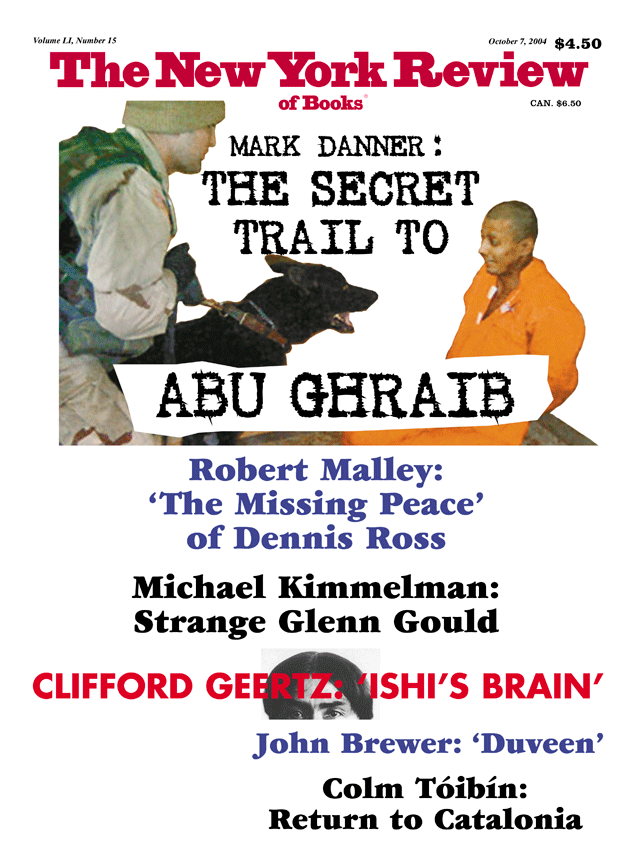
This Issue
October 7, 2004
-
1
See Edward Cody, “Iraqis Put Contempt for Troops on Display,” The Washington Post, June 12, 2004. ↩
-
2
See Osama bin Laden, “Jihad Against Jews and Crusaders,” February 28, 1998, in Voices of Terror, edited by Walter Laqueur (Reed, 2004), pp. 410–412. ↩
-
3
See my “Delusions in Baghdad,” The New York Review, December 18, 2003. ↩
-
4
See my “Torture and Truth” and “The Logic of Torture,” the first articles in the present series, in The New York Review, June 10 and June 24, 2004, respectively. ↩
-
5
See James Risen, David Johnston, and Neil A. Lewis, “Harsh CIA Methods Cited in Top Qaeda Interrogations,” The New York Times, May 13, 2004. ↩
-
6
See Risen, Johnston, and Lewis, “Harsh CIA Methods Cited in Top Qaeda Interrogations.” ↩
-
7
See Dana Priest and Barton Gellman, “US Decries Abuse but Defends Interrogations,” The Washington Post, December 26, 2002. ↩
-
8
See The Gangrene, translated by Robert Silvers (Lyle Stuart, 1960), pp. 81–82. ↩
-
9
See John Conroy, Unspeakable Acts, Ordinary People: The Dynamics of Torture (University of California Press, 2000), pp. 170–171. ↩
-
10
See Richard A. Serrano, “Prison Interrogators’ Gloves Came Off Before Abu Ghraib,” Los Angeles Times, June 9, 2004. ↩
-
11
See “The Logic of Torture.” ↩
-
12
Anthony Cordesman, “Goal in Iraq Is to ‘Get the Best Compromise You Can,'” interview with Bernard Gwertzman, Council on Foreign Relations, May 11, 2004. ↩