In the past year, Italy’s political life has come to resemble some strange cross between a Mexican soap opera and Suetonius’ description of the imperial excesses of the Caesars. First there were the revelations of Prime Minister Silvio Berlusconi’s peculiar relationship with Noemi Letizia, a teenage girl from Naples who called him “Papi,” prompting speculation about whether she was his illegitimate daughter or an underage lover. “I wish she was his daughter!” Berlusconi’s wife, Veronica Lario, commented; she asked publicly for a divorce, saying that she could no longer stay with a man who “frequented minors” and “was not well.”
Next there were the photographs of the bacchanalia with topless girls and pantless politicians at Berlusconi’s pleasure palace villa in Sardinia, recalling images of Tiberius at Capri. Finally, there was the case of the call girls attending Berlusconi’s parties at the presidential palace in Rome, many of them paid by a Southern Italian businessman interested in winning government contracts for his health care business.
Berlusconi’s bizarre behavior kept spilling over into international relations, leading to numerous embarrassing episodes. Seemingly jealous of Barack Obama’s star power, he referred to the newly elected US president as “tall, handsome, and suntanned,” and then, in explaining why he would not attend Obama’s inauguration, he said that he was a star, “not an extra.” After meeting Michelle Obama, he remarked that she, too, was suntanned.
At the same time, as if in the third ring of the circus, there were Berlusconi’s continuing legal troubles, a sixteen-year saga that has left a long trail of evidence of corruption, bribery, and contacts with organized crime. Last October, Italy’s highest court rejected a law that Berlusconi had passed granting himself immunity from all prosecution while he is in office. This meant he was again a defendant in a case in which his former British attorney, David Mills, had already been convicted of taking a $600,000 bribe from Berlusconi’s company to keep his name out of a series of other corruption investigations.
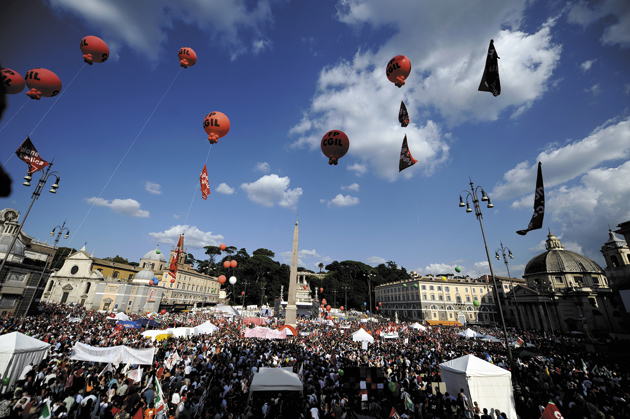
Berlusconi’s critics called on him to resign and, using the Internet, organized a mass protest in Rome on December 5 called “No Berlusconi Day,” which, despite the notable absence of Italy’s main opposition party, drew an estimated 350,000 Italians. Berlusconi proclaimed, with typical exaggeration, that Italy was on the point of civil war. And just when everyone thought it couldn’t get weirder, on December 13 a man with a history of mental illness struck him in the face with a stone replica of the Milan cathedral during a political rally in the city, breaking his nose and two teeth.
Within hours, his political associates—Maurizio Gasparri and Fabrizio Cicchitto, leaders of Berlusconi’s coalition in the Italian Senate and Chamber of Deputies—mounted a ferocious offensive, insisting that while the prime minister’s attacker may have been a mentally disturbed man acting alone, the “moral” sponsors of the attack were the newspapers and magazines and journalists who had created the “climate of hatred” around Berlusconi. The “party of hatred” was said to include journalists who published malicious gossip about his personal life, criticized his multiple conflicts of interest, wrote about the Mills case, and pointed out Berlusconi’s suspected ties to organized crime. Also at fault were the 350,000 demonstrators who had participated in “No Berlusconi Day” and the social networks of the Internet, which Berlusconi’s supporters in parliament have been trying to regulate, without success.
Taking advantage of a surge of sympathy, Berlusconi set back to work on a new law that would immediately eliminate the two criminal cases pending against him—the Mills case and another charging that his TV company, Mediaset, used offshore accounts to inflate the prices it paid for movie rights in order to cheat the Italian treasury of millions of dollars it would otherwise have owed. To avoid the suspicion that the law grants special status to Berlusconi, it is written so that it will absolve many other white-collar criminals and could eliminate as many as 80,000 to 100,000 criminal cases. By some counts, Berlusconi has passed eighteen laws that appear to have been written specifically to meet his own personal needs, but this time, neither Berlusconi nor his allies make much of a pretense that there is some larger public principle involved. It is government for and by one person.
A politician in most other democratic countries would have been destroyed by any one of these scandals, let alone several that have occurred in relentless sequence over a matter of months, and yet Berlusconi’s power has never been seriously in question. What are we to make of this bizarre situation?
Berlusconi’s persistent success—at least if measured by poll numbers—needs explaining. Is he simply a bizarre Italian anomaly in which sexist macho men and successful businessmen and swindlers are admired rather than vilified? Are the Berlusconi sex scandals merely froth and tabloid gossip, a kind of opera buffa that doesn’t stop his supporters from preferring him to a weak, divided, and inept center-left? Could the Berlusconi soap opera actually be a part of his appeal, a fusion of politics and entertainment prefigured by the kind of silly, salacious, and very popular TV programs that made his fortune? What if ratings and audience have replaced concrete accomplishments as the measure of political success?
Advertisement
Berlusconi has transformed the political life of a major nation into a kind of reality TV show in which he is star, producer, and network owner: he is the ultimate “Survivor,” who will lie and cheat to kick others off the island as well as “The Bachelor,” distributing roses to a group of beautiful young women. Consider that Berlusconi’s approval ratings are consistently higher than Barack Obama’s. As The Daily Beast pointed out recently, Obama’s TV ratings and poll numbers have gone down in lockstep as his health care legislation has been weakened and unemployment has remained high: “The fact is he had 49.5 million listeners to [his] first speech on the economy. On Medicare, he had 24 million. He’s lost his audience…. He has plunged in the polls.” Berlusconi, facing public scandals similar to those of Tiger Woods and John Edwards, has kept his audience.
Berlusconi has understood that contemporary politics is a permanent campaign. In the old days, a US president campaigned for six months and governed for three and a half years. Obama rather quaintly followed this old-fashioned model, working largely behind the scenes to promote health care and other legislation, while the Republicans held the stage, claiming that the Democratic plan imposed “death panels” and socialized medicine. Berlusconi would never have let that happen.
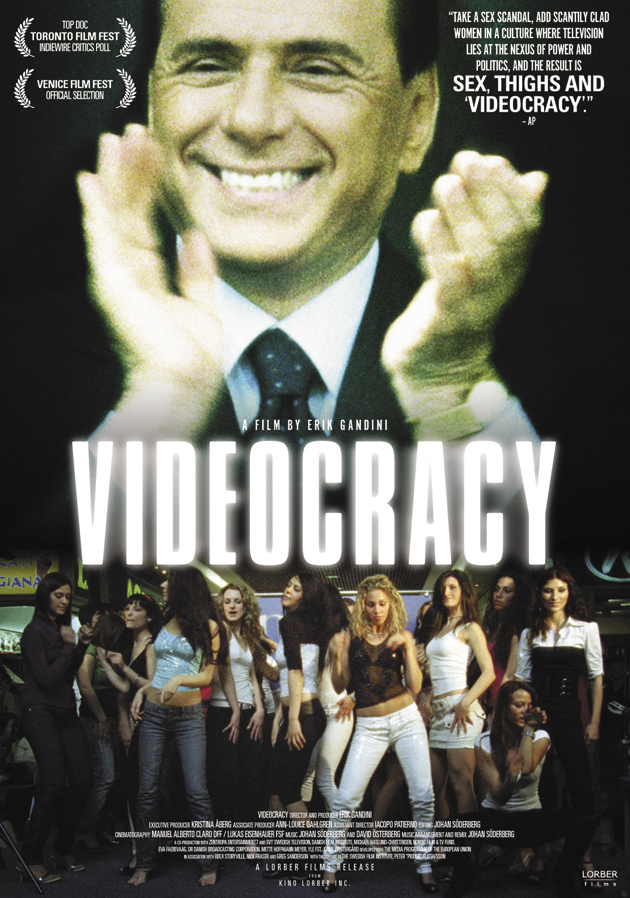
Several new books—together with the documentary film Videocracy—have come out in Italy describing the Berlusconi scandals of the last year (both sexual and legal) as well as offering some interpretations of Berlusconi’s staying power. What becomes clear is that the sex scandals are, in some sense, a natural progression of the extreme “personalization” of power that he has embodied. Berlusconi came to power soon after the fall of the Berlin Wall and the collapse of the ideologies that dominated Italian politics for most of the twentieth century. In Italy, political parties represented classes and major social groups. If you were a worker you voted for the Italian Communist Party; if you were a farmer or a small businessman you probably voted for the Christian Democratic Party. Political leaders—and their personal qualities—were not of supreme importance. During the cold war, the Christian Democrats along with four smaller satellite parties governed undisturbed for forty-five years in order to keep the Communists out of power. When the cold war ended, the corruption and inefficiency of one-party rule suddenly became intolerable and the governing Christian Democratic coalition disappeared almost overnight, leaving a majority of the Italian electorate unrepresented.
Berlusconi filled this void with extraordinary ability, understanding that his media empire—including the three largest private television networks—was the strongest institution left standing, and that his personal popularity and name recognition could be translated into political assets in an age in which celebrity mattered more than ideology. Instead of social and economic background, television preferences—which channels a person watches and for how long—are now the best predictor of a voter’s political preferences.
Berlusconi has personalized politics in a way new to Italy. Even in local races in which he is not a candidate, his face appears on most campaign posters. He has broken down the traditional boundaries between private and public by bringing into parliament members of his personal entourage—TV starlets, his personal lawyers, his personal doctor, accountants and executives from his companies, and scores of journalists and TV personalities, all of whom owe almost everything to him. He helped change the election rules so that voters do not get to choose among the candidates proposed by the parties. There is no question of primaries or intraparty polls. Instead the party secretary decides who will run where. This way everyone serves at the boss’s pleasure and individual politicians cannot claim special power to attract votes on their own. Under Berlusconi, politicians with a strong base of support in their home region have been replaced by personalities with quite different kinds of appeal: TV celebrities who can raise the profile of the party, friends and associates of the party secretary—and, increasingly, pretty girls with barely any political background.
The film Videocracy—a documentary made by Italian-Swedish director Erik Gandini—shows that the introduction of sex into TV was central to Berlusconi’s rise from the beginning. Post–World War II Italian culture was quite prudish—dominated by the Catholic Church and the austere Italian Communist Party. Berlusconi’s commercial TV, which began in the 1970s, flooded the TV screens and the minds of nearly sixty million Italians with a parade of scantily clad or seminude young women, the so-called veline, or showgirls, who appeared, silent but sexy, on either side of the male TV host. The film describes quite effectively how simply being on television—even when they are treated as a mute object or a sex toy—has become an ultimate aspiration among two generations of Italians.
Advertisement
One of the most telling moments in the story of Noemi Letizia, the Neapolitan teenager whose ill-defined personal relationship with Berlusconi—as described in Papi: Uno Scandalo Politico by the journalists Peter Gomez, Marco Lillo, and Marco Travaglio—set off the initial sex scandal, came when she told an interviewer: “I dream of being a ‘showgirl,'” and went on: “I am also interested in politics. I’m ready to take advantage of any opportunity at any of the 360 degrees of the circle.” When asked whether she might run for office in regional elections, she replied: “I’d rather have a place in parliament. Papi Silvio will decide.” In the world of Noemi Letizia—and of Berlusconi—being a showgirl and being a member of parliament are simply different ways of getting ahead and becoming famous.
Berlusconi did indeed bring several former showgirls into parliament in the 2008 elections. Two of them were made government ministers, one of equal opportunity, the other of tourism. Both had appeared, as starlets, on Berlusconi entertainment shows. A series of wiretapped conversations made during a criminal investigation was said to reveal that Berlusconi had a sexual relationship with some of these women but prosecutors destroyed numerous taped conversations of a “purely personal” nature because they had no bearing on the investigation. Wiretaps that have been made public show Berlusconi using the state television system as a kind of casting couch, getting auditions for le mie fanciulle (my girls) in order to “lift the morale of the boss.” In another instance, he worked extremely hard to get an acting part for the girlfriend of a senator of the center-left, hoping to use this as leverage to get the senator to switch sides and bring down the government of Romano Prodi, which was in power at the time.
The incident that initially infuriated Berlusconi’s wife, Veronica Lario, occurred in 2009 when he handpicked a couple of dozen showgirls, many of them young women in their early to mid-twenties, to be groomed as candidates for the European Parliament. Few of them had any political experience. One of them had been the weather girl on a Berlusconi network. Several had attended some of his private parties. He set up a school to give them a crash course in European politics so that they wouldn’t embarrass themselves during the campaign. Lario denounced the women as
trash without shame…who offer themselves like virgins to the dragon in order to chase after success, fame, and money.
Almost immediately, the right-wing newspaper Libero published a photograph of Lario topless from her time as an actress, reminding the public that she, too, had been a velina in her day. Libero also published an anonymous and almost certainly false account alleging that Lario was conducting an affair with her bodyguard, claiming that it was this—and not her husband’s conduct—that had provoked the rift within Italy’s first family. This type of gutter journalism apparently did not displease Berlusconi. He hired the editor of Libero, Vittorio Feltri, as the editor of the Berlusconi-owned newspaper Il Giornale, so that he could conduct character assassinations against others of the boss’s enemies.
The scene that callgirl Patrizia D’Addario describes in her memoir—of twenty almost identically dressed young women all vying for Berlusconi’s attention, stroking and petting him while he caresses them—is in many ways the realization of the same male fantasy that Berlusconi had been peddling on his TV stations for more than thirty years. “He wants to be adored by all the women who are here, he likes being touched, caressed, by many hands at once,” she wrote in her memoir Gradisca, Presidente (which means something like “At Your Pleasure” or “Help Yourself, Mr. President”).
I was watching the whole thing with curiosity and my first thought was that I’d found myself in a harem…. He was on the couch and all of us, twenty girls in all, were at his disposal. The younger women were in fierce competition with each other as to who could sit closest to the Prime Minister…. Having been an escort I thought I’d seen a lot, but this I’d never seen, twenty women for one man. Normally in an orgy you have roughly the same number of men and women, otherwise people get upset. But here the other men had no say. There was just one man with the right to copulate and that was the Prime Minister.
In many ways, perhaps the most revealing moment in D’Addario’s memoir came in their breakfast conversation the morning after her night at the presidential palace, which she captured on a digital tape recorder. Berlusconi is bragging about all the international meetings he has presided over, a G-8 summit, a G-14 summit, a G-16: “I am the only leader in the world who has presided over two G-8’s and now I will lead a third. Sono IN-SU-PER-ABILE! ” (“I am unbeatable!”)
D’Addario had little idea of what he was talking about. Despite a professed indifference to politics, she was put up as a candidate for the Rome city council as a member of Berlusconi’s coalition, although she received very few votes. She decided not to campaign—and to go public with her story—after Berlusconi failed to deliver on a promise that he had apparently made to her. He failed, she writes, to help her finish constructing a building she wanted to turn into a small hotel.
This scandal did not destroy Berlusconi in part because of his remarkable control of Italian television and the press. The news director of RAI-1 announced that he would not broadcast anything about the Berlusconi sex scandals, since it was gossip rather than news—a standard he has not maintained when the scandals involved politicians of the center-left. Indeed, the television stations and papers controlled by Berlusconi were able to drum up counter-scandals among his critics. Soon after being appointed the chief of Berlusconi’s Il Giornale and meeting personally with Berlusconi, who is technically not supposed to have any contact with the paper, Vittorio Feltri published a nasty story about the sex life of the editor of the Catholic newspaper LAvvenire, Dino Boffo, who had dared to criticize Berlusconi’s private conduct.
Feltri published what he said was a dossier revealing that Boffo had been accused of harassing a woman who was involved with a man whom Boffo was in love with. Boffo was forced to resign although the question remained: How did Berlusconi’s newspaper obtain information about what was supposed to be a sealed police investigation? Similarly, Berlusconi was handed another gift when police made and circulated a video of a center-left politician, Piero Marrazzo, consorting and snorting cocaine with a Brazilian transsexual prostitute. While the story was true, it was also clear that police, acting on a tip, ambushed Marrazzo with hopes of blackmailing him. They also circulated the video to gossip magazines in Milan, first among them the Berlusconi-owned Chi (Who); the magazine’s editor informed his owners and therefore Berlusconi knew about the tape.
The scandal broke, conveniently, when it did the most good in distracting public attention from Berlusconi’s own troubles. Berlusconi’s consorting with prostitutes appeared like good old-fashioned fun compared to the transsexual relations of the opposition politician. There are rumors that these same gossip magazines have damaging material about scores of politicians that is then used to keep them quiet. Controlling the police, the secret service, the gutter press, and the six main TV channels, Berlusconi is able to make and unmake scandals at will.
While most of the public attention, naturally, concentrated on the titillating details of Berlusconi’s sex life, in some ways the most serious aspects of the scandal received very little attention. Gianpaolo Tarantini, the man who paid D’Addario and several other women to go to Berlusconi’s party, was the head of a health care company from Puglia who was clearly trying to ingratiate himself with the prime minister in order to secure government contracts. Tarantini rented a large villa for some 70,000 euros (about $100,000) a month right next to Berlusconi’s pleasure palace in Sardinia and gave a string of parties with beautiful girls as a kind of honey trap for Berlusconi and other powerful people whose help he wanted. In Puglia and Sardinia, prosecutors have pieced together a seamy web of political patronage, prostitution, and cocaine, but they have done little by way of prosecution. Paolo Guzzanti, a former Berlusconi supporter and employee turned critic, writes that Italy, rather than being a videocracy, has become a “whore-ocracy”—in which hundreds of thousands of people, male and female, perform services for the powerful, some for cash, others for jobs, contracts, and privileges.
The idea of a whore-ocracy has gained considerable credibility in the last few weeks as the outlines of another major scandal have emerged. Prosecutors in Florence have arrested and indicted dozens of contractors and government officials involved in Berlusconi’s Civil Protection Department, the Italian equivalent of the US Federal Emergency Management Agency. Berlusconi has held up this agency as the shining example of his policy of creating a government of “doers” rather than talkers. The ministry’s head, Guido Bertolaso, was credited with the “miracle” of getting the garbage off the streets of Naples, responding to last summer’s earthquake in the Abruzzo, and managing various other public works projects.
In fact, if prosecutors are correct, Bertolaso’s ministry is an ugly tangle of cronyism, waste, and corruption, as well as prostitution. One favored contractor allegedly arranged a private party for Bertolaso involving call girls. Bertolaso insists that he only received “therapeutic massages” but has yet to explain why condoms were distributed at the party. It turns out that the expenses of Gianpiero Tarantani—who paid Patrizia D’Addario and other escorts of Berlusconi—were not in vain: he and his partners appear to have illegally benefitted from Bertolaso’s public works agency thanks to an introduction provided by Berlusconi.
A year after the earthquake, the city of Aquila, the capital of the Abruzzo and epicenter of the disaster, turns out to be a ghost town in which virtually no reconstruction work has taken place. The center of the city had been fenced off as a construction site and television cameras were kept out until angry citizens broke through a police barrier in order to see what had become of their homes. They were stunned to find everything exactly as it was the day of the earthquake. Meanwhile, Berlusconi-controlled state television had been running story after story about “the miracle” of the Abruzzo earthquake reconstruction efforts.
The latest set of scandals help make plain why Italy under Berlusconi has sunk into mediocrity. Italy is dead last in GDP growth per capita of all the thirty countries in the Organisation for Economic Co-operation and Development (OECD), a key measure of productivity and wealth. The average OECD nation grew at an annual rate of 2.6 percent between 1994 (the year Berlusconi first became prime minister) and 2007, while Italy grew at an annual rate of less than 1.5 percent. If Italians are not in a state of rebellion it is in part because the recession has not set off a dramatic string of bank failures and housing foreclosures or a national debt crisis, as it has in Greece, according to Tito Boeri, a professor at the Bocconi University in Milan, Italy’s leading economics and business university, and the editor of La Voce, a major Web site of economic news and analysis. “But if you look at Gross National Product and per capita income,” he said,
Italy has done worse than almost all other major countries, worse than Germany, than the US, than the UK, and much worse than France, which is a comparable country. We were doing worse before, part of a historic decline, and we have done worse during the recession.
The effects of the recession have been more bearable because the layoffs have primarily hit younger workers, many of whom still live at home; the Italian family has lessened the impact of the downturn.
Italy has done little or nothing to prepare itself for the future. Spain has increased its university population sevenfold since restoring democracy in the mid-1970s and now nearly 29 percent of its adult population has a university degree, while Italy is still poking along with only 12.9 percent. The norm in the OECD is 26 percent. Italy invests less than half the OECD average in research. Instead, one of the main features of Berlusconi’s economic program was something called the scudo fiscale—the tax shield—which allowed people who have been hiding their assets overseas to bring them back to Italy while paying only 5 cents on the dollar—a holiday for tax evaders and money launderers. This kind of crony capitalism will not pull Italy out of its economic funk. Italy is also ranked 84th out of 128 in the World Economic Forum’s 2007 index of gender equality, well after places like Uganda, Bolivia, and Kenya. The sexism of Berlusconi’s media and private conduct permeates the society as a whole. This is an economic and not just a moral issue since female participation in the workforce is a major factor in economic growth.
Berlusconi has also been highly successful in keeping information about the recession out of the news. He attacks as “defeatist” mass media outlets that have been covering the story and accuses them of having fostered the crisis by alarming Italian consumers. Berlusconi’s control of the press and television is unprecedented in a major democracy. Much of his career has been dedicated to the concept that it is appearance and not reality that counts. “Don’t you realize that something doesn’t exist—not an idea, a politician, or a product—unless it is on television?” Berlusconi explained to one of his closest associates. Continuing to remain popular in spite of incompetence, corruption, and national decline, he has shown there is much to that point of view.
Berlusconi’s long tenure in Italy is also, of course, a testament to the parlous state of the country’s opposition, which is hopelessly divided and lacking in vision. The Democratic Party—the principal opposition party—chose not to participate in the “No Berlusconi Day” in December, wasting an opportunity to address 350,000 potential voters and to tap into a growing protest movement on the Internet. The party’s new leader, Pier Luigi Bersani, is an intelligent but somewhat traditional politician, with roots in the old Italian Communist Party. He seems wary of a protest movement that has grown up independent of conventional politics. The parties of the opposition are still eager for a couple of minutes on prime-time TV, chasing after Berlusconi in a domain where he will always win, rather than using the new media that Berlusconi does not control and through which they might develop new forms of political communication and organization.
But while it is possible to manipulate sex scandals or to dismiss well-documented criminal cases as political witch hunts, it is harder to convince ordinary voters that they are better off when they are not. Many Italians are struggling to make ends meet and, according to some polls, they sense that all is not as it appears to be. So far no promising opponents have emerged to challenge Berlusconi; but as the economy fails to grow, reality may slowly make a comeback. Or perhaps Italy will continue to be enthralled by the ongoing reality TV show that Berlusconi has created.
—March 11, 2010
This Issue
April 8, 2010
This Issue
April 8, 2010

