

1.
One evening last October, several hundred new recruits to the Shimshon Battalion filed into the vast plaza adjoining the Western Wall in Jerusalem. At a site normally thronged with worshipers, the soldiers gathered to be sworn in to the Israel Defense Forces (IDF), surrounded by parents and well-wishers who snapped pictures and recorded the proceedings with handheld video cameras. One of the videos would soon make news, capturing the moment when, instead of proudly reciting the oath of loyalty in which military induction ceremonies traditionally culminate in Israel, two of the recruits unfurled a banner that left the nature of their loyalties unclear. “Shimshon Does Not Evacuate Homesh,” the banner proclaimed.
Homesh is a Jewish settlement whose existence may have slipped the minds of some Israelis, not least since, officially speaking, it doesn’t exist anymore. Situated on a steep hill a few miles northwest of Nablus, the remote, sparsely populated outpost was one of four West Bank settlements from which Israel withdrew in 2005 in connection with the Gaza disengagement plan carried out by Ariel Sharon. Houses were demolished, residents were relocated, and the area surrounding the vacated village was turned into a closed military zone. This hasn’t stopped some messianic Jewish settlers from returning to rebuild it. Again and again in recent years, the IDF has dispatched soldiers to remove them, but the settlers keep coming back, organizing pilgrimages, opening a yeshiva, and turning the ruins of Homesh into a symbol of their spiritual resolve.
The members of the Shimshon Battalion who held up the banner at the induction ceremony were letting their commanders know that, if ordered to dislodge the settlers from Homesh again, they would refuse, out of loyalty to God. The Israeli military wasted no time in dismissing their gesture of defiance as “a disgraceful disciplinary aberration.” Those responsible were sentenced to twenty days in prison, expelled from the brigade, and denounced in a speech before the Israeli Knesset by Defense Minister Ehud Barak. Yet a few weeks later, another sign appeared, this one suspended from the roof of a dining hall on a military base by members of the Nahshon Battalion, which declared, in solidarity, “Nahshon Also Does Not Expel.” Two of the soldiers involved were squad leaders who, earlier that day, had refused an order to block right-wing activists from reaching another West Bank settlement where the Israeli Civil Administration had ordered the demolition of two illegal buildings. This was followed by a third sign, put up at the training base of the Kfir Brigade: “Kfir Does Not Expel Jews.”
Until recently, displays of disobedience in the Israeli army were mainly carried out by so-called “refuseniks” on the left who risked being branded traitors (and sent to prison) to avoid serving in the occupied territories. The refuseniks making noise today come from Israel’s religious right, and they want to preserve the occupation, not end it. “Today, over a quarter of young officers wear skullcaps,” an Israeli general recently told the International Crisis Group, which devoted part of a July 2009 report to the trend. “In the combat units, their presence is two or three times their demographic weight. In the Special Forces it’s even higher.”
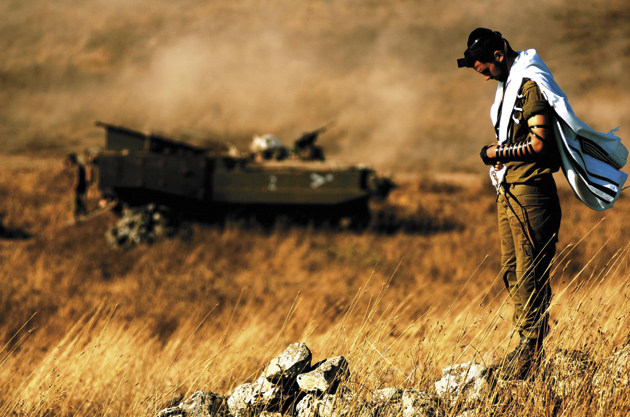
Some of these soldiers enter the military after attending pre-army Torah colleges, state-funded preparatory schools where high school graduates enroll for one year of “spiritual fortification” before joining their peers. Others go to places like the Birkat Yosef Hesder Yeshiva, a religious academy funded by the government under a formal arrangement with the Ministry of Defense, where roughly 250 students divide their time between Torah instruction and military service over a five-year period. The first hesder yeshiva opened its doors in 1965: around fifty such institutions are spread across Israel and the West Bank today. Some of the soldiers responsible for the recent sign-waving incidents were graduates of Birkat Yosef.
Last November, I visited Birkat Yosef, which is set on a hillside overlooking the orange-roofed houses of Elon Moreh, a settlement near Nablus. The adjoining valley is where, according to Genesis, Abraham first entered the land of Israel, and where in the 1970s members of Gush Emunim, the movement dedicated to establishing Jewish settlements in the West Bank, began appearing with prayer books in hand. I met the academy’s director, Rabbi Elyakim Levanon, in his office, where he sat beneath a framed photograph of his mentor, the late Rabbi Tzvi Yehuda Kook, the spiritual father of the settlement movement, with whom he studied for sixteen years. I asked him what would happen if the army ever ordered a large-scale removal of Jewish settlers from the West Bank, which he regards as sacred Jewish land. “This will destroy the army,” he said. “The order to do it will destroy the army.” He compared it to being asked to eat nonkosher food. “If a [religious] soldier is told to eat milk and meat, what will he say? ‘Because they’re telling me, I’ll eat it?’ He won’t eat it.”
Advertisement
2.
The Israeli army has long maintained that it is up to commanders, not soldiers or their rabbis, to decide which missions to perform. But the IDF has never been a purely secular institution. As Stuart A. Cohen notes in Israel and Its Army, the desire to integrate religious soldiers into the military led Israel’s secular founders to chart an accommodating path. From the start, army bases were equipped with synagogues; mess halls observed kosher dietary laws. Copies of the Old Testament were given out to soldiers at induction ceremonies, and all troops were required to attend ceremonies such as the blessing of the wine before the Friday evening Sabbath meal. The goal, in part, was to foster cohesion. “Our army will be a united army, without ‘trends,'” David Ben-Gurion insisted. The IDF’s accommodation of religious observances had the added benefit of imbuing military service with spiritual meaning.
Still, for many years religious young people either had an inconspicuous part in the army or avoided being drafted by requesting a deferment available to yeshiva students who wished to pursue full-time Torah instruction. The IDF’s senior levels were dominated by secular Ashkenazi Jews of European extraction and its elite battalions manned disproportionately by soldiers raised on kibbutzim. To some extent, the changes simply mirror how Israel itself has changed. A few decades ago, when becoming an officer was regarded as a means of upward mobility, young Israelis from the secular middle class competed fiercely for spots in the army’s top units. Today, many such young people aspire to be tech workers, patent attorneys, or filmmakers. They live in and around the prosperous commercial center often referred to as the “Tel Aviv bubble,” where few people go around boasting of being officers anymore.
Practically all secular Israelis still fulfill the basic terms of military service required of citizens once they reach the age of eighteen—three years for men, two years for women, followed by reserve duty whose length and frequency varies depending on the unit. But many no longer grow up hoping to serve in elite front-line units or become officers, a trend dating back several decades. New groups—immigrants, religious soldiers—have taken their place. Not only are some 30 percent of officers openly orthodox but an estimated 50 percent of soldiers in officer training colleges are now religious. While many secular recruits from less nationalistic backgrounds have gravitated to noncombat units, their religious counterparts have volunteered for infantry battalions in which they not only serve but also lead. “In a few years, religious soldiers will make up the majority of brigade commanders in all areas,” a “military Torah college head” told the International Crisis Group.
The transformation of the political landscape has accelerated the shift. The nationalism that swept through Orthodox circles after the 1967 Six-Day War created a large pool of highly motivated religious conscripts. Later, the 1982 Lebanon war and the first Palestinian intifada disillusioned many secularists, some of whom went on to become refuseniks. Meanwhile, the hesder yeshivas and, later, pre-army Torah colleges emerged, smoothing the recruitment and advancement of religious soldiers.
As a result of these changes, religious soldiers now “see themselves as leading the army,” said Amos Harel, the military correspondent for Haaretz. Harel told me the story of a recent ceremony for an elite paratroopers’ brigade at which a female soldier rose to sing an anthem, unaware that she was violating a Jewish religious ruling known as kol haisha arve, which holds that listening to the voice of a woman is improper. The religious soldiers in the audience decided to boycott the performance. “I think about one hundred soldiers left, because they refused to listen to or watch a woman singing,” Harel said. At the Shimshon Battalion’s swearing-in ceremony where soldiers held up the protest sign, three different religious leaders delivered sermons during the proceedings, interspersed with spiritual songs, according to Dror Ze’evi, a professor of Middle East studies at Ben-Gurion University, who was there because his son was among the inductees. Ze’evi himself had been inducted into a paratroop brigade a few decades earlier, also at the Western Wall, in a simple service with no preaching. The contrast with his son’s ceremony, he told me, disturbed him.
Overt preaching has cropped up on the battlefield as well. While serving in the Gaza war last January, a reservist I’ll call Avi Shalev (he did not want his real name used) attended a pep talk on his military base by a rabbi who cast the Gaza war as a battle between bnei ha-or—the children of light—and bnei ha-hosheh—the children of darkness. “In Hebrew literature, this is an eschatological war, a messianic war,” Avi, who was himself brought up in the religious education system, told me. His disquiet deepened after he acquainted himself with some of the religious pamphlets strewn around the base. One called for soldiers to show no mercy toward the enemy. Another consisted of a series of questions and answers. “Is it possible to compare today’s Palestinians to the Philistines of the past?” it asked. “A comparison is possible because the Philistines of the past were not natives…. The Palestinians claim they deserve a state here, when in reality there was never a Palestinian or Arab state within the borders of our country.” The pamphlets were inscribed with the insignia of the army rabbinate and the IDF, which Avi said would have troubled him whether or not he agreed with the message. “Every person in the country is supposed to go to the army and in order for that to take place the army has to be a neutral place,” he said.
Advertisement
Avi eventually took his concerns and some copies of the pamphlets to the group called Breaking the Silence, which recently published a collection of soldiers’ testimonies from the Gaza attack—called Operation Cast Lead—that features similar accounts from other reservists. An official in the army’s education department said that the more incendiary rabbis were outsiders. The IDF affirmed in a written statement that its chief rabbi, Avichai Rontzki, did not see or approve any published material that deviated from the “inclusive policy” he set, a characterization that some of the army’s own officers might find curious. Before the war, Rabbi Rontzki expanded the activities of a unit responsible for inculcating soldiers with Jewish values but that some officers complained was engaging in religious proselytizing and political “brainwashing.”1 Appointed by then Chief of Staff Dan Halutz in 2006 in an effort to appeal to the national-religious community, Rabbi Rontzki lives in the settlement of Itamar. (He wouldn’t be interviewed for this article, and will soon be replaced by Rafi Peretz, a rabbi from a similar background who is regarded as less divisive.)
Some Israeli commentators regard the growing influence of the religious right in the IDF as an ominous development. “Up until this period, the military prided itself on being very just-war oriented—that was the language we spoke,” said Mikhael Manekin, co-director of Breaking the Silence (and himself a former IDF officer). “That’s the military ethical code and I think it’s common to most Western militaries. Now you’re talking about a different voice within the military. And a different voice openly within the military and sometimes prominent in the military.”
3.
Rabbi Moshe Hagar-Lau, a tall, rangy man with a bristly black beard, runs the Beit Yatir pre-army Torah college in the southern Hebron Hills, across the Green Line. In his sparely furnished office, I spotted a familiar picture on the wall, a photograph of Rabbi Yehuda Kook, who he affectionately referred to as “my rabbi.” Pinned up next to Kook’s picture was another photo, however, of the person Rabbi Hagar-Lau called “my commander”—Defense Minister Ehud Barak. “In the army, there is only one commander,” he said, which is why students at his academy were taught to obey orders whether they agreed with them or not.
Rabbi Hagar-Lau led me to the dining room, where lunch was being served. I asked a cluster of students in jeans, T-shirts, and yarmulkes what they would do if given an order to evacuate settlers. One who used to live in Gush Katif, a bloc of seventeen settlements in the Gaza Strip that was dismantled in 2005, told me this would be extremely difficult for him. But he said he would do it. All the others nodded.
Some analysts, including Stuart Cohen, believe that the threat of insubordination is overblown. Back in 2005, before Gush Katif was evacuated, numerous observers predicted that an attempt by the IDF to close such settlements would divide Israel and lead to mass refusal among the several thousand soldiers deployed for the mission. In the end, sixty-three soldiers were punished for disobeying orders, but there was no mass refusal. The event showed how strong the bonds of loyalty and discipline are in the army. Yet as the sociologist and IDF analyst Yagil Levy has shown, the smoothness of the disengagement owed a great deal to the meticulous planning that preceded it. Before a single settler was removed, units with a high percentage of religious conscripts were not allowed to deal directly with the settlers.2
A senior IDF official told me that commanders are being trained to deal with future outbreaks of disobedience. But if a similar withdrawal from the West Bank were planned, Levy does not believe that such a smooth operation could be repeated; in the West Bank, there are far more settlers. For Israel’s religious right, he said, settlements such as Hebron and Elon Moreh are “the real game.” A senior Israeli military officer told the International Crisis Group that he would “rather give back Tel Aviv than Hebron,” which he described as “Jewish land” that “is promised to us by the Bible, by God…. This ideology is the backbone of the army, and so I will not obey such an order.”
During the Gaza disengagement, many settler leaders and rabbis called on soldiers not to disobey because, as they saw it, disobedience would turn the country and the security establishment against them. By contrast, when the Israeli government introduced a plan to dismantle twenty-six illegal settlement outposts in the West Bank last May, a coalition of rabbis based in the settlements advocated refusal. “The holy Torah prohibits taking part in any act of uprooting Jews from any part of our sacred land,” they wrote. After the incidents in which conscripts waved signs, some of the same rabbis met to praise them as “heroes.” An organization on the far right called SOS Israel, which strenuously opposes ceding any part of the Holy Land to non-Jews, held a ceremony in Jerusalem to bestow 20,000-shekel cash prizes on the members of the Shimshon Battalion who started the trend.
Although Prime Minister Benjamin Netanyahu warned after the sign incidents that challenging the IDF’s hierarchy could “bring about the collapse of the state,” Aryeh Eldad of the National Union party and Tzipi Hotobeli of Likud responded by introducing a bill that would prohibit the army from carrying out any future evacuations; eleven ministers joined as cosponsors. The measure calls for restricting such politically sensitive missions to the police—a force without the manpower or resources to execute them. Although the bill stands little chance of passing, it shows how much the political climate in Israel has shifted to the right since the Gaza disengagement, with a bloc of Knesset members now openly challenging the IDF’s authority to carry out missions in the territories that they believe, perhaps not wrongly, could spark mass mutiny.
Until recently, Ilan Paz, a retired brigadier general who served as head of civil administration in the West Bank, regarded pro-settler disobedience as a minor danger. He no longer feels this way: “I’m less worried about the problem of the soldiers—because with soldiers the army knows how to deal—than with the public support this phenomenon gets from the more right-wing sectors of society, from rabbis, from heads of the yeshivot hesder…from members of the Knesset.” Paz noted the irony of right-wing Israelis—long-standing allies of the settlers—suddenly demanding that the IDF not intervene in political matters related to the occupied territories. “If we don’t find a way to stop this phenomenon, in my opinion it will proliferate, and the army won’t be able to do anything in the territories,” he said.
In December, Defense Minister Ehud Barak ended the IDF’s relationship with the Har Bracha Hesder Yeshiva, whose leader, Rabbi Eliezer Melamed, had published a book distributed to its graduates that unabashedly promoted refusal.3 It was an unprecedented step, a signal from the defense establishment that rabbis preaching insubordination will not go unpunished. Yet the other academies in the program, including the one run by Rabbi Levanon, are still being funded by the government, despite evidence that some of their leaders occasionally preach a similar line. In January, it was revealed that Rabbi Haim Druckman, who heads the committee that oversees hesder yeshivas and is considered a relative moderate, endorsed insubordination in a leaflet distributed in synagogues. At a subsequent meeting with an aide to Prime Minister Netanyahu, Rabbi Druckman insisted that he did not support refusal, but went on to say that there were times when a soldier could not obey an order that violated his conscience, which in his view did not constitute insubordination.
For a generation of national-religious youth who grew up in its aftermath, the Gaza disengagement has become a symbol of shameful acquiescence. Some of them are in the IDF now; others, like Moshe Frumberg, will be soon, unless they or their commanders have second thoughts. A seventeen-year-old settler with six-inch side-curls, Frumberg was recently summoned to a draft center in Jerusalem to undergo an initial round of tests the army conducts for recruits. Before leaving, he and two friends hung a sign at the entrance that declared, “We Won’t Be Drafted to Evacuate Jews!”
Frumberg lives in Havat Gilad, an illegal settlement outpost populated by young people known for their militant views. An admirer of the late Meir Kahane, he told me he’d slash the tires of trucks to prevent settler evacuations. Where was the limit to what he would do, I asked? “There is no limit,” he said. Even among settlers, such views are extreme. But opposition to giving up more land—and a stated willingness to act on this belief—is increasing. While I was in Israel, a television reporter asked new recruits whether they would refuse orders to evacuate settlements. One after another said they would. A poll commissioned in February by the Maagar Mochot, an Israeli research institution, found that 48 percent of Israeli high school students would disobey evacuation orders. Of this group, 81 percent described themselves as religious.
On November 25, Netanyahu announced a ten-month freeze on some settlement construction. Settlers responded by blocking roads to prevent inspectors from handing out orders and, in one case, torching and desecrating a mosque, part of a new strategy to exact a heavy “price tag” for any measure detrimental to their interests.4 So fierce a reaction can be viewed as a sign of their fear that, like Ariel Sharon, Netanyahu may betray them. It can also be viewed as the predictable consequence of policies that have led settlers to feel they are entitled to take the law into their own hands. For all the outrage at the freeze, Dror Etkes, a researcher who has observed settlement activity for nearly a decade, told me that a halt in settlement construction has been observed at no more than a dozen West Bank sites and ignored at roughly fifty others. There is, he said, more construction underway across the Green Line today than a year ago.
Back in November, just before the freeze made headlines, Etkes took me to Haresha, a hilltop community near Ramallah that was established more than a decade ago without a legal permit. Today it has a synagogue, a school, an outdoor basketball court, and several houses built on what Etkes said used to be private Palestinian land, which the Israeli Civil Administration now claims is “state land.” A paved road connects houses that have been hooked up to the same electricity grid and water supply that serve other legal and illegal settlements nearby. The Ministry of Housing helped subsidize construction. Orders to demolish the houses have been ignored. At one point, Etkes pulled to a stop in front of a bus station where a poster had been taped up on a glass window. It was a notice alerting residents to the event being held to honor “the loyal soldiers” of the Shimshon Batallion who disrupted their swearing-in ceremony.
—March 31, 2010
This Issue
April 29, 2010

This Issue
April 29, 2010
-
1
See Amos Harel, “Israel Military Rabbi Under Fire for ‘Brainwashing’ Soldiers,” Haaretz, October 23, 2008. “In a number of cases it is religious brainwashing and, indirectly, also political [brainwashing],” a senior officer quoted in the story complained about Rontzki’s activities. ↩
-
2
See Yagil Levy, “The Embedded Military: Why Did the IDF Perform Effectively in Executing the Disengagement Plan,” Security Studies, Vol. 16, No. 3 (2007), pp. 382–408. ↩
-
3
In the book, Revivim, Rabbi Melamed writes, “A simple halakha [law] is that it is forbidden for any person, whether a soldier or an officer…to participate in the strictly forbidden act of expelling Jews from their homes and handing over any portion of the Land of Israel to enemies.” See Amos Harel and Anshel Pfeffer, “Meet the Rabbi Spurring IDF Troops to Refuse Orders,” Haaretz, November 18, 2009. ↩
-
4
The strategy is described in detail in the report “Israeli Settler Violence and the Evacuation of Outposts,” United Nations, Office for the Coordination of Humanitarian Affairs, occupied Palestinian territory, November 2009. ↩