My chair was on casters and began to roll. A large earthquake starts as a small earthquake. I saved my novel: Control+S. The horizon swayed at an angle. I had time to think many things—that’s how long the quake lasted. I thought that I should stand under the lintel of the doorway. I took my laptop and started to leave. Then, unsteady on my feet, I wondered whether the laptop wouldn’t be safer where it was. I put it back on the table. I went outside.
The office was a bungalow in a residential complex owned by a man who had made his fortune in powdered sugar. His wife had planted an elaborate garden of hanging and potted vases; they were falling or had fallen. The quake was a series of rolling waves, each sharper than the next. I expected them to stop but they didn’t. The visual effect was precisely that of the grainy videos that would later be shown on television, as of somebody shaking a camera sharply. It was tremendously loud—like huge stones grinding; I am not sure now if the sound was produced by the movement of the earth or by the simultaneous collapse of so many buildings.
I was alone on the sugar magnate’s flowery terrace. I dropped to one knee, not shaken to the ground, but unbalanced, as if I had spun around in circles too many times. It did not occur to me for a second that I might die. I was panting heavily. A fissure in the earth opened up in the concrete beside me, perhaps a foot wide, a foot deep, and at least thirty feet long. The earthquake seemed to last an immensely long time, seemed to gain in power always, and when it was over the movement of the earth did not subside or taper down: it simply stopped. For five seconds or perhaps longer, the world was perfectly still and immensely quiet. Then the screaming began.
I knew that Cristina, Leo, and Bruno—my wife, my ten-month-old son, and my father-in-law, on vacation from Italy—were at home, and that I had to get to them as quickly as possible. But I wasn’t worried. I knew that something could have happened to them but I knew that nothing had happened to them; a kind of reptilian optimism. I began to run. I had always imagined that the adrenaline response augmented one’s energies. But the opposite was true: the run to the house was all downhill, yet I was gulping for air, almost vomiting. Cristina, Leo, and Bruno were waiting for me at the bottom of the driveway. Cristina was in tears. The baby was collected and calm.
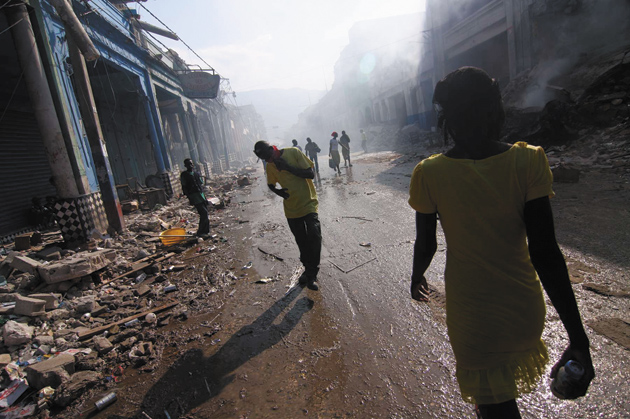
Port-au-Prince is a city of high walls, all of which came down. At first glance, the city seemed prettier in the fading light of day as all over Port-au-Prince secret gardens and hidden terraces covered in flowers and lawn furniture emerged from behind the collapsed walls. Inside these clandestine gardens, security guards fingered their guns and householders sat on curbsides. A wall had fallen on a neighbor’s pickup truck. A barrel of gasoline had overturned, leaving the road slick. Crowds began to arrive almost immediately at the Primature, the residence of the prime minister. There was a mood of fragile gaiety in the air, like the first minutes of a very lively party, ripples of giggles and laughter. A few women were in complete hysterical collapse—wailing, pounding the pavement, dragged along by men to the relative safety of the Primature.
A cluster of women began singing hymns; soon other women would join them; they would not relent for days. There were women dancing. A very large woman wearing a yellow bra cradled an unmoving bloodied child in her arms. (For some reason, my memories of the event are chiefly of women: women wailing, singing, dancing, crying, cradling the wounded, or wounded themselves; then later as corpses.) Beside my office, a large apartment complex had been in construction, two buildings, each four stories. It was a landmark on the horizon. Now one building was gone, and the other listed at a sharp angle.
All evening long there were aftershocks. We pulled a couch and chairs out of the house and sat in the driveway. Our house had suffered almost no damage; we were in no immediate danger. We had food and water for at least a week. We arranged Leo in his portable crib and covered him well with a mosquito net. He fell asleep at his habitual hour and did not wake up until the morning. We heard singing and drumming all night long—and high throbbing prayer like chanting, which as the aftershocks came redoubled in intensity to shouting. “T’ann prie, Jezi. T’ann prie,” they chanted. We beg you, Jesus. We beg you. Every now and again through the night there was a thud or an explosion. Our cellular telephones did not work. Our neighbor claimed to have been able to call on his network, but his phone, which functioned like all Haitian phones on a prepaid basis, was out of credit. I went out to look for cell-phone credit.
Advertisement
A large knot of people had gathered on the cul-de-sac leading to my office: a woman there had Internet access via satellite. She allowed me to write to our families that we were fine. Cristina’s radio with the Mission des Nations Unies pour la Stabilisation en Haïti (MINUSTAH) did not function. “Sierra Base, Sierra Base, this is Papa Golf 224,” she said. There was no response, only static. We listened to the car radio. Across a normally busy dial, there were only three operating stations. One was playing lively kompah music. Another was Radio France Internationale. On the hour they had news briefings announcing first a quake in Haiti, then an hour later a massive quake in Haiti, then two hours later a catastrophic quake in Haiti; this was between news of an African coup and interviews with French artists, writers, and intellectuals. Then there was a Creole news station. The director of a private morgue was on the air, asking for the emergency donation or loan of a 10–15 kilowatt generator. Later there was a preacher on the same station, announcing the “fin de temps. ”
It was a remarkably clear and beautiful night. The electricity was out all over Port-au-Prince, and when the moon set in the absence of light pollution and as the dust settled, a night sky of remarkable clarity emerged—the Big and Little Dipper, clouds of constellations. The night had a chill to it. Cristina was worried that Leo was cold and covered him with blanket after blanket. Even between aftershocks the earth did not feel stable but rather seemed to sway slightly as on the deck of a ship. The cat finally came home, tentatively meowing her presence, only to have the neighbor’s dog chase her off. She fled to the roof of the house.
The very strange thing was this: there were no sirens, no helicopters. We spent the better part of the night making lists of people we knew: our nanny, our friends, Cristina’s colleagues. Smith the real estate agent—he had a newborn daughter; so did Pierre the taxi driver. Boss Reginald the mechanic. We were alone in the driveway of our house as if the earthquake had sheared off the rest of the world, but for the sound of the praying, which finally abated not long before dawn.
In retrospect, the chief emotion I suffered in the days immediately following the quake was a powerful curiosity; an overwhelming desire to see for myself just what had happened. This was one of the most powerful emotions I have ever experienced. The next morning, I went on foot to the Hotel Montana. I had heard a rumor in the night that it had collapsed but did not believe it—the Hotel Montana was like a fortress! I was in San Francisco for the Loma Prieta quake of 1989. We had heard rumors that the Golden Gate Bridge had fallen into the Pacific, that the UC Berkeley library had burned to the ground. I imagined that now, too, the rumors far outstripped the truth. In this case, however, nobody knew what had really happened to Port-au-Prince.
Those who had come to the neighboring Caribbean islands or the Dominican Republic on vacation must have been delighted with the weather that morning, warm with a deep blue sky. Now the great lawn of the Primature was almost full. There was no organized aid or assistance, no Red Cross station, no sirens, no sign of the Police Nationale d’Haïti. The only official presence was a single security guard cradling a shotgun and dozing in a chair. People were stringing tarpaulins from trees to shelter themselves from the strong mid-morning sun. One shady patch of the Primature served as cemetery, the bodies wrapped in blankets and discarded there, a few powdered limbs escaping. The predominant smell of the earthquake in my experience was not decomposing bodies, as has been often reported in the press, but piss and shit.
The road to the Montana hugs a deep ravine, on both flanks of which and in the valley below a vast bidonville had been constructed, a cinder-block city densely reticulated in its narrow passageways like an Arab souk. This was not the housing of the very poorest, but of the Port-au-Prince middle class: people who could afford to rent or buy shelter. In our own house, one bottle had broken while its neighbor remained upright. In the bidonville, some houses had collapsed and the collapse of one house brought down the next; but in other places a patch of ten or twenty houses clung stolidly to the side of the hill. The collapsed houses were a smear of cement. Within the bidonville there were large open spaces—a soccer field, for example—and in these open spaces clusters of people had settled. Afterward, people who were not in the quake always asked about the bodies. But at the time, the bodies were far less shocking than the collapsed houses. The dead were discreet. The massive untidy solidity of a collapsed building was awful.
Advertisement
The side of the mountain had collapsed on the road, partially burying a pickup truck. A woman had been caught in the flatbed. Her eyes were open; the impact had split open her guts; she was covered in a film of gray dust. I thought to myself that she would haunt my nightmares but in fact writing this now is the first time I have recalled her since the event. On the side of the road there were souvenir vendors with brightly painted metal lizards and other handicrafts.
The mountain reeked of cologne: a small parfumerie had collapsed. On a large green lawn, wounded from the hotel lay in the deck chairs in which they had been evacuated. One man was still in a swimsuit. An Argentine helicopter landed, one or two of the wounded were loaded up, and the helicopter took off again, disappearing out of view into the vastness of the city. The twenty-foot steel wall surrounding the Montana was still standing and its gate was closed, hiding the damaged hotel from view. Under ordinary circumstances, the hotel loomed far above the walls. Now it had simply disappeared.
My wife and I came to Haiti in the spring of 2007 when she found a job with MINUSTAH. We had spent almost two years in the provincial town of Jérémie, then after Leo’s birth moved to Port-au-Prince. I was writing a novel about MINUSTAH. The protagonist of the novel was a former deputy sheriff from Florida, who joined the mission as an UNPOL—a police officer working with the UN to monitor, mentor, and support the Police Nationale d’Haïti. I wrote:
In the restaurant, they had a DVD of Aristide on the television. Jean-Bertrand Aristide was Haiti’s crazy ex-President. In his time in power, he dismantled the military and the police force, fearing, not without reason, a coup d’etat from one or the other. Then he distributed arms to his class allies, the gang lords who ran the slums. This created social stability to about the extent you can imagine. By the time Aristide fled Haiti in 2004 and the United Nations arrived, the country had fallen apart. Some blame Aristide, some blame his enemies. Drunken rebels ran riot on the streets of Port-au-Prince. Coke-mad teenage gangs controlled the cities. The new government of Haiti, such as it was, had no military and no police force. That’s why there was a United Nations Stabilization Mission in Haiti: soldiers were brought in to maintain order; I was there to train the new police force, the one that was going to keep order in the absence of the old police force.
My wife, unlike my protagonist, was a civilian employee of MINUSTAH. A lawyer herself, she worked with lawyers from a dozen other countries in an attempt to reform and stabilize the Haitian legal system—an effort that had so far borne only limited results. There were still several thousand Haitians in prison awaiting trial; some had been waiting for years. (The main prison collapsed in the earthquake and the surviving prisoners all escaped, effectively resolving this particular problem.) But there was only so much the United Nations could do: the UN in Haiti—unlike in Kosovo—did not possess executive authority. In my wife’s case, MINUSTAH could do little but gently coax local judicial authorities. At best, the UN and the government of Haiti had a delicate coexistence: the United Nations was in Haiti only with the permission of the government; but without the presence—and the guns—of the United Nations, the government would have been nothing but a band of refugees and exiles, some in Miami, some in Brooklyn, still others in Montreal.
That afternoon, leaving the baby with my wife, I went along the same road that led to the Hotel Montana but in the opposite direction, toward my wife’s offices in the Hotel Christopher. The impasse leading to the Christopher was blocked by barbed wire and protected by a few Filipino soldiers. A small crowd of Haitians stood at the wire; a man was pleading to be admitted, on the grounds that his car was parked inside. A Filipino said, “If I let you in, I have to let everybody in.” This debate continued in reasonable voices on both sides. I presented my wife’s badge and was allowed in.
It was eerily quiet in the cul-de-sac. The place had once bustled with purposeful movement. The Hotel Christopher and its adjacent buildings had been like a small college campus: the faces one encountered there were enthusiastic and alert, about half white and half black, either Africans or local Haitian staff. Signs had pointed the way to “Justice” or “Elections” or “Human Rights.” On the walls of the Christopher there were giant photographs illustrating inspiring moments in MINUSTAH history: Sri Lankan soldiers in uniforms and blue helmets pushing a stalled pickup truck, a Jordanian soldier with a bushy mustache holding hands with a little girl. A peacock and a peahen had patrolled the grounds. Now the Brazilian army had transformed the narrow impasse into a staging ground for heavy equipment in which the bulldozers and cranes were parked. There couldn’t have been more than a couple of dozen soldiers in all. A few Jordanians stood around taking pictures of the rubble.
My wife worked in a building one hundred meters from the Hotel Christopher—her building had collapsed. Cristina had been home only because her father was visiting. The UNDP had collapsed. Human Rights had collapsed. UNAIDS had collapsed. Villa Privé, the headquarter of the UNPOL program, had collapsed. We later learned that many UN staff members had died. I walked into the courtyard of the Hotel Christopher, where the vehicles of VIPs were under ordinary circumstances parked. This tall building too was gone, eight stories reduced to one—but the collapse was neat. It might simply have been a one-story building. Then I was alone in the courtyard, directly in front of the empty parking place of the Special Representative of the Secretary General.
By the next day or the day after that, the faces of those except the most profoundly bereft had returned to normal—normal in the sense that they were commensurate with the experience that we had undergone. Faces in the days to come would reveal weariness, despair, misery, grief, and very often joy. But everywhere I went on that first day after the quake, I saw a facial expression I had never before seen; I suppose I must have worn it as well. Our faces suggested only the most profound surprise.
This Issue
February 25, 2010
Food
A Deal with the Taliban?
The Triumph of Madame Chiang
This Issue
February 25, 2010
Food
A Deal with the Taliban?
The Triumph of Madame Chiang