


In 2003, several prominent Jewish philanthropists hired Republican pollster Frank Luntz to explain why American Jewish college students were not more vigorously rebutting campus criticism of Israel. In response, he unwittingly produced the most damning indictment of the organized American Jewish community that I have ever seen.
The philanthropists wanted to know what Jewish students thought about Israel. Luntz found that they mostly didn’t. “Six times we have brought Jewish youth together as a group to talk about their Jewishness and connection to Israel,” he reported. “Six times the topic of Israel did not come up until it was prompted. Six times these Jewish youth used the word ‘they’ rather than ‘us’ to describe the situation.”
That Luntz encountered indifference was not surprising. In recent years, several studies have revealed, in the words of Steven Cohen of Hebrew Union College and Ari Kelman of the University of California at Davis, that “non-Orthodox younger Jews, on the whole, feel much less attached to Israel than their elders,” with many professing “a near-total absence of positive feelings.” In 2008, the student senate at Brandeis, the only nonsectarian Jewish-sponsored university in America, rejected a resolution commemorating the sixtieth anniversary of the Jewish state.
Luntz’s task was to figure out what had gone wrong. When he probed the students’ views of Israel, he hit up against some firm beliefs. First, “they reserve the right to question the Israeli position.” These young Jews, Luntz explained, “resist anything they see as ‘group think.'” They want an “open and frank” discussion of Israel and its flaws. Second, “young Jews desperately want peace.” When Luntz showed them a series of ads, one of the most popular was entitled “Proof that Israel Wants Peace,” and listed offers by various Israeli governments to withdraw from conquered land. Third, “some empathize with the plight of the Palestinians.” When Luntz displayed ads depicting Palestinians as violent and hateful, several focus group participants criticized them as stereotypical and unfair, citing their own Muslim friends.
Most of the students, in other words, were liberals, broadly defined. They had imbibed some of the defining values of American Jewish political culture: a belief in open debate, a skepticism about military force, a commitment to human rights. And in their innocence, they did not realize that they were supposed to shed those values when it came to Israel. The only kind of Zionism they found attractive was a Zionism that recognized Palestinians as deserving of dignity and capable of peace, and they were quite willing to condemn an Israeli government that did not share those beliefs. Luntz did not grasp the irony. The only kind of Zionism they found attractive was the kind that the American Jewish establishment has been working against for most of their lives.
Among American Jews today, there are a great many Zionists, especially in the Orthodox world, people deeply devoted to the State of Israel. And there are a great many liberals, especially in the secular Jewish world, people deeply devoted to human rights for all people, Palestinians included. But the two groups are increasingly distinct. Particularly in the younger generations, fewer and fewer American Jewish liberals are Zionists; fewer and fewer American Jewish Zionists are liberal. One reason is that the leading institutions of American Jewry have refused to foster—indeed, have actively opposed—a Zionism that challenges Israel’s behavior in the West Bank and Gaza Strip and toward its own Arab citizens. For several decades, the Jewish establishment has asked American Jews to check their liberalism at Zionism’s door, and now, to their horror, they are finding that many young Jews have checked their Zionism instead.
Morally, American Zionism is in a downward spiral. If the leaders of groups like AIPAC and the Conference of Presidents of Major American Jewish Organizations do not change course, they will wake up one day to find a younger, Orthodox-dominated, Zionist leadership whose naked hostility to Arabs and Palestinians scares even them, and a mass of secular American Jews who range from apathetic to appalled. Saving liberal Zionism in the United States—so that American Jews can help save liberal Zionism in Israel—is the great American Jewish challenge of our age. And it starts where Luntz’s students wanted it to start: by talking frankly about Israel’s current government, by no longer averting our eyes.
Since the 1990s, journalists and scholars have been describing a bifurcation in Israeli society. In the words of Hebrew University political scientist Yaron Ezrahi, “After decades of what came to be called a national consensus, the Zionist narrative of liberation [has] dissolved into openly contesting versions.” One version, “founded on a long memory of persecution, genocide, and a bitter struggle for survival, is pessimistic, distrustful of non-Jews, and believing only in Jewish power and solidarity.” Another, “nourished by secularized versions of messianism as well as the Enlightenment idea of progress,” articulates “a deep sense of the limits of military force, and a commitment to liberal-democratic values.” Every country manifests some kind of ideological divide. But in contemporary Israel, the gulf is among the widest on earth.
Advertisement
As Ezrahi and others have noted, this latter, liberal-democratic Zionism has grown alongside a new individualism, particularly among secular Israelis, a greater demand for free expression, and a greater skepticism of coercive authority. You can see this spirit in “new historians” like Tom Segev who have fearlessly excavated the darker corners of the Zionist past and in jurists like former Supreme Court President Aharon Barak who have overturned Knesset laws that violate the human rights guarantees in Israel’s “Basic Laws.” You can also see it in former Prime Minister Ehud Barak’s apparent willingness to relinquish much of the West Bank in 2000 and early 2001.
But in Israel today, this humane, universalistic Zionism does not wield power. To the contrary, it is gasping for air. To understand how deeply antithetical its values are to those of Prime Minister Benjamin Netanyahu’s government, it’s worth considering the case of Effi Eitam. Eitam, a charismatic ex–cabinet minister and war hero, has proposed ethnically cleansing Palestinians from the West Bank. “We’ll have to expel the overwhelming majority of West Bank Arabs from here and remove Israeli Arabs from [the] political system,” he declared in 2006. In 2008, Eitam merged his small Ahi Party into Netanyahu’s Likud. And for the 2009–2010 academic year, he is Netanyahu’s special emissary for overseas “campus engagement.” In that capacity, he visited a dozen American high schools and colleges last fall on the Israeli government’s behalf. The group that organized his tour was called “Caravan for Democracy.”
Israeli Foreign Minister Avigdor Lieberman once shared Eitam’s views. In his youth, he briefly joined Meir Kahane’s now banned Kach Party, which also advocated the expulsion of Arabs from Israeli soil. Now Lieberman’s position might be called “pre-expulsion.” He wants to revoke the citizenship of Israeli Arabs who won’t swear a loyalty oath to the Jewish state. He tried to prevent two Arab parties that opposed Israel’s 2008–2009 Gaza war from running candidates for the Knesset. He said Arab Knesset members who met with representatives of Hamas should be executed. He wants to jail Arabs who publicly mourn on Israeli Independence Day, and he hopes to permanently deny citizenship to Arabs from other countries who marry Arab citizens of Israel.
You don’t have to be paranoid to see the connection between Lieberman’s current views and his former ones. The more you strip Israeli Arabs of legal protection, and the more you accuse them of treason, the more thinkable a policy of expulsion becomes. Lieberman’s American defenders often note that in theory he supports a Palestinian state. What they usually fail to mention is that for him, a two-state solution means redrawing Israel’s border so that a large chunk of Israeli Arabs find themselves exiled to another country, without their consent.
Lieberman served as chief of staff during Netanyahu’s first term as prime minister. And when it comes to the West Bank, Netanyahu’s own record is in its way even more extreme than his protégé’s. In his 1993 book, A Place among the Nations, Netanyahu not only rejects the idea of a Palestinian state, he denies that there is such a thing as a Palestinian. In fact, he repeatedly equates the Palestinian bid for statehood with Nazism. An Israel that withdraws from the West Bank, he has declared, would be a “ghetto-state” with “Auschwitz borders.” And the effort “to gouge Judea and Samaria [the West Bank] out of Israel” resembles Hitler’s bid to wrench the German-speaking “Sudeten district” from Czechoslovakia in 1938. It is unfair, Netanyahu insists, to ask Israel to concede more territory since it has already made vast, gut-wrenching concessions. What kind of concessions? It has abandoned its claim to Jordan, which by rights should be part of the Jewish state.
On the left of Netanyahu’s coalition sits Ehud Barak’s emasculated Labor Party, but whatever moderating potential it may have is counterbalanced by what is, in some ways, the most illiberal coalition partner of all, Shas, the ultra-Orthodox party representing Jews of North African and Middle Eastern descent. At one point, Shas—like some of its Ashkenazi ultra-Orthodox counterparts—was open to dismantling settlements. In recent years, however, ultra-Orthodox Israelis, anxious to find housing for their large families, have increasingly moved to the West Bank, where thanks to government subsidies it is far cheaper to live. Not coincidentally, their political parties have swung hard against territorial compromise. And they have done so with a virulence that reflects ultra-Orthodox Judaism’s profound hostility to liberal values. Rabbi Ovadia Yosef, Shas’s immensely powerful spiritual leader, has called Arabs “vipers,” “snakes,” and “ants.” In 2005, after Prime Minister Ariel Sharon proposed dismantling settlements in the Gaza Strip, Yosef urged that “God strike him down.” The official Shas newspaper recently called President Obama “an Islamic extremist.”
Advertisement
Hebrew University Professor Ze’ev Sternhell is an expert on fascism and a winner of the prestigious Israel Prize. Commenting on Lieberman and the leaders of Shas in a recent Op-Ed in Haaretz, he wrote, “The last time politicians holding views similar to theirs were in power in post–World War II Western Europe was in Franco’s Spain.” With their blessing, “a crude and multifaceted campaign is being waged against the foundations of the democratic and liberal order.” Sternhell should know. In September 2008, he was injured when a settler set off a pipe bomb at his house.
Israeli governments come and go, but the Netanyahu coalition is the product of frightening, long-term trends in Israeli society: an ultra-Orthodox population that is increasing dramatically, a settler movement that is growing more radical and more entrenched in the Israeli bureaucracy and army, and a Russian immigrant community that is particularly prone to anti-Arab racism. In 2009, a poll by the Israel Democracy Institute found that 53 percent of Jewish Israelis (and 77 percent of recent immigrants from the former USSR) support encouraging Arabs to leave the country. Attitudes are worst among Israel’s young. When Israeli high schools held mock elections last year, Lieberman won. This March, a poll found that 56 percent of Jewish Israeli high school students—and more than 80 percent of religious Jewish high school students—would deny Israeli Arabs the right to be elected to the Knesset. An education ministry official called the survey “a huge warning signal in light of the strengthening trends of extremist views among the youth.”
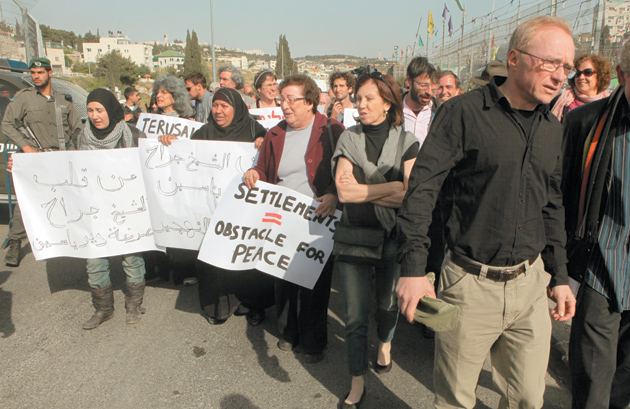
You might think that such trends, and the sympathy for them expressed by some in Israel’s government, would occasion substantial public concern—even outrage—among the leaders of organized American Jewry. You would be wrong. In Israel itself, voices from the left, and even center, warn in increasingly urgent tones about threats to Israeli democracy. (Former Prime Ministers Ehud Olmert and Ehud Barak have both said that Israel risks becoming an “apartheid state” if it continues to hold the West Bank. This April, when settlers forced a large Israeli bookstore to stop selling a book critical of the occupation, Shulamit Aloni, former head of the dovish Meretz Party, declared that “Israel has not been democratic for some time now.”) But in the United States, groups like AIPAC and the Presidents’ Conference patrol public discourse, scolding people who contradict their vision of Israel as a state in which all leaders cherish democracy and yearn for peace.
The result is a terrible irony. In theory, mainstream American Jewish organizations still hew to a liberal vision of Zionism. On its website, AIPAC celebrates Israel’s commitment to “free speech and minority rights.” The Conference of Presidents declares that “Israel and the United States share political, moral and intellectual values including democracy, freedom, security and peace.” These groups would never say, as do some in Netanyahu’s coalition, that Israeli Arabs don’t deserve full citizenship and West Bank Palestinians don’t deserve human rights. But in practice, by defending virtually anything any Israeli government does, they make themselves intellectual bodyguards for Israeli leaders who threaten the very liberal values they profess to admire.
After Israel’s elections last February, for instance, Malcolm Hoenlein, executive vice-chairman of the Presidents’ Conference, explained that Avigdor Lieberman’s agenda was “far more moderate than the media has presented it.” Insisting that Lieberman bears no general animus toward Israeli Arabs, Abraham Foxman, national director of the Anti-Defamation League, told the Jewish Telegraphic Agency that “He’s not saying expel them. He’s not saying punish them.” (Permanently denying citizenship to their Arab spouses or jailing them if they publicly mourn on Israeli Independence Day evidently does not qualify as punishment.) The ADL has criticized anti-Arab bigotry in the past, and the American Jewish Committee, to its credit, warned that Lieberman’s proposed loyalty oath would “chill Israel’s democratic political debate.” But the Forward summed up the overall response of America’s communal Jewish leadership in its headline “Jewish Leaders Largely Silent on Lieberman’s Role in Government.”
Not only does the organized American Jewish community mostly avoid public criticism of the Israeli government, it tries to prevent others from leveling such criticism as well. In recent years, American Jewish organizations have waged a campaign to discredit the world’s most respected international human rights groups. In 2006, Foxman called an Amnesty International report on Israeli killing of Lebanese civilians “bigoted, biased, and borderline anti-Semitic.” The Conference of Presidents has announced that “biased NGOs include Amnesty International, Human Rights Watch, Christian Aid, [and] Save the Children.” Last summer, an AIPAC spokesman declared that Human Rights Watch “has repeatedly demonstrated its anti-Israel bias.” When the Obama administration awarded the Presidential Medal of Freedom to Mary Robinson, former UN high commissioner for human rights, the ADL and AIPAC both protested, citing the fact that she had presided over the 2001 World Conference Against Racism in Durban, South Africa. (Early drafts of the conference report implicitly accused Israel of racism. Robinson helped expunge that defamatory charge, angering Syria and Iran.)
Human Rights Watch and Amnesty International are not infallible. But when groups like AIPAC and the Presidents’ Conference avoid virtually all public criticism of Israeli actions—directing their outrage solely at Israel’s neighbors—they leave themselves in a poor position to charge bias. Moreover, while American Jewish groups claim that they are simply defending Israel from its foes, they are actually taking sides in a struggle within Israel between radically different Zionist visions. At the very moment the Anti-Defamation League claimed that Robinson harbored an “animus toward Israel,” an alliance of seven Israeli human rights groups publicly congratulated her on her award. Many of those groups, like B’Tselem, which monitors Israeli actions in the Occupied Territories, and the Israeli branch of Physicians for Human Rights, have been at least as critical of Israel’s actions in Lebanon, Gaza, and the West Bank as have Amnesty International and Human Rights Watch.
All of which raises an uncomfortable question. If American Jewish groups claim that Israel’s overseas human rights critics are motivated by anti- Israeli, if not anti-Semitic, bias, what does that say about Israel’s domestic human rights critics? The implication is clear: they must be guilty of self-hatred, if not treason. American Jewish leaders don’t generally say that, of course, but their allies in the Netanyahu government do. Last summer, Israel’s vice prime minister, Moshe Ya’alon, called the anti-occupation group Peace Now a “virus.” This January, a right-wing group called Im Tirtzu accused Israeli human rights organizations of having fed information to the Goldstone Commission that investigated Israel’s Gaza war. A Knesset member from Netanyahu’s Likud promptly charged Naomi Chazan, head of the New Israel Fund, which supports some of those human rights groups, with treason, and a member of Lieberman’s party launched an investigation aimed at curbing foreign funding of Israeli NGOs.
To their credit, Foxman and other American Jewish leaders opposed the move, which might have impaired their own work. But they are reaping what they sowed. If you suggest that mainstream human rights criticism of Israel’s government is motivated by animus toward the state, or toward Jews in general, you give aid and comfort to those in Israel who make the same charges against the human rights critics in their midst.
In the American Jewish establishment today, the language of liberal Zionism—with its idioms of human rights, equal citizenship, and territorial compromise—has been drained of meaning. It remains the lingua franca in part for generational reasons, because many older American Zionists still see themselves as liberals of a sort. They vote Democratic; they are unmoved by biblical claims to the West Bank; they see average Palestinians as decent people betrayed by bad leaders; and they are secular. They don’t want Jewish organizations to criticize Israel from the left, but neither do they want them to be agents of the Israeli right.
These American Zionists are largely the product of a particular era. Many were shaped by the terrifying days leading up to the Six-Day War, when it appeared that Israel might be overrun, and by the bitter aftermath of the Yom Kippur War, when much of the world seemed to turn against the Jewish state. In that crucible, Israel became their Jewish identity, often in conjunction with the Holocaust, which the 1967 and 1973 wars helped make central to American Jewish life. These Jews embraced Zionism before the settler movement became a major force in Israeli politics, before the 1982 Lebanon war, before the first intifada. They fell in love with an Israel that was more secular, less divided, and less shaped by the culture, politics, and theology of occupation. And by downplaying the significance of Avigdor Lieberman, the settlers, and Shas, American Jewish groups allow these older Zionists to continue to identify with that more internally cohesive, more innocent Israel of their youth, an Israel that now only exists in their memories.
But these secular Zionists aren’t reproducing themselves. Their children have no memory of Arab armies massed on Israel’s border and of Israel surviving in part thanks to urgent military assistance from the United States. Instead, they have grown up viewing Israel as a regional hegemon and an occupying power. As a result, they are more conscious than their parents of the degree to which Israeli behavior violates liberal ideals, and less willing to grant Israel an exemption because its survival seems in peril. Because they have inherited their parents’ liberalism, they cannot embrace their uncritical Zionism. Because their liberalism is real, they can see that the liberalism of the American Jewish establishment is fake.
To sustain their uncritical brand of Zionism, therefore, America’s Jewish organizations will need to look elsewhere to replenish their ranks. They will need to find young American Jews who have come of age during the West Bank occupation but are not troubled by it. And those young American Jews will come disproportionately from the Orthodox world.
Because they marry earlier, intermarry less, and have more children, Orthodox Jews are growing rapidly as a share of the American Jewish population. According to a 2006 American Jewish Committee (AJC) survey, while Orthodox Jews make up only 12 percent of American Jewry over the age of sixty, they constitute 34 percent between the ages of eighteen and twenty-four. For America’s Zionist organizations, these Orthodox youngsters are a potential bonanza. In their yeshivas they learn devotion to Israel from an early age; they generally spend a year of religious study there after high school, and often know friends or relatives who have immigrated to Israel. The same AJC study found that while only 16 percent of non-Orthodox adult Jews under the age of forty feel “very close to Israel,” among the Orthodox the figure is 79 percent. As secular Jews drift away from America’s Zionist institutions, their Orthodox counterparts will likely step into the breach. The Orthodox “are still interested in parochial Jewish concerns,” explains Samuel Heilman, a sociologist at the City University of New York. “They are among the last ones who stayed in the Jewish house, so they now control the lights.”
But it is this very parochialism—a deep commitment to Jewish concerns, which often outweighs more universal ones—that gives Orthodox Jewish Zionism a distinctly illiberal cast. The 2006 AJC poll found that while 60 percent of non-Orthodox American Jews under the age of forty support a Palestinian state, that figure drops to 25 percent among the Orthodox. In 2009, when Brandeis University’s Theodore Sasson asked American Jewish focus groups about Israel, he found Orthodox participants much less supportive of dismantling settlements as part of a peace deal. Even more tellingly, Reform, Conservative, and unaffiliated Jews tended to believe that average Palestinians wanted peace, but had been ill-served by their leaders. Orthodox Jews, by contrast, were more likely to see the Palestinian people as the enemy, and to deny that ordinary Palestinians shared any common interests or values with ordinary Israelis or Jews.
Orthodox Judaism has great virtues, including a communal warmth and a commitment to Jewish learning unmatched in the American Jewish world. (I’m biased, since my family attends an Orthodox synagogue.) But if current trends continue, the growing influence of Orthodox Jews in America’s Jewish communal institutions will erode even the liberal-democratic veneer that today covers American Zionism. In 2002, America’s major Jewish organizations sponsored a large Israel solidarity rally on the Washington Mall. Up and down the east coast, yeshivas shut down for the day, swelling the estimated Orthodox share of the crowd to close to 70 percent. When the then Deputy Secretary of Defense Paul Wolfowitz told the rally that “innocent Palestinians are suffering and dying as well,” he was booed.
America’s Jewish leaders should think hard about that rally. Unless they change course, it portends the future: an American Zionist movement that does not even feign concern for Palestinian dignity and a broader American Jewish population that does not even feign concern for Israel. My own children, given their upbringing, could as easily end up among the booers as among Luntz’s focus group. Either prospect fills me with dread.
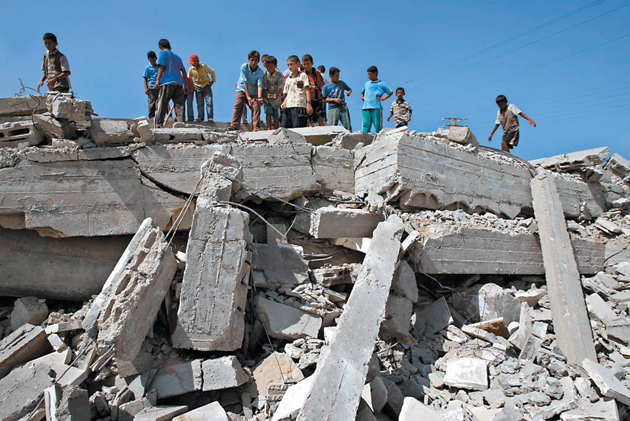
In 2004, in an effort to prevent weapons smuggling from Egypt, Israeli tanks and bulldozers demolished hundreds of houses in the Rafah refugee camp in the southern Gaza Strip. Watching television, a veteran Israeli commentator and politician named Tommy Lapid saw an elderly Palestinian woman crouched on all fours looking for her medicines amid the ruins of her home. He said she reminded him of his grandmother.
In that moment, Lapid captured the spirit that is suffocating within organized American Jewish life. To begin with, he watched. In my experience, there is an epidemic of not watching among American Zionists today. A Red Cross study on malnutrition in the Gaza Strip, a bill in the Knesset to allow Jewish neighborhoods to bar entry to Israeli Arabs, an Israeli human rights report on settlers burning Palestinian olive groves, three more Palestinian teenagers shot—it’s unpleasant. Rationalizing and minimizing Palestinian suffering has become a kind of game. In a more recent report on how to foster Zionism among America’s young, Luntz urges American Jewish groups to use the word “Arabs, not Palestinians,” since “the term ‘Palestinians’ evokes images of refugee camps, victims and oppression,” while “‘Arab’ says wealth, oil and Islam.”
Of course, Israel—like the United States—must sometimes take morally difficult actions in its own defense. But they are morally difficult only if you allow yourself some human connection to the other side. Otherwise, security justifies everything. The heads of AIPAC and the Presidents’ Conference should ask themselves what Israel’s leaders would have to do or say to make them scream “no.” After all, Lieberman is foreign minister; Effi Eitam is touring American universities; settlements are growing at triple the rate of the Israeli population; half of Israeli Jewish high school students want Arabs barred from the Knesset. If the line has not yet been crossed, where is the line?
What infuriated critics about Lapid’s comment was that his grandmother died at Auschwitz. How dare he defile the memory of the Holocaust? Of course, the Holocaust is immeasurably worse than anything Israel has done or ever will do. But at least Lapid used Jewish suffering to connect to the suffering of others. In the world of AIPAC, the Holocaust analogies never stop, and their message is always the same: Jews are licensed by their victimhood to worry only about themselves. Many of Israel’s founders believed that with statehood, Jews would rightly be judged on the way they treated the non-Jews living under their dominion. “For the first time we shall be the majority living with a minority,” Knesset member Pinchas Lavon declared in 1948, “and we shall be called upon to provide an example and prove how Jews live with a minority.”
But the message of the American Jewish establishment and its allies in the Netanyahu government is exactly the opposite: since Jews are history’s permanent victims, always on the knife-edge of extinction, moral responsibility is a luxury Israel does not have. Its only responsibility is to survive. As former Knesset speaker Avraham Burg writes in his remarkable 2008 book, The Holocaust Is Over; We Must Rise From Its Ashes, “Victimhood sets you free.”
This obsession with victimhood lies at the heart of why Zionism is dying among America’s secular Jewish young. It simply bears no relationship to their lived experience, or what they have seen of Israel’s. Yes, Israel faces threats from Hezbollah and Hamas. Yes, Israelis understandably worry about a nuclear Iran. But the dilemmas you face when you possess dozens or hundreds of nuclear weapons, and your adversary, however despicable, may acquire one, are not the dilemmas of the Warsaw Ghetto. The year 2010 is not, as Benjamin Netanyahu has claimed, 1938. The drama of Jewish victimhood—a drama that feels natural to many Jews who lived through 1938, 1948, or even 1967—strikes most of today’s young American Jews as farce.
But there is a different Zionist calling, which has never been more desperately relevant. It has its roots in Israel’s Independence Proclamation, which promised that the Jewish state “will be based on the precepts of liberty, justice and peace taught by the Hebrew prophets,” and in the December 1948 letter from Albert Einstein, Hannah Arendt, and others to The New York Times, protesting right-wing Zionist leader Menachem Begin’s visit to the United States after his party’s militias massacred Arab civilians in the village of Deir Yassin. It is a call to recognize that in a world in which Jewish fortunes have radically changed, the best way to memorialize the history of Jewish suffering is through the ethical use of Jewish power.
For several months now, a group of Israeli students has been traveling every Friday to the East Jerusalem neighborhood of Sheikh Jarrah, where a Palestinian family named the Ghawis lives on the street outside their home of fifty-three years, from which they were evicted to make room for Jewish settlers. Although repeatedly arrested for protesting without a permit, and called traitors and self-haters by the Israeli right, the students keep coming, their numbers now swelling into the thousands. What if American Jewish organizations brought these young people to speak at Hillel? What if this was the face of Zionism shown to America’s Jewish young? What if the students in Luntz’s focus group had been told that their generation faces a challenge as momentous as any in Jewish history: to save liberal democracy in the only Jewish state on earth?
“Too many years I lived in the warm embrace of institutionalized elusiveness and was a part of it,” writes Avraham Burg. “I was very comfortable there.” I know; I was comfortable there too. But comfortable Zionism has become a moral abdication. Let’s hope that Luntz’s students, in solidarity with their counterparts at Sheikh Jarrah, can foster an uncomfortable Zionism, a Zionism angry at what Israel risks becoming, and in love with what it still could be. Let’s hope they care enough to try.
—May 12, 2010
Peter Beinart is Associate Professor of Journalism and Political Science at the City University of New York, a Senior Fellow at the New America Foundation, and Senior Political Writer for The Daily Beast. His new book, The Icarus Syndrome: A History of American Hubris, will be published in June.
This Issue
June 10, 2010

This Issue
June 10, 2010