

1.
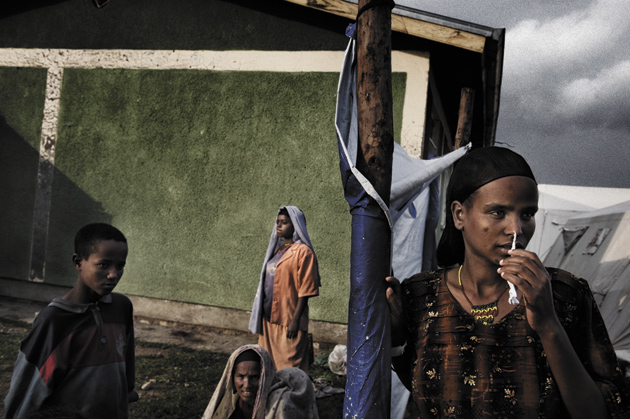
Parts of southern Ethiopia resemble the scenery in a Tarzan movie. When I was there last fall, the green forested hills were blanketed in white mist and rain poured down on the small farms and homesteads. In the towns, slabs of meat hung in the butchers’ shops and donkeys hauled huge sacks of coffee beans, Ethiopia’s major export, along the stony dirt roads. So I was surprised to see the signs of hunger everywhere. There were babies with kwashiorkor, a disease caused by malnutrition, which I’d assumed occurred only in war zones. Many of the older children were clearly stunted and some women were so deficient in iodine they had goiters the size of cannonballs.
This East African nation, famous for its ancient rock-hewn churches, Solomonic emperors, and seemingly intractable poverty, has a long history of famine. But I had always assumed that food shortages were more common in the much drier north of the country than in the relatively fertile south. Although rainfall throughout Ethiopia had been erratic in 2008 and 2009, the stunting and goiter I saw were signs of chronic malnutrition, which had clearly existed for many years.
What was causing it? Ethiopia’s long history of food crises is shrouded in myths and political intrigue. In 1984, famine killed hundreds of thousands of people and left millions destitute. At the time, the UN attributed the famine to drought. But most witnesses knew it had far more to do with a military campaign launched by Ethiopia’s then-Soviet-backed dictator Mengistu Haile Mariam against a rebel group based in the northern province of Tigray, known as the Tigrayan People’s Liberation Front (TPLF).1 Government forces isolated the peasantry, destroyed trade and markets, and diverted food aid to their own troops.
Western governments were slow to respond to this humanitarian crisis, but a global charity campaign led by the rock singer Bob Geldof’s Band Aid concerts and albums raised more than $100 million for relief organizations like Christian Aid and Oxfam. Because Tigray was under assault, these organizations established bases in neighboring Sudan. They handed food shipments over to the TPLF, which was supposed to deliver them to starving peasants in Tigray. However, it now appears that the TPLF may also have been using some of the aid to feed its soldiers and purchase weapons. In a March 2010 BBC report, a former TPLF fighter described masquerading as a Sudanese merchant and selling bags of “grain”—many containing only sand—to the aid workers, who then passed the sacks on to other TPLF cadres, who returned them to the “Sudanese traders,” who resold them to the aid workers, and so on. In this way, bags of grain/sand circulated back and forth across the border, as money poured into TPLF coffers. The CIA apparently knew about the scam.2
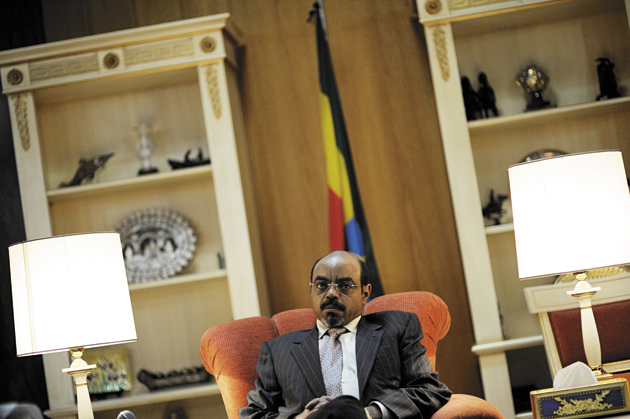
The TPLF’s political leader at the time is now Ethiopia’s prime minister, Meles Zenawi. Since it ousted Mengistu and took power in 1991, Meles’s government has received some $26 billion in development aid from Western donors including the US Agency for International Development, the World Bank, the European Union, and Britain’s Department for International Development. Meles, along with Geldof, has vehemently denounced the BBC’s report and demanded a retraction. But many aid workers who were around then have indicated that there is probably some truth to the story.3 Either way, it’s worth asking where Ethiopia’s development aid is going today, bearing in mind the theatrical inclinations of its prime minister.
2.
Shortly before its victory in 1991, the TPLF joined several other groups and changed its name to the Ethiopian People’s Revolutionary Democratic Front (EPRDF). Meles was an instant success with Western leaders including President Bill Clinton, who hailed him as a member of a “new breed” of post–cold war Africans who would bring stability and prosperity to their troubled continent. In 2005, Meles was a coauthor with Tony Blair of the report of the British government’s Commission for Africa, entitled Our Common Interest,4 which argued that reducing poverty, hunger, illiteracy, and the spread of AIDS and other diseases would create the foundation for economic growth, political stability, and democratic governance. The report, released amid a huge publicity campaign known as “Make Poverty History” led by the rock star Bono, called for sharply increased levels of foreign aid, which the authors referred to as “the big push.”5
Meles’s Ethiopia is now the subject of an informal experiment to see whether “the big push” approach to African development will work. Its foreign aid receipts, which have tripled since 2000,6 amounted to some $3 billion in 2008, more than any other nation in sub-Saharan Africa.7 A nominally Christian country surrounded by largely Islamic Somalia, Sudan, and Kenya, Ethiopia is also a key Western ally in the “war on terror,” and this is certainly a factor in how much foreign aid it receives—though most of the money goes not to the military but to development programs, especially health, education, and agriculture projects.8 The big push has financed 15,000 village health clinics, seventeen universities, countless schools, and the beginnings of a new road network that will bring trade and services to many previously isolated rural areas.
Advertisement
Unfortunately, this aid is also subsidizing a regime that is rapidly becoming one of the most repressive and dictatorial on the continent. During Ethiopia’s most recent parliamentary elections in May 2005, the government suspended the vote count in some areas when it seemed that the opposition was winning more seats than expected. When the results were eventually announced, Meles’s EPRDF, to no one’s surprise, had won. European Union observers criticized the conduct of the elections, and opposition supporters organized demonstrations that soon turned violent. Security forces shot into the crowds, killing some two hundred people, and thousands of others, including journalists and human rights activists, were arrested. Seventy opposition leaders were charged with treason. Although most were later pardoned, several, including the leader of the opposition party Unity for Democracy and Justice, Birtukan Mideksa, remain behind bars.9
On May 23, Ethiopia will hold its first parliamentary elections since 2005, but the results seem foreordained. Opposition groups have been prevented from opening local offices and some opposition candidates have been assaulted by EPRDF officials or arbitrarily detained by the police.10 The government uses Chinese spy technology to bug phone lines and Internet communications, and countless journalists, editors, judges, academics, and human rights defenders have fled the country or languish behind bars, at risk of torture. New laws passed since 2005 have made political activity more difficult than ever. The Anti-Terrorism Proclamation of 2009 makes hearsay admissible as evidence in court, and one of Ethiopia’s few remaining independent newspapers recently closed after its editors learned that charges against them were being prepared under the act. Voice of America and other international radio programs are routinely jammed before elections, including this one.11
These events are unfolding as billions of dollars in foreign aid pour into the country. Foreign aid is important. It helps needy people, it creates allies for our causes and markets for our products, and redeems some of the damage inflicted on the third world during the cold war. But aid agencies need to ensure that their programs don’t exacerbate the political problems that are keeping people poor in the first place.
When I asked aid officials why Meles, who seems so committed to poverty alleviation, seems so antagonistic to human rights, most pointed to the nation’s volatile ethnic politics. Ethiopia’s roughly 80 million people are divided among some ninety different groups.
A quarter of the population is Amhara, historically the most powerful tribe, with origins in the northern highlands where traditions of Ethiopian Orthodox Christianity date back to the fourth century. Closely related are Prime Minister Meles’s Tigray people, who make up about 7 percent of the population and whose grip on power is increasingly resented by others. The largest tribe, comprising some 40 percent of the population, are the Oromo, who traditionally herded livestock in the southern, central, and western regions of the country. Other groups include the Somalis, the Afar camel herders, and the Mursi and other southern pastoralist groups famous for their lip rings and colorful body paint. About half the population is Muslim, but at present, ethnic, not religious, tensions are central to the nation’s politics.
As a Tigrayan, Meles would face challenges from parties aligned with the far more numerous Amhara and Oromo no matter what he did, but his repressive policies have often made things worse. In November 2009, a group of military officers, furious that over 90 percent of Ethiopia’s generals are Tigrayan, were convicted of plotting a coup. Ethnically based rebel groups, including the Oromo Liberation Front (OLF) and the Ogaden National Liberation Front (ONLF), are engaged in violent antigovernment insurgencies, and dozens of local conflicts have erupted among various tribes and clans in recent years.12 But these problems have often been exacerbated by a government that allows no genuine opposition or even constructive policy debate. The OLF fought alongside the TPLF against Mengistu, and in 1991 it attempted to transform itself into a peaceful political party. But after facing widespread vote-rigging and harassment of their candidates, its leaders soon returned to armed struggle.
As this vicious cycle of repression and rebellion has escalated, Western officials have tended to express a diplomatic sense of optimism that Ethiopia’s political problems will iron themselves out. In 2007, former US Assistant Secretary for African Affairs Jendayi Frazer praised Ethiopia for the “monumental advancement in the political environment” since the bloody 2005 election.13 At the time, the US was backing Ethiopia’s 2006 invasion of Somalia, on the belief—largely mistaken at that time—that it had become a haven for al-Qaeda terrorists.14
Advertisement
At first, the Europeans threatened to cut off aid until Ethiopia made more progress on human rights, but then reconsidered. The Europeans had their own security and strategic interests in the region, and may have reasoned that without American cooperation, an aid boycott of Ethiopia would have little leverage over Meles’s human rights violations. These were also the days of Our Common Interest, Bono, and “Make Poverty History,” and cutting off aid to one of the poorest countries in the world might have been seen as a bad PR move. However, the Europeans resolved to channel their aid directly to local district authorities, bypassing the central government. This would prevent its use for political purposes, or so it was hoped.
The plan was not a success. As local elections scheduled for 2008 approached, opposition groups, mindful that so much money was now flowing into district coffers, feared widespread rigging. Local government officials earn meager salaries, but are enormously powerful because they control access to food aid programs, fertilizers, educational opportunities, jobs, plots of land, small business loans, and even health care.15 The opposition groups unsuccessfully petitioned the US and other donors to fund independent poll monitors, but when the EPRDF won 99.99 percent of the seats, US officials said they could not comment on the fairness of the elections because they hadn’t monitored them.16

Scholars and human rights groups had for years been alerting the international community to the fact that EPRDF officials frequently deny the benefits of foreign aid programs—food, fertilizers, training, and so on—to known opposition supporters.17 When I asked World Bank officials whether they were concerned about these allegations, they said that they’d heard a few anecdotal reports, but had yet to see convincing evidence that political diversion of resources was a systematic problem in their programs.
No doubt conducting a systematic survey would be difficult. A Human Rights Watch researcher was deported last November while attempting to investigate the politicization of a World Bank food aid program, and a journalist who tried to follow up the investigation was arrested and jailed for two days.18 In December 2009, the Western press began publicizing these stories, and the donors finally agreed to conduct a study of the “distortions” in the uses of aid in Ethiopia. However, this investigation will be overseen by the government.
For years, Ethiopia’s foreign donors supported a fledgling human rights community that provided voter education, documented political repression, and advocated for the rights of rape victims, abused children, the blind, deaf, and other vulnerable groups. In response to increasing criticism from some of these groups, the government recently enacted a Charities and Societies (CSO) law, forbidding them from receiving all but minimal funding from non-Ethiopian sources. Since few Ethiopians can afford to donate to charity, numerous human rights programs have shut down. The donor agency officials who once supported these programs have protested in internal reports and private meetings with the prime minister, but their public pronouncements have been conciliatory. On the day the EU announced a new €250 million aid package for Ethiopia, it expressed the hope that the CSO law would be “implemented in an open-minded and constructive spirit.”19
3.
Western aid officials seem reluctant to admit that there are two Prime Minister Meles Zenawis. One is a clubbable, charming African who gives moving speeches at Davos and other elite forums about fighting poverty and terrorism. The other is a dictator whose totalitarianism dates back to cold war days. During the early 1970s, when Meles was a medical student in Addis Ababa, he joined a Marxist study group that eventually became the TPLF. Meles’s military performance was undistinguished, but he had a talent for speech-making, and was appointed head of the TPLF’s political wing. In the training courses he ran for recruits, he celebrated Stalin’s achievement in modernizing Russia, but didn’t dwell on the blood that was shed in the process.
In 1985, Meles founded a unit within the TPLF known as the Marxist-Leninist League of Tigray, which was guided by the Leninist principle of “Democratic Centralism.” In pursuit of revolutionary socialist goals, the peasants were to be mobilized by a “vanguard elite,” which would exert total ideological and economic control over society.20 But after taking office in 1991, Meles downplayed his Marxist past and even enrolled in a correspondence course in business administration at Britain’s Open University. In discussions with US officials and journalists, he indicated that his Marxism extended to antifeudalism, equality, land reform, and teaching farming skills to women, but not to the nationalization of private enterprises or one-party rule.21
At first, Meles’s government allowed a degree of press freedom, multiparty democracy, and privatization of some state-owned enterprises. But as rigged elections and arrests of journalists continued, some observers wondered whether Meles’s political change of heart was genuine.22 In official English-language documents written for the World Bank and other agencies, his government expressed a commitment to human rights and democracy,23: but Ethiopian-language documents intended for internal government or EPRDF consumption told a different story. These documents outlined a policy known as “Revolutionary Democracy”—essentially the same Leninist program that Meles taught to his TPLF cadres in the 1980s, involving top-down decision-making, regular sessions of “self-criticism,” and single-party rule for generations. Revolutionary Democracy would be promoted through the gradual EPRDF takeover of all organs of “propaganda,” including schools, the civil service, the press, and religious institutions.24 “When ‘Revolutionary Democracy’ permeates the entire [Ethiopian] society,” Meles wrote in 2001,
individuals will start to think alike and all persons will cease having their own independent outlook. In this order, individual thinking becomes simply part of collective thinking because the individual will not be in a position to reflect on concepts that have not been prescribed by “Revolutionary Democracy.”25
Consistent with this aim, the EPRDF has used World Bank funds to purge much of the senior civil service of opposition supporters and replaced the independent Ethiopian Teachers Association with a party-affiliated body.26 Meles concedes that a Leninist economic program would not be possible as long as Ethiopia is dependent on foreign aid from capitalist countries,27 but his government still controls all land and telecommunications, and much of the banking and rural credit sectors. According to the World Bank, roughly half of the rest of the national economy is accounted for by companies held by an EPRDF-affiliated business group called the Endowment Fund for the Rehabilitation of Tigray (EFFORT).28 EFFORT’s freight transport, construction, pharmaceutical, and cement firms receive lucrative foreign aid contracts and highly favorable terms on loans from government banks.29 Ethiopia is not a typical African kleptocracy, and there is no evidence that Meles personally benefits from these businesses. Rather, they are part of a rigid system of control that aid agency officials, beguiled by Meles’s apparently pro-Western exterior, have only recently begun to recognize.
There is a type of Ethiopian poetry known as “Wax and Gold” because it has two meanings: a superficial “wax” meaning, and a hidden “golden” one.30 During the 1960s, the anthropologist Donald Levine described how the popularity of “Wax and Gold” poetry provided insights into some of the northern Ethiopian societies from which Prime Minister Meles would later emerge. Even ordinary conversations frequently contain double entendres and ambiguities. Levine theorized that this enabled the expression of satire, humor, and even insults in an otherwise strictly controlled and hierarchical society of all-powerful kings, peasants, and serfs.
However, he worried that this mode of communication would hold Ethiopians back in their dealings with Westerners, who tend to value concreteness and rationality. Double meanings and poetry provide no advantage when drafting legal contracts, filling out job applications, or designing nuclear reactors. It didn’t occur to Levine that “Wax and Gold”–style communication might give Ethiopians like Meles an advantage in dealing with Westerners, especially when the Westerners were aid officials offering vast sums of money to follow a course of development based on liberal democracy and human rights, with which they disagree.
4.
I first traveled to Ethiopia in 2008 to study the country’s new public health strategy. Nearly every government and aid agency official I met expressed enthusiasm for the many programs underway. Rates of AIDS, malaria, and infant mortality were falling,31 and Ethiopian health officials told me that there was no corruption; medicines were always in stock, even in faraway rural clinics; and community health workers were trained, efficient, and never absent from their posts. The government newspaper kept readers abreast of development news with such headlines as “Reinforcing UNDAF to meet PASDEP, MDGs”32
(UNDAF is the UN Development Framework, PASDEP is Plan for Accelerated and Sustained Development to End Poverty, and MDGs are the Millennium Development Goals).
Most of these programs were in rural areas far from the capital, Addis Ababa, where my interviews took place. I wanted to see them for myself, not least because I knew that some of the claims I was hearing weren’t entirely true. Government officials claimed that in 2005, 87 percent of children had received all major vaccines, but an independent survey suggested that the figure was closer to 27 percent.33 Similarly, the fraction of women using contraception was 23 percent, not 55 percent as government officials claimed. The annual growth in farm production was also probably nowhere near the government’s own figure of 10 percent.34
One day, I heard an aid official give a lecture about a small nutrition project in one of the poorest regions of the country. She showed pictures of the area and that’s when I noticed how green it looked. “It’s called ‘Green Famine,'” she said, but when I asked her what caused it, her answer rambled from rainfall patterns to soil erosion to local preferences for nutrient-poor root vegetables and made little sense.
Nevertheless, a few days later I visited the region myself. I was amazed by what I saw there. Roads were under construction, a university had recently opened, and crowds of children were on their way home from a new school. Health workers spoke enthusiastically about the malaria bednet program, the immunization program, the pit latrine program, and the family planning program. I attended a village meeting at which some fifty “model families” who had followed all the government-prescribed practices of a “healthy household” were awarded diplomas. Local officials gave speeches, everyone cheered, and a basket of popcorn was passed around.
But when I went to visit the nutrition project, my enthusiasm faded. It was intended for children, but many of their mothers were also malnourished. Several had obvious goiter, and a few were so anemic they nearly fainted while they were speaking to me. When I asked these women why they could not adequately feed their children or themselves, most replied that they didn’t have enough land, and therefore couldn’t grow enough food either to eat or to sell.
There is a long history to their predicament. During the nineteenth century, as the European powers were carving up the rest of East Africa into colonies, Amhara rulers from the northern highlands extended their power southward and established the boundaries of what would become Imperial Ethiopia. As they did so, they seized land, exacted tribute, and turned the once independent peoples of this region into serfs. When the last emperor, Haile Selassie, was overthrown in 1974, the new regime immediately enacted a land reform program that assigned each former serf a plot of his own. This was fine for one generation, but in rural Ethiopia, women have on average six surviving children. Now, thirty-five years later, millions of peasant families live on plots too small to support them.35 The government retains all property rights, so if the poor leave their tiny plots, they lose their only asset. Most remain where they are, living on the verge of starvation.
Half a dozen food security programs existed in the area, but for reasons no one, including the aid workers who managed them, could explain, they were having little effect. According to a government survey, half the families enrolled in the largest food aid program had, in order to feed themselves, been forced to sell what few assets they had, including goats, chickens, pots, and buckets.36 One household in eight had lost a child to hunger. Even so, competition for a slot in the program was so fierce that when the food trucks arrived, riots sometimes broke out. The truly destitute received barely enough to survive. One woman I met said that her family of five was somehow living on five kilos of cornmeal a month.
There is no simple solution to this crisis, but as the Ethiopia expert Siegfried Pausewang has long argued, only the peasants themselves have any hope of finding one. Working with agronomists and other experts, they could confront such issues as security of land tenure, the onerous rural tax regime, political favoritism, the low prices offered by party-run cooperatives, and compensation for those whose tiny land parcels can no longer support them. However, there are no independent organizations or other forums in which peasants can openly discuss these issues, air grievances, or advocate for their rights. Under the CSO law such forums are unlikely to emerge.
Ethiopia has an agricultural extension program, but it only gives orders. “They make a plan, they take over, they command us to do this, do that,” a farmer told Pausewang in 2001.37 If the peasants openly disagree with the plans the government has for them, they risk being denied fertilizers or credit, or even losing what land they have. As one farmer, who keeps his support for the opposition party a secret, told Human Rights Watch in 2009, “I am a member of EPRDF because I need relief assistance…. The list of receipts—the proof that I am paying my dues to the party—are required to get [it].”38 While aid officials may lecture about how hunger in Ethiopia is due solely to climate change, soil erosion, and the preference of poor people for root vegetables, this crisis, like the 1984 famine, is also primarily caused by politically motivated human rights violations.
5.
Before I left Ethiopia, I visited an old church in the Amhara highlands. Orthodox Christian traditions in this part of the country date back 1,600 years, and it’s astonishing to think that these impoverished people had a written language and a sophisticated clerical hierarchy that long ago. I was shown a beautifully illuminated set of liturgical manuscripts created in the 1700s, in which images of almond-eyed saints loomed amid the gospels written out in Ethiopia’s ancient Ge’ez script. In some of the paintings, you could see the artists’ struggles to reconcile their turbulent cultural heritage by combining the doctrinal power of the sacred word with the abstract flourishes more typical of the cultures of the African interior.
Outside the church, I noticed that some of the small children hanging around had leather pouches tied around their necks. “That’s to protect against ‘evil eye,'” an Ethiopian friend explained. “The pouches have fragments of scripture inside. They believe the Bible is ‘the word made flesh,’ and those pieces of paper will prevent their children from getting sick.”
In 2007, Meles called for an “Ethiopian renaissance” to bring the country out of medieval poverty, but the Renaissance he’s thinking of seems very different from ours. The Western Renaissance was partly fostered by the openness to new ideas created by improved transport and trade networks, mail services, printing technology, and communications—precisely those things Meles is attempting to restrict and control.
The Western Renaissance helped to democratize “the word” so that all of us could speak of our own individual struggles, and this added new meaning and urgency to the alleviation of the suffering of others. The problem with foreign aid in Ethiopia is that both the Ethiopian government and its donors see the people of this country not as individuals with distinct needs, talents, and rights but as an undifferentiated mass, to be mobilized, decentralized, vaccinated, given primary education and pit latrines, and freed from the legacy of feudalism, imperialism, and backwardness. It is this rigid focus on the “backward masses,” rather than the unique human person, that typically justifies appalling cruelty in the name of social progress.
—April 14, 2010
-
1
Alexander de Waal, Famine Crimes: Politics and the Disaster Relief Industry in Africa (Indiana University Press, 1997). I wish to acknowledge helpful discussions with John Ryle, Leslie Lefkow, and Ben Rawlence. ↩
-
2
See Martin Plaut, “Assignment: Aid for Arms in Ethiopia,” BBC World Service, March 7, 2010, available at [www.bbc.co.uk/programmes/p006dyn3](http://www.bbc.co.uk/programmes/p006dyn3). ↩
-
3
See Mark Colvin, “Aid Dogfight: Geldof and the BBC in War of Words,” The Drum, Australian Broadcasting Corporation (ABC) Online, March 17, 2010. ↩
-
4
Available at [allafrica.com/sustainable/resources/view/00010595.pdf](http://allafrica.com/sustainable/resources/view/00010595.pdf). See also UNCTAD, “Economic Development in Africa: Doubling Aid: Making the Big Push Work” (United Nations, 2006). ↩
-
5
See Tom Porteous, Britain in Africa (Zed, 2008). ↩
-
6
See Jason McLure, “The Troubled Horn of Africa,” CQ Global Researcher, Vol. 3, No. 6 (June 2009). ↩
-
7
See the Organization for Economic Co-operation and Development (OECD), “Statistical Annex of the 2010 Development Co-operation Report,” Table 25, December 2009, available at [www.oecd.org/dac/stats/dac/dcrannex](http://www.oecd.org/dac/stats/dac/dcrannex). ↩
-
8
See OECD, Aid Statistics, Recipient Aid Charts: Ethiopia, available at [www.oecd.org/dataoecd/21/7/1880804.gif](http://www.oecd.org/dataoecd/21/7/1880804.gif). ↩
-
9
According to the US government 2009 Human Rights Report, we don’t know how many political prisoners there are in Ethiopia. See [www.state.gov/g/drl/rls/hrrpt/2009/af/135953.htm](http://www.state.gov/g/drl/rls/hrrpt/2009/af/135953.htm). ↩
-
10
See Human Rights Watch, “One Hundred Ways of Putting Pressure: Violations of Freedom of Expression and Association in Ethiopia,” March 24, 2010. ↩
-
11
See “Ethiopia Admits Jamming VOA Radio Broadcasts in Amharic,” BBC News, March 19, 2010. ↩
-
12
See Jon Abbink, “Ethnicity and Conflict Generation in Ethiopia: Some Problems and Prospects of Ethno-Regional Federalism,” Journal of Contemporary African Studies, Vol. 24, No. 3 (September 2006). ↩
-
13
Testimony by Assistant Secretary for African Affairs Jendeyi E. Frazer, “Ethiopia and the State of Democracy: Effects on Human Rights and Humanitarian Conditions in the Ogaden and Somalia.” House Committee on Foreign Affairs Africa and Global Health Subcommittee Hearing, Rayburn House Office Building 2172. October 2, 2007. ↩
-
14
See Bronwyn Bruton, “In the Quicksands of Somalia—Where Doing Less Helps More,” Foreign Affairs (November/December 2009). The 2006 US/Ethiopian invasion of Somalia was extremely brutal (see Ethiopia’s Dirty War, Human Rights Watch, August 4, 2007). This helped radicalize the Somali population, and provided an opening for Middle Eastern jihadis to increase funding for the militant al-Shabab group that had previously been marginal in Somali politics, but would soon control much of the country. ↩
-
15
See Sarah Vaughan and Kjetil Tronvoll, The Culture of Power in Contemporary Ethiopian Political Life (Stockholm: SIDA Studies, No. 10, 2003). ↩
-
16
See Lovise Aalen and Kjetil Tronvoll, “The 2008 Ethiopian Local Elections: The Return of Electoral Authoritarianism,” African Affairs, Vol. 108, No. 430 (January 2009), pp. 111–120. ↩
-
17
See Aalen and Tronvill, “The 2008 Ethiopian Local Elections,” and Siegfried Pausewang, “Ethiopia: A Political View from Below,” South African Journal of International Affairs, Vol. 16, No. 1 (April 2009); Jon Abbink, “The Ethiopian Second Republic and the Fragile ‘Social Contract,'” Africa Spectrum, Vol. 44, No. 2 (2009); Human Rights Watch, “Suppressing Dissent: Human Rights Abuses and Political Repression in Ethiopia’s Oromia Region,” 2005; US State Department Human Rights Report: Ethiopia, 2009, 2010. ↩
-
18
Human Rights Watch, “One Hundred Ways of Putting Pressure.” ↩
-
19
Human Rights Watch, “One Hundred Ways of Putting Pressure.” ↩
-
20
See Paulos Milkias, “The Great Purge and Ideological Paradox in Contemporary Ethiopian Politics,” Horn of Africa, Vol. 19 (2001), pp. 1–99. Aregawi Berhe, A Political History of the Tigraya People’s Liberation Front, 1975–1991 (Tsehai, 2009). ↩
-
21
See Gayle Smith, “Birth Pains of a New Ethiopia,” The Nation, July 1, 1991. ↩
-
22
Vaughan and Tronvoll, The Culture of Power in Contemporary Ethiopian Political Life; and Paulos Milkias, “The Great Purge and Ideological Paradox in Contemporary Ethiopian Politics.” ↩
-
23
See the Ministry of Finance and Economic Development (MoFED), Ethiopia, Building on Progress: A Plan for Accelerated and Sustained Development to End Poverty (PASDEP) (2005/06–2009/10), Vol. 1, September 2006. ↩
-
24
TPLF/EPRDF, “Our Revolutionary Democratic Goals and the Next Step,” internal EPRDF document (June 1993). ↩
-
25
See Meles Zenawi, “Perspectives and ‘Bonapartism,'” in “The Gimgema Papers,” 2001; referred to in Milkias, “The Great Purge and Ideological Paradox in Contemporary Ethiopian Politics.” ↩
-
26
HRW 2010, “One Hundred Ways of Putting Pressure,” and discussions with HRW researchers. ↩
-
27
TPLF/EPRDF, “Our Revolutionary Democratic Goals and the Next Step.” ↩
-
28
John Abbink, “The Ethiopian Second Republic and the Fragile ‘Social Contract,'” Africa Spectrum 2009, Vol. 44, No. 2, pp. 3–28. ↩
-
29
See Paulos Chaine, “Clientism and Ethiopia’s Post 1991 Decentralisation,” Journal of Modern African Studies, Vol. 45, No. 3 (2007), pp. 355–384. ↩
-
30
See Donald N. Levine, Wax and Gold: Tradition and Innovation in Ethiopian Culture (University of Chicago Press, 1965). The name refers to the process sculptors use to transform a wax model into gold. They first cover the model with a clay mold, then they melt out the wax and replace it with gold. ↩
-
31
See Sandro Accorsi et al., “Countdown to 2015: Comparing Progress Towards the Achievement of the Health Millennium Development Goals in Ethiopia and Other Sub-Saharan African Countries,” Transactions of the Royal Society of Tropical Medicine and Hygiene, 2010. ↩
-
32
The Ethiopian Herald, June 26, 2009. ↩
-
33
Compare Ethiopia Demographic and Health Survey 2005 (Central Statistical Agency/ORC Macro, September 2006), available at [www.measuredhs.com/pubs/pdf/FR179/FR179.pdf](http://www.measuredhs.com/pubs/pdf/FR179/FR179.pdf), and The Health of Ethiopia: An Update by Ethiopia’s Health Minister (Center for Strategic and International Studies, October 20, 2008) available at [csis.org/event/audio-health-ethiopia-update-ethiopias-health-minister](http://csis.org/event/audio-health-ethiopia-update-ethiopias-health-minister)). ↩
-
34
See Stephan Dercon et al., “In Search of a Strategy: Rethinking Agriculture Led Growth in Ethiopia,” Synthesis Paper prepared as part of a study on Agricultural and Growth in Ethiopia, Oxford University, May 2009. ↩
-
35
The average per capita landholding fell from a quarter of a hectare to less than a tenth of a hectare between 1970 and 2000, and per capita food production fell by nearly half. See Todd Benson, “An Assessment of the Causes of Malnutrition in Ethiopia,” IFPRI, 2005. ↩
-
36
See Dessalegn Rahmato, “Ethiopia: Agriculture Policy Review,” in Taye Assefa, Digest of Ethiopia’s National Policies, Strategies and Programs (Addis Ababa: Forum for Social Studies, 2008), p. 148. ↩
-
37
See Siegfried Pausewang, “No Environmental Protection Without Local Democracy? Why Peasants Distrust Their Agricultural Advisers,” in Ethiopia: The Challenge of Democracy from Below, edited by Bahru Zewde and Siegfried Pausewang (Uppsala: Nordiska Afrikaininstitutet/Addis Ababa: Forum for Social Studies, 2009).; see also Kaatje Segers et al., “Be Like Bees: The Politics of Mobilizing Farmers for Development in Tigray, Ethiopia,” African Affairs Vol. 108, No. 430, pp. 91-109, and Tewodaj Mogues et al., “Agricultural Extension in Ethiopia through a Gender and Governance Lens,” IFPRI Ethiopia Strategy Support Program 2 Discussion Paper, No. ESSP2 007, October 2008. ↩
-
38
Human Rights Watch, “One Hundred Ways of Putting Pressure.” ↩