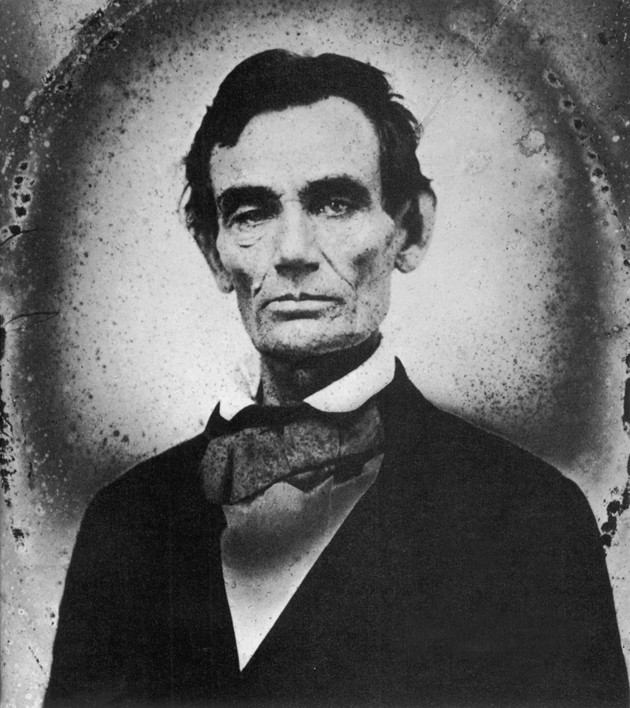
The Thirteenth, Fourteenth, and Fifteenth Amendments to the United States Constitution abolished slavery and barred states from abridging the equal civil and political rights of American citizens, including former slaves. Abraham Lincoln’s native state of Kentucky was the only state that refused to ratify all three amendments. The region of southern Indiana where Lincoln had lived from the age of seven to twenty-one (1816–1830) was among the most proslavery and anti-black areas in the free states during those years. Its representative in Congress also voted against the Thirteenth Amendment. So did the congressman from central Illinois, where Lincoln had lived for three decades. Lincoln himself had represented this district in the state legislature for eight years and in the United States Congress for one term in the 1830s and 1840s. And in 1842 he married a woman from a prominent Kentucky slaveholding family.
One might therefore expect that the cultural influences surrounding Lincoln during the first half-century of his life would shape his convictions about slavery and race in the same mold that characterized most politicians of his time and place. But instead, he was one of only two representatives in the Illinois legislature who presented a public “protest” against a resolution passed in 1837 by their colleagues that condemned abolitionist doctrines of freedom and civil equality and affirmed the right of property in slaves as “sacred to the slave-holding states.” Lincoln’s protest acknowledged that the Constitution did indeed sanction slavery in those states but declared that nevertheless “the institution of slavery is founded on both injustice and bad policy.”
In 1854 Lincoln made an even stronger protest, this time in the form of eloquent speeches against the Kansas-Nebraska Act. Illinois Senator Stephen A. Douglas, Lincoln’s longtime political rival, had rammed this law through a divided Congress. It repealed the earlier ban on the expansion of slavery into territories carved out of the Louisiana Purchase north of latitude 36º 30'. Douglas’s actions opened these territories to slavery and sparked the formation of the new “anti-Nebraska” Republican Party, which would nominate Lincoln for president six years later. Douglas had said that if the white people who moved to Kansas wanted slavery there, they should be allowed to have it. “This declared indifference, but as I must think, covert real zeal for the spread of slavery, I can not but hate,” said Lincoln in 1854, “because of the monstrous injustice of slavery itself” and also “because it deprives our republican example of its just influence in the world—enables the enemies of free institutions, with plausibility, to taunt us as hypocrites.”
When he ran for the Senate in the famous contest with Douglas in 1858, Lincoln declared: “I have always hated slavery I think as much as any Abolitionist.” Six years later he said with feeling: “If slavery is not wrong, nothing is wrong. I can not remember when I did not so think, and feel.” As Eric Foner makes clear in The Fiery Trial, however, Lincoln was antislavery but not an abolitionist. That is, he considered slavery a violation of the natural rights to life, liberty, and the pursuit of happiness enunciated in America’s founding charter (written by an antislavery slaveowner). Like Thomas Jefferson, Lincoln expected slavery eventually to die out in America. Preventing its spread into the territories was the first step, said Lincoln in 1858, toward putting it “in course of ultimate extinction.” But unlike the abolitionists, Lincoln and most Republicans in the 1850s did not call for the immediate abolition of slavery and the granting of equal citizenship to freed slaves.
Having grown up in Kentucky and the border regions of Indiana and Illinois, Lincoln also felt a degree of empathy with the South that was not shared by abolitionists of Yankee heritage. Although he hated slavery, he did not hate slaveowners. “I think I have no prejudice against the Southern people,” he said at Peoria, Illinois, in 1854. “When southern people tell us they are no more responsible for the origin of slavery, than we; I acknowledge the fact.” Lincoln also said he could “understand and appreciate” how “very difficult” it would be “to get rid of” slavery “in any satisfactory way…. If all earthly power were given me, I should not know what to do” about the institution where it then existed. “My first impulse would be to free all the slaves, and send them to Liberia. But a moment’s reflection would convince me” that even if such a project was feasible in the long run, “its sudden execution” was impossible. “What then? Free them all, and keep them among us as underlings? Is it quite certain that this betters their condition?”
What about the abolitionist proposal to “free them, and make them politically and socially our equals?” Lincoln confessed that
Advertisement
my own feelings will not admit of this; and if mine would, we well know that those of the great mass of white people will not. Whether this feeling accords with justice and sound judgment, is not the sole question…. A universal feeling, whether well or ill-founded, can not be safely disregarded.
The abolitionist program of immediate freedom was therefore unrealistic. “It does seem to me that systems of gradual emancipation might be adopted; but for their tardiness in this, I will not undertake to judge our brethren of the south.” Lincoln could not “blame them for not doing what I should not know how to do myself.”
Proslavery Southern whites did not reciprocate Lincoln’s expressions of empathy. To many of them, especially the radical disunionists known as fire-eaters, the divergence between “antislavery” and “abolitionist” was a distinction without a difference. In their view, anyone who considered slavery a monstrous injustice and spoke of placing it in the course of ultimate extinction was as dangerous as those who demanded its immediate extinction. When the “Black Republican” Lincoln was elected president in 1860, they led their states out of the Union to prevent the feared extinction of their peculiar institution. This preemptive action put in train a course of events that by 1864 brought about precisely what they feared.
By that time the nation was facing, as imminent realities, the same alternatives Lincoln had outlined as abstract possibilities in his famous Peoria speech ten years earlier: (1) free all the slaves and send them to Liberia (or elsewhere); (2) free them and keep them as “underlings” in the United States; or (3) free them and make them the political and social equals of white people (civil equality in modern terms). In 1864 Lincoln had a much more definite idea of “what to do” and a great deal more “earthly power” to do it than in 1854. His “brethren of the south” were now “rebels” whose war against the United States had given him that power as commander in chief of an army of a million men, one hundred thousand of them former slaves of those rebels.
Lincoln had tried a version of the first alternative (free slaves and send them abroad), but few wanted to go, and now that they were fighting so “gallantly in our ranks” their commander in chief no longer wanted them to go. By 1864 Lincoln therefore rejected that alternative and was looking beyond the second one of freeing them only to “keep them among us as underlings.” In 1862 the President had proposed gradual emancipation during which most black people would indeed have remained as underlings for an indefinite period. But he was now moving toward a belief in immediate abolition and equal rights for all citizens. According to Foner, Lincoln “began during the last two years of the war to imagine an interracial future for the United States.”
When he was sworn in for his second term on March 4, 1865, writes Foner,
For the first time in American history companies of black soldiers marched in the inaugural parade. According to one estimate, half the audience that heard Lincoln’s address was black, as were many of the visitors who paid their respects at the White House reception that day.
For “Lincoln opened the White House to black guests as no president had before.”
The central theme of The Fiery Trial is Lincoln’s “capacity for growth” in his “views and policies regarding slavery and race.” Foner does not doubt the sincerity of his statement in 1858 that he had “always hated slavery.” By the time of Lincoln’s death, however, “he occupied a very different position with regard to slavery and the place of blacks in American society than earlier in his life.” In 1837 Lincoln described slavery as an injustice; by 1854 it was a monstrous injustice; in 1862 he told a delegation of five black men he had invited to the White House that “your race are suffering in my judgment the greatest wrong inflicted on any people.” This was good abolitionist rhetoric. But Lincoln’s purpose at this meeting in 1862 was to publicize his program for government assistance to blacks who volunteered to emigrate. Like his political heroes Thomas Jefferson and Henry Clay, Lincoln could not yet in 1862 imagine a future of interracial equity in the United States. “Even when you cease to be slaves,” he told the five delegates, “you are yet far removed from being placed on an equality with the white race.” Moreover,
there is an unwillingness on the part of our people, harsh as it may be, for you free colored people to remain with us…. I do not propose to discuss this, but to present it as a fact with which we have to deal. I cannot alter it if I would…. It is better for us both, therefore, to be separated.
Despite overtones of empathy with the plight of blacks in a racist society, the condescension shown by these presidential remarks provoked widespread condemnation from abolitionists both black and white. “Pray tell us, is our right to a home in this country less than your own?” wrote one black man to the President. “Are you an American? So are we.” Few blacks offered to emigrate, and the one pilot project supported by the Lincoln administration to colonize several hundred black volunteers on a Haitian island was a failure. A good many Northern Republicans agreed with a fellow Republican who branded Lincoln’s “scheme” of colonization as “simply absurd” and “disgraceful to the administration.”
Advertisement
Lincoln came to see the “scheme” of colonization as unjust and impractical, though perhaps not disgraceful to his administration. As Foner points out, after the President issued the Emancipation Proclamation and committed the government to the recruitment of black soldiers into the Union army, Lincoln “abandoned the idea of colonization.” He could scarcely ask black men to fight for their country and then tell them they should leave it. “Black soldiers played a crucial role not only in winning the Civil War but also in defining its consequences,” writes Foner, by putting “the question of postwar rights squarely on the national agenda.” Because of Lincoln’s admiration for the courage of black soldiers and their contribution to Union victories, his “racial views seemed to change” and his “sense of blacks’ relationship to the nation also began to change.” Their military service “implied a very different vision of their future place in American society than plans for settling them overseas.”
Foner is right on the mark here. Indeed, perhaps he could have emphasized even more the timing as well as the importance of Lincoln’s praise for black soldiers. In August 1863 the President wrote one of his forceful public letters that served a purpose similar to a modern president’s prime-time televised speech or news conference. This letter appeared in print just one year after Lincoln’s colonization speech to blacks in the White House, and a month after white anti-draft rioters in New York City lynched black men at almost the same moment black soldiers were dying in the attack on Fort Wagner in South Carolina (dramatized in the movie Glory). Figuratively looking those anti-draft rioters in the eye, Lincoln declared: “You say you will not fight to free negroes. Some of them seem willing to fight for you.” When the war was won, Lincoln continued,
there will be some black men who can remember that, with silent tongue, and clenched teeth, and steady eye, and well-poised bayonet, they have helped mankind on to this great consummation; while, I fear, there will be some white ones, unable to forget that, with malignant heart, and deceitful speech, they have strove to hinder it.
A year later that “great consummation” seemed more distant than ever, as military stalemates on all fronts, after enormous casualties that summer, caused Northern morale to plummet to its lowest point yet. Lincoln came under intense pressure to retreat from the abolition of slavery as one of his publicly stated prior conditions for negotiations to end the war. He refused. To back away from the promise of freedom would be an egregious breach of faith, declared Lincoln. “Could such treachery by any possibility, escape the curses of Heaven”? More than 100,000 black soldiers were then fighting for the Union. Lincoln expressed contempt for those who
have proposed to me to return to slavery [these] black warriors… to conciliate the South. I should be damned in time & in eternity for so doing. The world shall know that I will keep my faith to friends & enemies, come what will…. Why should they give their lives for us, with full notice of our purpose to betray them?
What Lincoln and everyone else believed would come of this principled stand was his defeat for reelection in 1864. Two years after he had told African-Americans that they should leave the country for the good of both races, he now staked his career and reputation on defending the freedom they had earned by fighting for their country. As Eric Foner might have said, in echo of Winston Churchill, this was Lincoln’s finest hour.
Northern battlefield victories in the fall of 1864 turned around both the military and political situation by 180 degrees. Instead of being “badly beaten” at the polls in November, as he had expected in August, Lincoln was decisively reelected. In his inaugural address to the interracial crowd of thousands on March 4, 1865, he promised that this war he had insisted three years earlier was being fought solely for union would now go on until it assured the nation a new birth of freedom:
Fondly do we hope—fervently do we pray—that this mighty scourge of war may speedily pass away. Yet, if God wills that it continue, until all the wealth piled by the bond-man’s two hundred and fifty years of unrequited toil shall be sunk, and until every drop of blood drawn with the lash, shall be paid by another drawn with the sword, as was said three thousand years ago, so still it must be said “the judgments of the Lord, are true and righteous altogether.”
Five weeks later the swords were sheathed at Appomattox and the bloodshed came to an end. Two days after that consummation, in a speech to an interracial crowd on the White House lawn, Lincoln looked toward the future problem of reconstructing the war-torn South. At a time when black men could not vote even in most Northern states, the President expressed his preference for enfranchising literate blacks and all black Union military veterans in the new South. “This was a remarkable statement,” Foner rightly asserts. “No American president had publicly endorsed even limited black suffrage.”
Lincoln’s secretary of the interior considered this endorsement the opening wedge toward full and equal citizenship for all blacks. So did John Wilkes Booth, who on April 11 was in the crowd that heard Lincoln’s words. “That means nigger citizenship,” muttered Booth. “Now, by God, I’ll put him through. That is the last speech he will ever make.”
Three days later Booth fulfilled his dark oath. Lincoln did not get the chance to continue the trajectory that had propelled him from the gradualist and colonizationist limitations of his antislavery convictions of earlier years toward the immediatist and egalitarian policies he was approaching by 1865. “Lincoln had changed enormously during the Civil War,” Foner concludes. Most strikingly, “he had developed a deep sense of compassion for the slaves he had helped to liberate, and a concern for their fate.”
No one has written about this trajectory of change with such balance, fairness, depth of analysis, and lucid precision of language as Foner has done in The Fiery Trial. The minefield of Lincoln studies is filled with partisan and polemical writings through which Foner has carefully made his way and emerged without a scratch. “Given the size of the Lincoln literature, differences of interpretation exist on almost every issue discussed in this book,” he acknowledges with masterful understatement. Nevertheless, “I have generally chosen to tell the story as I see it without engaging in debates with other historians.” Fair enough.
But perhaps some readers might have wanted him to take on those historians who declaim from a libertarian or neo-Confederate platform that Lincoln was a tyrant who hijacked the Constitution in the process of Emancipating Slaves, Enslaving Free Men, to cite the title of one of their books. And some readers would doubtless like to know Foner’s opinion of historians on the left who insist that Lincoln was Forced Into Glory by the imperatives of war, to abandon his White Dream of a nation purged of African-Americans—to paraphrase the title of a book at that end of the ideological spectrum.1 But perhaps Foner is wise to avoid such debates, even in his endnotes, which might, as he explains, “result in a much longer, and extremely tedious, narrative.” His book is anything but tedious, and the skill of his pen carries the reader along in this narrative of America’s most important and dramatic achievement presided over by its greatest president.
This Issue
November 25, 2010
This Issue
November 25, 2010
-
*
Jeffrey Rogers Hummel, Emancipating Slaves, Enslaving Free Men: A History of the American Civil War (Open Court, 1996); Lerone Bennett Jr., Forced Into Glory: Abraham Lincoln’s White Dream (Johnson, 2000). ↩

