

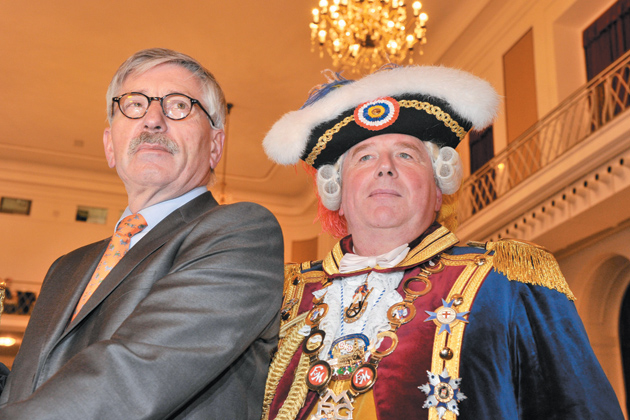
Like a neurotic student, united Germany celebrated its twentieth birthday by contemplating its own extinction. Published in the summer of 2010, Germany Abolishes Itself topped the best-seller lists throughout the autumn—straddling the twentieth anniversary of German unification on October 3—with 1.2 million copies delivered to bookshops by the end of the year. The author, Thilo Sarrazin, is a former finance ministry official and finance senator (in effect, finance minister) of the city of Berlin. He was until recently a director of the Bundesbank, a post from which he was persuaded to resign following the controversy around this book. He is, at this writing, still a member of the Social Democratic Party of Germany, although steps have been taken to propose his expulsion from it.
Sarrazin proceeds from two familiar observations—that Germany’s native-born population has a very low birthrate, and that the country has a lot of poorly integrated Muslim immigrants with (currently) a higher birthrate—to conjure a nightmare scenario in which, by the year 2100, a dwindling puddle of perhaps as few as twenty million true German Germans are dominated and pushed around by the descendants of Turkish and other Muslim immigrants, who build mosques and “Koran schools” while the country’s “churches, castles and museums” fall into decay.
Oswald Spengler, thou shouldst be living at this hour! Der Untergang des Abendlandes!
1 Finis Germaniae! The people Tacitus incompletely described around the year 100 AD in his Germania, all those manly Hermanns wandering the Teutonic forest, turning aside from their reading of Goethe and Schiller only to sire upon stout, fecund blond maidens many hearty, cultured little Sarrazins, will be no more. Germania, 100–2100, RIP. Unless, that is, Germania pulls itself together and takes the medicine prescribed by Dr. Sarrazin.
1.
Concern about the fact that Germany’s native-born population, along with that of several other West European countries, has a very low birthrate is not new. Some thirty years ago, a British postgraduate teaching at a West German university shared with his class a magazine article suggesting that according to current trends—the birthrate having plummeted from the mid-1960s on—there would eventually be no Germans left at all. He asked his students what they thought of this. After a long silence, one of them said, “Find’ ich gut!” (“I think that’s good!”) The remark was gloriously, ridiculously expressive of a now defunct West German attitude of self-abasement, after the horror and shame of Nazism.
Sarrazin does not find this prospect good. He is horrified by statistical projections that do indeed suggest that the German population would drop to 24 million by 2100—though only at current birthrates and assuming no further immigration.2 He is even more horrified that Germany, instead of attracting more highly qualified immigrants, has acquired a large number of poorly educated Muslims, many of whom—he argues—refuse to integrate, and instead sit around in poor neighborhoods such as Neukölln in Berlin, living off the overgenerous German welfare state. He describes West Germany’s import of so-called “guest workers” (Gastarbeiter), from the mid-1950s to the early 1970s, as a “gigantic mistake.” (He doesn’t pause to ask how exactly West Germany—facing a labor shortage that resulted from its economic boom and was exacerbated by the Berlin Wall cutting the flow of people from the East—could have attracted highly educated immigrants to do hard manual labor in its factories and sweep its streets.)
Sarrazin has nothing against the many immigrants of German origin (the so-called Aussiedler) from Eastern Europe, the Asians, and the East Europeans, who, he argues, generally integrate, do reasonably well at school, and contribute to society. It’s those who don’t who are the problem. And they, he claims, are currently those mainly Muslim families and descendants of the Gastarbeiter, living in the poorer parts of Berlin and other cities.
Now if Sarrazin had left it at that, this would have been a distinctly conservative but entirely reasonable challenge. At the end of this long book, his four-page alternative to his Spenglerian nightmare scenario contains a number of policy prescriptions, with all but one of which most liberal conservative or conservative liberal Europeans could readily agree. (I’ll come back to the one.)
Immigration policy, he argues, should be more rigorous and selective. All-day, universal kindergartens and schools should be introduced, with a free lunch for every child. Great attention should be paid to teaching children of migrants the German language and math. I would only add: also to teaching them history, civics, and a skill that would enable them to get a job. Here, all too briefly sketched, is a recipe for more active policies of what one might call civic national integration, of a kind that many West European countries are now adopting—policies that I, too, believe are overdue.
Advertisement
Unfortunately, Sarrazin does not leave it at that. He claims in the introduction that he is concerned above all to achieve “clarity and accuracy.” But Germany Abolishes Itself is actually a huge, indigestible pot of goulash, mixing numerous statistical tables and bullet-point lists, of the kind you might find in a German finance ministry internal report, with amateur history and philosophy, fragments of autobiography, and a meandering rant about Islam and the decline of the West. The finance ministry official plays Oswald Spengler.
He is, for example, obsessed with the hijab. “Millions of women in our midst,” he writes, “are compelled by the social pressure of their religion and culture to abide by clothing rules that abase them as autonomous individuals….” Millions? Even on his (high) estimate that among Germany’s 15 million people “with a migration background”—out of a total population of 82 million—there could be more than 6 million Muslims, this implies that almost all the Muslim women in Germany must be wearing the hijab. But later in the book he says that only 33 percent of German Muslim women wear the hijab. Math? Accuracy?
And how can he be sure that donning the hijab is always the result of social pressure? Has he never met, as some of us have, young, well-educated European Muslim women who wear the headscarf as a conscious, articulate choice? But he knows better:
The wearing of the headscarf never only expresses religiosity…. The headscarf means at the same time the acceptance of the subordination of woman to man, that is to say, the rejection of the emancipation of women on the Western [abendländlischen] model.”
Evidence?3
Dr. Sarrazin is as competent to explain the subjective “meaning” of wearing the headscarf for a German Muslim woman as a German Muslim woman would be to explain the meaning of Dr. Sarrazin’s moustache. And, by the way, in the 1950s of his childhood, which occasionally pops up in his text as a kind of golden age, many conservative Christian women—not to mention nuns—regularly wore a headscarf in public. Were they betraying the Abendland too?
Just how intemperate, illiberal, and inaccurate his views on these matters are can be seen in a comment he made during an interview with the German edition of Lettre Internationale in 2009, which began the furor:
I don’t need to respect anyone who lives off this state, rejects this state, does not properly provide for the education of his children, and constantly produces new headscarf-girls. That’s true of 70 percent of the Turkish and 90 percent of the Arab population in Berlin.
Accuracy?4
At times, we hear the plaintive tones of a crusty old man who no longer understands the world around him. After evoking some happy hours of his own childhood, spent reading to his heart’s content, curled up in a wingbacked armchair under a portrait of Goethe, he muses, “often I ask myself, where I would now be” if instead he had passed his time with the computer game World of Warcraft.
He makes the valid and important (though hardly original) observation that undiscriminatingly generous European welfare benefits have encouraged a culture of welfare dependency in many families of immigrant origin, and hindered the kind of work-based integration that one sees with immigrants to the United States.5 He combines this, however, with an idiosyncratic concern to demonstrate that one can live perfectly well on the basic German social security benefit. This produces a passage whose unintended comedy has been insufficiently remarked upon by German reviewers. He reports that he got one of his officials in the Berlin city finance department to work out in detail how one could feed oneself for three days on the €4.25 a day that (in 2008) was allowed for food. He reprints here the resulting menu, which he describes as providing four meals a day and being “very balanced and varied.” One of the four meals is “1 glass of tea + 3 biscuits.” The sum total of one supper is “1/2 gherkin, 130g sausage loaf (1 slice), 200g potato salad.” Who could ask for more?
Better still, he reports that he and his wife nourished themselves for several days “without any special effort at all” on this social security food allowance. Oh, had I the pen of Charles Dickens to conjure the scene! Herr Dr. Finanzsenator (salary in 2008: €138,000 a year) and his good lady sit down, in their presumably not uncomfortable abode, to sample the delights of living like the poor. Carefully they weigh out the potato salad. They slice the sausage loaf. They halve the gherkin. As they enjoy this ample meal, helped down with a glass of fine Berlin tap water, they talk of books, history, the decline of the West. A Schubert quintet sounds quietly in the background, from the gramophone under the portrait of Goethe. Then, replete, Dr. Sarrazin leans back and says, “You see, my dear, really the poor live quite well!”
Advertisement
Less amusing are his claims about the genetic inheritance of intelligence among different ethnic groups. In this German version of the Bell Curve, Sarrazin says that intelligence is 50 to 80 percent inherited. He then spends four pages explaining in some detail how intelligence research reveals that the Jews are 15 percent more intelligent than those around them. This was true in early-twentieth-century Germany, he asserts, “and to this day a similar order of magnitude is discovered among the Jews of North America.” Among the historical reasons for this is that “the rabbi had higher chances of passing on his seed [Fortpflanzungs-chancen] because he could marry the rich Jewish businessman’s daughter.” The Nazis, he explains, denounced intelligence tests as a Jewish discovery, designed to privilege a certain Jewish kind of intelligence. And he comments: “For the German Herrenmenschen an intelligence test in which the Jews got 115 but German Herrenmenschen on average only 100 was unacceptable.”
So clearly the Germans made a bad mistake by getting rid of their Jews. “The Turks are conquering Germany as the Kosovars have conquered Kosovo: by a higher birthrate,” Sarrazin told Lettre Internationale in his 2009 interview, adding, “That would please me if they were East European Jews with an IQ 15 percent higher than that of the German population.” Dr. Sarrazin is a great philo-Semite.
This group inheritance of intelligence is not just cultural but genetic. “All Jews share a particular gene,” he told Welt am Sonntag, “Basques have particular genes, which distinguish them from others.”6 He later distanced himself from this remark. For more recent printings of his best seller, he has added a new foreword saying that nature and nurture interact in complex ways, and “at no point in the book do I claim that certain ethnic groups are for genetic reasons ‘more stupid’ than others.”7
Sarrazin has also quietly made a number of small corrections. For example, where he wrote “demographically, the enormous fertility of Muslim migrants is a threat to the cultural and civilizational equilibrium of an aging Europe,” he has added “in the long term.” Does this make it more accurate? A thorough academic study of the fertility of immigrants in Germany, by Nadja Milewski, suggests that their birthrate has already declined in the second generation, trending downward toward local norms, and therefore precisely in the long term is unlikely to be so “enormous.”8
He told the Frankfurter Allgemeine Zeitung that he had removed another passage because some journalists had misrepresented him as saying that Muslims are more stupid. “That’s obviously nonsense,” he said.9 Unfortunately this is a misunderstanding he encourages, with his own repeated blurring of the line between cultural and genetic inheritance.
His chapter on demography is subtitled “More Children of the Clever, Before It Is Too Late.” His policy prescription at the end of the book—presented in the form of an alternative to the Spenglerian scenario for 2100—envisages “measures” to increase the share of births attributable to “women with a medium and high standard of education.” These “measures” are unspecified, but he describes them as “especially controversial,” which leaves us wondering what they would be. Tax breaks and a newly created Bundesmutterkreuz (Federal Mother’s Cross) for blond graduate Dr. Sabine Volksretterin? And would there be complementary “measures” to discourage excessive childbearing among stupid, backward women in hijabs? I think we should be told.
2.
This pot of half-cooked goulash, with its mix of the edible and the unsavory, has become the biggest political best seller in the western part of Germany in a quarter-century, and second to none in the twenty years of united Germany.10 As with the success of Oswald Spengler’s The Decline of the West in the years after World War I, what we have here is not just a publishing phenomenon but a cultural and political one.
The twentieth anniversary of German unification was marked by the usual round of grumbling introspection about whether Ossis (East Germans) and Wessis (West Germans) are really becoming one people; but even the Germans seem to have grown tired of that. So instead, Ossis and Wessis picked up Sarrazin’s book and whinged together about these bloody Muslim immigrants.11 Alternatively, they grumbled about the profligate Greeks, Irish, Portuguese, Italians, etc., who were calling on frugal, hardworking Germans to bail out the Eurozone. If one were unkind, one might say that the inner unification of the Germans is proceeding nicely thanks to these two sets of whipping boys. There’s nothing like a common enemy to bring people together.
The fact that this is a German book dealing with matters such as the relative intelligence of Jews will inevitably wake old fears and associations. While I was reading it, I visited what is reportedly the first public exhibition about Hitler to be mounted in the history of the Federal Republic, a restrained and critical display at the German Historical Museum in Berlin. An involuntary shudder passed down my spine when I came upon a Nazi poster showing how people of “inferior race” would overtake healthy Aryans as a proportion of the population within some decades, because of their differential birthrates—or, to put it another way, their “enormous fertility.”
Yet I emphatically agree with Jürgen Habermas that Nazism is the wrong frame of reference in which to discuss the “Sarrazin debate.” Habermas suggests that this is a revival not of the 1930s but rather of the 1990s, when Germany had its first big controversy about immigration.12 The most important comparison, however, is not historical but contemporary. The “Sarrazin debate” is the German version of a discussion taking place at the same time in every other West European country that has a significant Muslim minority. Comparative polling shows the British, Italians, and Spanish all expressing more negative views of the impact of immigration than the Germans.13 In the Netherlands, the sweeping anti-Islam (not just anti-Islamist) rhetoric of Geert Wilders helped win his party more than 15 percent of the popular vote in the June 2010 election, giving it powerful leverage over government.
In Germany, there has been nothing like that. In Germany, not merely the inflammatory but even the frank discussion of this subject has been constrained by the kind of nervous taboos attacked by Sarrazin and his supporters as “political correctness”—and such taboos are backed up by the threat of prosecution for hate speech. (A prosecutor’s investigation for possible incitement charges was initiated after Sarrazin’s Lettre Internationale interview, but fortunately soon closed.)
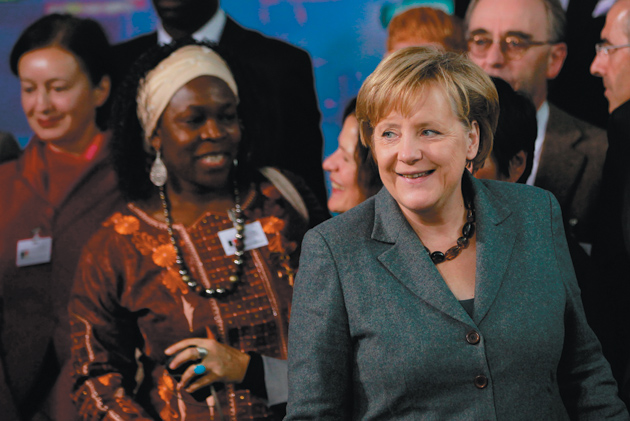
Instead of openly confronting people’s real concerns, a characteristic German reaction has been so was sagt man nicht!—“One doesn’t say things like that.” But the more people didn’t say it, the more they thought it. So the pressure of the unspoken built up, like steam in a pressure cooker—until, with the publication of Sarrazin’s book in summer 2010, the lid blew off. Now the cry went up: endlich sagt das einer! (“At last, someone is saying it.”) On the day Chancellor Angela Merkel was holding a well-intentioned “integration summit” of community leaders and politicians in the Federal Chancellery in Berlin, the mass-market tabloid Bild printed a page of extracts from what it described as “thousands” of fan letters to Sarrazin, so that—according to Bild—“the summit participants can read what the Germans think.”14
As in the crisis of the Eurozone, the other great trauma of united Germany’s twentieth year, Merkel has responded with the kind of tactical search for a domestic consensual center that has stood her in good stead before but is not serving her—or Europe—well in more testing times. Her first reported reaction to the views of the Social Democrat Sarrazin was dismissive: “Such simplistically sweeping judgments are stupid and don’t get us any further.”15 When, however, his simplistically sweeping judgments turned out to be wildly popular among her own conservative electorate, she turned around and told a meeting of the youth wing of her Christian Democrats that the multicultural (“multi-kulti”) concept had “failed, and failed utterly.”
At her party conference in November, Merkel said that she “takes seriously” the “broad discussion about migrants of the Muslim faith.” Then she produced this gem of Christian Democratic evasion: “It is after all not the case that we have too much Islam, but rather that we have too little Christianity.” She did, however, also say that any migrant who learns German and respects “our laws and values” is welcome; and she has called for more positive steps to support integration.
3.
Some people whom I respect say: well, Sarrazin may have been too provocative, but at least he has unleashed an honest debate on a major issue.16 I understand why they say this, but the opposite seems to me true. Precisely because there is a serious issue here, it is damaging that the German discussion of it should arrive in a half-boiled sauce of eugenics and cultural pessimism.
All West European societies are wrestling with the legacy of their multiple past mistakes with respect to immigration and integration. These mistakes include the folly of treating people of migrant backgrounds, even in the second or third generations, as transient “guests,” and the unacceptable moral and cultural relativism of some of the policies that have passed for “multiculturalism” during the last decades.17 All this was described and analyzed in the Dutch scholar Paul Scheffer’s excellent The Immigrants, which appeared in German in 2007, but his book obviously never had a chance of becoming a best seller, since it was well-informed, accurate, nuanced, moderate, and sensitive.18
Sarrazin sums up his recipe for better integration as “expect more, offer less.” Mine is “expect more, offer more.” However, that “more” we offer should not be indiscriminate welfare benefits or state-subsidized multiculturalist folderol, but good education, professional training, genuinely equal opportunities in the labor market, and a welcoming, open, free society, confident in upholding its own values, such as free speech, tolerance, and equal rights for women. The “more” that a free country is entitled to expect of those who wish to live in it is summed up by Mustafa Ceri´c, the thoroughly down-to-earth grand mufti of Bosnia-Herzegovina. His simple message to the immigrant: first, respect the laws of the land; second, learn the language; third, do something useful for the society in which you live.
What is ultimately most depressing about Sarrazin’s book is its lack of faith in the very thing it claims to value most highly: education, culture, everything that is summed up in the untranslatable German word Bildung. Sarrazin quotes Erasmus: “People are not born but made [gebildet].” So why doesn’t he believe it? German culture is, after all, one of the richest in the history of humankind. It was this culture that took an immigrant from Switzerland called Sarrazin (the name apparently derived from “Saracen,” i.e., marauding Muslim) and turned his alien stock, over a few generations of Bildung, into the ur-German finance official and amateur philosopher Thilo Sarrazin. It is this culture, this Bildung, that has already given us a leader of the German Greens called Cem Özdemir, a female Christian Democrat minister in Lower Saxony called Aygül Özkan, and numerous other Turkish Germans or German Turks in various professions.
Such educated men and women of migrant background will also mingle and mix with others, producing children and grandchildren who will have ever more complex identities. This highly desirable mixing will itself subvert those simplistic, black-and-white demographic projections of there being more “Turks” than “Germans” in a hundred years’ time. I had to laugh out loud when, having finally waded my way through to the book’s acknowledgments, I found Sarrazin thanking his editor for significantly improving the readability of his German prose. Her name? Ditta Ahmadi. (I dread to think what Sarrazin’s prose was like before Ahmadi improved it.)
This Germany, if it remains true to the best of its culture, should be an attractive place for highly educated migrants. At the moment, it doesn’t seem to be. Indian IT specialists somehow prefer to go to California, and not just because of the English language. Germany’s thriving economy may face a shortage of up to 400,000 skilled workers, according to the German chambers of commerce, but it has seen a net loss of its most highly qualified people in every year from 2005 to 2009.19 Ironically enough, some of the well-educated people leaving are second- and third-generation German Turks/Turkish Germans, going (“back”?) to take interesting jobs in the booming Turkish economy.20
Sarrazin himself obviously wants highly qualified migrants—especially East European Jews, and other congenital geniuses—to come and stay. But his book, and the popular mood music around it, will hardly have made Germany a more attractive place for skilled migrants. In this sense, one might say that Sarrazin is the disease for which he claims to be the cure.
Germany is going to change, of course. According to one scholarly demographic projection, by 2050 something like one in every four Germans will probably have a “migration background”21 But if it is true to the best of its own traditions, Germany will also remain Germany. It will not abolish itself but recreate itself. That’s what nations do. They change, and they remain the same. If they are wise, they change in order to remain the same.
Nations can do this because they are made not by genes but by language, history, and geography, by myths, values, shared ways of life and thought. Thus, for example, it is somehow deeply characteristic of Germany that it feels a strange compulsion, every now and then, to contemplate its own extinction in turgid prose. In that sense, I suppose one could say that Sarrazin has contributed to Germany’s survival after all.
This Issue
February 24, 2011
This Issue
February 24, 2011
-
1
Spengler’s title is conventionally translated as The Decline of the West, but the conservative flavor of the word Abendland is perhaps better captured by the now archaic “Occident.” ↩
-
2
See Steffen Kroehnert et al., The Demographic State of the Nation (Berlin-Institute for Population and Development, 2006). ↩
-
3
Just two pages after this sweeping generalization, he himself summarizes the observations of the mayor of the Berlin neighborhood of Neukölln thus: “The girls with the strictest headscarves come from the religiously orthodox families and are mainly rather well educated. The especially strictly veiled [sic] are often the best at speaking German.” For a realistic and nuanced account of the different kinds of hijab that German Muslims wear, and their diverse reasons for wearing it, see Ahmet Toprak, Integrationsunwillige Muslime? Ein Milieubericht (Lambertus, 2010). ↩
-
4
“Klasse statt Masse,” Lettre Internationale (German edition), No. 86, Autumn 2009. Another tiny example of his accuracy: on page 274 he attributes a quotation to one Timothy Gordon Ash. ↩
-
5
In his excellent comparative account of immigration in Western Europe, published in German as Die Eingewanderten: Toleranz in einer grenzenlosen Welt (Carl Hanser Verlag, 2007), Paul Scheffer records that roughly half the people of Moroccan and Turkish origin in Amsterdam were not employed, whereas one study found some 90 percent of first-generation immigrants in New York had work. ↩
-
6
“Mögen Sie keine Türken, Herr Sarrazin?” Welt am Sonntag, August 29, 2010. ↩
-
7
The foreword is dated September 2010, and appears from the eleventh printing on. ↩
-
8
See Nadja Milewski, Fertility of Immigrants: A Two-Generational Approach in Germany (Springer, 2010), available online at http://www.demogr.mpg.de/books/drm/006. ↩
-
9
“Sarrazin: Ich mache keine inhaltlichen Korrekturen,” Frankfurter Allgemeine Zeitung, November 15, 2010. The sentence was: “Among migrants from the Near East, genetic burdens—determined by the marriage between relatives that is usual there—play a significant role and produce a higher than average proportion of inherited diseases.” ↩
-
10
It seems that the last comparable political best seller in (then still) West Germany was Günter Wallraff’s Ganz Unten, which in 1985 reportedly sold more than 1.5 million copies in a matter of weeks. The comparison is instructive. Where Sarrazin’s book denounces the inadequate integration of Turkish Gastarbeiter, Wallraff’s book was a firsthand account of all the prejudice a Turkish Gastarbeiter faced in the workplace—based on Wallraff himself going to work pretending to be a Turk called Ali. ↩
-
11
I asked Sarrazin’s very helpful publishers if they could establish whether, proportional to population, more copies had been purchased in the old East or the old West, but they tell me that due to the wholesale book distribution system, it’s impossible to say. ↩
-
12
See Jürgen Habermas, “Leadership and Leitkultur,” The New York Times, October 28, 2010. ↩
-
13
See the report on a Harris poll for the Financial Times, “Britons Lead on Hostility to Migrants,” Financial Times, September 6, 2010. ↩
-
14
“Herr Sarrazin, Sie Sind ein Prophet,” Bild (Bundesausgabe), November 3, 2010. ↩
-
15
Quoted in Der Fall Sarrazin: Eine Analyse (Albersroda: Institut für Staatspolitik, 2009), p. 41. ↩
-
16
This was the initial reaction of former Chancellor Helmut Schmidt to Sarrazin’s 2009 Lettre Internationale interview. See also the assessment by the British writer David Goodhart in “The Challenge to German Liberalism,” Prospect, November 17, 2010. ↩
-
17
I have long argued that the ideological term “multiculturalism,” as distinct from the descriptive adjective “multicultural,” should simply be abandoned. See my 2008 Isaiah Berlin memorial lecture, available on the Oxford University iTunes website at http://itunes.apple.com/itunes-u/the-isaiah-berlin-lecture/id381700653. ↩
-
18
Paul Scheffer, Die Eingewanderten: Toleranz in einer grenzenlosen Welt (Munich: Carl Hanser Verlag, 2007). An English-language edition of Scheffer’s book is to be published by Polity Press, entitled Immigrant Nations. ↩
-
19
See Quentin Peel, “Berlin Pushes for Integration of Immigrants,” Financial Times, October 19, 2010, and “Deutschland verliert Spitzenkräfte an Europa,” Frankfurter Allgemeine Zeitung, November 16, 2010. ↩
-
20
As vividly reported in Bild, “Wir Deutsch-Türken sind zurück in die Türkei gegangen,” November 27, 2010. I am most grateful to my Oxford colleague Kerem Oktem for this and other references. ↩
-
21
As reported in a valuable survey article by the Oxford University demographer David Coleman, “Immigration and Ethnic Change in Low-Fertility Countries: A Third Demographic Transition,” Population and Development Review, Vol. 32, No. 3 (September 2006), pp. 401–446, this on p. 431. ↩

