1.
He would have loved it. Dead for a hundred years, but climbing the best-seller lists with a memoir whose publication he deferred for a century till everyone mentioned in it, along with anyone who remembered them, would be dead too and in no position to complain. Since he lived (1835–1910) as if a single lifetime could not contain him, it’s entirely apt that he’s back with a posthumous encore.
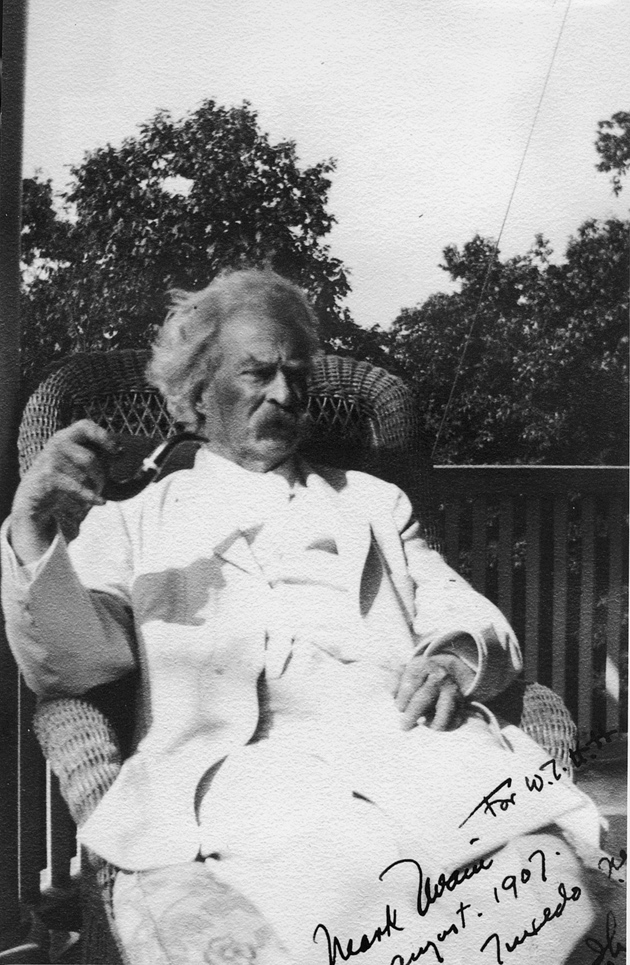
Mark Twain is sometimes imagined as a shambling fellow with a slow drawl (there are no known recordings of his voice), but in fact, he was incessantly restless, edgy, tight-wired, rarely at rest. In one three-month period while living in Washington, he moved five times. He made dozens of ocean crossings and lecture tours, including one between the summers of 1895 and 1896 during which he “barked at audiences” up to twenty times a month across the United States, Canada, Australia, New Zealand, South Africa, India, and what was then Ceylon.
Even on those rare occasions when he was more or less sedentary, he kept up a prodigious pace, “working,” by his own account, “every night from eleven or twelve until broad day in the morning.” If his drive slackened on one book, as it did repeatedly while he was writing The Adventures of Huckleberry Finn (1884), he would “pigeonhole” it, turn to another, then come back renewed by the deflected effort. He was never much for sleeping. According to his friend William Dean Howells, he would coax himself to bed with champagne, beer, or hot scotch—sometimes, no doubt, mixing them into a soporific cocktail. “I am going to settle down some day,” he wrote to a fellow contributor to the San Francisco Alta, the paper that gave him his start by printing his dispatches from Europe that became The Innocents Abroad (1869), “even if I have to do it in a cemetery.”
As it turned out, he never did settle down, exactly. Instead, he spent his last years planning on “speaking from the grave”—his phrase for the memoir that has now appeared upon the centenary of his death. With the excusable vanity of genius, he had high expectations for its reception. It will “live a couple of thousand years without any effort,” he told Howells, and will “then take a fresh start and live the rest of the time.”
In one way or another, he worked at it for much of his life. “The truth is,” he told a friend, “my books are simply autobiographies” in the sense that they are stocked with fictional versions of people he had known, including himself. But starting around age forty, he made some tentative attempts at a memoir of a more conventional kind. Already famous as the author not only of The Innocents Abroad but also Roughing It (1872) and The Adventures of Tom Sawyer (1876), he had reason to think there was money to be made from such a book. A big spender and a bad investor, he needed money all the time.
At first he did not advance very far with the project, allowing only a few bits into print as magazine pieces now and then. Others were published in sanitized form after his death—in 1924, by his first biographer Albert Bigelow Paine, later by Bernard DeVoto in a compilation entitled Mark Twain in Eruption (1940), and most recently—until now—in a book too authoritatively entitled The Autobiography of Mark Twain (1959) by its editor, Charles Neider, who presented the scattered materials “in the sequence which one would reasonably expect from autobiography.”
There is nothing reasonable about the new book. In some respects it is another compendium of fragments. Some have never been published before, while those that have been are presented here, for the first time, in the order of their composition rather than re- arranged in the order of reported events. Here we meet “Uncle Dan’l,” a middle-aged slave of “wide and warm” sympathies whom Twain knew as a child and on whom he modeled Jim in Huckleberry Finn, as well as a boy named Tom Blankenship, the model for Huck himself, “ignorant, unwashed, insufficiently fed; but…tranquilly and continuously happy.” We meet, too, the originals of lesser characters, such as Twain’s mother’s cousin, James Lampton, the model for Colonel Sellers (Twain’s version of Mr. Micawber) in The Gilded Age (1873), who lived his whole life “prospectively rich,” in limbo between the last disappointment and the next scheme.
Included in a recent exhibition of Twain manuscripts and memorabilia at the Morgan Library and Museum was an intriguing item: a board game, which he designed and patented at age fifty, called “Mark Twain’s Memory-Builder,” in which the players earn points by filling in a centuries-long calendar with the names of battles, kings, and the like.1 The autobiography, too, appears to have been a kind of memory-builder—an exercise by which Twain kept up his powers of recollection against the dimming effects of time: “I can see the farm yet, with perfect clearness,” he writes about his uncle’s home, where he had spent happy times more than fifty years earlier, and the writing is so vivid that one smells the winter fires and sees “the slick and carpetless oak floor faintly mirroring the dancing flame-tongues and freckled with black indentations where fire-coals had popped out and died a leisurely death.”
Advertisement
Sometimes the autobiography seems Twain’s letter to posterity. At other times, reading it feels like eavesdropping on a conversation he is having with himself. As always, there were financial considerations. Approaching seventy, with mortality on his mind—“it is a bad business to get the habit of being sick. You will find it hard to break”—he got the idea of carving up his reminiscences and adding them “as notes (copyrightable) to my existing books,” and thus ensuring a protected income for his survivors.
2.
So what should we make of the result? Well, it’s just at the start of its two- thousand-year run, two thirds of the whole work aren’t yet in print (this is the first of three projected volumes), and the early reviews are mixed. “A disjointed and largely baffling bore” was Adam Gopnik’s verdict in The New Yorker. Garrison Keillor, in The New York Times Book Review, dismissed it as “a ragbag of scraps,” and Jonathan Yardley, of The Washington Post, found some passages engaging but felt “trapped in a locked room with a garrulous old coot.” On the other hand, in an editorial-page hurrah, The New York Times declared the book a gift from a time-traveler whose voice remains amazingly fresh: “We can hardly wait for Volume 2.”
I’m with the Gray Lady. By turns charming and cranky, the old coot is very good company—especially when he dredges up old grudges. He “did not forgive his dead enemies,” Howells said with affection; “their death seemed to deepen their crimes, like a base evasion, or a cowardly attempt to escape.” A reviewer who panned The Gilded Age is a “reptile.” A publisher who refused Twain’s terms is an “animal,” and, more particularly, a “skinny, yellow, toothless, bald-headed, rat-eyed” animal. A good deal of the autobiography is about settling old accounts.
But it is “not,” as Twain says, “a revenge-record.” What really inflames him are not the discourtesies committed by people, but the injuries delivered by time. There is a lot of death in this book—the witnessed or reported deaths of family and friends, and, throughout, his own prospective death. He is driven to white-hot anger by those who dishonored his friend Ulysses S. Grant, whose agonizing cancer of the tongue and jaw never revealed itself “in the expression of his face…as long as he was awake,” though his courage by day could not conceal his ordeal by night, since “when asleep his face would take advantage of him and make revelations.”
In 1906, as if it had happened yesterday, Twain writes about the death in 1858 of his brother Henry, to whom doctors administered an inadvertently fatal dose of morphine following a steamboat fire that had scalded his lungs. With excruciating intimacy, but without the slightest trace of what Huck calls “sentimentering,” he reports how word of the death of his favorite child, Susy, at age twenty-four, reached him while he was an ocean away. As the truth of the news defeats his incredulity, he finds himself hearing in his memory the sound of her child’s voice—the “funny musketry-clatter of little words, interrupted at intervals by the heavy-artillery crash” of big words that she didn’t quite get right, as when, at age five, she told a visitor that she had been to church only once—to see her little sister Clara crucified. (She meant christened.)
And then there are the harrowing pages that recount how his beloved wife Livy (“slender and beautiful and girlish…to the last day of her life”) faded away before his eyes, despite his having taken her here and there and everywhere in the hope that she would rally in some healthful clime, until she finally gave up in a gorgeous room flooded with sunshine in their rented Florentine villa—too weak to walk to the window “to see the sun sink down, drowned in his pink and purple and golden floods, and overwhelm Florence with tides of color that make all the sharp lines dim and faint and turn the solid city to a city of dreams.” The sentences wander, the paragraphs go on; but there is nothing languid in the long descriptions of the furnishings in the death-house: the “sumptuous canopy over the brass bedstead…made of…shouting lemon-colored satin,” the doors “hooded with long curtains that descend to the floor and are caught apart in the middle to permit the passage of people and light.”
Advertisement
In the midst of the inventory by which he fixes in his mind the scene of the calamity, his attention wanders to another “venerable fortress,” Windsor Castle, which he had visited years before, where he imagines Queen Victoria supervising the installation of a dumbwaiter for bringing meals up from the basement kitchen and a modern trolley system for carrying them to royal guests—hints of the stupendous transformation of the British-ruled world over which she had reigned for most of a century. “She saw the whole of the new creation, she saw everything that was made, and without her witness was not anything made that was made.” More than thirty years earlier, in Roughing It, Twain had written of Joseph Smith’s Book of Mormon that “whenever he found his speech growing too modern…he ladled in a few such Scriptural phrases” without which “his Bible would have been only a pamphlet.” He does a good deal of ladling into his own baggy book, but this reader, at least, would not have had him leave anything out.
3.
It will doubtless strike some readers as incoherent. And so it is—in just the way that Twain thought good writing should be. “To string incongruities and absurdities together in a wandering and sometimes purposeless way,” he wrote in an 1895 essay, “How to Tell a Story,” was the basis of his art. In the title of that little manifesto, he used the word “tell” instead of “write” because he was, first and last, a talker. A prodigious speechmaker, he rarely spoke from a prepared text, especially when preceded by other speakers, whose remarks he liked to use as provocation for his own. “I had all the advantages,” he recalls about one occasion when he followed Brander Matthews, Richard Watson Gilder, and other worthies to the podium, “for I came without a text, and these boys furnished plenty of texts for me.” Spontaneous speech, he knew, is liable to digression, repetition, contradiction, and—if the audience is lucky—to “stretchers” and malapropisms, which have their best effect when the speaker seems “innocently unaware” of what he is saying. He was, in other words, his own best straight man.
This is the Twain who, at a formal Washington gathering in honor of “Woman,” announced that “as a wet nurse, she has no equal among men.” It is the Twain—the first American author, as Hemingway famously put it, to “use the words that people have always used in speech”—who described a murder trial in Tom Sawyer, Detective (1896) at which witnesses for “the prostitution” testify to the bad blood that existed between the defendant and “the diseased.” It is the same writer who, in Huck Finn, gives this famous rendition of Shakespeare at his most elevated:
To be, or not to be; that is the bare bodkin
That makes calamity of so long life;
For who would fardels bear, till Birnam Wood do come to Dunsinane,
But that the fear of something after death
Murders the innocent sleep,
Great nature’s second course,
And makes us rather sling the arrows of outrageous fortune
Than fly to others that we know not of…
But soft you, the fair Ophelia:
Ope not thy ponderous and marble jaws,
But get thee to a nunnery—go!
Yet ever since they became certified classics, Twain’s books—led by Huckleberry Finn, lately joined by Pudd’nhead Wilson (1894), whose theme of racial ambiguity has made it a classroom staple—have been subjected to the test of formal or ideological coherence. It’s a test he cannot pass. Many critics have wanted to know why Huckleberry Finn concludes with a drawn-out “coon game,” with Jim as hapless victim. It seems a case of the tail wagging the dog, and, worse, a relapse on Huck’s part into the childish insouciance with which he had once treated Jim. But the very subject of the book is inconstancy and improvisation. Whenever Huck goes ashore to figure out how far downstream he and Jim have drifted, or to replenish their provisions, he goes in disguise—dissembling, tall-tale telling, so inventive of new identities that he runs the risk of forgetting his alias of the day. Why should he evolve from a prankster into the achieved hero of a bildungsroman?
Others want to know what Twain’s position was on, say, technology, or war, or religion, or the idea of progress. But such questions miss the kind of writer he was—a writer whose only method was to follow his responses to whatever he sees, wherever they lead, often into collision with himself. As Howells put it:
He was not enslaved to the consecutiveness in writing which the rest of us try to keep chained to. That is, he wrote as he thought, and as all men think, without sequence, without eloquence, without an eye to what went before or should come after. If something beyond or beside what he was saying occurred to him, he invited it into his page.
As Twain grew old, he wanted still more latitude. “With a pen in the hand,” he said, “the narrative stream is a canal; it moves slowly, smoothly, decorously, sleepily, it has no blemish except that it is all blemish. It is too literary, too prim, too nice.” He wanted to break free from the chronology of lived experience and to take advantage of what Harriet Elinor Smith, chief editor of the new edition, nicely calls “the disinhibiting nature of talk.” And so, in his last years, he abandoned the pen altogether in favor of a technique he had tried from time to time: dictation.
At first he spoke to a hired “shorthander,” later to a machine (an early “recording phonograph”), then to willing friends and family—his former lecture agent, James Redpath, his daughter Jean, who became a proficient typist—and finally to a series of stenographers, including Isabel Lyon, whose relation to Twain in his late years has long been the subject of speculation.2 The switch from writing to talking doubtless made the project seem less daunting. But he had an artistic motive as well. He wanted to register the way memory actually works—long-ago incidents popping into the mind not by some sequential logic that replicates the order in which they occurred, but through the associative process by which experiences separated by years suddenly show up, unbidden and in a disorderly jumble. To his brother Orion, who was thinking about writing his own autobiography, he made this suggestion: “When you recollect something that belonged in an earlier chapter do not go back, but jam it in where you are.” The more Twain worked at his own memoir, the more he took his own advice.
The result is recognizably the work of the same writer who, in Following the Equator (1897), launches into a tirade against Oliver Goldsmith’s The Vicar of Wakefield as “one long waste-pipe discharge of goody-goody puerilities” for no reason other than the fact that the ship conveying him across the Pacific does not contain a copy of Goldsmith’s book in its library. The sight of the Taj Mahal, about whose sublimity he had heard and read too much, sends him back in memory to his first visit many years earlier to Niagara Falls, when, expecting “a sea-green wall of water sixty miles front and six miles high,” he found, instead, the “toy reality” of “a beruffled little wet apron hanging out to dry.”
The practitioner of this associative method was a glaringly, gloriously erratic writer who could have said, with Whitman (whom he warmly admired), “Do I contradict myself?/Very well then I contradict myself.” He was both a fabulist and a realist, a writer of children’s stories and a pornographer who wrote a faux-Elizabethan tale (for private circulation) about a golden age when “pricks were stiff and cunts not loath to take ye stiffness out of them.” He was a memoirist of Southern innocence and yet, as Howells called him, “the most de-southernized Southerner.” He insisted that “no nation, howsoever mighty, occupies a foot of land that was not stolen,” yet he praised the “English resolution and English devotion” of India’s colonial rulers.
4.
So it is fruitless to search the autobiography for coherence or a strong narrative line. These were rarely Twain’s aims—certainly not in this end-of-life work. What he was after, I think, was to cross the “abyss of time” and make the past vivid—in the first instance for himself. To that end, he threw into the work anything that would help: diary entries, texts of his own speeches delivered years before, passages from the touching biography that Susy had begun to write of her father when she was a child, pasted-in newspaper clippings about events that had once caught his interest—everything from the latest pogrom in Russia to the expulsion from the White House of an aggrieved woman who had come seeking an audience with President Roosevelt.
But there is a common premise throughout the miscellany. Twain knew that “history can carry on no successful competition with news“—in the sense that the past comes alive only if rendered with eyewitness immediacy. To do so was his great gift. “Dear me,” he interrupts himself during one dictating session, “the power of association to snatch mouldy dead memories out of their graves and make them walk!” At one point, he employs a single word—“embroidery”—as a bridge between his childhood memory of his mother cautioning a friend that when her boy Sam tells a tale, it must be discounted “30 per cent for embroidery” and an occasion forty years later when a member of a Hartford literary club used the same word to cast doubt on Twain’s claim that he had seen his brother’s death foretold in a dream.
“It is almost always wise,” he tells us, “and is often in a manner necessary, to kill an editor.” The autobiography was his murder weapon. It contains passages that even America’s literary icon could not have gotten past any editor, such as this one explaining that America’s favorite holiday has its origin in the vicious cycle of wars between white men and Indians:
Thanksgiving Day became a habit, for the reason that in the course of time, as the years drifted on, it was perceived that the exterminating had ceased to be mutual and was all on the white man’s side, consequently on the Lord’s side, consequently it was proper to thank the Lord for it and extend the usual annual compliments.
This is the same Twain whom one glimpsed through another striking item in the show at the Morgan Library—a handwritten note on the flyleaf of his excoriating 1905 pamphlet King Leopold’s Soliloquy: A Defense of His Congo Rule, in which he proposed that the front wrapper should display an image of the king holding a “basket of severed hands in one hand & butcher knife in the other.”3 The proposal was rejected. The final published cover shows a crucifix lying across a sheathed knife.
“We have two opinions,” Twain says about the writing life, “one private, which we are afraid to express; and another one—the one we use—which we force ourselves to wear to please Mrs. Grundy.” In the autobiography he is finished with Mrs. Grundy. The man we meet here is generous at one moment, cruel the next; grateful and bitter by turns; petty and large-hearted, sometimes driven to hot indignation, sometimes stoic and kind. He is freer in scope and tone than elsewhere in his writings, yet he is ultimately the writer we know from his best work, as when, in Huckleberry Finn (a book, he said, about the collision between “a sound heart and a deformed conscience”), he describes Huck’s contradictory fears that his brutal father might come back and that he might not come back. Twain knew that any picture of any human being as a self-consistent creature is a false picture. He “may have been,” as Justin Kaplan has said, “the least ‘racist’ of all the major writers of his time, Herman Melville excepted”—yet in the autobiography he refers sneeringly to a Connecticut acquaintance as “the dullest white man” in the state.
He was a connoisseur of his own contradictions. He was preoccupied with the theme of conflict between apparently identical twins (in Pudd’nhead Wilson and The Prince and the Pauper (1881), among other works)—but his real theme was the deeper one of the divided self, as in this portrait, in Following the Equator, of the “native Australasian”:
He kills the starving stranger who comes begging for food and shelter—there is proof of it…. He takes his reluctant bride by force, he courts her with a club, then loves her faithfully through a long life—it is of record. He gathers to himself another wife by the same processes, beats and bangs her as a daily diversion, and by and by lays down his life in defending her from some outside harm—it is of record. He will face a hundred hostiles to rescue one of his children, and will kill another of his children because the family is large enough without it…. He is a sociable animal, yet he turns aside and hides behind his shield when his mother-in-law goes by.
Lest this catalog be mistaken for a list of “primitive” man’s qualities, he remarks that among the “many humorous things in the world” is “the white man’s notion that he is less savage than the other savages.” What saved Twain from misanthropy was his unsparing self-knowledge—what Howells called the “kind contempt to which he was driven by our follies and iniquities as he had observed them in himself as well as in others.”
In the double-anniversary year just passed (one-hundredth of his death, one-hundred-seventy-fifth of his birth), he has been the subject of many articles, symposia, exhibitions, and books, including a collection of contemporary views of him, an anthology of writers’ responses to his work, and an informative new biography.4 To my mind, however, the most sensitive portrait remains Howells’s little memoir My Mark Twain (1910), in which Howells recalls how his friend “was apt to smile into your face with a subtle but amiable perception, and yet with a sort of remote absence; you were all there for him, but he was not all there for you.” This first installment of Twain’s autobiography brings us closer to all of him than we have ever come before.
This Issue
February 24, 2011

This Issue
February 24, 2011
-
1
See the exhibition catalog by Isaac Gewirtz, Mark Twain: A Skeptic’s Progress (New York Public Library, 2010), p. 78. ↩
-
2
In Dangerous Intimacy: The Untold Story of Mark Twain’s Final Years (University of California Press, 2004), Karen Lystra portrayed Lyon as a manipulative woman intent on displacing Twain’s daughters in his affections as he grew old and dependent. Michael Shelden, in Mark Twain: Man in White—The Grand Adventure of His Final Years (Random House, 2010), suggests that she took advantage of the aging widower’s trust to exploit him financially. In Mark Twain’s Other Woman: The Hidden Story of His Final Years (Knopf, 2010), however, Laura Skandera Trombley aims to rehabilitate Lyon’s reputation by presenting her as the victim of both Twain’s attraction and his irrational anger. ↩
-
3
See Gewirtz, Mark Twain: A Skeptic’s Progress, pp. 106–107. ↩
-
4
Gary Scharnhorst, Twain in His Own Time (University of Iowa Press, 2010); The Mark Twain Anthology: Great Writers on His Life and Works, edited by Shelley Fisher Fishkin (Library of America, 2010); Jerome Loving, Mark Twain: The Adventures of Samuel L. Clemens (University of California Press, 2010). ↩