

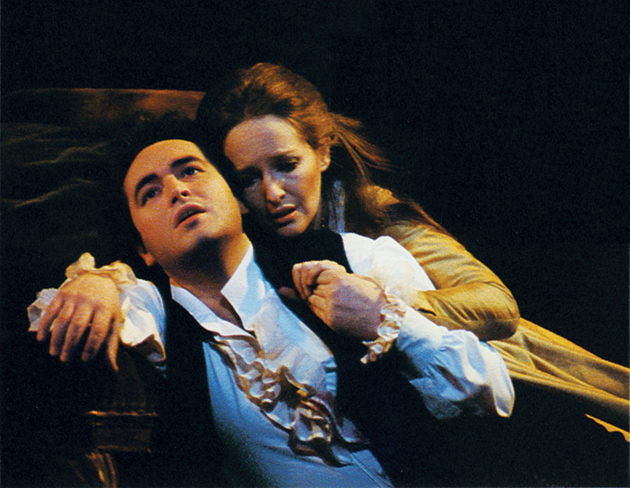
In the spring of 1771 Werther (no first name), a young man of good education and comfortable means, arrives in the small German town of Wahlheim. He is there to attend to family business (an inheritance) but also to escape an unhappy love affair. To his friend Wilhelm back home he writes long letters telling of the joys of living close to nature as well as of his meeting with a local belle, Charlotte (Lotte), who shares his tastes in literature.
Unfortunately for Werther, Lotte is betrothed to Albert, an up-and-coming young bureaucrat. Albert and Lotte treat Werther with the utmost friendliness, but he finds the frustration of his undeclared love for Lotte increasingly hard to bear. He quits Wahlheim to take up a diplomatic post in a principality some distance away. Here he suffers a humiliating snub when, as a person of middle-class origin, he is asked to leave a reception for the diplomatic corps. He resigns, and for months drifts around before fatalistically returning to Wahlheim.
Lotte and Albert are now married; there is no hope for Werther. His letters to Wilhelm break off, and an unnamed editor appears on the scene, undertaking to put together a record of Werther’s last days from his diaries and private papers. For, it emerges, having decided that there is no way out, Werther has borrowed Albert’s dueling pistols and, after a last, stormy meeting with Lotte, shot himself.
The Sufferings of Young Werther (otherwise known as The Sorrows of Young Werther) appeared in 1774. Goethe sent a synopsis to a friend:
I present a young person gifted with deep, pure feeling and true penetration, who loses himself in rapturous dreams, buries himself in speculation, until at last, ruined by unhappy passions that supervene, in particular an unfulfilled love, puts a bullet in his head.
This synopsis is notable for the distance Goethe seems to be putting between himself and a hero whose story was in important respects his own. He too had gloomily asked himself whether a self-defeating compulsion did not underlie his practice of falling in love with unattainable women; he too had contemplated suicide, though he had lacked the courage to do the deed. The crucial difference between himself and Werther was that he could call on his art to diagnose and expel the malaise that afflicted him, whereas Werther could only suffer it. As Thomas Mann put it, Werther is “the young Goethe himself, minus the creative gift.”
Two energies go into the making of Werther: the confessional, which gives the book its tragic emotional force, and the political. Passionate and idealistic, Werther is representative of the best of a new generation of Germans sensitive to the stirrings of history, impatient to see the renewal of a torpid social order. An unhappy love affair may precipitate his suicide, but the deeper cause is the failure of German society to offer young people like him anything but what Goethe would later call “dull, spiritless citizen life.”
The Sufferings of Young Werther was avidly read; its youthful author was lionized. A spate of unauthorized editions and translations followed (authors in Goethe’s day had little protection against piracy). The gossip press soon uncovered who the characters in the book “really” were: Lotte was Charlotte Kestner, née Buff, daughter of a bailiff in the town of Wetzlar; Albert was Johann Kestner; and of course Werther was Goethe himself. Kestner was justifiably peeved at what he regarded as a betrayal of their friendship. Goethe shamefacedly pleaded that his book was “an innocent mixture of truth and lies”; but Kestner continued to grumble that his wife had never been on such close terms with their visitor as was claimed, nor was he as cold a fish as Goethe made him out to be.
If Goethe was now surrounded by a buzz of scandal in which art was hopelessly confused with life, he had only himself to blame. He had meant to maintain an ironic distance between himself as author and Werther as character; but for most readers the irony was too subtle. As a text ostensibly assembled from writings the dead man had left behind, Werther lacks a guiding authorial voice. Readers naturally identified with the point of view of Werther himself, the sole narrator until the late appearance of his “editor” (Wilhelm’s responses to Werther’s letters are not reproduced). The excesses of Werther’s language, the discrepancies between his idealized view of Lotte and Lotte’s often coquettish behavior, were passed over by all but the most attentive readers. Werther was read not only as a roman à clef about Goethe and the Kestners, but as an endorsement of Romantic suicide.
In the fourth of his Roman Elegies, written in 1788–1789, in a suppressed draft, Goethe gives thanks that he has escaped from the endless interrogation—Was there really such a person as Werther? Was it all true? Where did Lotte live? “How often I have cursed those stupid pages/That exposed my youthful suffering to the masses,” he writes. “Even if Werther had been my brother and I had killed him,/It could not be worse than this: being vengefully pursued by his sad ghost.”
Advertisement
The image of Werther as a twin or brother who has died or been killed and returns to haunt him recurs in a poem entitled “To Werther,” written when Goethe was near the end of his life. Between Goethe and his Werther self there was a complex, lifelong relationship that swung back and forth. In some accounts, Werther is the self he had to split off and abandon in order to live (Goethe spoke of the “pathological state” out of which the book emerged); in others, Werther is the passionate side of himself that he sacrificed, to his own cost. He was haunted not only by Werther but by the story of Werther he had put out into the world, which called out to be rewritten or more fully told. He spoke at various times of writing another Werther and of writing a prequel to Werther; but it would seem he could not find his way back into Werther’s world. Even the revisions he did to the book in 1787, masterly though they are, were done from the outside, and are not at one with the original inspiration.
The history of Werther and his Lotte comes to an end with Werther’s death on Christmas Day, 1772. But the story of Goethe and his model Charlotte Buff had yet a while to run. In 1816 Charlotte, then a widow of sixty-three, visited Goethe’s home town of Weimar and contacted him. After their meeting she wrote to her son: “I have made the acquaintance of an old man, who, if I had not known it was Goethe, and even then, made no very pleasing impression on me.” Coming across this sour remark, Thomas Mann made a note: “I believe this anecdote could form the basis…of a novel.”
In 1939 Mann published Lotte in Weimar, in which he dramatizes the 1816 encounter, bringing together the couple who, inextricably confused as they are in the national imagination with their fictional avatars, belong by now to the realm of myth. Goethe is as ungracious as can be (“Why could not the old woman have spared me this?”). Reluctantly he invites Charlotte and her daughter to his grand home, then pays more attention to the daughter than to her. Observing that she suffers from a tremor, he shuts his eyes fastidiously. For her part, Charlotte recalls why she turned Goethe down in the old days: because he seemed “inhuman, without purpose or poise.”
In this novel about the transfiguring powers of art, Goethe the artist—or the human shell in which the artist resides—takes second place behind his model Frau Charlotte Kestner, who in Weimar can at last become who she truly is: Germany’s sweetheart, the beautiful, dark-eyed heroine of Werther. Rumors of her presence cause a sensation. Fans camp outside her hotel hoping to catch a glimpse of her. She revels in her celebrity.
Having resolved to kill himself, Werther writes a farewell note to be handed to Lotte after his death. But then he cannot resist calling in person one last time.
Lotte is not thrilled to see the distracted young man. At a loss for how to deal with him, she produces a manuscript he has lent her and asks him to read to her. Werther proceeds to read aloud from his translation of The Works of Ossian, renderings into rhythmical English prose by James Macpherson, a young Scottish schoolmaster, of fragments of what he claimed to be epic poetry sung by the bard Ossian in the third century CE, passed down orally from one generation to the next of Gaelic-speaking Scots.
The poetry moves Lotte to tears, in which Werther joins. Their hands touch; they embrace; he tries to kiss her. She tears herself free. “This is the last time! Werther! You will never see me again,” she cries, and hurries from the room.
Werther’s declamation from Ossian is no small affair: for page after page ancient bards raise their voices in lament over lost heroes. The taste for Ossian is a feature of early Romantic sensibility easy to mock. The fact is, however, that until well into the nineteenth century the poems were widely accepted as a great epic of northern European civilization. “The Homer of the North,” Madame de Staël called Ossian. The recovery of the Ossian epic in Scotland became a spur to the recovery—or invention—of other founding national epics: Beowulf in England, the Kalevala in Finland, the Nibelungenlied in Germany, the Chanson de Roland in France, the Song of the Host of Igor in Russia.
Advertisement
Macpherson was not a great poet (pace William Hazlitt, who set him alongside Dante and Shakespeare) nor even a dedicated one: his Ossian project concluded, Macpherson quit the Highlands for London, where he was fêted, then took ship to Pensacola in the new British colony of West Florida, where he spent two years on the staff of the governor. Returning to England, he entered politics; he died a wealthy man.
As a historian of ancient times Macpherson was unreliable: much of his archaic Scotland was cribbed from Tacitus on the Gauls and Germans. His barbaric warriors behave like eighteenth-century gentlemen of sensibility, tempering pride of arms with generosity to fallen foes. Nonetheless, he was an innovator of genius. The wild popularity of his Ossian signaled the rise of a new, assertive nationalism in which each European people would demand not only its national independence but its national language and national literature and unique national past too.
Macpherson’s most perceptive reader was Walter Scott. The Ossian poems were certainly not what they were claimed to be, namely the words of a blind bard from the third century, said Scott, yet Scotland might be proud that in modern times it had brought forth “a bard, capable…of giving a new tone to poetry throughout all Europe.”
Macpherson’s signal achievement was to detect, ahead of anyone else, that the public was ripe not just for tales of clashing broadswords and keening women, but also—and more interestingly—for a new poetic speech that would sound convincingly like the way bards and heroes would have spoken in an archaic, if not mythical, British past. Brushed aside is John Dryden’s ideal of making an ancient author “speak such English as he would himself have spoken, if he had been born in England, and in this present age,” that is, of rendering the classics in discreetly modern speech. On the contrary, Macpherson’s English carries echoes, sometimes lofty, more often merely quaint, of a barbaric foreign original conveyed to us by a strenuous labor of translation.
In Britain the Ossian poems were tainted by controversy over their authenticity. Were there indeed Highlanders who could recall and recite these ancient lays, or had Macpherson made them up? Macpherson did not help his case by seeming reluctant to produce his Gaelic originals.
In Europe the question of authenticity had no purchase. Translated into German in 1767, Ossian had a huge impact, inspiring an outpouring of bardic imitations. The young Goethe was so smitten that he taught himself Gaelic in order to translate directly into German the specimens of Scots Gaelic he found in The Works of Ossian. The early Schiller is full of Ossianic echoes; Hölderlin committed pages of Ossian to memory.
The most obvious way of translating Werther’s German Ossian into English is by reproducing the English original. This procedure, however, nullifies the numerous changes Goethe made to his source. Goethe normalizes locutions that sound dialectal or ornamentally archaic or simply eccentric; he clarifies the logical relations between sentences by inserting conjunctions; he elides phrases that do no work; he brings down to earth lofty locutions (thus “ascends the deep” becomes simply “rows”); he improves on bland phrasing (“those that have passed away” becomes “grave-dwellers”); he regularizes Macpherson’s irregular (pseudo-Gaelic) word order; he interprets enigmatic Gaelic idioms rather than just reproducing them; and he does some mild bowdlerizing (“white-bosomed Colma” becomes “pale Colma”).
Samuel Johnson disliked Ossian. Macpherson spun out Ossianic prose like a priest in a vatic trance, he remarked. Goethe’s prose is generally tighter and more purposeful than its original. Had he been able to read German, Macpherson would probably have disapproved: the incantatory tone, the tone that Johnson derided, is missing.
In spite of Goethe’s deviations from his source, however, most translators—including Stanley Corngold—elect to translate Goethe by reproducing Macpherson’s English. Here are some lines from Ossian, first in Corngold’s version, identical to Macpherson’s save in punctuation, then in a close translation of Goethe’s German, then in a version by Catherine Hutter, the one translator known to me who retranslates Goethe:
I sit in my grief! I wait for morning in my tears! Rear the tomb, ye friends of the dead! Close it not till Colma come. My life flies away like a dream! why should I stay behind? Here shall I rest with my friends, by the stream of the sounding rock. When night comes on the hill; when the loud winds arise; my ghost shall stand in the blast, and mourn the death of my friends. The hunter shall hear from his booth. He shall fear, but love my voice!
I sit in my misery, I wait for morning in my tears. Dig the grave, ye friends of the dead; but do not close it until I come. My life vanishes like a dream; how can I stay behind! Here will I reside with my friends by the stream of the echoing rock—When night falls on the hill, and the wind comes over the heath, my ghost shall stand in the wind and mourn the death of my friends. The hunter hears me from his covert, fears my voice and loves it….
I sit in my misery, bathed in my tears, and wait doggedly for the morn. Dig the grave of the dead, my friends, but do not cover it until I am come. Like a dream, my life leaves me—how can I remain behind? Here, beside the stream in the echoing rocks, I shall dwell with my friends. When night falls on the hill, and the wind sweeps o’er the heath, let my spirit stand in the wind and mourn the death of my friend. The hunter in his covert hears me, fears my voice and loves it….
Hutter’s version is unnecessarily free. Goethe follows his original closely (though he misses the echo of Macbeth in “stand in the blast”), but cuts out the dialect (“booth”), reduces the archaism, and tones down the declamation. The second passage, though a reflection of the first, is clearly the product of a different poetic sensibility. To reproduce Macpherson as a translation of Goethe thus seems to me a plain error of judgment.
In an otherwise informative introduction Corngold refers dismissively to Ossian but does not explain why he reproduces Macpherson’s text. He does his case no favors by transcribing that text carelessly. Macpherson writes of a warrior arriving on a skiff; Corngold puts him on a cliff. Macpherson writes of a song of mourning, Corngold of a song of morning.
Ossian is exactly the kind of poetry that we would expect a young man like Werther to go into raptures over; but it would be excessively subtle to say that the rendering of Ossian in Werther is designed to reflect the mind of Werther, as opposed to the mind of his author. Goethe claimed that he wrote the first draft of Werther in four weeks, in a somnambulistic trance. There is no reason to doubt him. But he achieved that feat only by absorbing into the text a body of preexisting material: diaries, letters, and his own Ossian translations. As a matter of aesthetic judgment, reproducing a monstrous slab of Ossian in so short a short novel is a misstep. The holdup in the action while Werther delivers his aria is a steep price to pay for what the aria actually achieves: raising the emotional temperature, reducing Werther and Lotte to tears.
Goethe outgrew his taste for Ossian. If the public took Werther’s enthusiasm for Ossian as an endorsement of Ossian, he remarked, the public should think again: Werther admired Homer while he was sane, Ossian when he was going mad.
Germany in the mid-eighteenth century was a loose federation of states of various sizes nominally ruled by an emperor. Politically it was disunited and riven with strife. Culturally it was directionless. The literature of the courts was imported from France.
About 1770 a movement of young intellectuals coalesced under the name Sturm und Drang, rebelling against stifling social conventions as well as against French literary models. For his generation, said Goethe, “the French way of life [was] too restricted and genteel, their poetry cold, their criticism destructive, their philosophy abstruse yet unsatisfying.” English literature, with its “earnest melancholy,” was more to their taste. They revered Shakespeare (Hamlet in particular) and Ossian. For their literary credo they relied upon Edward Young’s Conjectures on Original Composition, in which the great soul, the genius, uses his semidivine creative powers to transform experience into art.
Sturm und Drang foreshadowed full-blown Romanticism in its emphasis on originality as against imitation, the modern as against the classical, inspiration as against learning, intuition as against rules, as well as in its enthusiasm for philosophical pantheism, the cult of genius, and a return to the Middle Ages. Goethe was never more than a fringe member of the group; Werther is a more representative camp follower.
Sturm und Drang did not last long: its social base was too narrow. But despite the twists and turns of his later career Goethe adhered to the core aspiration of the movement: to build a new national literature that would overturn ossified norms of conduct and thought. Even as he anatomized Sturm und Drang in the person of Werther, he offered, in Werther, a seminal contribution to that new national literature.
The strongest philosophical influence on the young Goethe was Johann Herder, to whose anthology of folk poetry he contributed his Ossian versions. To Herder the spirit of a language is the spirit of the people. Thus any renewal of national literature had to go back to native sources. Here again the British showed the way with Macpherson’s Ossian and, in 1765, Bishop Thomas Percy’s collection of folk ballads Reliques of Ancient English Poetry.
In the Germany of Goethe’s youth there was still some reserve about the novel as a serious literary form. But Goethe grasped early on the potentialities of the novel of multiple perspectives perfected by Richardson and Rousseau; while from Sterne he absorbed the technique of illuminating the interior by bringing up fragments of involuntary memory. The first pages of Werther bear all the signs of Sterne’s mercurial narrative style.
Rousseau, in particular the Rousseau of La Nouvelle Héloïse, was the shining exception to the strictures of Sturm und Drang on French literature of the day. Read simplistically as a plea for the rights of individual sensibility over convention, and generally for the privileging of feeling over reason, Rousseau’s novel was popular among the German public, to whom it offered Thränenfreude, the pleasure of tears. To Goethe it demonstrated how a narrative can evolve on the basis of a character’s gradual self-disclosure.
In his introduction Stanley Corngold spells out some of the procedures he follows. He does each page “cold,” then checks it against extant translations (he lists the seven he has principally used). He follows Goethe’s German closely, even at the risk of sometimes sounding foreign. He takes pains not to use words that were not part of the English language by 1787.
The reason for the 1787 cutoff date is obvious: to avoid anachronism. But anachronism is not only a matter of word choice. Just as the prose style of typical eighteenth-century narrative—the style of Goldsmith, say, whom Goethe admired—seems old-fashioned today in its striving for elegant balance in sentence structure, so a passage like the following, from Corngold’s Werther, would to Goldsmith have seemed inelegant, lacking in finish. If Goldsmith had been gifted with visionary foresight, he might even have said the passage was typical of late-twentieth-century narrative prose, and therefore anachronistic in a novel of the 1770s.
At six in the morning the servant comes in with a light. He finds his master on the ground, the pistol and blood. He cries out, he touches him; no response except a death rattle.
Corngold here sticks close to Goethe, and Goethe, always a supple stylist, chooses to stick close to the source on which he based his harrowing account of Werther’s death: a long letter from none other than Johann Kestner describing the suicide of a mutual friend, a letter whose style is “natural” if only because the letter is dashed off unrevised.
Corngold’s scholarly concern about anachronism raises a wider issue: With works from the past, how should the language of the translation relate to the language of the original? Should a twenty-first-century translation into English of a novel from the 1770s read like a twenty-first-century English novel or like an English novel from the era of the original?
Werther—the 1774 version—was first translated into English in 1779. The translation is usually attributed to Daniel Malthus, father of the economist, though there are grounds to doubt this. By today’s standards Malthus’s Werther is an unacceptable piece of work: not only has it been translated at second hand, through an intermediate French Passions du jeune Werther, but passages have been omitted, perhaps because Malthus thought they would offend his public. Nevertheless, Malthus’s version affords us a window into how Werther was read in the England of Goethe’s time.
I cite one telling instance. In his very first letter Werther mentions a former woman friend, and asks rhetorically: “Was it my fault that…passion formed in her poor heart?” (Corngold’s translation). Malthus renders these words as: “Am I to be blamed for the tenderness which took possession of her heart…?”
We are in the sphere of the tender passions, and the word at issue is eine Leidenschaft. Leidenschaft is, in every sense of the word, “passion”; but what is “passion”? Why does Malthus mute “passion” to “tenderness” (or why does his French intermediary mute it to tendresse)? We can only surmise that to Malthus the obscure feeling that invades the heart of the young woman in question, given how little we know of her (this is her sole mention in the book), is more likely (or more appropriately) a yielding feeling than a fiery one, more likely (or more appropriately) constant than erratic, and is therefore best rendered as “tenderness.”
Our first impulse may be to say that Malthus mistranslates Leidenschaft; yet his choice of “tenderness” cannot but be deliberate. It may be fairer to say that he here performs an act of cultural translation, translation informed by his embeddedness in the cultural norms of his society, including its norms of feeling (what one feels in one’s heart in given circumstances) and its norms of polite discourse (what one says and does not say in given circumstances).
This, then, is what it comes down to: where we, observing the tender passions at work, see passion predominating, an educated Englishman of the 1770s saw tenderness. A translation of Werther that is true to our twenty-first-century understanding of Goethe, yet in which readers from the 1770s would have felt at home, is an unattainable ideal.
The Sorrows/Suffering of Young Werther has not lacked for translators. Among first-rate modern versions are those by Burton Pike, Michael Hulse, and Victor Lange. Corngold’s new translation is of the very highest quality, punctiliously faithful to Goethe’s German and sensitive to gradations of style in this extraordinary, trail-blazing first novel.