When Soviet forces began to pull out of Afghanistan in 1988 they were leaving behind a mixed group of Afghan forces, much as the Americans will be leaving behind a mixed group when they complete their pullout in 2014.
First, there was the president of the pro-Soviet Republic of Afghanistan, a Communist-turned-Afghan-nationalist strongman named Mohammad Najibullah, whom the CIA thought could survive only a few weeks once the Soviets left. In fact, his regime would last until 1992, when the Soviet Union collapsed and the money and supplies it had been providing the Afghan government stopped. There were also many local militias led by warlords created by Soviet Special Forces and the KGB, as well as rival ethnic groups, drug lords, and a Pakistan-based opposition collectively called the Mujahideen. This group, which hoped to topple the Communist regime, was riven by deep factionalism and overt interference by the CIA and Pakistan’s Interservices Intelligence (ISI), which the Communist government in Kabul used to its advantage by playing divide and rule among the Mujahideen’s various components. There were also large numbers of urban Afghans who supported Najibullah and who had benefited from Soviet rule.
The Afghan government had little control of the countryside outside the major cities. Afghanistan had been left in a state of near chaos by the widespread corruption in the country fueled by drug trafficking, an army and economy totally dependent on Soviet aid, and advisers facing increasing interference by Afghanistan’s neighbors—such as Iran and Pakistan—and by the Mujahideen in safe havens in Pakistan.
This may sound all too familiar. Still, there is an important difference between Afghanistan in 1992 and Afghanistan today. Unlike the Americans, before they left the Soviets (and their protégé Najibullah) had tried hard to carry out a political reconciliation process not only with the Mujahideen leaders and field commanders but also with their backers, the United States and Pakistan. Though their attempts at political reconciliation did not succeed, the Soviets’ contact with Afghan commanders allowed the Red Army to withdraw with few casualties in just nine months because Afghan commanders had agreed not to fire on departing Soviet soldiers. The US withdrawal will in comparison be carried out in stages and ultimately take two years and be very bloody.
Najibullah’s political strategy was based on Afghan nationalism. It included introducing a new constitution, a multiparty system, and an Islamic legal system. His army held on for three years defending all the major cities against the Mujahideen until the collapse of the Soviet Union stopped aid and money supplies. Meanwhile, the United Nations, having organized the five-year-long negotiations that led to the Soviet withdrawal, did not give up. The UN envoys Diego Cordovez and later Benon Sevan continued actively to try to lay the groundwork for an inclusive power-sharing agreement between Najibullah’s government and the Mujahideen. In Afghanistan today, US talks with the Taliban have stalled while the US has refused to adopt a neutral international partner as mediator.
At least 13,833 Soviet soldiers were killed in the decade-long occupation, more than double the roughly 6,000 US and NATO troops killed over the past ten years (although Gregory Feifer in his masterly reconstruction of the Soviet occupation says many Russian soldiers still believe that up to 75,000 of their number were killed). The key difference between then and now is that the Soviets left behind a system, a nation-building effort that for many Afghans was worth defending, not to speak of their fear of the Mujahideen. They also left Najibullah, who was able to rally many people, and a core group of die-hard Afghan Communist officers who led the army—even though all that remained needed propping up with huge amounts of Soviet aid. But the alternative was even worse. When the Mujahideen occupied Kabul, civil war broke out between competing factions.
Will this, too, sound familiar before very long? Many journalists and commentators have predicted that war will break out once the Americans leave. The simple but startling outcome of the NATO summit in Chicago in May was that there is apparently no “Plan B.” Every source I have consulted has made it clear that there are no contingency plans if the promised withdrawal of Western forces by 2014 becomes very difficult to carry out; if US and NATO efforts to stabilize and strengthen the Afghan regime fail; if efforts to reduce rising ethnic tensions between the Pashtuns and non-Pashtuns are unsuccessful; if the 350,000-strong Afghan army and police do not hold together; if neighboring states like Pakistan and Iran step up their battle for influence; and if Pakistan does not stop giving sanctuary to the Taliban. A lot of things have to go right before the withdrawal can be seen as successful. On the other hand, only a few things have to go wrong to turn it into a debacle.
Advertisement
There was wishful thinking at Chicago that the insurgency will automatically subside simply because the Americans are leaving, or that somehow the lack of good governance and of economic reforms, as well as other problems, will suddenly be remedied. There is a blithe new NATO phrase—“Afghanistan good enough”—implying that expectations for leaving behind a more stable and secure Afghan government should be downgraded. The US and NATO have made a commitment to continue funding the Afghan army for five years, providing $4.1 billion a year, while the international community at the recent Tokyo conference committed some $16 billion for budgetary support for the government and economic development. But the global economic crisis may make it impossible for Europe especially to fulfill such commitments. Spain and Italy have already announced that because of the economic crisis they have slashed their budget commitments to Afghanistan. Doubtless more will follow that example. On July 7, the US declared Afghanistan a “major non-NATO ally,” but it is unclear how much of a commitment this entails, and in any case it is clear that without US and NATO money, Afghanistan’s army would dissolve and be divided up among warlords—precisely what happened to post-Soviet Afghanistan.
This is a long way away from the support the Afghan people gave the Americans in 2001, when they welcomed them for ousting the Taliban regime. Hopes then were that the Americans would rebuild Afghanistan. As Lucy Morgan Edwards reveals in her book The Afghan Solution, there was even an alternative—presented by some anti-Taliban political figures and commanders—to the outright invasion of Afghanistan by US forces. Prominent figures like the former anti-Soviet field commander Abdul Haq, whose wife and child were murdered by the Taliban, tried to persuade some moderate Taliban commanders to break with al-Qaeda before the US invasion started. Such military leaders who advocate reconciliation with the Taliban to bring the war to an end are needed today, but are nowhere to be found in the Afghan landscape, partly because the US has declined to support such compromisers.
Today the reality is that the insurgency is likely to get worse rather than better, unless there is a peace deal with the Taliban. In a revealing statement, General John Allen, the head of US and NATO forces in Afghanistan, admitted to Michael Hirsh of The Atlantic in May that the insurgents still number between 30,000 and 35,000. “Nobody knows for sure,” he added.* In 2006, when the Taliban launched a major attack to try to capture Kandahar, US officials estimated their total numbers at 25,000. So there are more Taliban now than before and after ten years of war. Nobody, not even the US, knows their true number. It is a strange kind of success when US intelligence has no idea how many enemies there are.
The reality is that there is no clear US political strategy to deal with the aftermath of its withdrawal in 2014. The most important components are the need for dramatic progress in US talks with the Taliban, a strategy to stabilize the Afghan government, which faces presidential elections in 2014, and to resolve the US conflict with Pakistan over Taliban safe havens. Talks with the Taliban—which started at their insistence last year—have been suspended since January because of the US military’s refusal to accept the first confidence-building measures that were agreed on between the two sides: the freeing of five senior Taliban figures from Guantánamo and allowing the Taliban to open a political office in Qatar. In return, the Taliban would free Bowe Bergdahl—a twenty-six-year-old US army sergeant taken prisoner in Afghanistan in June 2009. Internal disputes between the Pentagon and the State Department over the freeing of Taliban commanders and the military’s general reluctance to negotiate anything with the Taliban have slowed down the prospects of dialogue, while President Obama seems absent from the debate. The US military’s hubris about Afghanistan is dangerous and it is almost certain to run up against the realities of Afghanistan’s resistance to outsiders. This hubris is what Michael Hastings’s book, The Operators, is all about.
Hastings is the Rolling Stone reporter who single-handedly caused the downfall of General Stanley McChrystal, the commanding officer of US and NATO forces in Afghanistan, in 2010. The Operators is based on Hastings’s now infamous profile of McChrystal, “The Runaway General,” which was published in the July 2010 issue of Rolling Stone. When first assigned the article, Hastings was meant to have access to McChrystal and his staff for only two days in Paris, but when the Icelandic volcano Eyjafjallajökull erupted, Hastings’s flight home was canceled, and he accepted an invitation from McChrystal’s press officer to accompany them to Berlin. Hastings then spent over two months with McChrystal and his team, following them, as Hastings himself has said, “from Paris to Berlin to Kabul to Kandahar and then back to Washington, D.C.”
Advertisement
Hastings came to know McChrystal’s team of advisers—among whom, he noted, were “a former head of British Special Forces, two Navy Seals, an Afghan Special Forces commando, a lawyer, two fighter pilots and at least two dozen combat veterans and counterinsurgency experts.” He heard them and McChrystal himself make disparaging remarks about the president and his senior staff. One aide, for instance, referred to Joe Biden as “bite me.” Another aide told Hastings that McChrystal thought Richard Holbrooke, President Obama’s personally appointed special representative to Aghanistan and Pakistan, was a “wounded animal.”
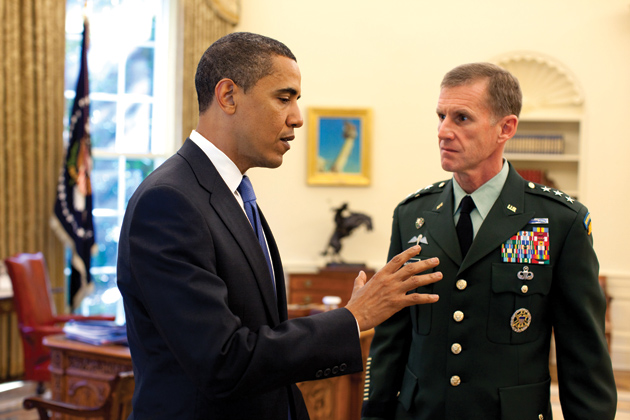
Perhaps most damaging were McChrystal’s reported comments about Obama himself. Hastings wrote that one of McChrystal’s aides had told him that the general, on first meeting Obama, thought the president looked “intimidated and uncomfortable” around senior military officials. McChrystal later had a one-on-one meeting with Obama in the Oval Office, which, the aide reported,
was a ten-minute photo op [that indicated that] Obama clearly didn’t know anything about [McChrystal], who he was. Here’s the guy who’s going to run his fucking war, but he didn’t seem very engaged. The Boss was pretty disappointed.
Obama obtained a copy of the profile before it was published and soon after summoned McChrystal to the White House. On June 23, 2010, two days before the piece was available on newsstands, McChrystal tendered his resignation.
To start where praise is due, Hastings has written the funniest book I have read on the war and the US presence in Afghanistan—and it’s not easy being funny about Afghanistan or the US Army. The last time someone tried it was in the 1980s, when P.J. O’Rourke wrote hilarious pieces—also for Rolling Stone—about the Mujahideen in Peshawar and later the Taliban.
Hastings describes an encounter with a blond in Berlin with a “very pronounced upper body” who tries to ingratiate herself with McChrystal’s aides while they try to figure out whether she is a prostitute or a spy. It’s a very funny interlude but revealing of macho military culture in which American women soldiers must still face a distinct disadvantage. Hastings’s sense of humor is sly, cynical, and disrespectful, but it is honest.
Hastings repeatedly makes the point that after ten years of being at war in Afghanistan, most of the US military is still unable or unwilling to understand foreign cultures, values, and social complexities. Nor do the military leaders have much respect for civilian authority in Washington. Taken together, these two observations explain in large part why the US military is not winning the war in Afghanistan. As one State Department official describes McChrystal, who had been in the secret world of US Special Forces most of his military career, “he doesn’t really understand civilians—he doesn’t understand what their purpose is, doesn’t see how they are useful.” The American military culture Hastings observed is locked into a self-created, self-centered world. Senior US officers on the ground are protected by a security bubble that also cuts them off from close acquaintance with Afghan life.
Yet McChrystal was probably the best of the six commanders who have led US forces in Afghanistan since 2001. He was a man of intellectual curiosity who read and learned about Afghan culture and rebuilt the faltering US relationship with the mercurial President Hamid Karzai. He introduced new and enlightened rules of counterinsurgency that were more considerate of Afghan civilians. But his staff, as Hastings makes clear, revealed much ignorance and awkwardness in their attitudes toward Afghanistan.
Unintentionally, Hastings’s book points to the dangers of embedding journalists with the military for long periods of time. Despite rules set by the military, what is on or off the record over long embeds increasingly becomes a matter of a journalist’s judgment. Embedding is now the only way the Western media are allowed to cover their own military in war, but it is severely limiting because it cuts journalists off from the other realities. It is difficult for them to get to know Afghans in the villages or on the streets, and very few do so. At the same time the embedded journalist becomes so dependent on the military command that it is difficult to maintain objectivity and rare for a journalist to be openly critical
What is entirely lacking in Hastings’s book is any Afghan perspective. Hastings is just as guilty of ignoring Afghan culture, values, and people as the military he criticizes for doing the same. He quotes only a handful of Afghans in the entire book; one wonders how many he met. Even on his other trips to Afghanistan he does not appear to be particularly interested in Afghans or their country or what the war is doing to them.
His only story of interest begins when he is allowed to go to Paris to write a cover story about the visit there of General McChrystal, his staff, and their wives. Hastings describes how McChrystal’s staff are trying, with the help of the Pentagon’s media machine, to remake the image of the general:
It’s hard for McChrystal to leave his terrorist-hunter image behind, despite the fact that the media have tried to give him a total makeover as a counterinsurgency evangelical. He is not a killer anymore—he’s an intellectual and a philosopher.
Hastings finds him a somewhat daunting character. “His slate blue eyes,” he writes, “had this eerie capacity to drill down into your brain, especially if you fucked up or said something stupid.” A page later Hastings describes McChrystal’s Special Forces background as making him “the nation’s most respectable assassin.” When McChrystal arrives in Afghanistan he increases the number of US Special Forces units operating in that country from four to nineteen. The forces are charged with killing Taliban leaders as secretly and anonymously as possible. Hastings never found out much about their nighttime attacks on Taliban hiding places, except that they were taking place.
Still, future historians will take note of McChrystal’s efforts to change the nature of the war in Afghanistan. He ordered a reduction in the use of force and air power to the point that some US soldiers questioned whether they could defend themselves adequately, but his strategy was largely accepted despite Hastings’s claims to the contrary. General David Petraeus, who re- placed McChrystal, immediately reversed these orders. Yet as Hastings asks, how much change is possible when “in the past ten years, no high-ranking American officer has ever been severely punished for killing [Afghan] civilians”? It is this lack of accountability by US forces and their commanders that has so angered President Karzai and the Afghan people and turned so many Afghans into Taliban. Despite his changes in the tactics of making war, McChrystal failed to introduce any real accountability for US commanders.
Hastings gives a telling account of the Pentagon’s media operation, which tried to “make over” McChrystal. The Pentagon spends $4.7 billion a year on public relations and has 27,000 people working on them. Every general has his own team of media handlers—all too evident to any journalist who has interviewed senior US brass in Iraq or Afghanistan. On a regular trip General Petraeus would have a staff of fifty walking before and after him. In contrast, a senior State Department official would have less than five staff members, including his security detail.
The last revealing account of the US military’s behavior abroad was Dana Priest’s decade-old The Mission, which described how the US military had an effect on US foreign policy in different parts of the world ranging from Indonesia to Afghanistan to the Balkans. As one might expect, there are hardly any Soviet accounts available on how the Soviet army behaved in Afghanistan. Only two such books were translated into English. Both Zinky Boys: Soviet Voices from a Forgotten War, by Svetlana Alexievich, and The Hidden War: A Russian Journalist’s Account of the Soviet War in Afghanistan, by Artyom Borovik, were written by journalists who became dissidents, and both were highly critical of the Soviet officer class and the Soviet system. Both had much to say about the suffering of ordinary solders, many of whom were wounded. Both books asked why the Red Army was in Afghanistan, just as many Americans today are asking the same question about their army’s presence in Afghanistan.
The Soviets also embedded journalists with their army, and the rules were clear: they were expected to follow the Party line. (When I reported from Afghanistan, I refused to become attached with the Soviet army, although I took Soviet military planes to travel around the country.) For Soviet journalists to report on war and become dissidents was part of a tradition that went back to World War II when young Soviet journalists like Vasily Grossman reported the heroic fighting of front-line troops, only to later become critics of Stalin.
What no Soviet dissident journalist would ever do is put himself personally in the spotlight. Yet at any given moment we know what Hastings is wearing, what he is eating or drinking, and what he thinks of everyone around him. It’s the kind of personalized, pop journalism first made popular by Tom Wolfe in the 1960s and since then a specialty of Rolling Stone, but I fail to see how it is suited to dealing with issues of war, life and death, and the survival of nation-states.
Why on earth, with Hastings present, did McChrystal’s aides or at least one of them allow themselves to talk so freely? A recent review in The Wall Street Journal claims that most of the damaging statements in the original Rolling Stone article, variously attributed to a “member,” or an “aide,” or an “advisor,” were in fact made by a thirty-three-year-old lieutenant commander. One of the aides tells Hastings that they are trying to build a “Brand McChrystal”—“ballsy, envelope-pushing, risk-taking.” Hastings writes, “It was a natural evolution of a very aggressive media strategy to establish McChrystal as a contender for the greatest general of his generation, on a par with Petraeus.”
Hastings quotes one of McChrystal’s aides as saying that there was a gentleman’s agreement that Hastings broke. Hastings himself never says whether there was such an agreement or whether there were clear rules about what was to be off the record. McChrystal’s speedy offer of resignation to President Obama is the only indication that he allowed the reporter to get too close.
At the end of his tale Hastings adopts a strong moral tone:
I saw how the political and media class had completely misinterpreted my piece. The story had terrified them, striking deep-seated fears in the Washington psyche. It demonstrated just how tenuous one’s own position could be—careers could flame out overnight. And the political and media class saw the story as a threat to their schmoozy relationship—their very existence and social life. If you can’t get wasted with a journalist who’s writing a profile of you and piss all over the president who appointed you, what’s the world coming to?
He adds, “You really weren’t supposed to write honestly about people in power. Especially those the media deemed untouchable.”
Hastings is an American kind of dissident. He is free to pursue other journalism, but he is now banned by the US military and NATO from any access to territory they control. Unlike Soviet dissidents, he became a celebrity, loathed by the military but temporarily famous. In the former Soviet Union any hint that he would reveal what high officers were saying would have led him to the firing squad or at the very least to Siberia. Clearly there are benefits to being an American. However neither the book nor American generals cast any light on the question that General Petraeus once asked about Iraq, and which now seems all the more prescient: “Tell me how this ends?” About this question there is no word in Hastings’s book.
This Issue
September 27, 2012

Pride and Prejudice
Cards of Identity
Are Hackers Heroes?
This Issue
September 27, 2012
Pride and Prejudice
Cards of Identity
Are Hackers Heroes?
-
*
Michael Hirsh, “American Ally, American Adversary: Our Worsening Pakistan Problem,” The Atlantic, May 30, 2012. ↩

