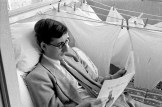
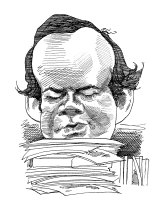
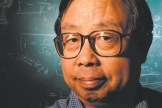

Freeman Dyson has spent most of his life as a professor of physics at the Institute for Advanced Study in Princeton, taking time off to advise the US government and write books for the general public. He was born in England and worked as a civilian scientist for the Royal Air Force during World War II. He came to Cornell University as a graduate student in 1947 and worked with Hans Bethe and Richard Feynman, producing a user-friendly way to calculate the behavior of atoms and radiation. He also worked on nuclear reactors, solid-state physics, ferromagnetism, astrophysics, and biology, looking for problems where elegant mathematics could be usefully applied.
Dyson's books include Disturbing the Universe (1979), Weapons and Hope (1984), Infinite in All Directions (1988), Origins of Life (1986, second edition 1999), and The Sun, the Genome and the Internet (1999). He is a fellow of the American Physical Society, a member of the National Academy of Sciences, and a fellow of the Royal Society of London. In 2000 he was awarded the Templeton Prize for Progress in Religion.
July 17, 2008: The Brief Life of a Molecule (letter)
June 12, 2008: The Question of Global Warming
A Question of Balance: Weighing the Options on Global Warming Policies by William Nordhaus
Global Warming: Looking Beyond Kyoto edited by Ernesto Zedillo
February 14, 2008: Von Braun's Bargain (letter)
January 17, 2008: Rocket Man
Von Braun: Dreamer of Space, Engineer of War by Michael J. Neufeld
October 25, 2007: Working for the Revolution
Faust in Copenhagen: A Struggle for the Soul of Physics by Gino Segrè
October 11, 2007: 'Our Biotech Future' (letter)
September 27, 2007: 'Our Biotech Future': An Exchange
July 19, 2007: Our Biotech Future
May 31, 2007: Francis Bacon & the Frozen Chicken (letter)
May 10, 2007: The Dream of Scientific Brotherhood
The Fellowship: Gilbert, Bacon, Harvey, Wren, Newton, and the Story of a Scientific Revolution by John Gribbin
November 2, 2006: Respect for Our Enemies (letter)
October 19, 2006: Writing Nature's Greatest Book
The Best of All Possible Worlds: Mathematics and Destiny by Ivar Ekeland
August 10, 2006: 'Breaking the Spell' (letter)
June 22, 2006: Religion from the Outside
Breaking the Spell: Religion as a Natural Phenomenon by Daniel C. Dennett
December 15, 2005: Norbert Wiener at MIT (letter)
October 20, 2005: Wise Man
Perfectly Reasonable Deviations from the Beaten Track: The Letters of Richard P. Feynman edited and with an introduction by Michelle Feynman, with a foreword by Timothy Ferris
October 20, 2005: 'The Bitter End' (letter)
July 14, 2005: The Tragic Tale of a Genius
Dark Hero of the Information Age: In Search of Norbert Wiener, the Father of Cybernetics by Flo Conway and Jim Siegelman
April 28, 2005: The Bitter End
Armageddon: The Battle for Germany, 1944–1945 by Max Hastings
The End: Hamburg 1943 by Hans Erich Nossack, translated from the German and with a foreword by Joel Agee, and with photographs by Erich Andres
February 24, 2005: Seeing the Unseen
The Fly in the Cathedral: How a Group of Cambridge Scientists Won the International Race to Split the Atom by Brian Cathcart
A Sense of the Mysterious: Science and the Human Spirit by Alan Lightman
July 15, 2004: 'The Fabric of the Cosmos' (letter)
May 13, 2004: The World on a String
The Fabric of the Cosmos: Space, Time, and the Texture of Reality by Brian Greene
March 25, 2004: One in a Million
Debunked! ESP, Telekinesis, Other Pseudoscience by Georges Charpak and Henri Broch, translated from the French by Bart K. Holland
November 6, 2003: Clockwork Science
Einstein's Clocks, Poincaré's Maps:Empires of Time by Peter Galison
August 14, 2003: Measuring the Sea (letter)
July 3, 2003: A New Newton
Isaac Newton by James Gleick
May 15, 2003: What a World!
The Earth's Biosphere: Evolution, Dynamics, and Change by Vaclav Smil
February 13, 2003: The Future Needs Us!
Prey by Michael Crichton
December 5, 2002: In Praise of Amateurs
Seeing in the Dark: How Backyard Stargazers Are Probing Deep Space and Guarding Earth from Interplanetary Peril by Timothy Ferris
March 28, 2002: Science & Religion: No Ends in Sight
The God of Hope and the End of the World by John Polkinghorne
July 16, 1998: Words and Things (letter)
May 28, 1998: Is God in the Lab?
The Meaning of It All: Thoughts of a Citizen Scientist by Richard P. Feynman
Belief in God in an Age of Science by John Polkinghorne
April 10, 1997: Can Science Be Ethical?
March 6, 1997: The Race is Over
October 5, 1995: 'A Matter of Temperament' (letter)
May 25, 1995: The Scientist as Rebel
August 17, 1989: Free Taysir Aruri! (letter)
April 30, 1981: Winner
| The Scientist as Rebel New in paperback. Dyson profiles scientists—Newton Einstein, Teller, Feynman—whose independent thought allowed them to make great conceptual leaps. Dyson also puts forth some heterodox ideas of his own on topics like space colonization and the paranormal, living up to his reputation as "one of the world's most original minds."—Times (London) |
| The Scientist as Rebel An illuminating collection of essays by an award-winning scientist whom the London Times calls "one of the world's most original minds." |
The Sun, the Genome, & the Internet: Tools of Scientific Revolutions (1999)
Imagined Worlds (1997)
Selected Papers of Freeman Dyson with Commentary (1996)
Infinite in All Directions: Gifford Lectures Given at Aberdeen, Cotland, April-November 1985 (1988)
Origins of Life (1985)
Weapons and Hope (1984)
Values at War: Selected Tanner Lectures on the Nuclear Crisis (1983)
Disturbing the Universe (1979)
The World, the Flesh and the Devil: The Third J.D. Bernal Lecture Delivered at Birkbeck College, London, 16th May 1972 (1972)