
Richard Bernstein was Time‘s bureau chief in China and has been a correspondent in France and Germany for The New York Times. His books include The Coming Conflict with China and, most recently, A Girl Named Faithful Plum: The True Story of a Dancer from China and How She Achieved Her Dream. (February 2012)
-
The Chinese Are Coming!
February 23, 2012
A Contest for Supremacy: China, America, and the Struggle for Mastery in Asia
by Aaron L. Friedberg
-
A Very Superior ‘Chinaman’
October 28, 2010
Charlie Chan: The Untold Story of the Honorable Detective and His Rendezvous with American History
by Yunte Huang
-
The Empire of Sister Ping
November 19, 2009
The Snakehead: An Epic Tale of the Chinatown Underworld and the American Dream
by Patrick Radden Keefe
-
At Last, Justice for Monsters
April 9, 2009
Closing Order Indicting Kaing Guek Eav alias Duch by the Office of the Co-Investigating Judges of the Extraordinary Chambers in the Courts of Cambodia, Phnom Penh
-
The Death and Life of a Great Chinese City
March 26, 2009
The Last Days of Old Beijing: Life in the Vanishing Backstreets of a City Transformed
by Michael Meyer
Out of Mao’s Shadow: The Struggle for the Soul of a New China
by Philip P. Pan
Serve the People: A Stir-Fried Journey Through China
by Jen Lin-Liu
-
The Korean War: An Exchange
November 22, 2007
-
Good War Gone Bad
October 25, 2007
The Coldest Winter: America and the Korean War
by David Halberstam
-
How Not to Deal with North Korea
March 1, 2007
A Moment of Crisis: Jimmy Carter, the Power of a Peacemaker, and North Korea’s Nuclear Ambitions
by Marion V. Creekmore Jr.
Nuclear Showdown: North Korea Takes On the World
by Gordon G. Chang
Rogue Regime: Kim Jong Il and the Looming Threat of North Korea
by Jasper Becker
-
‘The Culture Wars’: An Exchange
November 3, 1994
-
‘Guilty If Charged’: An Exchange
March 24, 1994
-
Guilty If Charged
January 13, 1994
-
French Collaborators: The New Debate
June 25, 1992
-
The People's Republic of Rumor
July 30, 2012
The official Chinese media have reported that seventy-seven people died as a result of torrential rains last week, but the Chinese blogosphere tells a different story: of hundreds and possibly thousands of deaths, and widespread damage and chaos. Apart from describing the flood itself, these reports suggest that, once again, Chinese officials were striving to downplay the scope of a disaster to avoid public dissatisfaction. China is a country where there is no truth, though there is certainly plenty of anecdotal evidence that if there is a truth on a subject deemed sensitive, whether about the feelings of Tibetans or the number of dead in a storm, it is to be found online, not in official accounts.
-
China's Tibetan Theme Park
September 12, 2011
In the international press, China’s tensions with Tibet are often traced to the Chinese invasion of 1950 and Tibet’s failed uprising of 1959. But for the Chinese themselves, the story goes back much further—at least to the reign of Kangxi, the Qing Dynasty emperor, who ruled for sixty-one years (1661-1722) and, in the official Chinese view, incorporated many lands, including Tibet, into a glorious Chinese empire. One of the most important symbols of those events, moreover, lies not in Tibet but thousands of miles east in the city of Chengde, near Beijing. There, Kangxi’s grandson, the emperor Qianlong, built one of the more astonishing architectural monuments in China: a Tibetan Buddhist temple housed in a scrupulously detailed scale model of the Potala Palace in Lhasa, the seat of Tibetan cultural and spiritual power. This Little Potala, as it’s called, was intended as an architectural expression of the great unity of China under his rule. In recent years, the tourist authorities have used Chengde to create a sort of national monument to Kangxi, and, through him, to advance China’s contemporary position on Tibet.
-
Beijing's Bluster, America's Quiet: The Disturbing Case of Xue Feng
October 6, 2010
Quiet diplomacy, as it’s called, has served for years as the principle guiding US relations with China: the theory is that it is far better to engage the Chinese government quietly, behind the scenes, rather than through more robust public confrontation. But how effective is quiet diplomacy in practice? Two cases have made this question urgent.
-
Booming China, Migrant Misery
September 14, 2010
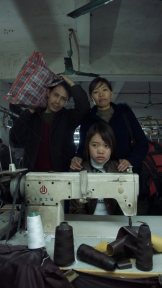
There are an estimated 130 million nung-gong, or peasant workers, in China, making up what Lixin Fan, in his powerful documentary Last Train Home calls “the world’s largest human migration.”