

1.
If the term had not been coined to define an essentially surrealist/exotic mode of twentieth-century fiction, “magical realism” would more accurately describe the considerable emotional power that can be generated by a sudden illumination of meaning in the ordinary, routine, and largely unobserved in our daily lives. Realism is a mimicry of life in the quotidian, not the heroic or the cataclysmic; at its core, the greatest of all dramas can be simply the passage of time. Where the essential strategy of poetry is distillation, the strategy of the realistic novel is accumulation, which is why novels as diverse as Flaubert’s Madame Bovary, Arnold Bennett’s The Old Wives’ Tale, and James T. Farrell’s Studs Lonigan trilogy depend for their effect upon a painstaking if not obsessive recording of minutiae. When the realistic novel works its magic, you won’t simply have read about the experiences of fictitious characters, you will have seemed to live them. Your knowledge of their lives transcends their own, for they can only live in chronological time. The experience of reading such fiction when it’s carefully composed can be almost literally breathtaking, like being given the magical power of reliving passages of our own lives, indecipherable at the time of being lived.
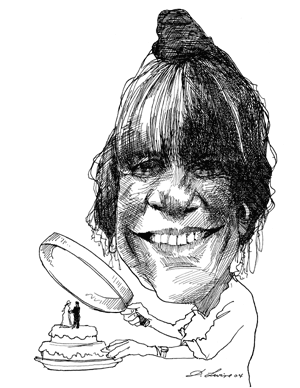
Through sixteen novels of poetic realism set predominantly in Baltimore in the middle decades of the twentieth century and encoded with this unnerving “magic” in the minutiae of daily life, Anne Tyler has created a gallery of American originals. Tyler’s people seem to be members of a single extended clan, lovingly observed eccentrics inhabiting a mythic Baltimore located somewhere between the elevated folksiness of Thornton Wilder’s Our Town and the flat-out grotesqueries of Sherwood Anderson’s Winesburg, Ohio. Her slightly seedy, quaintly run-down neighborhoods are contiguous with the small Mississippi towns and villages of Eudora Welty, Tyler’s most obvious influence, and the North Carolina settings of Reynolds Price, with whom Tyler studied as an undergraduate at Duke University. Ostensibly mid- to-late twentieth century, Tyler’s Baltimore is quintessential 1950s, radically different from the adulterous/alcoholic suburbias of John Cheever and predating those of John Updike while bearing no relationship at all to the postmodern cityscapes, ravaged by irony as in a harsh fluorescent glare, of Thomas Pynchon and Don DeLillo.
Though African-Americans play walk-on roles in some of Tyler’s fiction—there is a “darky,” Eustace, who assists in a grocery store in The Amateur Marriage—Tyler’s Baltimore shares no borders with the cityscapes of Toni Morrison, Gloria Naylor, John Edgar Wideman, or Walter Mosley. As Tyler’s themes are exclusively domestic and family-centered, so her settings seem to exist in a historic void: it’s significant that, in The Amateur Marriage, men who serve in the armed forces in World War II, and the women who wait for them at home, never express a single political thought about the war, its origins, its consequences, the unmitigated horrors of the Holocaust. Evil as a force, individual or collective, simply doesn’t exist in Tyler’s universe; she has never created a character capable of violence or deliberate cruelty, let alone evil. Such tragic vistas are precluded by Tyler’s comic-melancholy tenderness toward her characters. Where her older contemporary Diane Arbus famously remarked, “You see someone on the street, and essentially what you notice about them is the flaw,” Anne Tyler has said:
People have always seemed funny and strange to me, and touching in unexpected ways. I can’t shake off a sort of mist of irony that hangs over whatever I see…
Tyler recalls having read, as a high school student who’d hoped to be an artist, a book of short stories by Eudora Welty in which a character named Edna Earle appeared:
…so slow-witted she could sit all day just pondering how the tail of the C got through the loop of the L on the Coca-Cola sign. Why, I knew Edna Earle. You mean you could write about such people?*
Tyler’s favored characters are not slow-witted so much as quietly subversive, refusing to behave as others wish them to behave. They tend to seem, or to be, sexless, with the defiance of overgrown children. They are likely to be pathologically reclusive, like the hapless thirty-eight-year-old child-man Jeremy of Celestial Navigation (1974), of whom family members love to despair:
[Jeremy] is, and always has been, pale and doughy and overweight, pear-shaped, wide-hipped. He toes out when he walks. His hair is curly and silvery-gold, thin on top. His eyes are nearly colorless…. There is no telling where he manages to find his clothes: baggy slacks that start just below his armpits; mole-colored cardigan strained across his stomach and buttoning only in the middle, exposing a yellowed fishnet undershirt top and bottom, and tiny round-toed saddle oxfords. Saddle oxfords? For a man?
If not reclusive, they are likely to be obsessive in their interest in others’ lives, as a way of shoring up the emptiness of their own lives, like the wily shape-changer/confidence man Morgan of Morgan’s Passing (1980), who intrudes in the lives of a young married couple:
Advertisement
He was a lank, tall, bearded man in a shaggy brown suit that might have been cut from blankets, and on his head he wore a red ski cap—the pointy kind, with a pom-pom at the tip. Masses of black curls burst out from under it. His beard was so wild and black and bushy that it was hard to tell how old he was. Maybe forty? Forty-five?…
You could say he was a man who had gone to pieces, or maybe he’d always been in pieces; maybe he’d arrived unassembled. Various parts of him seemed poorly joined together. His lean, hairy limbs were connected by exaggerated knobs of bone; his black-bearded jaw was as clumsily hinged as a nutcracker. Parts of his life, too, lay separate from other parts. His wife knew almost none of his friends. His children had never seen where he worked…. Last month’s hobby—the restringing of a damaged pawnshop banjo, with an eye to becoming suddenly musical at the age of forty-two—bore no resemblance to this month’s hobby, which was the writing of a science-fiction novel…. He thought of clothes—all clothes—as costumes.
A typical Tyler eccentric is the widowed Mrs. Emerson of The Clock Winder (1972), who inhabits a falling-down old Victorian house literally filled with antique clocks that must be wound at different times to achieve a synchronized time: “What was the meaning of these endless rooms of clocks, efficiently going about their business while she twisted her hands in front of them?” In so gothic a setting, who will come to Mrs. Emerson’s rescue? Another Tyler recluse awaiting a catalyst to propel him from the stasis of his life is the “accidental tourist” Macon of Tyler’s best-selling romantic comedy The Accidental Tourist (1985), who becomes an obsessive-compulsive after his wife leaves him:
…He dressed in tomorrow’s underwear so he wouldn’t have to launder any pajamas…. He had developed a system that enabled him to sleep in clean sheets every night without the trouble of bed changing…. What he did was strip the mattress of all linens, replacing them with a giant sort of envelope made from one of the seven sheets he had folded and stitched together…. He thought of this invention as the Macon Leary Body Bag.
Ezra Tull, of Tyler’s most engaging novel, Dinner at the Homesick Restaurant (1982), is another feckless, good-hearted bachelor who has come to seem to himself unreal: “His large, floppy clothes covered a large, floppy frame that seemed oddly two-dimensional. Wide in front and wide behind, he was flat as paper when viewed from the side.” Ezra has no sexuality, no life apart from being his mother’s son and the proprietor of the Homesick Restaurant where “home-cooked” meals are served to customers yearning for the comforts of nostalgia: “Try our gizzard soup…. It’s really hot and garlicky and it’s made with love.” The appealing fantasy of a restaurant where strangers come as if to family meals is rebuked by Ezra’s own difficult family, who continually upset the meals he so pains- takingly tries to arrange, and constitutes an apt metaphor for the fiction of Anne Tyler, which manages to be both comforting and gently rebuking. Ezra’s brother disrupts even the meal following their mother’s funeral:
“You think we’re a family…. You think we’re some jolly, situation-comedy family when we’re in particles, torn apart, torn all over the place, and our mother was a witch.”
In novels as artfully composed as Dinner at the Homesick Restaurant, Searching for Caleb (1976), Saint Maybe (1991), and The Amateur Marriage, which move at times as if plotless in the meandering drift of actual life, it is time itself that constitutes “plot”: meaning is revealed through a doubling-back upon time in flashes of accumulated memory, those heightened moments which James Joyce aptly called epiphanies. The minutiae of family life can yield a startling significance seen from the right perspective, as Tyler shows us. Even her relatively light, formulaic works of fiction—Breathing Lessons (1988), Ladder of Years (1995), A Patchwork Planet (1998), Back When We Were Grown-Ups (2001)—are laced with such moments in the way that certain minerals, dull in daylight, yield a startling phosphorescence in semidarkness.
It was famously said by T.S. Eliot that Henry James had a mind “so fine that no idea could violate it.” But, in fact, James was supremely a writer of ideas; his works of fiction are highly conceptualized, like formal works of music. Anne Tyler is much more the kind of writer to whom ideas have very little appeal, as ideas have little appeal to her characters. Tyler writes as if the team of Gass/Gaddis/Barth/Barthelme/ Coover had never existed, let alone the maestro Nabokov. Her novels are narrated by near-identical voices, sympathetic but detached. Like the soft-focus cover art of Tyler’s hardcover novels, domestic images and scenes perceived through a scrim of nostalgia and varying minimally from book to book, Tyler’s voice is unfailingly reassuring. It’s a voice in which authorial omniscience is qualified by human kindness of the sort we all might wish to narrate the stories of our muddled lives.
Advertisement
2.
They were such a perfect couple. They were taking their very first steps on the amazing journey of marriage, and wonderful adventures were about to unfold in front of them.
The Amateur Marriage begins with cinematic zest in 1941 in a Polish grocery in the “poky” East Baltimore neighborhood of St. Cassian. Virtually at once the ill-advised romance of the naive twenty-year-old virgins Michael Anton (the family name has been changed from Antonczyk) and Pauline Barclay becomes community property: “Anyone in the neighborhood could tell you how Michael and Pauline first met.” In romantic Hollywood films it used to be called “meeting cute”: a pretty girl, bleeding from a superficial forehead wound, is given first aid by an attractive young man who seems to fall in love with her in the space of a few dazed seconds: “Her voice was low and husky…. Her eyes were the purple-blue color of pansies. Michael swallowed.” It’s a scene that might have been enacted by Debbie Reynolds and Eddie Fisher early in their careers, the ravages of marital unhappiness yet to come.
Michael is caught up in the excitement following Pearl Harbor, and the excitement of first love: he enlists in the US Army, is discharged after a training “accident” (he’s shot in the buttocks by a fellow trainee, is discharged back to Baltimore with a permanent limp to acquire, in time, the mythic designation “war wound”), and marries Pauline. Though the two are ill-suited from the start, virtual strangers to each other, a kind of legend-making process seems to buoy them along:
Long, long afterward, reminiscing together about how oddly exhilarating those hard, sad war years had been, more than one of the [St. Cassian] women privately summoned the picture of Michael Anton and his mother hugging on the sidewalk while Pauline watched, smiling, tipping slightly backward against the weight of his bag.
In a structure that replicates that of Dinner at the Homesick Restaurant, The Amateur Marriage is divided into ten chapters shaped like independent stories. These move swiftly through the years, dramatizing the saga of the “amateurs” from alternating and contrasting points of view. As in Dinner at the Homesick Restaurant, it’s the children who provide the most insight, especially as the novel moves into its final, elegiac chapters bringing us into the twenty-first century. For decades the Antons endure as a couple trapped together in a TV situation comedy, or a comic strip like Blondie; their exchanges are mostly superficial bickering, with now and then a moment of ominous insight: “Pauline believed that marriage was an interweaving of souls, while Michael viewed it as two people traveling side by side but separately.” Pauline takes it amiss when Michael gives her a family-sized canning kettle for her twenty-third birthday. Michael is miffed at her reaction: “Was it possible to dislike your own wife?” Belatedly we learn Pauline had written a letter to Michael in training camp, breaking off their engagement, but, when he’d been “wounded,” she had torn up the letter and gone through with the marriage.
Tyler moves the Antons through a paint-by-numbers sequence of marital strains. Briefly, Pauline is attracted to a neighbor whose wife has left him, a man hardly more promising than Michael as an object of romance, but nothing comes of their flirtation; she is stuck with Michael, who so lacks imagination and verve, he’s afraid to telephone the police when their seventeen-year-old daughter Lindy is missing over- night, insisting upon waiting twenty-four hours. Pauline’s disillusion with her marriage trails somewhat behind the reader’s:
When he didn’t get her jokes, when he sacrificed her feelings to his mother’s feelings, when he showed a lack of imagination, when he criticized one of her friends, she gave a kind of mental blink and persevered in her original version of him: he was the romance she had been waiting for all her life.
In turn, Michael sees Pauline as a “frantic, impossible woman, so unstable, even in good moods, with her exultant voice and glittery eyes, her dangerous excitement.” Pauline would seem to be bipolar by present-day psychiatric standards, while Michael’s problems are rather more imbued in his deeply conservative, unimaginative character, which takes its cues from other people, so far as Michael can decode them:
Sometimes he felt they were more like brother and sister than husband and wife. This constant elbowing and competing, jockeying for position…. Did other couples behave that way? They didn’t seem to, at least from outside.
He believed that all of them, all those young marrieds of the war years, had started out in equal ignorance. He pictured them marching down a city street…. Then two by two they fell away, having grown seasoned and comfortable in their roles, until only he and Pauline remained, as inexperienced as ever—the last couple left in the amateurs’ parade.
It’s a poignant image, to set beside the more sexually experienced couples of John Updike’s marriage stories, who, like the Antons, make their way toward separation and divorce. Unfettered by exaggerated romantic expectations, Updike’s couples break up more readily, and remarry; only after thirty embattled years do the Antons decide to separate. The metaphor for the death of their marriage provides the chapter title “Killing the Frog by Degrees,” a singularly ugly image:
[Michael says], “Seems if you put a frog in a kettle of cold water and light a slow flame beneath, the water heats up one degree at a time and the frog doesn’t feel it happening. Finally it dies; never felt a thing.”
Though Anne Tyler writes compellingly about the Antons, especially post-marriage, Michael and Pauline are not among her more interesting or original creations. Their quarrels are generic, the issues between them trivial. In Hollywood terms, there’s no “chemistry” in their relationship, only childish contentiousness. Far more than Ezra Tull, who comes to think of himself as two-dimensional, the Antons resemble comic-strip characters. Still, we feel a pang of sympathy for Pauline when, after years of telling her husband to leave if he’s so unhappy, Michael moves out and suddenly she’s alone:
She had a slippery, off-balance feeling, the feeling a person might get if she were sitting on a stopped train and the train next to hers started gliding away and she wasn’t sure, for a second, whether it was her train or the other one that was moving.
The most substantial chapters of The Amateur Husband are those involving the Antons’ rebellious daughter, Lindy, “a jagged dark knife of a person,” who runs away from home to San Francisco, has a baby whom she abandons when he’s three years old, disappears, and, like the wayward father in Dinner at the Homesick Restaurant, unexpectedly reappears many years later. Initially, Lindy’s character is a compendium of clichés:
This was a skinny, bony girl (deliberately skinny, calorie-obsessed—a girl who weighed all her clothes before deciding what to wear to the doctor’s office), but somehow she managed to loom…. She spat out words like “middle class” and “domestic” as if they were curses. She quoted a line from a poem called “Howl” that got her banished to her room. She urged books upon her parents—her beloved Jack Kerook and someone named Albert Caymus….
Lindy’s abandoned son, Pagan, mildly autistic, is brought home to be raised by the Antons, who devote themselves to their traumatized grandson even as their marriage deteriorates. Like the Learys of The Accidental Tourist, whose son is killed, the Antons become further estranged in the aftermath of family tragedy. Many years later when Lindy returns as a middle-aged woman, a veteran of the San Francisco drug scene whose brain has been “zonked”—“zapped”—“fried”—“hopped up”—“wigged out”—“blown away by drugs,” she turns out to be an individual of no special distinction in wool knee socks and felt clogs, colorless and shabby, wanly “witchlike.” Yet Lindy has been to the Antons what the long-missing Caleb Peck is to his left-behind family: “the central mystery of their lives, the break at the heart of the family.” Caleb Peck, who makes a belated appearance in the Eudora Welty–inspired Searching for Caleb, however, is a far more engaging and convincing character than the sketchily drawn Lindy.
In an offhand remark to her brother, Lindy provides some insight into her behavior:
“…those eternal family excursions! ‘Just us,’ Mom would say, ‘just the five of us,’ like that was something to be desired, and I’ll never forget how claustrophobic that made me feel. Just the five of us in this wretched, tangled knot, inward-turned, stunted, like a trapped fox chewing its own leg off.”
Yet “those eternal family excursions” are Anne Tyler’s inspired subject, as the abiding myth of the family as both nurturing and devouring its captive young remains one of the great subjects of our literature. In the carefully orchestrated closing chapters of The Amateur Marriage Tyler allows us to feel, not simply to observe, the ravages of time and loss in the Antons’ lives. The novel’s poignant ending brings us, with a now elderly Michael Anton, to the twilit edge of senility where, to his astonishment and ours, he imagines the long-dead Pauline as his vibrant young wife again, awaiting his return home: “He began to walk faster, hurrying toward the bend.”
This Issue
February 26, 2004

This Issue
February 26, 2004
-
*
Anne Tyler, “Still Just Writing,” in The Writer on Her Work, edited and with an introduction by Janet Sternburg (Norton, 1980), p. 14. ↩
