

1.
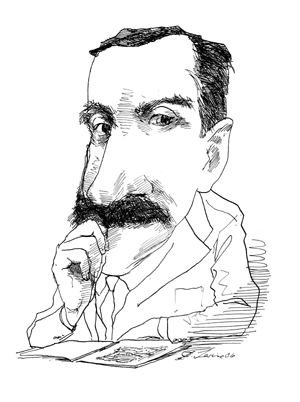
In the 1920s and 1930s Stefan Zweig was an immensely popular writer, a man who had to barricade himself in his house in Salzburg in order to avoid the fans lurking around his property in the hope of waylaying him. According to his publisher, he was the most widely translated author in the world. Today, while he is still read in Germany and also in France, his name is barely known to the average Anglophone reader. In the last few decades, however, there has been an effort on the part of several publishers to get Zweig back into print in English. In my opinion, no book of his deserves reissue more than his one novel, Beware of Pity (Ungeduld des Herzens, 1938).*
Zweig was a friend and admirer of Sigmund Freud, his fellow Viennese, and it was no doubt Freud’s writings, together with the experience of two world wars, that persuaded him of the fundamental irrationalism of the human mind. Absolutely central to his fiction is the subject of obsession. And so it is with Beware of Pity. To my knowledge, this book is the first sustained fictional portrait of emotional blackmail based on guilt. Today, it is a commonplace that one person may enslave another by excessive love, laced with appeals to gratitude, compassion, and duty, and that the loved one may actually feel those sentiments—love, too, of a sort—while at the same time wanting nothing more than to be out the door. But even in the iconoclastic Thirties, gratitude, compassion, and duty were not yet widely seen as potential engines of tyranny. It was partly for his cold examination of those esteemed motives that Zweig admired Freud—”he enlarged the sincerity of the universe,” Zweig wrote—and in Beware of Pity he carried the analysis forward.
The story opens in 1913, in a small garrison town on the Hungarian frontier. Stationed there is Anton Hofmiller, a second lieutenant of the Austro-Hungarian cavalry. He is twenty-five, but having spent much of his life in a military academy, he is younger than his years. One night he wangles an invitation to dinner at the local Schloss, the home of Herr Lajos von Kekesfalva, a great industrialist. He spends the evening in a daze of Tokay and admiration. The halls are hung with Gobelins; the dinner is magnificent; his seatmate, Kekesfalva’s niece Ilona, has arms “like peeled peaches”; he dances the night away. Then, as he is about to leave, he remembers that his host has a daughter—Edith, seventeen or eighteen years old—and that he should ask her to dance. In a side room, he finds her, a frail-looking girl with gray eyes. He bows to her, and says, “May I have this dance, gnädiges Fräulein?” Her response is not what he expected:
The bowed head and shoulders jerked backwards, as though to avoid a blow;…the eyes stared fixedly at me with an expression of horror such as I had never before encountered in my whole life. The next moment a shudder passed through the whole convulsed body…. And suddenly there burst forth a storm of sobbing…. The weeping went on, grew, if anything, more vehement, breaking forth again and again, like a gush of blood, like a hot agony of vomiting, in spasm after spasm.
Hofmiller retreats to the salon, where Ilona intercepts him. “Are you mad?” she says. “Didn’t you see her crippled legs?” No, he didn’t; she was sitting at a table. He bolts from the house, his heart “hot with shame.”
Edith has thus made her first strike, spontaneously. (As we discover, she often has such fits when something displeases her.) But for the folie à deux that is the novel’s subject to take root, Hofmiller must make a complementary response. Already that night, he is appalled at having given such pain: “I felt as though I had struck an innocent child with a whip.” At the same time, another thought—one that will become important as the story progresses—begins working on his mind: his prestige as an officer. He has committed a gaffe, a social error, and has thereby dishonored both his regiment and himself within the regiment: “At our mess table every piece of idiocy on the part of any one of us was chewed over for the next ten or twenty years.”
The following morning, spending all he has left of his month’s pay, he sends Edith a great bouquet of roses. In return, he receives a note from her, inviting him to tea. He needn’t say what day he’s coming, she adds: “I am—alas! —always at home.” Already she is appealing to his compassion, and when, the next afternoon, he pays his call, she does so again, telling him how, before the illness that paralyzed her legs five years earlier, she loved to dance, she wanted to be Pavlova. But alas!
Advertisement
The day after this visit, the innocent Hofmiller is riding out to the morning parade, his men behind him:
I am passionately fond of riding. I could feel the blood flowing from my hips, coursing through my relaxed limbs in a warm, pulsating, life-giving stream, while the cold air whistled round my brow and cheeks. Marvellous morning air: one could still taste the dew of the night in it, the breath of the loosened soil…. On, on, on, gallop, gallop, gallop! Ah, to ride thus, to ride thus to the ends of the earth!
But suddenly, in the midst of this ecstasy, he remembers Edith, and is ashamed of his physical strength, physical enjoyment. He orders his men to slow to a trot. Disappointed, they obey. That, Hofmiller says, was “the first symptom of the strange poisoning of my spirit by pity.”
Interestingly, anti-sentimentally, the object of his pity is not endearing. Edith is narcissistic and imperious—a diva of pain. At tea the day before, she had had to leave her guest early (the masseur had arrived), and, though accustomed to using a wheelchair, this time she insisted on walking:
She pressed her lips firmly together, raised herself on to the crutches and—tap-tap, tap-tap—stamped, swayed, heaved herself forward, contorted and witch-like, while the butler held his hands out behind her to catch her should she slip or collapse. Tap-tap, tap-tap, tap-tap—first one foot and then the other, and between each step there was a faint clanking and squeaking as of tautly stretched leather and metal [the sound of her braces]…. She wanted to show me, me in particular, to show all of us, that she was a cripple. She wanted, out of a kind of mysterious vindictiveness born of despair, to torture us with her torture.
In the course of the novel, that “tap-tap” will come to sound like something out of Poe, and Edith’s witch-like character will become more pronounced. When she speaks, it sounds to Hofmiller as if she were “hacking away at something with a knife.” When she laughs, “the sound was as sharp and jagged as a saw.” In a way, her father, grieving for her, his only love (he is a widower), appeals more powerfully to Hofmiller’s compassion than Edith does. Zweig makes it clear, however, that the wounded do deserve our pity. And how are we to withhold it, though in giving it in the measure they ask—Hofmiller is soon expected at the house every afternoon—we may feel coerced?
That, in any case, is Hofmiller’s reasoning as, from day to day, he doles out the greater and greater reassurances that Edith demands. She of course falls in love with him, and her doctor tells him that he cannot disabuse her as to his feelings, or not yet, for this would doom a cure that she is about to undertake in Switzerland. So he descends ever deeper into hypocrisy. In the process, Zweig gives us a piercing analysis of the motives underlying pity. Gradually Hofmiller realizes how much he enjoys the courtesies paid to him for his emotional services, how it pleases him that when he arrives at the Schloss his favorite cigarettes—and also the novel (its pages already cut) that he had said in passing that he wanted to read—are laid out on the tea table. Nor is it lost on him that his own sense of strength is magnified by Edith’s weakness and, above all, by his growing power over the Kekesfalvas, the fact that if he, a poor soldier, does not present himself at teatime, this great, rich household is thrown into a panic, and the chauffeur is dispatched to town to spy him out and see what he is doing in preference to waiting on Edith. Beyond the matter of power, however, Hofmiller finds that the emotion of pity is a pleasure just in itself. It exalts him, takes him to a new place. Before, as an officer, he was required only to obey orders and be a good fellow. Now he is a moral being, a soul.
That anatomy of compassion is one of the book’s foremost contributions, but any psychoanalyst could have done it. What only Zweig could have created are the scenes between Hofmiller and Edith: the concrete, subtle, and hair-raising enactments of ambivalence, hers as she vacillates between appealing to his pity and asking for his love, his as he is torn between solicitude and recoil. Late in the novel, during one of his visits, she finds his attentions insufficient. She starts to have one of her fits, and to allay it, he places his hand on her arm:
Advertisement
Suddenly the spasm ceased; she grew rigid again and did not stir. It was as though her whole body were straining to understand what this touch indicated, to know whether it was a gesture of…love or merely of pity. It was terrible, this waiting with bated breath, this waiting of a tense, motionless body. I had not the courage to withdraw the hand which had with such marvellous suddenness stilled the paroxysm of sobs, and on the other hand I had not the strength to force from my fingers the caress that Edith’s body, her burning flesh—I could tell—so urgently awaited. I let my hand lie there, as though it were not a part of me, and I felt as though all the blood in her body came surging in a warm pulsating stream to this one spot.
Now she moves his hand to her heart and begins caressing it:
There was no avidity in this fervent stroking, only serene, awe-struck bliss at being allowed at last to take fleeting possession of some part of my body…. I enjoyed the rippling of her fingers over my skin, the tingling of my nerves—I let it happen, powerless, defenceless, yet subconsciously ashamed at the thought of being loved so infinitely, while for my part feeling nothing but shy confusion, an embarrassed thrill.
The image of Hofmiller standing there awkwardly as Edith fondles his captured hand, the sheer, no-exit suffocation of the situation: the great psychologists of love (Stendhal, Flaubert, Tolstoy, Turgenev) never went further than this. The scene combines their moral knowledge with a kind of neurotic, subdermal excitement reminiscent of Schnitzler, a friend of Zweig’s and another legatee of Freud. Nothing in the book is more striking than this sustained and morbid tension: the nervous laughter, the drumming fingers, the moments of happiness than convert in an instant to fury and grief, with the cutlery suddenly thrown onto the plates. Like Hofmiller, the reader is dragged down, by the neck.
A few days after the above episode, Edith will again seize Hofmiller’s hand, and slip an engagement ring onto his finger. From there, the relationship moves swiftly to its fated, disastrous conclusion. Hofmiller defects; Edith commits suicide; Hofmiller spends the rest of his life in shame and despair. That very fatedness, not just in Beware of Pity but in his stories too, has been held against Zweig. A number of critics have remarked on the lock-step progression of his plots and, correspondingly, on the psychological fixity of his characters. His fictional writings are in some measure case histories, textbook portraits of neurosis, Hofmiller’s indecision and Edith’s guilt-wielding being prime examples. To my mind, however, Edith’s character—her unlovability, even as she needs and demands to be loved—is a wonderfully bold stroke, opening up whole caverns of psychological meaning. The outcasts of the world “desire with a more passionate, far more dangerous avidity than the happy,” Hofmiller says. “They love with a fanatical, a baleful, a black love.”
2.
Zweig was born in Vienna in 1881, within months of many of the great early modernists (Joyce, Stravinsky, Kafka, Virginia Woolf, Picasso), but his outlook was not the same as theirs. Silence, exile, and cunning: these were imposed on him, but they were torture to him, and he never ceased to mourn the passing of what, in his memoir, The World of Yesterday (Die Welt von Gestern, 1942), he called the “Golden Age of Security” represented by pre– World War I Vienna. From Musil and Schnitzler and Joseph Roth, we have learned to view Franz Josef’s Vienna as a scene of empty (however gorgeous) pomp in the public sphere and neuroticism in the private sphere, but Zweig’s circumstances were different from those men’s. He was the son of a millionaire industrialist—and the second son, the one not required to go into the family business. Already as a teenager he had joined a group of aesthetes whose lodestar was the brilliant young Hugo von Hofmannsthal. His thoughts were only for art, which he saw in the most ideal terms. After a conversation with Rilke, he wrote, “one was incapable of any vulgarity for hours or even days.” A visit to the studio of Rodin bestowed on one “the Eternal secret of all great art, yes, of every mortal achievement,…that ecstasis, that being-out-of-the-world of every artist.”
Zweig’s politics were correspondingly vague and soaring. In keeping with the so-called “Austrian idea”—that multinational, multiethnic Austria-Hungary was a symbol of human fellowship—he saw himself as a citizen not of any one country, but of Europe as a whole, “our sacred home, cradle and Parthenon of our occidental civilization.” His membership in that collective fired him with humanitarianism and optimism. In 1914, he writes in The World of Yesterday, “The world offered itself to me like a fruit, beautiful and rich with promise.”
The fact that he was Jewish did not dent his confidence. He was one of that large class of educated, assimilated, secular European Jews who were to receive such a surprise in the 1930s. As a young man, he said, he never “experienced the slightest suppression or indignity as a Jew,” and his Moravian family were “free both of the sense of inferiority and of the smooth pushing impatience of the… Eastern Jews.” Note his willingness to disassociate himself from the despised Ostjuden, who at that time were pouring into Western Europe in flight from the Russian pogroms. Herr von Kekesfalva, in Beware of Pity, started out as one of that species, and Zweig’s portrayal of Kekesfalva’s early years is what, today, many of us would call anti-Semitic writing. But Zweig, as a youth, didn’t really regard himself as a Jew, or not much. That was his father’s world, or his grandfather’s. By the time he wrote The World of Yesterday, in the 1940s, he had, perforce, learned to identify with the Jews and to make claims for them as a people. “Nine-tenths of what the world celebrated as Viennese culture in the nineteenth century was promoted, nourished, or even created by Viennese Jewry,” he says, and he names the names. With typical modesty, he does not include himself in the list, but by the age of nineteen he had published his first book of poems and had begun writing feuilletons for the highly regarded Neue Freie Presse, under the editorship of Theodor Herzl.
Mad for art, he was nevertheless unconfident of his ability to contribute to that enterprise, and so he spent many of his early years in service to other artists, as translator or biographer. During his lifetime he was valued for his biographical books and essays—on Verlaine, Verhaeren, Balzac, Dickens, Dostoevsky, Romain Rolland, Hölderlin, Kleist, Nietzsche, Stendhal, Tolstoy, Freud, Erasmus, Marie Antoinette, Mary Queen of Scots, and Magellan, among others—as for anything else that he wrote, though his collections of novellas were also hugely popular, with their portrayals of sex and madness breaking though the laquered screen of upper-bourgeois manners. In addition, he wrote plays, travel books, and an opera libretto. He was a literary man of all trades, not so much an author as a “voice”—to some, the voice of Europe.
Zweig often received letters from female fans, and one such correspondence—with Friderike von Winternitz, a young writer—led to his first marriage. Friderike left her husband for Zweig, and they were together for more than twenty years, his most productive years, from the 1910s to the 1930s. Then, in 1933, Friderike hired a new secretary for Zweig: Charlotte Altmann, a shy, self-effacing German-Jewish woman, twenty-seven years his junior, whose family had just been run out of Germany. Lotte immediately fell in love with him. What he felt in return is not clear to his biographers, but at this time his mood was very bleak. His youthful confidence had been badly wounded by World War I, and as the Nazis began dragging Europe into a second war, his former optimism converted to an equally absolute pessimism. By 1933 the Hitler Youth were burning his books; in 1935 Richard Strauss’s opera The Silent Woman was canceled after two performances because Zweig had written the libretto.
But his problem went beyond politics. He had come to hate the bustle and noise of his Salzburg household. He was a manically devoted worker. Friderike, though she tried to insulate him, had two daughters from her previous marriage, and she enjoyed visitors. In her 1946 biography of Zweig she blames his defection on “the climacteric.” Maybe so, but it seems that he just wanted out, of everything except silence and work, two things that Lotte could help him achieve. After several years of vacillation—for he was, by nature, as indecisive as Hofmiller—Zweig in 1938 persuaded Friderike to give him a divorce, assuring her that he had no intention of remarrying and needed only to regain his “student’s freedom.” The following year, he married Lotte.
By then he had escaped to London, and it was during this terrible period, the late Thirties, that he wrote Beware of Pity. Some people have seen Lotte—vulnerable not just politically but also physically (she had severe asthma), and utterly dependent on Zweig—as a model for Edith, but Zweig’s guilt over discarding Friderike must have had some part in the portrait. Then there was Zweig’s mother, a willful and self-important woman with whom, Friderike reports, he lived in open conflict throughout his childhood, a situation that left “indelible scars.” This does not exhaust the list of probable sources. Freud’s case histories unquestionably contributed to Beware of Pity. His patients often suffered paralyses, and tended to fall in love with their doctor. The words “hysteria” and “subconscious” recur in the novel.
Finally, it does not need restating that this dark book was written during the buildup to World War II. During the Thirties and Forties, Zweig was criticized by many of his colleagues for making no public denunciation of Nazism. His famous name would have added heft to the antifascist cause. But for all his humanitarianism, Zweig had a horror of politics. (He didn’t vote; he allowed no radio in the house; he read the newspapers only at night, in the café, lest they disturb his day’s work.) His response to Europe’s peril was indirect, symbolic: Beware of Pity, among other writings.
Zweig tried to mitigate the novel’s depressing message. In an epigraph to the book, he writes that there are two kinds of pity:
One, the weak and sentimental kind, which is really no more than the heart’s impatience to be rid as quickly as possible of the painful emotion aroused by the sight of another’s unhappiness…; and the other, the only kind that counts, the unsentimental but creative kind, which knows what it is about and is determined to hold out, in patience and forbearance, to the very limit of its strength and even beyond.
This, as we discover later, is a quotation from Edith’s physician, Dr. Condor, and Zweig may have intended it as a tribute to Freud’s treatment of his patients. Hofmiller’s is the wrong kind of pity; Dr. Condor’s—and Dr. Freud’s—is the right kind. One wonders whether Zweig actually believed this. Condor, with his supposedly good kind of pity, married a blind woman to console her for his failure to cure her. Late in the novel, we meet her: she hangs on Condor, presses on him her anxiety and gloom. Zweig, like many bold writers, posed himself problems that he could not always solve. In such cases, one has to ask oneself what feels true, what feels false, on the page. In Beware of Pity, what feels true are the scenes in which we are shown the futility of pity. This is a horrible lesson; it is also what makes the book radical and modern.
But however modern in his subject matter, Zweig was not what we call a modernist. Though he flourished in the Twenties and Thirties, his memoirs make no mention of T.S. Eliot, Virginia Woolf, Picasso, Stravinsky. He knew Joyce, but he doesn’t seem to have read Ulysses. He went to a Schönberg première, but he doesn’t say he liked it. The frontier of modern art, in his mind, appears to have been Rilke and Richard Strauss. This fact—that in a period of formal experimentation, he was not an experimentalist—is part of the reason that he, together with other stylistically traditional moderns (Joseph Roth, for example), has been valued by later generations at less than his true worth. At the same time, Zweig had real faults as a writer. I have mentioned the subservience of plot and character to idea. He was also fond of clanking narrative devices: the tale told by the stranger in the night; the lightning and thunder as the plot reaches its turning point. One must also note the plump, upholstered quality of some of his writing. This is a sin one is sorry to hold against him. He had a magnificently cultivated mind, strong emotions, a pronounced idealism, and a passionate devotion to nineteenth-century art. Put those things together, and it is no surprise that he was likely, in the words of one of his editors, to sing an “aria” at the end of a chapter, or even a paragraph. But these blasts of hot air, rife in The World of Yesterday, are absent from Beware of Pity. As for the predictability of plot and character, and the shopworn narrative conventions, they are there, but they count for little next to the subtlety and intensity of the psychological situation.
In 1941 Zweig and Lotte emigrated to Brazil, where they (and Zweig’s income) would be safe from harm. Zweig also thought that in multiethnic Brazil he would find a happy, supranational society like that of the Austria-Hungary of his imagination. At first he seemed to adjust fairly well. He and Lotte settled in Petropolis, in the mountains outside Rio. He started a biography of Montaigne. He acquired a little dog, who, he wrote to Friderike, had won second prize in a beauty contest. He and the dog took walks every day, and he gazed at the fabulous vistas. But they were not his vistas; those were in Europe, being overrun by killers. On the night of February 23, 1942, he wrote a note of thanks to the people of Brazil and a salute to his friends: “May it be granted them yet to see the dawn after the long night! I, all too impatient, go on before.” Then he and Lotte took an overdose of barbiturates. The next morning, they were found dead, in their bed, holding hands.
This Issue
July 13, 2006

This Issue
July 13, 2006
-
*
This essay appears in slightly different form as the introduction to a new edition of Beware of Pity, published by New York Review Books in June 2006. ↩