

Russian poetry has not been lucky with its translations into English. It has been so unlucky that it may seem that the problem is in the Russian language itself—a synthetic, too flexible language which cannot be reproduced adequately in analytic English with its “iron word-order.” Successful translations are rare.
Usually translations are done by American (or English) poets, who generally do not know Russian, or by Slavic scholars, who have extremely vague conceptions of poetic technique. Since the results in both cases are most often lamentable, working in tandem has become popular of late—i.e., co-operation between a poet and a Slavist. This collection of Akhmatova’s poems is an example of the tandem method.
Apart from theoretical and other obvious virtues, the tandem technique is also convenient because in case of failure it is generally impossible to know whom to blame—did the scholar misunderstand the text, or did the poet misunderstand the scholar? The unpleasant aspect of such cooperation is that one is forced to criticize two people at once. On the other hand, it is easier for two people to bear the criticism than one. A fact on which I very much rely as I compose this review.
For most American poets, translating from Russian is nothing but an “ego trip.” To some extent any translation, even of a scholarly text, is an ego trip; but in the case of poetry it is even considered that there is a good reason for this. Above all this is because contemporary Russian poets use a technique which seems archaic to their American colleagues. It is not just shameful for a contemporary American poet to use rhymes, it is unthinkable. It seems banal to him; he fears banality worse than anything, and therefore he uses free verse—though free verse is no guarantee against banality. (Incidentally, the quantity of free verse written today must be equal to the total of everything written in traditional forms during the last millennium.)
When we see “free verse,” we should first of all determine what it is “free” from. Most often we do not determine this, but simply suppose it is something phonetically and graphically opposite to traditional verse. It is also presupposed that every poet has gone over this road (enslavement by traditional verse and then liberation from it), as if recapitulating in miniature the historical process. Therefore there is seeming reason to expect that when any poet undertakes a translation, he is capable of using the techniques created in the original.
In fact, things do not turn out quite that way. As a rule the historical process is not recapitulated in miniature, or it is recapitulated to such a minimal degree that the poet is simply incapable of operating within traditional metrical verse. It makes absolutely no difference what heights he has achieved with his free verse technique. What matters is that he does not possess the technique of the original; therefore his use of his own technique in translating is not a chosen, new, manifestation of his own individuality—it is something over which he has no control.
Parallels with other forms of art are dubious, but let’s suppose for a moment that you have only one color on your palette and you have to copy Raphael. You have to try something, and something or other will result—maybe even something very interesting, original, as they say. That’s fine, but you don’t have to call it a copy of Raphael. To translate poetry, one has to possess some art, at the very least the art of stylistic re-embodiment. This is possible when your reserve of technical skills is varied. A good example is W. H. Auden, who is capable of translating Icelandic sagas or the diaries of the late Dag Hammerskjold, using equivalents of the languages in which they were written.
Failing this, the results will be amateurish and jerrybuilt, no matter what argument you use in justification. Translation is not original creation—that is what one must remember. In translation, some loss is inevitable. But a great deal can be preserved too. One can preserve the meter, one can preserve the rhymes (no matter how difficult this may seem each time), one can and must preserve the meaning. Not one of these three things, but all together. Images exist, and one must follow them—and not propound fashionable theories in introductions.
Akhmatova is a traditional poet, in the highest sense of the word. Her verse looks traditional not only to the American reader, but to the Russian one as well. But it possesses a quality which allows the Russian reader to love it more than the achievements of the Russian Futurists, Constructivists, Imagists, etc., with all their stylistic transformations and transfigurations, performed in free verse or in canonical verse. As Max Hayward correctly notes in his quite sensible introduction describing the climate of the Silver Age of Russian poetry at the turn of the century, the situation in Russian literature was very similar to the situation in most European literatures—there was an inflation of harmonic verse, the last apostles of which were the Symbolists. It was natural that a reaction, a devaluation, should begin. This did happen, and the groups and movements mentioned above were a form of this devaluation. But in most cases they were talking only about new denominations on the bills—the backing was the same. That is, to a significant degree they were all nothing but revolts of one set of devices against another set of devices.
Advertisement
But Acmeism was a revolt of essence against essence (or lack of essence). Purely technically Akhmatova’s poetry differs little from that of the Symbolists, but even an inexperienced reader will immediately single her out in the crowd—not by her dress, but by her speech. The dress, in principle, is the same; and here I would like to explain why it is that Russian poets generally prefer the traditional verse line with rhyme and its other attributes. This comes about first of all because the use of rhyme is a way to organize that which is not subject to any organization, i.e., it is an establishment of order in chaos. Apart from this, the traditional line of verse puts you at a clear disadvantage; it is as if it depersonalizes you because it is in essence neutral. And then it depends on you, as a poet, whether this line of verse will becomes yours or remain alien, or more precisely, remain no one’s. In other words, what you put into it depends on your soul.
Traditional verse more vividly than free verse emphasizes the banal, or the basic, in what is said. The contrast of traditional form to so-called contemporary content gives the work greater scale and tension. The principle is extremely simple: here is a normal person, with arms and legs, properly dressed, a tie and stickpin, but just look at the way he talks! Remember how the author of The Waste Land dressed, or imagine an automobile rushing straight toward you in your lane, and you will discover the function of the traditional verse line in Russian nineteenth-century poetry.
But Akhmatova is traditional in yet another respect. If an explosion takes place as a result of the contrast of form and content on paper, then what happens to the reader before whose eyes the poet himself stifles this explosion? Most of Akhmatova’s poems are written with falling intonation toward the end, as if nothing special has happened. Whether she is calming herself or the reader is unimportant; what is important is the fact that she does this, and it is even more important to know why she does it. The answer to this question is important above all to the translator. Because in order to translate, one must if not know, then at least have some conception of not only the author’s complex of ideas, his education, and the details of his personal biography, but also his etiquette, or better, the etiquette of the poetry in which the poet worked.
I will allow myself a generalization. One of the main characteristics of Russian poetry is its restraint. Russian poets (I am speaking of the best of them) never allow themselves hysterics on paper, pathological confessions, spilling ashes over their heads, curses aimed at the guilty, no matter what the character of the events which they become witness to, participants in, or, sometimes, victims of. Akhmatova was a profound believer, and therefore she understood that, more or less, no one is guilty. Or more precisely, that the guilty exist, but that they are also human beings, just like their victims. I think that she knew the ambivalence of consciousness characteristic of all Russians. As a rule ambivalence leads to one of three things: cynicism, wisdom, or complete paralysis, i.e., an inability to act. Akhmatova achieved wisdom. Therefore her verse is extremely simple, restrained, and at times, like all real wisdom, it sounds banal. It is essential to understand this and then there will be no temptation to omit some things, emphasize others, use free verse where the original is in sestets, etc. That is, the translator must have not only the technical but also the spiritual experience of the original.
In a clear sense Akhmatova was lucky with her translator here. Stanley Kunitz turns out to be a person who is spiritually and technically qualified for the task. If he makes mistakes, the mistakes are more in technical details than in conveying the spirit of the poems chosen. And these mistakes, if they do lead the reader astray, at least do not take him in the opposite direction. Since Kunitz is a man of experience, he has no need of my compliments or those of anyone else; and I think it is better to pause on the mistakes which are results of the above-mentioned tendencies among poet-translators. Let us take for example the poem “Imitation from the Armenian.”
Advertisement
The poem is dedicated to her son who is in a concentration camp, the padishah is Stalin. Let us compare a literal translation and Kunitz’s translation:
Podrazhanie Armianskomu
Ia prisnius’ tebe chernoi ovtsoiu
Na netverdykh, sukhikh nogakh,
Podoiudu, zableiu, zavoiu:
“Sladko l’uzhinal, padishakh?
Ty vselennuiu derzhish’, kak busu,
Svetloi volei Allakha khranim….
I prishelsia l’synok moi po vkusu
I tebe i detkam tvoim?”You will dream me as a black ewe
On unsteady, withered legs,
I will come up, I will bleat, I will moan:
“Did you sweetly dine, Padishah?
You hold the universe like a bead,
Protected by the radiant will of Allah….
And did my son suit the taste
of you and your babies?”
—Akhmatova (literal translation)In the form of a black ewe my ghost
will straggle through your dreams
on faltering, withered legs,
bleating: “Shah of the Shahs,
blessed in Allah’s eyes,
how well did you feast?
You hold the world in your hand
as if it were a cold bright bead….
But what about my boy,
did you enjoy his taste?”
—Kunitz
The first question—What happened to the rhymes?—we will leave unanswered. But why was “My ghost will straggle through your dreams” necessary? For emphasis, of course. And here the poet makes himself felt. The poem is emphatic enough even without the introduction of the ghost, but in the poet’s brain a vision arose which he does not want to give up, all the more so that it doesn’t look bad on paper, if fits the context, and mainly, it would be lost forever if he didn’t write it down. This is an emotional mistake. The second mistake is technical: Akhmatova has two verbs “zableyu, zavoyu“—“I will bleat, I will moan”—which are extremely expressive in their howling phonetics. But this can be forgiven. It is more difficult to forgive the destruction of logical order beginning with “Shah of the Shahs” (the last five lines of the literal translation, the last seven of the Kunitz translation).
In the first place everything is more concise in Akhmatova. In the second place, “Did you sweetly dine, Padishah” is not the beginning of a sentence, but the end (all the more since the original is written with alternating rhyme, and this is the fourth line of the sequence ababcdcd). After this appeal to the padishah, Akhmatova says: “You hold the universe like a bead / Protected by the radiant will of Allah.” These two lines are not an appliqué à la Saadi, but a description of a Russian’s feelings toward Stalin—because it really did seem to them that he held the universe like a bead, and that there was only one explanation for his going without punishment, for his being untouched—he was protected by heaven itself. The change in construction here leads to a rather cruel revenge: it results in a change in meaning.
The poem culminates with what from my point of view is a very bad miscalculation—Akhmatova asks: “And did my son suit the taste / Of you and your babies?” But Kunitz leaves the question directed only to the padishah. But the point is not just in the padishah Stalin, but in his little children, his babies. If the whole point were only in the padishah, then perhaps there would have been no need to write the poem; and if it were necessary, it would not have been obligatory to call it “Imitation from the Armenian.” The poem is called this precisely because of his children, who were concerned with all of the details. It struck Kunitz as possible to throw out the children because, first, the poem seemed sufficiently powerful even so (which is true), and second, because he is not sufficiently familiar with Russian fauna. This is not his fault, however, but that of Professor Hayward.
Thus, the translator first rejected the metrical structure and the rhymes of the original. Theoretically this should have guaranteed him a definite amount of freedom. But even if it did guarantee such freedom, the translator did not use it very sensibly—or else it seemed insufficient to him. In any case, he allowed himself to change the meaning (without going beyond the author’s framework, of course). The end result was that the freedom turned out to be a burden and led to a certain heaviness of style: instead of the eight Russian lines we have ten English lines. And this happens despite the fact that the English words are two or three times shorter—in number of syllables—than the Russian ones. In English a line of iambic pentameter can contain up to nine words, while in Russian not more than six will fit. I say this on the basis of a fair amount of experience.
I admit that when a translator rejects traditional verse and turns to free verse, he may be guided not just by a desire to undertake the usual ego trip, but by the very best impulses with regard to the original: he does not want a good poet to seem old-fashioned. But is the effect of old-fashionedness so inevitable? While only insignificantly changing the meter and rhyme scheme, Kunitz achieves considerable success in the poem “Boris Pasternak,” in many passages of “Requiem” (a good translation of which exists, done by Joseph Langland), “Cleopatra,” and other poems.
What is incomprehensible to me is why in one case the translator attempts to preserve the structure of the original, while in another he totally ignores it. This is especially annoying in the case of the excerpts from A Poem Without a Hero. This poem is written in a special “Akhmatova stanza” which in its musical density has nothing equal to it in Russian poetry. Akhmatova often said that if you want to write a poem, first of all you must create your own stanza. (This, of course, is a terribly Russian matter, but she said that in his long poem Retribution, Blok had been done in by an alien, i.e., Pushkinian stanza.) And Kunitz translated this work, which took her almost two decades, in free verse. Imagine “The Hollow Men” translated into sonnets or triolets. I recall how Akhmatova wept when she saw what one English poet’s translation had done to her.
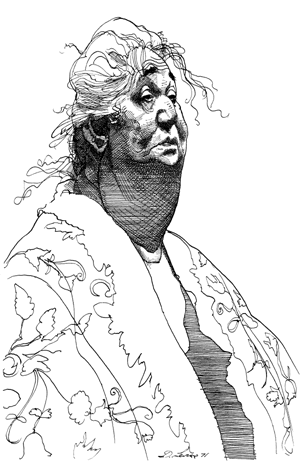
In the case of this book, I think she would smile. It is a good book nevertheless, and to a certain degree it does represent Akhmatova. Even if it is in profile—which corresponds to the dust jacket. Akhmatova lived a long life and wrote much. The selection done for this book is a bit strange and one-sided. Akhmatova furiously opposed the tendency of many native and Western literary scholars to interpret her as a chamber poetess of the Teens or as a “fighter against the regime.” She is an extremely profound and diverse poet. She is a lyric poet and a chronicler, but hers is the lyricism and chronicling of a person who “like a river, was reversed by the cruel epoch.” Meditativeness and surrealism are characteristic of her, however it is the meditation not of a prophet sitting under a tree but of a person whose sufferings make her speak in a hoarse, almost disembodied voice; and her surrealism is not esthetic, but psychological, i.e., the madness of philosophy. The poetry is very musical, very rich phonetically, and the phonetics communicate a metaphysical reality to the information given in the text.
For all this she is an extremely restrained poet, almost simple. But her simplicity is like the “simplicity” of Robert Frost, to whom, in my opinion, she is extremely close stylistically in her “Northern Elegies,” one of which the reader will find on page 129 of the book under review. Unfortunately, in the translation something is lost, or more accurately, oversimplified. It is particularly too bad about this passage:
To me are known beginnings and endings
And life after the end….
Kunitz:
I know beginnings, I know endings too,
and life-in-death, and something else….
It is not at all “life-in-death,” which sounds like some sort of existential cliché. It is also inconceivable why there was such a great necessity to translate into free verse a poem which was originally in blank verse. As for the choice of poems for this publication, I think it can be explained—although not completely—by the earlier Penguin edition of Akhmatova and by the authors’ desire not to duplicate it. But taken together, these two books represent about one-tenth of one percent of all that Akhmatova wrote.
I repeat, this is a good book, but I would like to think that it is only the beginning. For the successes of this particular tandem are quite obvious, and I speak of the oversights which have occurred with a certain harshness, precisely because they are in such contrast to the generally high level of the work. I think that this book should be interesting to the American reader, particularly the reader of poetry. Akhmatova’s poetry contains the unique lesson of Christian ethics in literature—a lesson all the more valuable in that it was given at a time and under circumstances in which man was distinguished from the animal rather by the number of his extremities than in any other way.
Akhmatova is still a very Russian poetess. Russian not in the sense of “baring the soul” or of a landscape with gold cupolas (which appear in Kunitz’s version of the “March Elegy” as if a metastasis of the typical Intourist treatment), but in the psychological sense, in the depth of penetration into any character—whether a beloved or an executioner. This is a characteristic of Russian psychological prose, out of which Akhmatova came, in the words of Osip Mandelstam, who once answered a request from an audience to identify himself by saying, “I am a contemporary of Akhmatova.”
Still, it is sad that linguistic barriers exist. We lose so much. But since they do exist, we must make the maximal effort, if not to leap over them, at least to broach them. Pushkin called translators “the post-horses of enlightenment.” If we take this metaphor to its logical conclusion (which is always dangerous), we should note that horses run as hard as they can only when a whip is whistling over them. In Soviet publishing houses there exist institutes of editors. As a rule these are people who know the language and literature from which the translations are made. No matter how well known your name is, the editor can return your manuscript to you if he finds that you have allowed inaccuracies. One has to rework it dozens of times, but when the book is published, the author’s name has full right to be on it.
I would like to advise that something like this practice be introduced in this country. No one would suffer from it, and the gain from this kind of innovation would more than make up for any possible losses. But failing this, then (to go a little further than Robert M. Adams, who in his essay “The Tongue-Tied Mind” [Columbia Forum, Winter, 1973] made the remark that there are “more semi-languaged readers than publishers are ready to admit”) why not at least publish bilingual editions with notes on the metrical structures of the poems, plus inter-linear literal translations? Because there are more people experienced in poetry among us than publishers are ready to admit.
I allow myself to make all of these remarks and give such advice, because I consider translation to be a quite serious matter, and because good translations are an exception now. It is desirable—and the sooner the better—to collect a sufficient number of exceptions to make a new rule. Russian poetry in any case deserves this, and has a right to expect it.
—translated by Carl R. Proffer
This Issue
August 9, 1973

This Issue
August 9, 1973