

To the Editors:
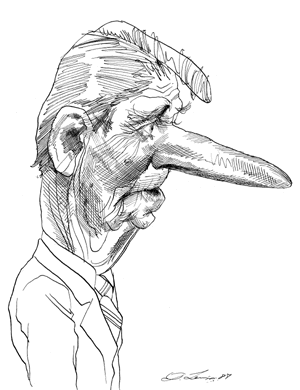
Professor Ronald Dworkin has twice in your pages launched an extraordinary attack upon Judge Robert Bork, depicting him as a right-wing ideologue who uses an “original intent” constitutional theory as a mere mask for lawless judging [NYR, November 8, 1984; August 13, 1987]. But Bork’s judicial practice is wholly consistent with Dworkin’s jurisprudential theory, as that is expressed in the justly celebrated article “Hard Cases” (reprinted as Chapter 4 in Taking Rights Seriously, Harvard University Press, 1977). Hence it appears that Dworkin’s real complaint is simply that he disagrees with Bork on controversial questions of constitutional right.
In imputing to Bork a “hostility to ordinary legal argument,” Dworkin concentrates his fire on the opinion in Dronenberg v. Zeck, 741 F.2d 1388 (1984), in which a three-judge panel of the Court of Appeals, D.C. Circuit, affirmed a lower-court decision which upheld Dronenberg’s discharge from the Navy for having engaged in homosexual acts. Dronenberg argued that his conduct was shielded by the constitutional right to privacy. The Supreme Court has never held that consensual homosexual acts come within the ambit of this right; and it summarily affirmed the decision in Doe v. Commonwealth’s Attorney, 403 F.Supp. 1119 (1975), which had upheld Virginia’s criminal sodomy statute. Despite this, Dronenberg argued that the cumulative effect of important recent Supreme Court decisions was to establish a fundamental constitutional right to engage in any manner of consensual, nonharmful sexual practice. (These decisions comprise inter alia: Griswold v. Connecticut, 381 US 479 [1965], state cannot forbid dissemination of birth control information and devices to married couples; Eisenstadt v. Baird, 405 US 438 [1972], unmarried persons have a privacy right to purchase and use contraceptives; Roe v. Wade, 410 US 113 [1973], women have an absolute privacy right to abortion during the first trimester of pregnancy.)
Without contending that the rejected constitutional claim was clearly correct, Dworkin castigates Bork for having “brushed aside” Dronenberg’s arguments, and for having expressed the belief that “he has no responsibility to treat the Constitution as an integrated structure of moral and political principles, and no responsibility to respect the principles latent in past Supreme Court decisions he regrets were made.” But examination of Dronenberg does not corroborate this description of Bork’s practice. In rejecting Dronenberg’s claims, Bork held firstly that he was bound by the Supreme Court’s summary affirmance in Doe. This was a controversial conclusion, but is one that other courts, and other judges on Bork’s court, have also reached. (See, e.g., Lovisi v. Slatyton, 539 F.2d 349, 352 [4th Cir. 1976] [en banc]; Matlovich v. Secretary of the Air Force, 13 EPD 6088 [D.D.C. 1976]; and the opinion of Judge Ginsberg in the Appeals Court decision refusing en banc rehearing, Dronenberg v. Zech, 746 F.2d 1579, 1581 [1984].)
Secondly, after an extensive survey of the privacy cases, Bork concluded that they express no clear principle yielding the constitutional right which Dronenberg claimed. In the course of his survey, Bork argued that the Supreme Court had created “new” constitutional rights in those decisions. His “original intent” constitutional theory was not a premise in his argument, but only the claim (which Dworkin calls a platitude) that “…[constitutional] rights must be fairly derived by standard modes of legal interpretation from the text, structure, and history of the Constitution” (741 F.2d at 1396 n.5). Bork intimated that the Court should not create new rights, but declared himself bound as a circuit judge to enforce whatever rights it might announce (id). But he argued too that a lower court ought not extend constitutional rights which it believes to be new beyond the boundaries expressly delineated by the Supreme Court.
This last particularly aroused Dworkin’s ire. But his feeling finds no support in his philosophical account of judicial obligation (which I take to be the best that anyone has yet devised). In “Hard Cases” (and in his later writings), Dworkin argued that legal rights are institutional moral rights, which are determined by the best moral theory which explains a jurisdiction’s settled legal standards. These comprise (in the present connection) the Constitution, Supreme Court decisions, and those of the inferior federal courts and state courts. To decide a controversial case—one in which competent lawyers may reasonably disagree as to its correct result—a judge must employ what seems to her to be the best theory of institutional rights that she can devise or find. However, no theory will be able to explain all of a jurisdiction’s settled standards: those standards which a judge’s theory cannot fit he must categorize as mistaken. A mistake may retain its “specific authority,” but he will accord it no “gravitational force,” i.e., no authority to influence legal results which lie beyond the ambit of that standard’s clear holding. One hallmark of an institutional mistake is “that it is now widely regretted within the pertinent branch of the profession” (Taking Rights Seriously, page 122).
Advertisement
Judge Bork evidently considers the privacy decisions to be institutional mistakes; and, as Dworkin’s jurisprudential theory recommends, he is willing to enforce their specific authority, but to accord them no gravitational force. Bork’s view of these decisions is undoubtedly controversial, but is one that is widely held among judges, constitutional scholars, and lawyers generally. This is particularly true of the abortion decision, Roe v. Wade. (For a sympathetic yet critical account of that decision, see L. Tribe, American Constitutional Law, 1978, pages 924–934.) In a recent survey of 348 states and 57 federal judges, 44 percent thought that case rightly decided, whereas 39 percent thought it mistaken, of which number roughly half thought it should be overruled (The New York Times, August 2, 1987, page A-22). It is also relevant that, in this same survey, 50 percent of the judges said that, were they senators, they would vote to confirm Bork’s appointment to the Supreme Court, 24 percent would be opposed, and the rest had no opinion.
Dronenberg therefore was a controversial, yet legally responsible, decision. It provides no support whatever for Dworkin’s claim that Bork has “only right-wing dogma to guide his decisions.” And it is simply false to maintain that Bork is outside the pale of respectable legal opinion and practice. At bottom, Dworkin’s complaint is simply that Judge Bork holds conservative political views and disagrees with him on issues of constitutional right. This is a perfectly good reason for Dworkin to join the political opposition to Bork’s confirmation to the Supreme Court. But the professor of jurisprudence at Oxford University ought frankly to state the grounds on which he is opposed.
M.B.E. Smith
Smith College
Northampton, Massachusetts
Ronald Dworkin replies:
Professor Smith discusses only my remarks about Judge Bork’s opinion in the Dronenburg case, and therefore neglects most of my argument, which analyzed Bork’s opinions, speeches, and academic writing as a whole. Nevertheless Smith’s suggestions about Bork’s opinion in that single case are illuminating and merit an extended reply.
In Dronenburg Bork went out of his way to attack a large number of past Supreme Court decisions that his right-wing supporters particularly disliked. He said that since these decisions invented new rights, he had no obligation to respect the principles they rested on, or to apply those principles in other circumstances. So though the Court had appealed, in its abortion and contraception decisions, to principles that would equally protect homosexuals, Bork refused to apply those principles and upheld the Navy’s decision to dismiss a homosexual after many years of honorable service.
Smith describes very clearly the argument that Bork should have made, as a judge in our legal system, to defend his refusal to apply a principle embedded in a string of past Supreme Court decisions. As Smith says, Bork should have tried to show that these decisions were inconsistent with the Supreme Court’s more general record; he should have tried to show, that is, that the principles the mistaken decisions relied on had in fact been rejected in more important or sweeping or fundamental or numerous other decisions. But Bork made absolutely no effort even to sketch an argument of that kind. He simply begged the question by saying that the decisions he disapproved invented new rights, as if no more argument were needed than his personal thumbs down.
It is plain enough why Bork did not attempt to make the normal, lawyerlike argument Smith recommends. Bork is not a legal conservative, anxious to protect law’s overall integrity, but a radical: his opinion in Dronenburg signaled his readiness, if he is appointed to the Supreme Court, not just to prune decisions that time had shown to be inconsistent in principle with the main lines of constitutional development of the last several decades, but wholly to reverse that development by attacking the main lines themselves. That is, I believe, the least understood part of the threat Bork’s nomination poses. It is certainly possible to criticize isolated Supreme Court decisions as mistakes in the application of more general principles the Court has mainly accepted. (Several legal scholars have in fact criticized the abortion decisions in that way.) But Bork defends his challenge to controversial decisions with claims so broad and radical that they would, if applied with even minimal consistency, sweep away a good part of the constitutional structure most Americans now take for granted. His attack, as he has himself said, embraces a “large proportion of the most significant constitutional decisions of the past three decades.”
In his Dronenburg opinion alone, Bork condemns as having “created new rights” not only the Court’s central abortion decision, Roe v. Wade, but its various decisions about contraception, including the landmark Griswold v. Connecticut, which held that married couples have a right to use contraceptives if they wish, and that part of its decision in Loving v. Virginia, which held that a statute forbidding interracial marriages violated constitutional rights to liberty. He has denounced the Court’s 1922 decision in Meyer v. Nebraska declaring unconstitutional a state law making it a crime to teach a foreign language to children; and its 1925 decision in Pierce v. Society of Sisters, which struck down a law making religious or private schools illegal.
Advertisement
Behind this impressive line of decisions, all of which Bork rejects as grave mistakes, lies a central principle of our constitutional law: that liberty is secured only when the government leaves citizens alone to decide the most intimate or personal questions about their own lives for themselves, except when urgent social policies make that impossible. Of course reasonable people disagree about the right balance between individual liberty and such urgent social needs. But Bork’s indefensible interpretation of constitutional intention, that the Constitution contains no rights beyond topics or areas the “framers” actually discussed, would read liberty out of the Constitution altogether: state legislators would have the unchecked power to regulate the most private aspects of personal and family life in any way they wished.
Since my article was published, a great many studies of Bork’s academic writings and speeches, and of his record as a circuit court judge, have been prepared by political action, public service, and other groups, and these provide further material against which to test Smith’s objection to my claim that Bork’s positions and decisions reflect no coherent judicial philosophy of original intention but only right-wing dogma. I have reviewed several reports, including a substantial position paper prepared by the White House in support of Bork, and valuable scholarly reports by the AFL-CIO, which opposes the nomination; by the American Civil Liberties Union, which broke its tradition of taking no position on Supreme Court appointments to oppose the nomination; by The Public Citizen Litigation Group, which is a component of Public Citizen, a public interest organization founded by Ralph Nader in 1971; by The Nation Institute, which is associated with The Nation magazine; and, in draft form, a joint report by the NAACP Legal Defense and Education Fund, Inc., and People for the American Way.
The White House position paper supports Professor Smith’s thesis. It denies that Bork is a constitutional radical. It argues that he is part of a “mainstream tradition exemplified by jurists such as Frankfurter, Harlan and Black,” that he is, in fact, close in doctrinal beliefs to Justice Powell, whom he was nominated to succeed, that he has been a fierce champion of free speech and other civil rights, and that he “has consistently demonstrated…that he is committed to the idea of judges confining themselves to interpreting the law rather than advocating their own ideas of wise public policy.” It dismisses fears that he would overrule substantial areas of constitutional law; his alarming academic writings, it says, should be regarded only as professorial exercises which Bork as justice would put behind him. The White House paper offers a stunningly unhelpful response to the suggestion that Bork’s reliance on original intent is only a smoke screen. “The objection to Judge Bork’s reliance on original intent,” it says, “cannot be that existing constitutional protections would be eroded. Plainly, they would not be. Rather, the objection must be that Judge Bork would be unwilling to invalidate laws to which the Constitution does not speak, but which the critics find objectionable.”1
The chairman of the Senate Judiciary Committee, Senator Biden, commissioned a group of consultants to reply to the White House position paper, and their report was recently released.2 It demolishes the White House paper in almost every respect, revealing, along the way, a substantial number of surprising omissions and even falsifications in the paper’s account of Bork’s record. (The White House paper claimed, for example, that Justice Powell had agreed with Bork’s view that a woman who was forced into sexual relations in order to retain her job could not sue for sexual harassment because her conduct was “voluntary.” In fact, a unanimous Supreme Court flatly rejected Bork’s view. The paper also quoted a story in the Los Angeles Times to give the impression that that paper supported Bork’s nomination. In fact an editorial in the same edition made plain that it did not; the editorial described Bork as an ideologically committed “rock-solid right winger,” and expressed regret that he had been nominated and fear about his influence on constitutional law if he is confirmed.)
The consultants had no difficulty rebutting the White House paper’s description of Bork as a friend to civil rights: they document his at least initial opposition to every important development in the statutory and judicial protection of civil rights in the last three decades. These include the civil rights acts and judicial decisions that protect open housing, require one-person one-vote electoral districting, invalidate racially restrictive covenants forbidding homeowners to sell to blacks, and outlaw poll taxes.
Their report is equally powerful in answering the White House paper’s suggestion that Bork’s academic writings, in which he denounced such a substantial part of our constitutional history as mistaken and ripe for overruling, should not be taken seriously. They note that Bork has often, and recently, cited the most radical of all his academic work, his 1971 “Neutral Principles” article, as stating the philosophy he has now settled on, and that he insists that his views “have remained about what they were” when he was an academic. And they quote his chilling remark, made to a right-wing lawyers’ group earlier this year, that “Certainly, at the least, I would think that an originalist judge would have no problem whatever in overruling a non-originalist precedent, because that precedent, by the very basis of his judicial philosophy, has no legitimacy.” Since Bork calls any decision he thinks unfaithful to his elastic concept of the framers’ intention a “non-originalist precedent,” he apparently would think himself free, as a justice, to overrule any past decision he thinks wrong. In any case he has expressly designated a long list of past decisions as non-originalist, including, in addition to the cases I have already mentioned, Shelley v. Kraemer, the 1948 decision in which the Court invalidated agreements prohibiting people from selling their homes to blacks,3 and Skinner v. Oklahoma, a 1942 case in which the Court refused to allow a state to sterilize criminals against their will.
The consultants’ report explores another central claim of the White House paper: that Bork is a devoted defender of free speech. It notes that though he has disowned the absurd claim of the 1971 article, that the First Amendment protects only expressly political speech, he remains reluctant to extend protection to distinctly nonpolitical forms of artistic expression, and expressly hostile to an idea many people consider the core of the First Amendment: that even speech advocating violation of law must be permitted except when that speech incites to violence or otherwise presents a “clear and present” danger. Holmes and Brandeis launched that idea in famous dissents now celebrated in law schools as triumphs of our constitutional system, and the Supreme Court has followed and expanded it for fifty years, relying on it in 1969 to overturn the conviction of a Ku Klux Klan leader for advocating violence, for example. Bork describes this whole, long line of decisions as based on “fundamentally wrong interpretation” of the First Amendment. If his views about the proper scope of the First Amendment had been law in the 1960s Martin Luther King could have been jailed simply for advocating peaceful civil disobedience.
The record, then, hardly bears out Smith’s suggestion that Bork’s decisions have been guided by respect for legal principles embedded in the Supreme Court’s history taken as a whole. It suggests, on the contrary, that Bork is guided only by political convictions and preferences. The Public Citizen Litigation Group tested that hypothesis statistically. It analyzed Judge Bork’s votes in split decision cases according to the character of the litigants rather than the precise legal issue involved in the case.4 It reported, for example, that in split cases in which individuals, public interest groups, or other nonbusiness plaintiffs brought cases against the government on any issue, Bork decided for the plaintiff twice and for the government twenty-six times, while in cases in which business brought cases against the government, he decided for the plaintiff eight times and for the government not once. On the crucial issue of access to the courts—whether a particular person or group is entitled to sue in a federal court—Bork decided against access in fourteen split decision cases, and for access in none of them, and he also voted for the government, and against the claimant, in all seven split decisions in which the claimant sought information under the Freedom of Information Act. These findings have been confirmed by a further study to be published in the Columbia Law Review, which states that though President Reagan’s other appointees to federal courts, as a group, have voted for what might be called the “liberal” side in 31 percent of the split decision cases they have decided, Bork has voted for that side in only 9 percent of such decisions.
Statistics of this sort must be used with great care: they can easily mislead, and they are no substitute for the careful analysis of the facts and legal background case by case. But the figures alone are nevertheless striking in Bork’s case, because they are so stark, and because the judicial philosophy he cites to explain his anti-individual, pro-business votes is so transparently insubstantial, as I argued in my article. In any event, a case by case study confirms what the figures suggest, as the Public Citizen Group’s report shows. Bork claims, for example, to follow a policy of judicial restraint which requires judges not to set aside decisions of other branches of government without the clearest possible legal authority. If that explains his almost uniform votes in favor of the decisions of administrative agencies when these are challenged by individuals or public interest groups, it cannot explain his wholly uniform votes against those decisions when they are challenged by large business institutions.
The Nation Institute’s Report relies not on statistics but on a particularly thorough and comprehensive study of all Bork’s writings and opinions in eleven crucial areas of statutory and constitutional law. It reinforces the conclusions of the other scholarly reports I have described: that Bork’s opinions and views are radical and challenge central and widely accepted lines of constitutional law, that they cannot be explained by anything resembling a judicial philosophy, and that they are impressive only as an extreme example of politically sensitive, result-driven jurisprudence. In a lucid and wide-ranging introductory essay, Professor Stephen Gillers, of New York University Law School, raises a further question. How should the Senate react if Bork suggests that he has now abandoned some of his extreme views?
Bork has gone out of his way to stress, in recent press interviews, that his opinions about constitutional law do not necessarily reflect his personal political views, that his opposition to the Supreme Court’s decision striking down anti-abortion laws, for example, does not mean that he would vote for such laws if he were a state legislator. That, of course, is no concession. The crucial question is whether he still thinks that such laws violate no constitutional rights and, if so, whether he would vote to overturn past Supreme Court decisions to the contrary.
Suppose, however, that in the Senate Judiciary Committee hearings he goes further and says that in spite of his statement earlier this year about overruling “non-originalist” precedents, he would not, after all, vote to overrule many of the past decisions he dislikes.
Gillers suspects that any disclaimers Bork made would be unreliable. He notes that Bork has disowned past views in confirmation proceedings before, though some of the views he disowned reappeared in speeches before right-wing groups later. Whether or not Gillers’s suspicions are sound, my own concerns would not be met even if Bork were to assure the committee that he would now accept some of the past precedents he previously denounced. For even if he would not vote to repeal the precedents he dislikes, he would presumably treat these precedents, at best, as he did in Dronenburg: not as instances of wider principles judges must do their best to apply according to their understanding of what these principles require, but as relics to be confined to their own facts so that their scope is left a matter of historical accident.
That would deny the nation the kind of principled adjudication that Professor Smith rightly expects from the Supreme Court. Bork might accept, for example, that women are now entitled to the protection of the Equal Protection Clause, in spite of his past announcement that that clause outlaws only racial discrimination. But he would be likely to limit the scope of that protection only to the specific examples of gender discrimination the Court has already banned, and not to extend protection to other nonracial groups, who are just as much victims of unjust discrimination as women.
Our constitutional tradition is jeopardized as much by that policy of stagnation as by outright repeal, because the heart of that tradition is the idea of constitutional integrity—that the freedom and dignity recognized for one group of Americans, in one set of decisions, must be available to all other groups with equal moral claims. So long as Bork rejects that ideal of constitutional integrity, that tradition is not safe in his hands.
This Issue
October 8, 1987
This Issue
October 8, 1987
-
1
The critics’ real objection, of course, is that Bork decides whether or not the Constitution “speaks” to some law by manipulating the idea of original intention to reach the result he wants, so that he might well erode what most lawyers think are important constitutional protections by discovering that the Constitution did not, after all, speak to those issues. ↩
-
2
Research for the report was conducted by Jeffrey Peck, a Washington lawyer, and Christopher Schroeder, who is professor of law at Duke University. It was reviewed by a panel consisting of Floyd Abrams, a New York lawyer who is a leading expert on First Amendment law, Clark Clifford, a prominent and distinguished Washington lawyer who was secretary of defense under President Johnson, Walter Dellinger, a well-known constitutional scholar who is also a professor of law at Duke, and Laurence Tribe, a professor of law at Harvard and author of American Constitutional Law, the most comprehensive and prestigious textbook on that subject. ↩
-
3
Justice Rehnquist assumed that such agreements were invalid in explaining why he had not bothered to remove a similar racial covenant from the deed of his vacation house. ↩
-
4
Split decisions are those in which the panel of judges who decide some case disagree among themselves, so that some judge dissents from the other judges’ decision. Since these are usually cases requiring judgment in the application of the law, they are better indicators of possible judicial bias than more routine cases. ↩