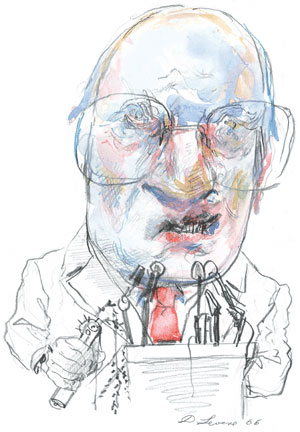
It was in some ways predictable that the central player in the system of willed errors and reversals that is the Bush administration would turn out to be its vice-president, Richard B. Cheney. Here was a man with considerable practice in the reversal of his own errors. He was never a star. No one ever called him a natural. He reached public life with every reason to believe that he would continue to both court failure and overcome it, take the lemons he seemed determined to pick for himself and make the lemonade, then spill it, let someone else clean up. The son of two New Deal Democrats, his father a federal civil servant with the Soil Conservation Service in Casper, Wyoming, he more or less happened into a full scholarship to Yale: his high school girlfriend and later wife, Lynne Vincent, introduced him to her part-time employer, a Yale donor named Thomas Stroock who, he later told Nicholas Lemann, “called Yale and told ’em to take this guy.” The beneficiary of the future Lynne Cheney’s networking lasted three semesters, took a year off before risking a fourth, and was asked to leave.
“He was in with the freshman football players, whose major activity was playing cards and horsing around and talking a lot,” his freshman roommate told the Yale Daily News, not exactly addressing the enigma. “Wasn’t gonna go to college and buckle down” and “I didn’t like the East” are two versions of how Cheney himself failed to address it. As an undergraduate at the University of Wyoming he interned with the Wyoming State Senate, which was, in a state dominated by cattle ranchers and oil producers and Union Pacific management, heavily Republican. This internship appears to have been when Cheney began identifying himself as a Republican. (“You can’t take my vote for granted,” his father would advise him when he first ran for Congress as a Republican.) He graduated from Wyoming in 1965 and, in the custom of the Vietnam years, went on to receive a master’s degree. He never wrote a dissertation (“did all the work for my doctorate except the dissertation,” as if the dissertation were not the point) and so never got the doctorate in political science for which he then enrolled at the University of Wisconsin.
Still, he persevered, or Lynne Cheney did. When, in 1968, at age twenty-seven, a no-longer-draft-eligible “academic” with a wife and a child and no Ph.D. and no clear clamor for his presence, he left Wisconsin for Washington, he managed to meet the already powerful Donald Rumsfeld about a fellowship in his House office. Cheney, by his own description and again failing to address the enigma, “flunked the interview.” He retreated back to the only place at the table, the office of a freshman Republican Wisconsin congressman, Bill Steiger, for whom Cheney was said to be not a first choice and whose enthusiasm for increased environmental and workplace protections did not immediately suggest the Cheney who during his own ten years in Wyoming’s single congressional seat would vote with metronomic regularity against any legislation tending in either direction.
The potential rewards of Washington appear to have mobilized Cheney as those of New Haven and Madison had not. Within the year, he was utilizing Steiger to make another move on Rumsfeld, who had been asked by Richard M. Nixon to join his new administration as director of the Office of Economic Opportunity. Cheney, James Mann wrote in Rise of the Vulcans, noticed a note on Steiger’s desk from Rumsfeld, looking for advice and help in his new OEO job. Cheney spotted an opportunity. Over a weekend, he wrote an unsolicited memo for Steiger on how to staff and run a federal agency.
Rumsfeld hired Cheney, and, over the next few years, as he moved up in the Nixon administration, took Cheney with him. Again, in 1974, after the Nixon resignation, when Rumsfeld was asked to become Gerald Ford’s chief of staff, he made Cheney his deputy.
In Cheney, Rumsfeld had found a right hand who took so little for granted that he would later, by the account of his daughter Mary, make a three-hour drive from Casper to Laramie to have coffee with three voters, two of whom had been in his wedding. In Rumsfeld, who would be described by Henry Kissinger as “a special Washington phenomenon: the skilled full-time politician-bureaucrat in whom ambition, ability, and substance fuse seamlessly,” Cheney had found a model. In the Ford White House, where he and Rumsfeld were known as “the little Praetorians,” Cheney cultivated a control of detail that extended even to questioning the use in the residence of “little dishes of salt with funny little spoons” rather than “regular salt shakers.”
Together, Cheney and Rumsfeld contrived to marginalize Nelson Rockefeller as vice-president and edge him off the 1976 ticket. They convinced Ford that Kissinger was a political liability who should no longer serve as both secretary of state and national security adviser. They managed the replacement of William Colby as CIA chief with George H.W. Bush, a move interpreted by many as a way of rendering Bush unavailable to be Ford’s running mate in 1976. They managed the replacement of James Schlesinger as secretary of defense with Rumsfeld himself. Cheney later described his role in such maneuvers as “the sand in the gears,” the person who, for example, made sure that when Rockefeller was giving a speech the amplifier was turned down. In 1975, when Ford named Rumsfeld secretary of defense, it was Cheney, then thirty-four, who replaced Rumsfeld as chief of staff.
Advertisement
Relationships matter in public life, until they do not. In May, during a commencement address at Louisiana State University, Cheney mentioned this long relationship with Rumsfeld by way of delivering the message that “gratitude, in general, is a good habit to get into”:
I think, for example, of the first time I met my friend and colleague Don Rumsfeld. It was back in the 1960s, when he was a congressman and I was interviewing for a fellowship on Capitol Hill. Congressman Rumsfeld agreed to talk to me, but things didn’t go all that well….
We didn’t click that day, but a few years later it was Don Rumsfeld who noticed my work and offered me a position in the executive branch.
Note the modest elision (“it was Don Rumsfeld who noticed my work”) of the speaker’s own active role in these events. What Cheney wanted to stress that morning in Baton Rouge was not his own dogged tracking of the more glamorous Rumsfeld but the paths one had possibly “not expected to take,” the “unexpected turns,” the “opportunities that come suddenly and change one’s plans overnight.” The exact intention of these commencement remarks may be unknowable (a demonstration of loyalty? a warning? to whom? a marker to be called in later? all of the above?), but it did not seem accidental that they were delivered during a period when one four-star general, one three-star general, and four two-star generals were each issuing calls for Donald Rumsfeld’s resignation as secretary of defense. Nor did it seem accidental that the President and the Vice President were taking equally stubborn and equally inexplicable lines on the matter of Rumsfeld’s and by extension their own grasp on the war in Iraq. “I hear the voices and I read the front page and I know the speculation,” George W. Bush said in response to a reporter’s question during a Rose Garden event. “But I’m the decider and I decide what’s best. And what’s best is for Don Rumsfeld to remain as the secretary of defense.”
The question of where the President gets the notions known to the nation as “I’m the decider” and within the White House as “the unitary executive theory” leads pretty fast to the blackout zone that is the Vice President and his office. It was the Vice President who took the early offensive on the contention that whatever the decider decides to do is by definition legal. “We believe, Jim, that we have all the legal authority we need,” the Vice President told Jim Lehrer on PBS after it was reported that the National Security Agency was conducting warrantless wiretapping in violation of existing statutes. It was the Vice President who pioneered the tactic of not only declaring such apparently illegal activities legal but recasting them as points of pride, commands to enter attack mode, unflinching defenses of the American people by a president whose role as commander in chief authorizes him to go any extra undisclosed mile he chooses to go on their behalf.
“Bottom line is we’ve been very active and very aggressive defending the nation and using the tools at our disposal to do that,” the Vice President advised reporters on a flight to Oman last December. It was the Vice President who maintained that passage of Senator John McCain’s legislation banning inhumane treatment of detainees would cost “thousands of lives.” It was the Vice President’s office, in the person of David S. Addington, that supervised the 2002 “torture memos,” advising the President that the Geneva Conventions need not apply. And, after Admiral Stansfield Turner, director of the CIA between 1977 and 1981, referred to Cheney as “vice president for torture,” it was the Vice President’s office that issued this characteristically nonresponsive statement: “Our country is at war and our government has an obligation to protect the American people from a brutal enemy that has declared war upon us.”
Advertisement
Addington, who emerged into government from Georgetown University and Duke Law School in 1981, the most febrile moment of the Reagan Revolution, is an instructive study in the focus Cheney favors in the protection of territory. As secretary of defense for George H.W. Bush, Cheney made Addington his special assistant and ultimately his general counsel. As vice-president for George W. Bush, Cheney again turned to Addington, and named him, after the indictment of I. Lewis “Scooter” Libby in connection with the exposure of Ambassador Joseph Wilson’s wife as a CIA agent, his chief of staff. “You’re giving away executive power,” Addington has been reported to snap at less committed colleagues. He is said to keep a photograph in his office of Cheney firing a gun. He vets every line of the federal budget to eradicate any wording that might restrain the President. He also authors the “signing statements” now routinely issued to free the President of whatever restrictive intent might have been present in whichever piece of legislation he just signed into law. A typical signing statement, as written by Addington, will refer repeatedly to the “constitutional authority” of “the unitary executive branch,” and will often mention multiple points in a single bill that the President declines to enforce.
Signing statements are not new, but at the time Bill Clinton left office, the device had been used, by the first forty-two presidents combined, fewer than six hundred times. George W. Bush, by contrast, issued more than eight hundred such takebacks during the first six years of his administration. Those who object to this or any other assumption of absolute executive power are reflexively said by those who speak for the Vice President to be “tying the president’s hands,” or “eroding his ability to do his job,” or, more ominously, “aiding those who don’t want him to do his job.”
One aspect common to accounts of White House life is the way in which negative events tend to be interpreted as internal staffing failures, errors on the order of the little dishes of salt with the funny little spoons. Cheney did not take the lesson he might have taken from being in the White House at the time Saigon fell, which was that an administration can be overtaken by events that defeat the ameliorative power of adroit detail management. He took a more narrow lesson, the one that had to do with the inability of a White House to pursue victory if Congress “tied its hands.” “It’s interesting that [Cheney] became a member of Congress,” former congressman Tom Downey said to Todd Purdum, “because I think he always thought we were a massive inconvenience to governing.” Bruce Fein, who served in the Meese Justice Department during the Reagan administration, told Jane Mayer of The New Yorker that Cheney’s absence of enthusiasm for checks and balances long predated any argument that this was a “wartime presidency” and so had special powers.
This preceded 9/11. I’m not saying that warrantless surveillance did. But the idea of reducing Congress to a cipher was already in play. It was Cheney and Addington’s political agenda.
“I have repeatedly seen an erosion of the powers and the ability of the president of the United States to do his job,” the Vice President said after one year in office. “We are weaker today as an institution because of the unwise compromises that have been made over the last thirty to thirty-five years.” “Watergate—a lot of the things around Watergate and Vietnam, both, in the ’70s, served to erode the authority, I think, the President needs to be effective,” he said to reporters accompanying him on that December 2005 flight to Oman. Expanding on this understanding of the separation of powers as a historical misunderstanding, the Vice President offered this:
If you want reference to an obscure text, go look at the minority views that were filed with the Iran-Contra Committee; the Iran-Contra Report in about 1987. Nobody has ever read them, but we—part of the argument in Iran-Contra was whether or not the President had the authority to do what was done in the Reagan years. And those of us in the minority wrote minority views, but they were actually authored by a guy working for me, for my staff, that I think are very good in laying out a robust view of the President’s prerogatives with respect to the conduct of especially foreign policy and national security matters.
There are some recognizable Cheney touches here, resorts to the kind of self-deprecation (as in “I didn’t like the East” and “I flunked the interview”) that derives from a temperamental grandiosity. The “obscure text” that “nobody has ever read” was the two-hundred-page minority report included in the 1987 Report of the Congressional Committees Investigating the Iran-Contra Affair, a volume printed and widely distributed by the US Government Printing Office. The unidentified “guy working for me” was Addington, at the time of the Iran-contra hearings a counsel to the committees but during the events that led to Iran-contra an assistant general counsel at William Casey’s CIA, where he would have been focused early on locating the legal enablement for what Theodore Draper, in his study of Iran-contra, A Very Thin Line, called the “usurpation of power by a small, strategically placed group within the government.”
This minority report, which vehemently rejects not only the conclusions of the majority but even the report’s (“supposedly ‘factual’”) narrative, does allow that “President Reagan and his staff made mistakes” during the course of Iran-contra. Yet the broadest mistake, the demented “arms for hostages” part of the scheme, the part where we deal the HAWK missiles to Iran through Manucher Ghorbanifar and Robert McFarlane flies to Tehran with the cake and the Bible and the falsified Irish passports, is strenuously defended as a “strategic opening,” an attempt to “establish a new US relationship with Iran, thus strengthening the US strategic posture throughout the Persian Gulf region.”
We had heard before, and have heard recently, about “strategic openings,” “new relationships” that will reorder the Middle East. “Extremists in the region would have to rethink their strategy of Jihad,” Cheney told the Veterans of Foreign Wars in August 2002 about the benefits that were to accrue from invading Iraq. “Moderates throughout the region would take heart. And our ability to advance the Israeli-Palestinian peace process would be enhanced, just as it was following the liberation of Kuwait in 1991.” We had heard before, and have heard recently, that what might appear to be an administration run amok is actually an administration holding fast on constitutional principle.
Watergate, Cheney has long maintained, was not a criminal conspiracy but the result of a power struggle between the legislative and executive branches. So was the 1973 War Powers Act, which restricted executive authority to go to war without consulting Congress and which Cheney believed unconstitutional. So was the attempt to get Cheney to say which energy executives attended the 2001 meetings of his energy task force. This issue, both Cheney and Bush explained again and again, had nothing to do with Enron or the other energy players who might be expecting a seat at the table in return for their generous funding (just under $50 million) of the 2000 Republican campaign. “The issue that was involved there,” Cheney said, misrepresenting what had been requested, which was not the content of the conversations but merely the names of those present, “was simply the question of whether or not a Vice President can sit down and talk with citizens and gain from them their best advice and counsel on how we might deal with a particular issue.”
The 1987 minority report prefigures much else that has happened since. There is the acknowledgment of “mistakes” that turn out to be not exactly the mistakes we might have expected. The “mistake” in this administration’s planning for the Iraq war, for example, derived not from having failed to do any planning but from arriving “too fast” in Baghdad, thereby losing the time, this scenario seemed to suggest, during which we had meant to think up a plan. Similarly, the “mistakes” in Iran-contra, as construed by the minority report, had followed not from having done the illegal but from having allowed the illegal to become illegal in the first place. As laid out by the minority, a principal “mistake” made by the Reagan administration in Iran-contra was in allowing President Reagan to sign rather than veto the 1984 Boland II Amendment forbidding aid to contra forces: no Boland II, no illegality. A second “mistake,” to the same point, was Reagan’s “less-than-robust defense of his office’s constitutional powers, a mistake he repeated when he acceded too readily and too completely to waive executive privilege for our Committees’ investigation.”
The very survival of the executive species, then, was seen by Cheney and his people as dependent on its brute ability to claim absolute power and resist all attempts to share it. Given this imperative, the steps to our current situation had a leaden inevitability: if the executive branch needed a war to justify its claim to absolute power, then Iraq, Rumsfeld would be remembered to have said on September 12, 2001, had the targets. If the executive branch needed a story point to sell its war, then the Vice President would resurrect the aluminum tubes that not even the US Department of Energy believed to be meant for a centrifuge: “It’s now public that, in fact, [Saddam] has been seeking to acquire…the kinds of tubes that are necessary to build a centrifuge.” The Vice President would dismiss Joseph Wilson’s report that he had found no yellowcake in Niger: “Did his wife send him on a junket?”
As for the weapons themselves, the Vice President would deride the collective judgment of his own intelligence community, which believed, according to Paul R. Pillar, then the CIA national intelligence officer for the Near East and South Asia, that any development of a nuclear weapon was several years away and would be best dealt with—given that the community’s own analysis of the war option projected violent conflict between Sunnis and Shiites and guerrilla attacks on any occupying power—“through an aggressive inspections program to supplement the sanctions already in place.” “Intelligence,” the Vice President would say dismissively in an August 2002 speech to the Veterans of Foreign Wars, “is an uncertain business.” The Vice President would override as irrelevant the facts that Hans Blix and his UN monitoring team were prepared to resume such inspections and in fact did resume them, conducting seven hundred inspections of five hundred sites, finding nothing but stopping only when the war intervened. “Simply stated, there is no doubt that Saddam Hussein now has weapons of mass destruction,” he would declare in the same speech to the Veterans of Foreign Wars.
A person would be right to question any suggestion that we should just get inspectors back into Iraq, and then our worries will be over…. A return of inspectors would provide no assurance whatsoever of [Saddam’s] compliance with UN resolutions.
If the case for war lacked a link between September 11 and Iraq, the Vice President would repeatedly cite the meeting that neither American nor Czech intelligence believed had taken place between Mohamed Atta and Iraqi intelligence in Prague: “It’s been pretty well confirmed that [Atta] did go to Prague and he did meet with a senior official of the Iraqi intelligence service in Czechoslovakia last April, several months before the attacks,” he would say on NBC in December 2001. “We discovered…the allegation that one of the lead hijackers, Mohamed Atta, had, in fact, met with Iraqi intelligence in Prague,” he would say on NBC in March 2002. “We have reporting that places [Atta] in Prague with a senior Iraqi intelligence officer a few months before the attacks on the World Trade Center,” he would say on NBC in September 2002. “The senator has got his facts wrong,” he would then say while debating Senator John Edwards during the 2004 campaign. “I have not suggested there’s a connection between Iraq and 9/11.”
This was not a slip of memory in the heat of debate. This was dishonest, a repeated misrepresentation, in the interests of claiming power, so bald and so systematic that the only instinctive response (Did too!) was that of the schoolyard. By June 2004, before the debate with Edwards, Cheney had in fact begun edging away from the Prague story, not exactly disclaiming it but characterizing it as still unproven, as in, on a Cincinnati TV station, “That’s true. We do not have proof that there was such a connection.” It would be two years later, March 2006, before he found it prudent to issue a less equivocal, although still shifty, version. “We had one report early on from another intelligence service that suggested that the lead hijacker, Mohamed Atta, had met with Iraqi intelligence officials in Prague, Czechoslovakia,” he told Tony Snow on Fox News. “And that reporting waxed and waned where the degree of confidence in it, and so forth, has been pretty well knocked down at this stage, that that meeting ever took place. So we’ve never made the case, or argued the case, that somehow [Saddam Hussein] was directly involved in 9/11. That evidence has never been forthcoming.”
What the Vice President was doing with the intelligence he received has since been characterized as “cherry-picking,” a phrase suggesting that he selectively used only the more useful of equally valid pieces of intelligence. This fails to reflect the situation. The White House had been told by the CIA that no meeting in Prague between Mohamed Atta and Iraqi intelligence had ever occurred. The International Atomic Energy Agency and the US Department of Energy had said that the aluminum tubes in question “were not directly suitable” for uranium enrichment. The White House had been told by the CIA that the British report about Saddam Hussein attempting to buy yellowcake in Nigeria was doubtful.
“The British government has learned that Saddam Hussein recently sought significant quantities of uranium from Africa,” the President nonetheless declared in his 2003 State of the Union address, the “sixteen enormously overblown words” for which Condoleezza Rice would blame the CIA and for which George Tenet, outplayed, would take the hit. Nor would the President stop there: “Our intelligence sources tell us that he has attempted to purchase high-strength aluminum tubes suitable for nuclear weapons production.”
What the Vice President was doing, then, was not cherry-picking the intelligence but rejecting it, replacing it with whatever self-interested rumor better advanced his narrative line. “Cheney’s office claimed to have sources,” Ron Suskind was told by those to whom he spoke for The One Percent Doctrine.
And Rumsfeld’s, too. They kept throwing them [at the CIA]. The same information, five different ways. They’d omit that a key piece had been discounted, that the source had recanted. Sorry, our mistake. Then it would reappear, again, in a memo the next week.
The Vice President would not then or later tolerate any suggestion that the story he was building might rest on cooked evidence. In a single speech at the American Enterprise Institute in November 2005 he used the following adjectives to describe those members of Congress who had raised such a question: “corrupt,” “shameless,” “dishonest,” “reprehensible,” “irresponsible,” “insidious,” and “utterly false.” “It’s not about our analysis, or finding a preponderance of evidence,” he is reported by Suskind to have said in the November 2001 briefing during which he articulated the doctrine that if there was “a one percent chance” of truth in any suspicion or allegation, it must be considered true. “It’s about our response.”
To what end the story was being cooked was hard to know. The Vice President is frequently described as “ideological,” or “strongly conservative,” but little in his history suggests the intellectual commitment implicit in either. He made common cause through the run-up to Iraq with the neoconservative ideologues who had burrowed into think tanks during the Clinton years and resurfaced in 2001 in the departments of State and Defense and the White House itself, but the alliance appeared even then to be more strategic than felt. The fact that Paul Wolfowitz and Richard Perle and Elliott Abrams shared with Cheney a wish to go to war in Iraq could create, in its confluence with September 11, what many came to call a perfect storm—as if it had blown up out of the blue beyond reach of human intervention—but the perfect storm did not make Cheney a neocon.
He identifies himself as a conservative, both political and cultural. He presents himself as can-do, rock-solid even if he is forced to live in Washington (you know he only does it on our behalf), one politician who can be trusted not to stray far from whatever unexamined views were current in the intermountain West during the 1950s and 1960s. He has described a 1969 return visit to the University of Wisconsin, during which he took Bill Steiger and George H.W. Bush to an SDS rally, as having triggered his disgust with the Vietnam protest movement. “We were the only guys in the hall wearing suits that night,” he told Nicholas Lemann. As a congressman he cast votes that reflected the interests of an energy-driven state that has voted Republican in every presidential election but one since 1952. His votes in the House during 1988, the last year he served there, gave him an American Conservative Union rating of 100.
Yet his move to push Nelson Rockefeller off Gerald Ford’s 1976 ticket had seemed based less on philosophical differences than on a perception of Rockefeller as in the way, in the lights, a star, like Kissinger, who threatened the power Cheney and Rumsfeld wielded in the Ford White House. In 1976, unlike most who called themselves conservatives, Cheney remained untempted by Reagan and clung to Ford, his best ticket to ride. Nor did he initially back Reagan in 1980. Nor, when it has not been in his interest to do so, has he since taken consistent positions on what would seem to be his own most hardened policies.
“I think it is a false dichotomy to be told that we have to choose between ‘commercial’ interests and other interests that the United States might have in a particular country or region around the world,” he said at the Cato Institute in 1998, during the period he was CEO of Halliburton, after he had pursued one war against Iraq and before he would pursue the second. He was arguing against the imposition by the United States of unilateral economic sanctions on such countries as Libya and Iran, two countries, although he did not mention this, in which Halliburton subsidiaries had been doing business. Nor did he mention, when he said in the same speech that he thought multilateral sanctions “appropriate” in the case of Iraq, that Iraq was a third country in which a Halliburton subsidiary would by the year’s end be doing business.
The notion that he takes a consistent view of America’s role in the world nonetheless remains general. The model on which he has preferred to operate is the cold war, or, to use the words in which he and the President have repeatedly described the central enterprise of their own administration, the “different kind of war,” the war in which “our goal will not be achieved overnight.” He has mentioned H. Bradford Westerfield, a political scientist at Yale and at the time Cheney took his introductory course a self-described hawk, as someone who influenced his thinking, but Westerfield later told the Nation correspondent John Nichols that his own hard line had softened by late 1967 or early 1968, when he came to see that Vietnam “really was unwinnable” and “the hawkish view was unrealistic.”
Cheney, by then positioning himself in Washington, never drew those conclusions, nor, when he saw Westerfield in the 1990s at a memorial service for Les Aspin, did he seem to Westerfield interested in discussing them. “He seems to be determined to go his own way, no matter what facts he is confronted with,” Westerfield told Nichols. “As a veteran of the political wars,” Henry Kissinger later wrote about the years when Saigon was falling and Donald Rumsfeld and Richard Cheney were running the Ford White House,
Rumsfeld understood far better than I that Watergate and Vietnam were likely to evoke a conservative backlash and that what looked like a liberal tide after the election of the McGovernite Congress in fact marked the radical apogee.
Rumsfeld and Cheney, in other words, had transcended what others might present as facts. They could feel the current. They knew how to catch the wave and ride it.
Cheney leaves no paper trail. He has not always felt the necessity to discuss what he plans to say in public with the usual offices, including that of the President. Nor, we learned from Ron Suskind, has he always felt the necessity, say if the Saudis send information to the President in preparation for a meeting, to bother sending that information on to Bush. Only on the evening of September 11, 2001, did it occur to Richard A. Clarke that in his role as national security coordinator he had briefed Cheney on terrorism and also Condoleezza Rice and Colin Powell, but never the President. Since November 1, 2001, under this administration’s Executive Order 13233, which limits access to all presidential and vice-presidential papers, Cheney has been the first vice-president in American history entitled to executive privilege, a claim to co-presidency reinforced in March 2003 by Executive Order 13292, giving him the same power to classify information as the president has.
He runs an office so disinclined to communicate that it routinely refuses to disclose who works there, even for updates to the Federal Directory, which lists names and contact addresses for government officials. “We just don’t give out that kind of information,” an aide told one reporter. “It’s just not something we talk about.” When he visits his house in Jackson Hole and the local paper spots his plane and the anti-missile battery that accompanies him, the office until recently refused to confirm his presence: “In the past, they’ve been kind of weird,” the paper’s co-editor told The Washington Post in August. “They’d say, ‘His airplane’s here and the missile base is here, but we can’t tell you if he’s here.’”
His every instinct is to withhold information, hide, let surrogates speak for him, as he did after the quail-shooting accident on the Armstrong ranch. His own official spoken remarks so defy syntactical analysis as to suggest that his only intention in speaking is to further obscure what he thinks. Possibly the most well-remembered statement he ever made (after “Big-time”) was that he did not serve in the Vietnam War because he had “other priorities.” Bob Woodward, in Plan of Attack, describes an exchange that took place between Cheney and Colin Powell in September 2002, when Cheney was determined that the US not ask the UN for the resolution against Iraq that the Security Council, after much effort by Powell, passed in November:
Powell attempted to summarize the consequences of unilateral action…. He added a new dimension, saying that the international reaction would be so negative that he would have to close American embassies around the world if we went to war alone.
That is not the issue, Cheney said. Saddam and the clear threat is the issue.
Maybe it would not turn out as the vice president thinks, Powell said. War could trigger all kinds of unanticipated and unintended consequences….
Not the issue, Cheney said.
In other words the Vice President had by then passed that point at which going to war was “not about our analysis.” He had passed that point at which going to war was not about “finding a preponderance of evidence.” At the point he had reached by September 2002, going to war was not even about the consequences. Not the issue, he had said. The personality that springs to mind is that of the ninth-grade bully in the junior high lunchroom, the one sprawled in the letter jacket so the seventh-graders must step over his feet. There was in a June letter from Senator Arlen Specter to Cheney, made public by Specter, an image that eerily conveyed just that: “I was surprised, to say the least, that you sought to influence, really determine, the action of the Committee without calling me first, or at least calling me at some point,” Specter wrote, referring to actions Cheney had taken to block his Judiciary Committee from conducting a hearing on NSA surveillance. “This was especially perplexing since we both attended the Republican Senators caucus lunch yesterday and I walked directly in front of you on at least two occasions enroute from the buffet to my table.”
There was a reason, beyond the thrill of their sheer arrogance, why the words “other priorities” stuck in the national memory. They were first uttered not in but outside the room in which Cheney’s 1989 confirmation hearings were held, to a Washington Post reporter who asked why the candidate for secretary of defense had sought the five (four student and one “hardship”) deferments that had prevented him from serving in Vietnam. This is what the candidate said:
I had other priorities in the ’60s than military service. I don’t regret the decisions I made. I complied fully with all the requirements of the statutes, registered with the draft when I turned 18. Had I been drafted, I would have been happy to serve. I think those who did in fact serve deserve to be honored for their service…. Was it a noble cause? Yes, indeed, I think it was.
The words stuck because they resonated, and still do. They resonated the same way the words “fixed himself a cocktail back at the house” resonated when Katharine Armstrong, Cheney’s hostess and fill-in (in the vacuum of his silence) apologist, used them to explain what he had done after the quail-hunting accident in lieu of either going to the hospital with Harry Whittington or explaining to the sheriff’s office how he had just shot him. “Fixed himself a cocktail back at the house” suggested the indifference to assuming responsibility for his own mistakes that had become so noticeable in his public career. “Ultimately, I am the guy who pulled the trigger and fired the round that hit Harry,” he managed, four days later, to say to Fox News in a memorable performance of a man accepting responsibility but not quite. “You can talk about all the other conditions that existed at the time, but that’s the bottom line. It’s not Harry’s fault. You can’t blame anybody else.”
Like “it’s not Harry’s fault,” which implied that you or I or any other fair observer (for example Katharine Armstrong, characterized by Cheney as “an acknowledged expert in all of this”) might well conclude that it had been, “other priorities” suggested a familiar character wrinkle, in this case the same willingness to cloud an actual issue with circular arguments (“I complied fully with all the requirements of the statutes”) that would later be demonstrated by the Vice President’s people when they maintained that the Geneva Conventions need not apply to Afghan detainees because Afghanistan was a “failed state.” What these tortured and in many cases invented legalities are designed to preclude is any acknowledgment that the issue at hand, whether it is avoiding military service or authorizing torture, might have a moral or an ethical or even a self-interested dimension that merits discussion.
This latter dimension, self-interest, which was the basis for John McCain’s argument that we could not expect others to honor the Geneva Conventions if we did not do so ourselves, was dismissed by David Addington, at the time Cheney’s legal architect, in the “new paradigm” memo he drafted in 2002 to go to the President over White House Counsel Alberto R. Gonzales’s signature. “It should be noted that your policy of providing humane treatment to enemy detainees gives us the credibility to insist on like treatment for our soldiers,” the memo read, sliding past a key point, which was that the “new paradigm” differentiated between “enemy detainees” and “illegal enemy combatants,” or “terrorists,” a distinction to be determined by whoever did the detaining.
Moreover, even if GPW [Geneva Convention III Relative to the Treatment of Prisoners of War] is not applicable, we can still bring war crimes charges against anyone who mistreats US personnel. Finally, I note that…terrorists will not follow GPW rules in any event.
This is not law. This is casuistry, the detritus of another perfect storm, the one that occurred when the deferments of the Vietnam years met the ardor of the Reagan Revolution.
About this matter of priorities. At an October 2005 meeting at Stanford University of the American Academy of Arts and Sciences, the historian David M. Kennedy expressed concern about the absence of political accountability in a nation where
no American is now obligated to military service, few will ever serve in uniform, even fewer will actually taste battle—and fewer still of those who do serve will have ever sat in the classrooms of an elite university like Stanford…. Americans with no risk whatsoever of exposure to military service have, in effect, hired some of the least advantaged of their fellow countrymen to do some of their most dangerous business while the majority goes on with their own affairs unbloodied and undistracted.
Early in 1995, his tenure as George H.W. Bush’s secretary of defense timed out, Dick Cheney was raising money for a stalled 1996 presidential run when he was asked, legendarily out of the blue on a fly-fishing trip but in fact unsurprisingly for someone with government connections in both energy and defense, to become CEO of Halliburton. In the early summer of 2000, flying home with his daughter Mary from a hunting trip, Cheney, then five years into his job at Halliburton, a period for which he had collected $44 million (plus deferments and stock options) and during which the Halliburton subsidiary Brown & Root had billed the United States $2 billion for services in Bosnia and Kosovo, told Mary that Joe Allbaugh, the national campaign manager of Bush’s 2000 campaign, had asked him to consider being Bush’s running mate. In July 2000, after conducting a search for another candidate and detailing the reasons why he himself would be a bad choice (“Knowing my dad, I’m sure he didn’t hold anything back as he laid out the disadvantages of selecting him as the nominee”), in other words assuring himself carte blanche, Cheney agreed to join the ticket.
In February 2001, Joe Allbaugh, whose previous experience was running the governor’s office for Bush in Texas, became head of FEMA, where he hired Michael D. (“Brownie, you’re doing a heckuva job”) Brown. In December 2002, Allbaugh announced that he was resigning from FEMA, leaving Brown in charge while he himself founded New Bridge Strategies, LLC, “a unique company,” according to its Web site, “that was created specifically with the aim of assisting clients to evaluate and take advantage of business opportunities in the Middle East following the conclusion of the US-led war in Iraq.”
This was the US-led war in Iraq that had not then yet begun. When David Kennedy spoke at Stanford about the vacuum in political accountability that could result from waging a war while a majority of Americans went on “with their own affairs unbloodied and undistracted,” he was talking only about the absence of a draft. He was not talking about the ultimate step, the temptation to wage the war itself to further private ends, or “business opportunities,” or other priorities. Nor was he talking about the intermediate step, which was to replace the manpower no longer available by draft by contracting out “logistical” support to the private sector, in other words by privatizing the waging of the war. This step, now so well known as to be a plot point on Law and Order (civilian contract employees in Iraq fall out among themselves; a death ensues; Sam Waterston sorts it out), had already been taken. There are now, split among more than 150 private firms, thousands of such contracts outstanding. Halliburton alone had by July 2004 contracts worth $11,431,000,000.
Private firms in Iraq have done more than build bases and bridges and prisons. They have done more than handle meals and laundry and transportation. They train Iraqi forces. They manage security. They interrogate prisoners. Contract interrogators from two firms, CACI International (according to its Web site “a world leader in providing timely solutions to the intelligence community”) and Titan (“a leading provider of comprehensive information and communications products, solutions, and services for National Security”), were accused of abuses at Abu Ghraib, where almost half of all interrogators and analysts were CACI employees. They operate free of oversight. They distance the process of interrogation from the citizens in whose name, or in whose “defense,” or to ensure whose “security,” the interrogation is being conducted. They offer “timely solutions.”
In his 1991 book A Very Thin Line, Theodore Draper wrote:
The Iran-contra affairs amounted to more than good plans gone wrong or even bad plans gone wildly wrong. They were symptomatic of a far deeper disorder in the American body politic. They were made possible by an interpretation of the Constitution which Poindexter and North thought gave them a license to carry on their secret operations in the name of the president, in defiance of the law and without the knowledge of any other branch of government…. Somehow the highly dubious theory of a presidential monopoly of foreign policy had filtered down to them and given them a license to act as if they could substitute themselves for the entire government.
There remains a further reason why “other priorities” still nags. It suggests other agendas, undisclosed strategies. We had watched this White House effect the regulatory changes that would systematically dismantle consumer and workplace and environmental protections. We had watched this White House run up the deficits that ensured that the conservative dream of rolling back government will necessarily take place, because there will be no money left to pay for it. We had heard the Vice President speak as recently as January 2004 about our need to recolonize the world, build bases, “warm bases, bases we can fall in on, on a crisis and have present the capabilities we need to operate from.” “Other priorities” suggests what the Vice President might have meant when he and the President talked about the “different kind of war,” the war in which “our goal will not be achieved overnight.” As a member of the House during the cold war and then as secretary of defense during the Gulf War and then as CEO of Halliburton, the Vice President had seen up close the way in which a war in which “our goal will not be achieved overnight” could facilitate the flow of assets from the government to the private sector and back to whoever in Washington greases the valves. “The first person to greet our soldiers as they arrive in the Balkans and the last one to wave goodbye is one of our employees,” as he put it during his Halliburton period.
He had also seen up close the political advantage to which such a war could be put. “And so if there’s a backlash pending I think the backlash is going to be against those who are suggesting somehow that we shouldn’t take these steps in order to protect the country,” as he put it when asked last December if his assumption of presidential autonomy might not provoke a congressional backlash. In the apparently higher interest of consolidating that political advantage he had made misrepresentations that facilitated a war that promised to further destabilize the Middle East. He had compromised both America’s image in the world and its image of itself. In 1991, explaining why he agreed with George H.W. Bush’s decision not to take the Gulf War to Baghdad, Cheney had acknowledged the probability that any such invasion would be followed by civil war in Iraq:
Once you’ve got Baghdad, it’s not clear what you do with it. It’s not clear what kind of government you would put in…. Is it going to be a Shia regime, a Sunni regime or a Kurdish regime? Or one that tilts toward the Baathists, or one that tilts toward the Islamic fundamentalists?… How long does the United States military have to stay to protect the people that sign on for that government, and what happens to it once we leave?
By January 2006, when the prescience of these questions was evident and polling showed that 47 percent of Iraqis approved of “attacks on US-led forces,” and the administration was still calculating that it could silence domestic doubt by accusing the doubter of wanting to “cut and run,” the Vice President assured Fox News that the course had been true. “When we look back on this ten years hence,” he said, a time frame suggesting that he was once again leaving the cleanup to someone else, “we will have fundamentally changed the course of history in that part of the world, and that will be an enormous advantage for the United States and for all of those countries that live in the region.”
—September 7, 2006
This Issue
October 5, 2006
This Issue
October 5, 2006
