Nineteen children preceded him into a world that he could never quite take seriously but that hurt and tormented him all the same. The great writer of nonsense poetry Edward Lear, born in 1812, was the twentieth of twenty-one children. The Lear household was prosperous, despite its slew of dependents. It was located in Highgate, in those days a charming rural village not yet swallowed up by London. Edward’s father was a stockbroker. His mother, it seems safe to say, had her hands full with the children.
Too full, it appears. The father’s business collapsed in 1816, and the family lacked the means, financial and psychological, to hold itself intact. In time, Edward was effectively turned over to his eldest sister, Ann, twenty-one years older than he. In his later years, Edward spoke reverently of her: “Ever all she was to me was good, & what I should have been unless she had been my mother I dare not think.”
Lear’s childhood was beset by two further tribulations. The first was physical: epilepsy, which arrived when he was about five. He called it “the Demon” in his journals, and it was a lifelong affliction. Lear was an unforthcoming man, much of whose inner life can only be guessed at, but to judge by how zealously he guarded his secret (even close friends were unaware of his condition), and by his tendency to blame his attacks on a failure of willpower, his illness was probably his life’s defining burden.
The second difficulty was psychological: bouts of what we would likely call depression and what he referred to—with seemingly self-defensive offhandedness—as “the Morbids.” At the age of sixty-four, reminiscing in his diary, he wrote:
The earliest of all the morbidnesses I can recollect must have been somewhere about 1819—when my father took me to a field near Highgate, where was a rural performance of gymnastic clowns &c.,—& a band. The music was good,—at least it attracted me:—& the sunset & twilight I remember as if yesterday. And I can recollect crying half the night after all the small gaiety broke up—& also suffering for days at the memory of the past scene.
All his life, Lear had a heightened sense of the perishability of pleasure and joy. Or you might say that, from a very young age, happiness made him sad.
Even so, Lear possessed considerable inner resources. Although he forever regretted his lack of formal artistic training, he was a precociously gifted draftsman. He began making an artist’s pick-up living at about the age of fifteen—selling illustrations to shops, offering drawing lessons. A few years later, after sketching and studying at the Gardens of the London Zoological Society, he produced the first two folios of Illustrations of the family of Psittacidae, or Parrots. This was a milestone in English ornithology—the first book devoted to a single family of birds, and the first drawn chiefly from live rather than stuffed models—and an amazing accomplishment for a teenager.
He had as well a gift for eliciting help from those well suited to help him: he secured influential patrons throughout his life. This knack seems to have been a result less of studied ingratiation than of freshness and likability of spirit. Lear’s work at the zoo led to an acquaintance with the society’s president, Lord Stanley, heir to the Earl of Derby, who invited the young man to his estate, Knowsley, to draw the animals of his private menagerie. Lear was soon told he would be ” one of us—and not dine with the servants.” He got along with everyone at Knowsley, but was especially popular in the nursery, where he entertained the children with songs and nonsense poems and drawings; he was preparing for a future he could hardly yet envision.
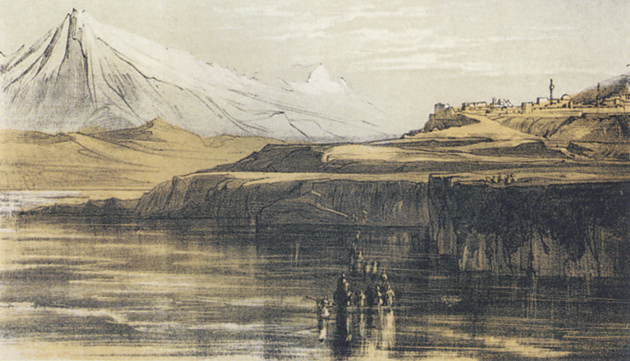
Lear also had great vigor and a robust willingness to overlook bodily discomfort—a combination that served him well in adult life, when he supported himself largely as a travel writer and landscape artist. He shifted from natural history illustration to landscapes while still in his twenties, and still in England; he lived most of his adult life abroad, chiefly in Italy, from which he undertook long and arduous artistic pilgrimages (what he called a “stopping, prying, lingering mode of travel”). A handsome example of this line of work was recently reissued as Edward Lear in Albania: Journals of a Landscape Painter in the Balkans.1
These journals present a useful reminder that while Lear is best known today for his poetry, his creative energies were mainly devoted to the visual arts. His poetry came easily; it is difficult to imagine him tortured over the resolution to a limerick. But the business of being a landscape artist, particularly of his venturesome sort, meant real work, and Edward Lear in Albania is a cheerful catalog of trials and woes: frightful weather, inedible food, dangerous diseases, precarious mountain trails. There were delays and forced detours, language barriers, and constant fretting that the goods he was transporting for future use—sketches for landscape paintings—were fragile and irreplaceable.
Advertisement
Moments arise in Edward Lear in Albania when he plainly questions the whole enterprise. Couldn’t he contrive a sedentary and comfortable existence in England—some snug studio from which to produce a remunerative stream of work? And yet—one of Lear’s most likable traits—he was forever coming upon some remote sight that struck him as unparalleled and not to be missed. His letters and travel journals abound in words like “most” and “greatest” and “deepest.” Over the decades Lear the landscapist moved through a shifting terrain of superlatives. Here he is in his twenties on a first trip to Italy: “As for scenery— it was quite beyond anything I had seen..” And in Athens in his thirties: “Poor old scrubby Rome sinks into nothing by the side of such beautiful magnificence.” And in Egypt in his forties: “I think the sunset last night was the most astonishingly beautiful I ever saw.” And in Malta in his fifties: “No words can describe its magnificence.” And in India in his sixties: “O new palms! O flowers! O creatures! O beasts! Anything more overpoweringly amazing cannot be conceived!”
Edward Lear in Albania left me pondering a hypothetical reader: If someone stumbled onto this book without knowing of Lear’s reputation as an enduring, if minor, English poet, would he or she have any inkling of Lear’s literary stature? What exactly connects Lear the painter and Lear the poet?
The book imparts almost no sense of Lear’s reading, the literary spirits he might have been seeking to commune or contend with during his travels. Most of the few literary references are to Byron, only because he happened to precede Lear to Albania by a couple of decades. Sentence by sentence, the book gives scant indication of a poet’s sensibility, for Lear was a slapdash prose stylist. Edward Lear in Albania often seeks to portray panoramic landscapes through words, a challenge that typically elicited from Lear sweeping and obvious adjectives: “noble,” “majestic,” “sublime.” He was especially fond of “picturesque,” which at one point appears three times in a single paragraph.
The book’s reproductions of Lear’s watercolors show a stickler’s taste for precision not always found in his prose. And yet within them—as in so many of his drawings, watercolors, and oil paintings of foreign landscapes—there’s a hard-to-place air of unreality in which a nonsense writer might feel at home. His trees tend to writhe with some just faintly human perturbation; his perhaps slightly elongated mountains lunge with their own mineral longings. It is as though what is to be exalted must first become enchanted.
Yet the journal-keeping landscape painter and the nonsense poet seem most closely allied in moments of unease or jarring incongruity, often involving sleepless nights:
I lie, barricaded by boxes and bundles from the vicinity of the stable, and enduring with patience the fierce attacks of numberless fleas. All the [inn] sleeps, save two cats, which indulge in festive bouncings, and save a sleepless donkey, which rolls too contiguously to my head.
Or:
In the middle of the night, the roof of Seid Efféndi’s house being slight, a restless stork put one of his legs through the crevice and could not extricate it; whereon ensued much kicking and screams, and at the summons came half the storks in Thessaly, and all night long the uproar was portentous. Four very wet jackdaws also came down the chimney and hopped over me and about the room till dawn.
Either scene might plausibly find its way into nonsense verse. And at one juncture the landscape painter and the nonsense writer felt indissolubly fused: “At length we reached Draghiádhes, the houses of which were by no means pretty, being one and all like the figures of ‘H was a House,’ in a child’s spelling-book.”
For the most part, painter and poet seem like complementary rather than coextensive aspects of the same person. Lear’s painterly aspirations lay with the conventionally beautiful—the noble, the majestic, the sublime—while as a poet (and as an illustrator of his poems) he aimed for something antic and oddly angled. This division may reflect less a schism of personality than a savvy personal recognition of where his respective talents lay. Lear had the modest wisdom to see he was no Tennyson.
And yet he revered his friend Tennyson—that exemplar of the noble, majestic, sublime—who once wrote a tribute to Lear, “To E.L., on his Travels in Greece” (“I read and felt that I was there”). For more than three decades Lear toiled on a collection of illustrations to Tennyson’s poems. The project never saw completion (although a lovely selection, Edward Lear’s Tennyson, edited by Ruth Pitman, commemorated in 1988 the centenary of Lear’s death2), and yet it remains a harmonic ideal: a zone where the painter’s most high-minded images would pair with words equally lofty and fine.
Advertisement
Vivien Noakes, the preeminent living Lear scholar, provides an introduction to Edward Lear in Albania. She also has produced a graceful biography, Edward Lear: The Life of a Wanderer, and—more significant still—she edited The Complete Verse and Other Nonsense, which incorporated previously unpublished material. The latter volume, which includes an introduction, a table of dates, and extensive notes and indices, for the first time assembles a satisfactory single-volume portrait of Lear’s range and achievement.
Lear broke sharply with his literary forebears. He was not one for the grand scale—beside light verse masters like Pope and Dryden, his work looks trifling and odd—and he lacked the flow and facility of contemporaries like W.M. Praed and C.S. Calverley, who turned out vers de societé of lacerating finesse. And yet Lear’s poems, especially when set beside their jittery and forceful accompanying drawings, seem modern in a way that those of his predecessors and contemporaries often do not. He prefigures cartoonist-wordsmiths like James Thurber, Walt Kelly (the creator of “Pogo”), Edward Gorey, and Richard Wilbur, who similarly has illustrated his own nonsense poems.
Lear is often thought of, inaccurately, as the inventor of the limerick. Actually, he popularized an existing form rooted in the oral tradition—itself a variant of ballad meter—and he never used the term “limerick” to describe the more than two hundred such poems he compiled over the years.
In all its silliness and deliberate inconsequentiality, the limerick discourages serious literary analysis. Yet it’s a highly interesting structure, anomalous for both its heavy reliance on trisyllabic (anapestic) feet and its brevity. (Syllabically, it runs less than a third the length of its only rival as the most popular short form in English poetry, the sonnet.) It is clearly the most adaptable and pandemic of all English poetic forms: you’re hardly surprised to see it appear in a newspaper or a high school yearbook, at an academic celebratory dinner or as a wedding toast, as an advertising jingle or on a men’s room wall.
Bathroom graffiti have been largely supplanted, I suspect, by the Internet, which likewise provides a forum for the broadcasting of private observation to a wide and unforeseeable future audience. But wherever it surfaces, the limerick’s ties to ribaldry remain undiminished. It is our only poetic form that immediately raises the possibility, no matter how respectable-sounding its opening line, that bawdiness will soon lift its unruly head. (One of W.H. Auden’s wonderful “dirty” limericks ever-so-respectably begins: “The Bishop elect of Hong Kong….”3 )
Lear’s poetry, it must be noted, scrupulously avoids any hint of the lubricious. His limericks tend to follow a constrained course. He usually repeats his first line as his last, often with minor variations:
There was a Young Lady of Norway,
Who casually sat in a doorway;
When the door squeezed her flat,
She exclaimed, “What of that?”
This courageous Young Lady of Norway.
In the typical Lear limerick, the first line grounds us: we are planted somewhere upon the earth, however far-flung our outpost (“There was a Young Lady of Corsica” or “There was an Old Man of Cape Horn” or “There was an Old Person of Philae”). The second line catapults us into the air, into the ether of pure nonsense, often through some unorthodox activity or physiological deformation (“Whose head was infested with beads” or “Who painted his face with red ochre” or “Who had an immoderate mouth” or “Who shut his wife up in a box”). The succeeding couplet enhances or resolves the peculiarity (“Till he once, by mistake,/Was mixed up in a cake,” “When he said, ‘I will scratch it’/They gave him a hatchet”). And the concluding line, returning to the opening, settles us back in the workaday world (“That expensive Young Lady of Corsica,” “That dolorous Man of Cape Horn”).
Few devotees of the limerick have adopted Lear’s practice of repeating the first line as the last. The argument against doing so seems persuasive: When a poet has a mere five lines, why sacrifice one to repetition? Certainly, Lear’s limericks often disappoint at the close. Just when you’re looking for some projection into further nonsense, a flight beyond all reach of terrestrial gravity, you come bumping back down to earth:
There was an Old Man in a barge,
Whose nose was exceedingly large;
But in fishing by night,
It supported a light,
Which helped that Old Man in a barge.
And yet there are moments when the repeated line, often modified by a single telling adjective, effectively confirms a desired monotony or oppressiveness:
There was an Old Man in a Marsh,
Whose manners were futile and harsh;
He sate on a log,
And sang songs to a frog,
That instructive Old Man in a Marsh.
The gently ironic “instructive”—how dreary the muddy little scene is!—makes all the difference.4
Limericks preponderate in The Complete Verse and Other Nonsense, but anthologists often prefer Lear’s somewhat longer poems, of which the three most famous are probably “The Jumblies,” “The Courtship of the Yonghy-Bonghy-Bò,” and “The Owl and the Pussy-cat.” Although these can be found in The Complete Verse, keener pleasure is to be had when encountering them in the twin set recently published by University of Chicago Press, Nonsense Botany and Nonsense Alphabets and Nonsense Songs and Stories, which reprints volumes from the 1880s. In restoring a feeling for scale, a jointed rightness of typeface and margin and drawing, the two books work to create a world at once fitting and weird.
I must confess I’ve never cared whether the Jumblies—those madcap little sailors who went to sea in a sieve—lived or drowned, but “The Yonghy-Bonghy-Bò” and “The Owl and the Pussy-cat” strike me as lovely and original and touching. Both poems—perhaps not coincidentally—are about marriage, a subject over which Lear, a lifelong bachelor, brooded endlessly. The cartoonish little man known as the Yonghy-Bonghy-Bò, who lives “in the middle of the woods” and who in Lear’s illustration has a spherical head far bigger than his body, makes a wedding proposal to his beloved, Lady Jingly Jones. The offer is not ill-judged but ill-timed:
Lady Jingly answered sadly,
And her tears began to flow,—
“Your proposal comes too late,
Mr Yonghy-Bonghy-Bò!
I would be your wife most gladly!”
(Here she twirled her fingers madly,)
“But in England I’ve a mate!”
One’s delight in the poem lies partly in the fair Lady Jingly’s being genuinely heartbroken at the loss of her little egg-headed man, partly in the poignant realization that even in kingdoms of pure enchantment, where Bong-trees flourish and men ride on turtles’ backs across the sea, love can still go hopelessly astray.
Lear’s most famous poem, “The Owl and the Pussy-cat,” presents another visibly mismatched romance. Amid serenades and starlight, Owl falls in love with Pussy-cat, and Pussy-cat with Owl, and again marriage is proposed. But this time, after they have sailed away for a year and a day, once more to a land of Bong-trees, the marriage actually takes place, gloriously celebrated with feast and moonlit dance. Lear’s readers have at last beached up in a Peaceable Kingdom, where natural enemies like lion and lamb—or bird and cat—consort as soulmates.
Noakes sees Lear as essentially homosexual in temperament. There is much murkiness here, both psychological (Noakes: “As it was, Lear probably only partly realized his homosexuality, though in the deeper layers of his mind there was conflict as he fought to suppress it”) and documentary (many of Lear’s personal papers were destroyed after his death). While Noakes’s surmise makes intuitive sense, I wish she had spent more time analyzing the tenacious grip that marriage held on Lear’s imagination. He kept sensing the potential for personal salvation in an institution that heretofore had brought him little but pain (“Every marriage of people I care about rather seems to leave me on the bleak shore alone”).
Over the decades it became an idée fixe: he hoped to settle down with a younger wife and find respite from his painful bouts of loneliness and melancholy. The satisfactions derived from his own work, whether literary or painterly, were plainly insufficient. He noted ruefully that a beautiful painting might delight “hundreds of others for a century or more,” although its creator had found little pleasure in its exacting creation—“a very unfair division of happiness.”
His romantic longings eventually focused on an old friend’s daughter, Augusta (“Gussie”) Bethell, who was twenty-four. Lear was fifty. He did not act. Three years later, we find Lear in his diary contemplating a proposal: “If her life is sad,—united to mine would it be less so? Or rather—would it not be more so?” The next year, as he explored the island of Corfu (“So bright & glorious is all I now see & feel, it seems to overpay any outlay of pain—time—money! Can I give no idea of this Paradise island to others? Would Gussie like to live here?”), she walked in fantasy by his side.
He soon returned to England and visited Gussie. He was in quite a determined state: “This—the last dream—to burst in a bubble or flourish into reality—is indeed a strange matter.” Yet the matter neither burst nor flourished. Instead, Lear left England in a state of psychological suspension, and the dream continued to ramify. He returned, newly resolute, a year later (another diary entry: “I do not say that I am decided to take this leap in the dark, but I say that I am nearer to doing so than I ever was before”), but felt his hopes dashed by a conversation with Gussie’s sister: ” it broke up a dream rudely & sadly.”
Yet the broken dream again reconstituted itself. Lear was in his early sixties when he learned that Gussie was to marry an elderly invalid. Once again he felt that a dream had been shattered: “There is now no hope of any but a dark & lonely life.”
And still his tale of unconsummation strung itself out. In the spring of 1883, when Lear was in his early seventies, Gussie visited him in Italy. Her husband had died a few months before. “What will happen now, who can tell?” he wondered. She departed after a brief stay, no declarations ever vouchsafed, and Lear wrote: “Had her husband died 10 years ago, I might even then have hoped to have a good woman to nurse me to the last….” Or in the words of Lady Jingly: “Your proposal comes too late.”
Timid by nature anyway, Lear was doubtless further balked by his secret epilepsy; he could hardly marry Gussie without a full medical confession. He obliquely recorded his epileptic attacks with little crosses in his diary—much as some more freewheeling spirit might tally sexual liaisons. (Poor Lear’s secret assignations were with the Demon.)
The allure of improbable romance may account for Lear’s frequent comments on female beauty as he wandered through Albania. Many of the women were veiled Muslims, and their cloaked inaccessibility to the eye seems only to have enhanced their charms. Albania was for him a dizzyingly foreign land—unfamiliar in religion, architecture, landscape, customs, language—where foreign thoughts might naturally arise. Young girls kept catching his eye.
And in another foreign land—the land of the limerick—Lear entertained a similar preoccupation, as the index to first lines in The Complete Verse and Other Nonsense reveals. He wrote 118 limericks that began “There was an Old Man” and twenty-eight beginning “There was a Young Lady”—as opposed to six that began “There was an Old Lady” and none beginning “There was a Young Man” or “There was a Young Boy.”
And why shouldn’t it happen: Why might an odd old man not marry an appealing young lady? Stranger things had happened—in his poetry, anyway. But oh, how many obstacles the days presented! Lear’s limericks are a chronicle of things going awry: unexpected interruptions and interventions, illnesses and household accidents, invasions of unforeseen animals…. The path was clear—but cluttered. What kept getting in the way? Life. Or else call it nonsense.
This Issue
November 5, 2009

This Issue
November 5, 2009
-
1
In addition, a beautiful catalog of his early landscape drawings, Edward Lear the Landscape Artist: Tours of Ireland and the English Lakes, 1835 & 1836, has just appeared in England through the Wordsworth Trust. ↩
-
2
Carcanet. ↩
-
3
> The Bishop elect of Hong Kong ↩
-
4
Given the form’s constriction, it’s hardly surprising that some of the most effective limericks take narrowness and confinement as their subject: ↩

