
We don’t have a history of the Holocaust that is set in the Eastern European lands where the victims died, and that describes the interactions of the German invaders, the Jewish inhabitants, and the peoples among whom the Jews lived. Why not? The vast literature on the Holocaust based on German sources, though it represents perhaps the most impressive historical research of recent decades, seldom draws from Eastern European languages. Eastern European historians, for their part, have traditionally avoided a topic that transcends national history and challenges national myths of innocence. In Historians of the Jews and the Holocaust, the NYU historian David Engel suggests a surprising addition to this list of limitations: historians of Jewish life, scholars comfortable with the longue durée of Jewish history and with Hebrew and Yiddish, have sequestered Jewish societies and institutions from the Holocaust. Over decades, says Engel, they have built a “wall separating study of the Holocaust from study of all other aspects of the Jewish past.”
In much of Eastern Europe for much of the half-millennium before the Holocaust, Jews had managed, in various ways and to various degrees, to oversee their own religious and communal affairs. Because the Jewish institutions of the Nazi era—the Jewish councils and the Jewish police forces—drew from pre-war elites, they looked uncomfortably like a continuation of Jewish tradition. Because these institutions aided the Germans in the ghetto roundups and deportations that preceded the mass shootings and gassings of the Holocaust, the Eastern European Jewish tradition could seem like a dead end. After the Holocaust and the establishment of the State of Israel, Engel maintains, scholars found it difficult to integrate the mass killing of the Jews into a history of Jewish life.
For some Israelis the Jewish councils and police forces were a perversion of an essentially sound tradition that had preserved Jewish life for centuries despite the difficulties of diaspora, for others a confirmation that diaspora life was itself a perversion. The issue brought so much unease in Israel, Engel suggests, that Israeli scholars preferred to avoid open international scholarly discussion of it. Contrary to what outsiders might suppose, “Zionist historiography has hardly placed the Holocaust at the center of its agenda.”1
These sensitivities were heightened, Engel argues, by the appearance of the first systematic study of the Holocaust. In 1961 a little-known young American scholar, Raul Hilberg, published The Destruction of the European Jews, now in a third edition and still the basic guide to the institutions that brought about the expropriation and murder of German and European Jews. In some brief passages on the Jewish councils, Hilberg drew damning conclusions about Jewish self-destruction. His chief sources were German reports from the field and documents from German administrative offices in Berlin. These sources described Jewish councils and Jewish policemen collecting valuables, arranging for labor brigades, and urging cooperation in the “selections” that preceded death by bullets or gas. Since Hilberg did not rely upon Jewish memoirs, he did not note the many (if usually futile) attempts by a number of Jewish councils to improve the desperate lot of their people, let alone their widespread (although usually defeated) attempts to conspire against the Germans. Most difficult of all to extract from German sources were the almost ubiquitous efforts to preserve Jewish religious and cultural life, which Yehuda Bauer, a professor at Hebrew University in Jerusalem and academic adviser to Yad Vashem, includes within his notion of Jewish resistance, or amidah.
At the time of its first edition, writes Engel, Hilberg’s pioneering work seemed to confirm the dangers of mixing the history of Jewish life with the history of mass Jewish death. In Israel, the history of the Holocaust was entrusted to a separate state institution, Yad Vashem; in America, historians of Jewish life used methodology as an excuse not to write about the Holocaust. Major scholars such as Steven Zipperstein and Paula Hyman wished to prevent Hitler from shaping the history of earlier centuries of Jewish life.
Engel, who sees modern Jewish history in Europe as of a piece, and believes that it is right to understand the whole with respect to its end, regards the restraint of his colleagues as “little more than a discursive affectation.” He is correct to note the historians’ hesitation, but he is unconvincing in his critique of their historical method. The danger of defining previous Jewish history entirely with respect to the Holocaust is real enough among scholars, university students, and the general public. The resistance of historians to determinism and teleology provides one defensible way (as the works of Hyman and Zipperstein show) to produce lively accounts of the variety of Jewish experience in modern Europe in the centuries before the Holocaust.2
Advertisement
The problem Engel sees arises partly (though not entirely) from the definitions he uses to categorize historians. He criticizes historians of Jewish life for not engaging with the Holocaust. In his account, historians of the Holocaust figure not so much as Jewish historians but as a problem for Jewish historians. But with just a slight shift in perspective, one could see Hilberg as representing a different tradition of Jewish scholarship, that of Jewish historians who rely on German-language primary sources to document the collapse of a German civilization to which they themselves, in some measure, belong.
This tradition continues a major current of modern Jewish intellectual life, that of the Jewish Enlightenment (Haskalah) in its Central European form. Much of the outstanding work by historians published in the United States, from Hilberg’s through Saul Friedländer’s, could be classified in this way. In this light, Friedländer’s latest work, The Years of Extermination: Nazi Germany and the Jews, 1939–1945, a powerful narrative account of German killing policy that draws on Jewish memoirs and evokes the lives of Jewish victims, addresses Engel’s challenge. Because Friedländer uses chiefly German-language sources, however, his portrayal of Jewish life is bound within a familiar but in fact atypical perspective. He makes excellent use of important first-person sources, such as the diaries of Victor Klemperer, whose situation, that of a Jewish husband protected by marriage to a non-Jewish German wife, was all but unthinkable in lands further east. In occupied Poland, where there were also many mixed marriages, Jewish husbands of non-Jewish Polish wives were sent to ghettos, deported to death factories, and gassed. German Jews were a very small proportion of the victims of the Holocaust, some 3 percent. Polish Jews were more than half.
A complete account of Jewish life and death in Europe, and thus the meeting of European and Jewish history, would have to be centered in Poland, where most of the victims of the Holocaust lived and even more of the victims died.3 As Engel mentions, there is also the school of Polish-Jewish positivist historians, concerned chiefly with the collection of sources. Today its best-known member is Emanuel Ringelblum, who organized the archive of the Warsaw ghetto, an invaluable source for scholars working in Polish or Yiddish (the languages of Warsaw Jews). The same tradition also continues in the archival collections of the Jewish Historical Institute in Warsaw, which include thousands of surveys of Holocaust survivors, in Polish and Yiddish, taken right after the war.
Although Engel does not discuss them as such, historians within this Polish-Jewish tradition might also be regarded as scholars of Jewish life who write about the Holocaust. Since the end of communism in Poland in 1989, this empirical approach has been revived by the new Polish Center for Holocaust Studies, and also (though unevenly) by the official Institute for National Remembrance. The Jewish Historical Institute, under new leadership, has published and annotated sources such as the diary of Marek Szapiro, who survived in hiding in Warsaw. Though postwar testimonies are many, actual diaries are very few. Szapiro’s diary—written and published in Polish—is particularly important, since it recounts the daily efforts of a Jew in Warsaw to make sense of the last years of the war, and includes frank discussions of personal relationships with non-Jewish Poles, including rescuers and blackmailers. The most important recent example of this Polish-Jewish positivist tradition is the encyclopedic and now indispensable guide to the Warsaw ghetto by Barbara Engelking and Jacek Leociak, now available in an excellent English-language edition.
The Polish-Jewish positivist school has the vices of its virtues: it transmits valuable Polish (and sometimes Yiddish) sources, but does not take account of the interpretative discussions taking place in German and English. Its very important findings, which include detailed examples of Jewish resistance, are thus usually ignored in the larger debates.4
Perhaps the most appealing feature of Engel’s book is its open-ended conclusion. Although he makes clear his own view—that the Holocaust was an unsurprising end to an increasingly difficult period of Jewish history—he understands that the conclusions of future researchers are impossible to predict. Daniel Jonah Goldhagen, by contrast, in Worse than War, takes the view that we already know all that we need to know about the Holocaust, and indeed about all of the other calamities of the twentieth century.[^ ]:In an earlier work, Hitler’s Willing Executioners,5 Goldhagen sought to explain the Holocaust as an expression of a longstanding and special German “eliminationist anti-Semitism.” One criticism of that book was its limited attention to other anti-Semitic and racist cultural traditions—for example, among Germany’s neighbors—which, were Goldhagen’s thesis true, would also have brought about Holocausts. In his current book, Goldhagen responds to that criticism by replacing “eliminationist anti-Semitism” with “eliminationism,” a state of mind among people who take part in mass murder.
Advertisement
Rather than refining his simple explanation, he merely extends it from the Holocaust to other genocides.6 Mass murder is to be understood as a matter of will: the “decision-making moment,” he maintains, is a “self-sufficient account for why these people perpetrate mass murder and elimination.” Goldhagen asserts that other students of the Holocaust clutter the story with colonial institutions set up by Germany in the countries it occupied during World War II. Rather than consider the political or historical backdrop, we should rely upon our intuitions, upon “what we know about individual and social life in general.” This ostensible knowledge includes the capacity to perceive the “beast within”—within other people, that is, never Goldhagen himself or his readers. National societies, we are to understand, differ in their level of subhumanity: “there is variation of beastliness across cultures and subcultures.”
Goldhagen’s writing has been, as his publisher says, “very popular,” perhaps because it is tempting to distinguish among murderers and the murdered in such a stark way. Goldhagen’s own categories, if rigorously applied, reveal a problem of his approach. For Goldhagen, a “perpetrator” is someone who “knowingly contributes in some tangible way to the deaths or elimination of others, or to injuring others as part of an annihilationist or an eliminationist program.” How would such a definition apply in the case of one of the worst of the Nazi crimes, the mass murder of the Jews of Warsaw in the summer of 1942?
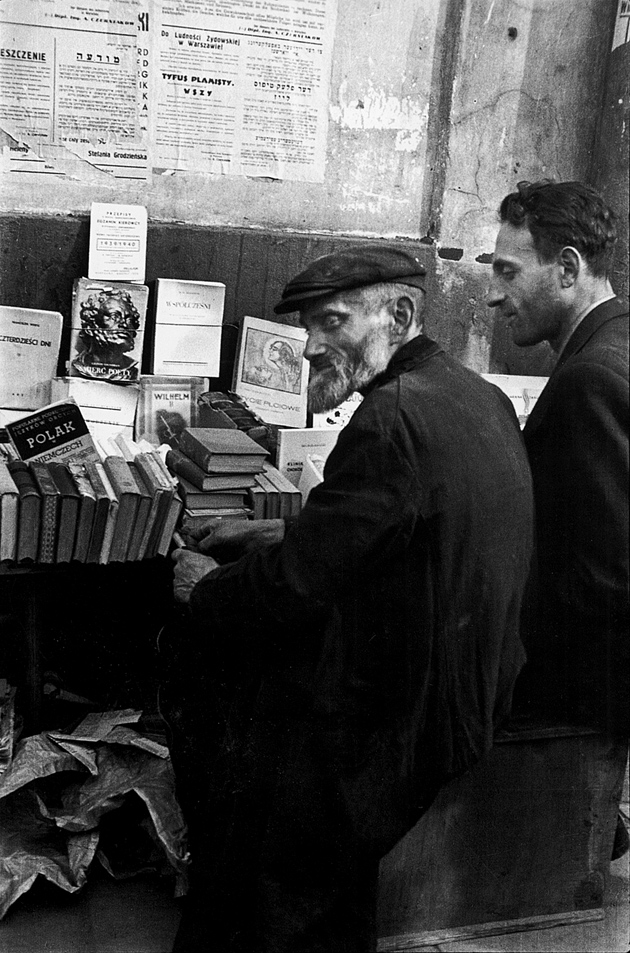
Goldhagen is right that no account can do without the ideologically motivated leaders; he mentions Hitler and Himmler. One might add Odilo Globocnik, the SS leader who was responsible for the liquidation of the ghettos in the German colony known as the General Government, including the extermination of Jews; or his deputy Hermann Höfle, who along with his German SS and police subordinates oversaw deportations from individual ghettos. In Engelking and Leociak’s compendium of the creation and destruction of the Warsaw ghetto, the importance of its two thousand Jewish policemen is also excruciatingly clear. They did most of the work and they knew what was happening; by Goldhagen’s definition, they too were “perpetrators.” As such, the Jewish policemen must have acted, in Goldhagen’s account, according to their anti-Semitic desire to eliminate Jews. This is absurd.
Goldhagen might of course counter that Jewish policemen acted from nonideological motivations, such as the desire to save themselves or their families. But his analysis leaves no room for perpetrators who act according to such calculations. He might wish to argue that Jewish policemen armed with clubs were taking orders from German policemen armed with guns, as was the case. But Goldhagen explicitly and repeatedly denies the importance of coercion to the actions of perpetrators. He seems reluctant to examine the layers of authority that brought Jews to the death factories; he calls the gas chambers “incidental implements” of mass murder. Most historians would reject that formulation.
Goldhagen is of course right that anti-Semitism is indispensable to the explanation of the Holocaust. Where Goldhagen differs from other scholars is his impatience with plural causality, and, in this new book, with historical analysis that might reveal what linked the hatred to the killing. He is wrong to see free will, and only free will, everywhere we find mass killing. The Holocaust as it actually happened involved the participation of many tens of thousands of people who, contrary to Goldhagen, had no “decision-making moment,” had not “freely opted” to participate in the killing, and had taken part in no murderous “conversation about the dehumanized or demonized victims.”
Just as Jewish policemen under German command provided most of the labor for the deportation of Warsaw Jews to Treblinka, captured Soviet soldiers under German command operated that death facility. In Chil Rajchman’s troubling and moving memoir of Treblinka, as in earlier memoirs by others of the handful of Treblinka survivors, these guards and executioners figure as human beings.7 The people operating the death facility in 1942 were survivors of the Germans’ other major policy of mass killing, the deliberate starvation of Soviet prisoners of war. These men, of various national backgrounds, had in common Soviet citizenship and a Soviet education that was anti-racist and anti-anti-Semitic. They had very likely saved their own lives by collaborating. They had been recruited for a task they neither foresaw nor chose, while imprisoned in starvation camps in which about two million Soviet soldiers had died before the gas chambers of Treblinka were in operation. Like the Jewish policemen, they were not free actors realizing their individual wills within “supportive eliminationist milieus.”
How exactly did these Jewish policemen (Polish citizens) and these Treblinka guards (Soviet citizens) come under German power? Goldhagen writes as if Hitler had always controlled most of Europe’s Jews. He claims that the Nazis experimented with various “eliminationist” solutions before deciding the kill the Jews of Europe. It is true that the German leadership, through terror, intimidation, and theft, brought about the emigration of over half of Germany’s Jews. It is also true that Hitler and other leaders considered various deportation schemes that would rid Europe of Jews. But the Nazi regime could not have killed (or in any other way eliminated) the Jews of Europe without war, since in 1939 almost all of Europe’s Jews lived beyond Germany’s borders. In the first six years of Hitler’s rule, before Germany attacked Poland, the regime killed Jews by the hundreds. Between 1939 and 1941, after the invasion of Poland but before the invasion of the Soviet Union, Jews died by the tens of thousands in the ghettos. After the invasion of the Soviet Union, Jews were shot and gassed by the millions.
Though Goldhagen prefers not to mention other scholars by name, he has an epithet for people who wish to complicate his account with factors such as institutions and war: “apologists.” The intellectual authority he prefers is that of the killers themselves. He repeatedly cites the words of murderers, and concludes from what they say of their own motives that his account must be the right one.
The notion that the motivation to kill is the same as the explanation provided by killers defies what we do indeed know of individual and social life. Some people enjoy killing and kill from hatred. But others, probably a far larger number, seek explanations for their extraordinary acts, and find them in the ideology or rhetoric supplied by those who hold power. They repeat the claims of criminal leaders, but we must not confuse their secondhand ideology with a full explanation. Reiterating the reasoning of the killers in the guise of scholarly analysis risks not only naive error but emulation of their thinking.
After noting that the Nazis dehumanized their Jewish (and other) victims, Goldhagen himself associates human beings with beasts: not as a rhetorical flourish, which would be bad enough, but as a category within his major argument. After reminding the reader that the Nazis defined their Jewish victims as bearers of disease, he himself applies the very category he finds in Nazi rhetoric (“pathology”) to the perpetrators—and to “Political Islamists,” such as Mahmoud Ahmadinejad, who he believes will become perpetrators in the future. Goldhagen’s emphasis on will, propaganda, and subhumanity recalls the 1930s; his book is less an analysis of the age of mass killing than its angry product. As Yehuda Bauer points out, “our moral problem” with the Holocaust “is not that the perpetrators were inhuman but that they were human, just like ourselves, and that we human beings are prone to the kind of murderousness they evinced.”
After decades as a leading scholar of the Holocaust, Bauer has turned his attention in The Death of the Shtetl to its epicenter: the belt of territory between the Baltic and the Black Seas, occupied first by the Soviet Union from September 1939 as a result of the Molotov-Ribbentrop pact between Moscow and Berlin, and then by Germany from June 1941 after the Nazis betrayed their Soviet allies. It was here, in eastern Poland, northeastern Romania, and the Baltic States, that the Holocaust began, and here that more than a quarter of its victims died. In eastern Poland, the largest part of this zone, traditional Orthodox Jewish small towns, or shtetlach, were commonplace until World War II. Jews lived here among Poles, Ukrainians, Belarusians, Germans, and others. Bauer investigates the painful question of Jewish actions during the war by studying a handful of selected shtetlach in what was once eastern Poland and is now western Ukraine and western Belarus.
In eastern Poland, occupied by Soviets and then Germans, the issue of Jewish historical responsibility is even more complex than Engel proposes. Here, the Red Army and the NKVD preceded the Wehrmacht and the SS as occupiers. Before the Germans summoned the Jewish councils into existence, the Soviets had recruited some Jews into their local administration. Bauer writes that certain Jewish members of pre-war Communist parties “became prominent in the transition to Soviet rule” after the Red Army invaded eastern Poland in 1939. In the new Soviet economy installed in these lands, “Jews came to occupy a Soviet version of their traditional economic position as a middle class.” Although many Jews suffered under the Soviet regime, notes Bauer, it was “popular among the young generation of Jews.” Just as the participation of Jewish local elites in the Jewish councils under the Nazis seemed to later scholars to contaminate the history of traditional Jewish communal life, the participation of young Jews in the Soviet regime seemed to corrupt the (also traditional) left-wing Jewish revolt against the authority of prosperous leaders of the Jewish communities. Although the most important Jewish political party in interwar Poland was the religiously Orthodox Agudas Israel, which sought a political accommodation with the Polish authorities, it was challenged on the left by the socialist Bund, various Labor Zionist parties, and the Communist Party (which in eastern Polish towns and cities was heavily Jewish in its membership before the war).
For Hilberg, the tragedy of Jewish history was that Jewish traditions of accommodation precluded resistance to the Germans. For Bauer, by contrast, the tragedy of Jewish society in eastern Poland is that it proved so vulnerable to Soviet coercion and Communist ideology in 1939. Bauer’s concern with the integrity of Jewish life perhaps leads him to overstate the significance of Jewish collaboration with Communists. Ukrainians and Belarusians took part in the Soviet administration as well, as did some Poles. Local Jews, though some occupied visible functions as Soviet militiamen and local administrators, were absent from the higher reaches of Soviet administration, which was dominated by Ukrainians, Belarusians, and Russians from further east in the USSR.
Yet when the Germans conquered these lands in the summer of 1941, at the very beginning of their invasion of the Soviet Union, German Einsatzgruppen revealed that the NKVD had murdered thousands of prisoners, and Nazi propaganda blamed the Jews as such for the NKVD executions—which continued until the very moment the Germans arrived. Through emotional, exaggerated, and simplified accounts of these crimes, the Germans sought to inspire local non-Jewish populations to kill Jews.
Goldhagen inverts the Nazi propaganda: rather than all Jews being murderous Communists, all non-Jews are murderous anti-Semites. Thus the “local peoples,” says Goldhagen, “as a matter of antisemitic hallucination, conceived of the Jews collectively as Bolsheviks.” Most Jews had nothing to do with the Soviet regime, but the association was not a delusion: it was an unfair stereotype, sometimes (according to Bauer’s evidence) based on experience, always endorsed by the propaganda of those who now held undisputed power.
Goldhagen himself indulges in exaggeration when he claims that the “local peoples” killed the Jews, thereby “sparing the Germans from doing the job themselves.” The pogroms by Lithuanians, Ukrainians, Poles, and others in the summer of 1941 killed some 20,000 people, a horrible total—but less than 2 percent of the final number of victims of the Holocaust in these lands. The Germans, disappointed by what they saw as the failure of “self-cleansing,” carried out their next million killings that year by firing squad and gas van. When they did seek assistance, it was usually from released prisoners of war and local policemen under their direct command rather than from anti-Semites acting from emotion. A subtle but grave error here is Goldhagen’s use of the general term “peoples,” especially since the vast majority of local people took no direct part in the killing of Jews.
Because the focus of Bauer’s microhistorical study is so fine, he notices features of the double occupation that make simple explanations of these pogroms harder to sustain. Bauer is the latest of a series of historians, working in different fields, to realize that double occupation means double collaboration. This does not mean that some people collaborated with the Soviets and then other people collaborated with the Germans. It means that many individuals, from all groups, took some part in the institutions of both the Soviet and the German occupier. As Bauer notes, some of the non-Jews who joined the auxiliary police under the Germans had served in the red militias under the Soviets. These local collaborators were important to both Soviet and German policies, first the one, and then the other: but it is hard to square their actions with any prior ideological commitments. Indeed, in some cases people took part in German anti- Semitic policies to distance themselves, in the eyes of their new masters, from their own previous involvement in the Soviet administration.8
Bauer regards agreement by Jews to serve in the Jewish Councils in 1941 as the reconstitution, in terrible and unprecedented circumstances, of Jewish communal life. Under his close observation, many clichés collapse. Hilberg’s image of a German killing machine is complemented in Bauer’s portrait of the dying shtetlach by the portrayal of many individual Jews seeking to preserve elements of Jewish life in an essentially hopeless situation.
Bauer finds that in general the Jews chose their own leaders, who often tried to protect Jewish interests. They usually failed, and were replaced by others chosen by the Germans. In almost every ghetto Jews organized resistance in one form or another: often this was the moral affirmation of Jewish life that Bauer includes in amidah. Goldhagen’s generalized image of hateful local people also dissolves. Bauer believes (though he does not show) that most non-Jews approved of the Holocaust. Nevertheless, his very fine chapter on “neighbors” reveals the improbable courage some Christians showed in saving Jews. This does not change the general picture of German slaughter and local indifference or hostility to Jews, but it does restore humanity to the millions of people Goldhagen tends to reduce to collective stereotypes. By the end, Bauer has supplied a partial solution to David Engel’s problem. In the Jewish communities he discusses, he has united the history of Jews in the European Jewish homeland with the history of the Holocaust.
Bauer’s success is limited chiefly by a problem of sources, one that oddly echoes the criticism of Hilberg that is so important to Engel’s account. Hilberg once drew inappropriately categorical conclusions about Jewish life on the basis of German sources. Now Bauer describes the life of Poles (and others) on the basis of Jewish sources. His closing words about Poles recall Hilberg’s severe conclusions about Jews: Polish society, says Bauer, “imploded under the weight of its own corruption, economic failure, and uselessness.” As Bauer knows, the Polish state collapsed because its leaders chose, as the first Europeans to do so, to resist Hitler. Although some Poles behaved lamentably during the war, Polish underground society was quite developed, and Polish underground resistance formidable. Had Bauer investigated the very same region using Polish-language sources, he would not have been able to claim, as he does, that amidah—standing up against danger—is an exclusively Jewish phenomenon. Poles, and others too, practiced various kinds of active defense of their national life, including armed uprisings. Bauer does not see Polish amidah because it is not prominent in the Jewish sources he uses—much as Hilberg did not see Jewish amidah in the German sources he used.9
Bauer’s account of Jewish life can thus be read as a summons to a new method, one that might recall both the dignity of the shtetl and the historical integrity of the region. The major homeland of the Jewish people cannot be recalled without its languages. When Hannah Arendt was asked what was left after the murderous self-destruction of Germany, she famously answered: “Es bleibt die Muttersprache“—the German mother tongue remains. What does not remain, after the Holocaust, is the multilingual Europe that produced scholars fully capable of understanding not only Hebrew and Yiddish but also German, Polish, Ukrainian, Belarusian, and Russian. Research in German sources can recover much of the institutional history of the Holocaust, as Hilberg showed so impressively long ago; and the restoration of Jewish life using Hebrew and German testimonial sources, as Bauer and Friedländer (respectively) demonstrate, can balance his approach by recreating Jewish life in Germany and in the small Jewish towns of the East. The renaissance of Jewish history in Poland, as exemplified by Engelking and Leociak, adds a third element: their research in Polish sources permits a reconstruction of the most important center of Jewish life and Jewish death, the city of Warsaw.
Mutual recognition among the prac titioners of these approaches would be a step forward. But the fundamental task is to understand German policies, and Jewish ways of life, in the Eastern European lands where they met, on the basis of primary sources in the relevant languages. They remain, in abundance, many of them scarcely used. “I know that they died,” writes Bauer of the Jews of his shtetlach. “I want to know how they lived.” Jews lived among others, and their lives, not just their deaths, are incomprehensible without the lives, and sometimes also the deaths, of their non-Jewish neighbors. For that matter, Polish, Ukrainian, and Belarusian were also Jewish mother tongues, and not so very long ago.
This Issue
September 30, 2010
This Issue
September 30, 2010
-
1
Engel means that prominent Zionist historians preferred to avoid the subject. He does not mean that no Israeli historians wrote about these difficult issues. ↩
-
2
For example, Zipperstein’s The Jews of Odessa: A Cultural History, 1794–1881 (Stanford University Press, 1986) and Hyman’s The Emancipation of the Jews of Alsace: Acculturation and Tradition in the Nineteenth Century (Yale University Press, 1991). In his later work Zipperstein is more willing to countenance the “backshadowing” of the Holocaust onto earlier events than Engel credits: see his Imagining Russian Jewry: Memory, History, Identity (University of Washington Press, 1999). ↩
-
3
Jews from beyond Poland, most of them from Hungary, were deported to Auschwitz and gassed. Smaller numbers of European Jews were deported to other death factories in occupied Poland and gassed. ↩
-
4
See my “[Jews, Poles & Nazis: The Terrible History](/articles/archives/2010/jun/24/jews-poles-nazis-terrible-history/),” The New York Review, June 24, 2010, and “[Nazis, Soviets, Poles, Jews](/articles/archives/2009/dec/03/nazis-soviets-poles-jews/),” The New York Review, December 3, 2009. ↩
-
5
Knopf, 1996. ↩
-
6
Goldhagen’s analysis fares worse in the Soviet and Chinese Communist cases than it does with the German. In the Communist cases, the threat and application of terror to perpetrators was routine. ↩
-
7
Goldhagen claims that Germans were too consistent in their racism to rape Jewish women. Rajchman’s memoir is among a considerable number of sources that indicate otherwise. ↩
-
8
The idea of such individual self-cleansing was advanced by Jan T. Gross in Neighbors: The Destruction of the Jewish Community in Jedwabne, Poland (Princeton University Press, 2001). For examples of double collaboration in recent scholarship, see Anton Weiss-Wendt, Murder Without Hatred: Estonians and the Holocaust (Syracuse University Press, 2009), pp. 115–119, and Alexander Brakel, Unter Rotem Stern und Hakenkreuz: Baranowicze 1939 bis 1944 (Paderborn: Schöningh, 2009), p. 304. ↩
-
9
In the Yiddish oyfshtand and the Polish powstanie, as in the Hebrew amidah, the notion of “standing up” is equated with resistance and the dignity it endows. ↩