
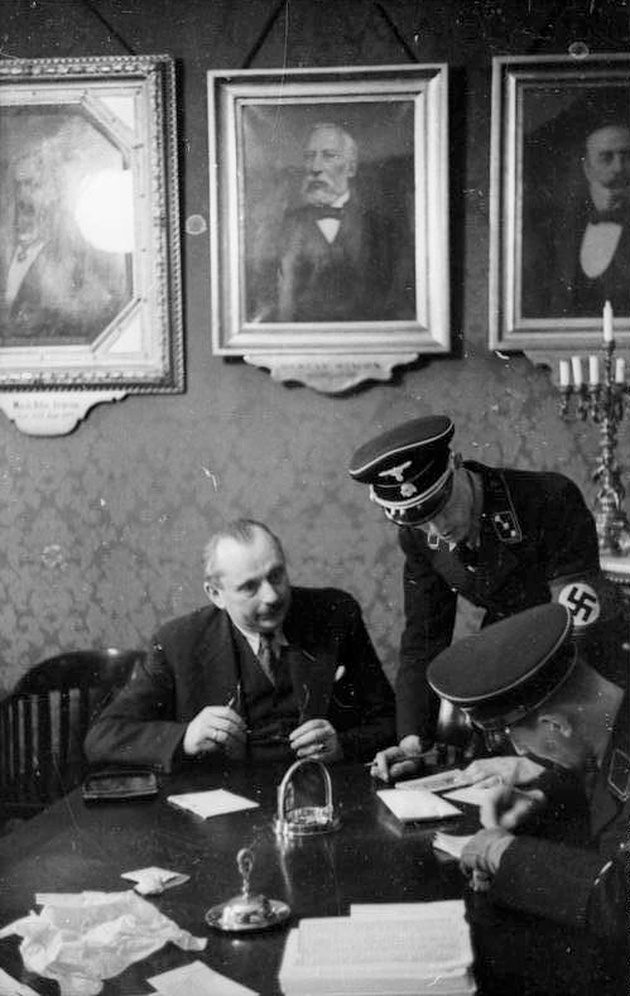
How to assess—historically and morally—the actions of Jewish leaders and other functionaries who negotiated with or were appointed by the Nazis during the Holocaust has been one of the most contentious and enduring controversies of Holocaust historiography. The embittered and accusatory early testimonies of many survivors, the honor courts of the immediate postwar period in which Jewish collaborators were tried and censured, and the libel trial and assassination in Israel of Rudolph Kasztner—who negotiated with the Nazis to rescue Jews in Hungary—constituted only the first chapters of the fierce debate over this sensitive and painful topic.
The heat of the debate peaked in the early 1960s with Hannah Arendt’s coverage of the trial of Adolf Eichmann, first in a series of articles in The New Yorker and then in her book Eichmann in Jerusalem: A Report on the Banality of Evil. Arendt criticized Israeli Prime Minister David Ben-Gurion for hijacking the trial for the purposes of national and international politics at the expense of individual justice, and insofar as the trial had been designed for didactic purposes she particularly lamented its failure to educate the wider public about the “darkest chapter” of the Holocaust, namely the “role of the Jewish leaders in the destruction of their own people.” In perhaps the single most infamous sentence in her provocative book, she wrote: “The whole truth was that if the Jewish people had really been unorganized and leaderless, there would have been chaos and plenty of misery but the total number of victims would hardly have been between four and a half and six million people,” and she then endorsed the calculation that “about half of them could have saved themselves if they had not followed the instructions of the Jewish Councils.”1
As a target of vituperation, Arendt was immediately paired with Raul Hilberg, whose initially little-known The Destruction of the European Jews had been published in 1961. In a book focused on the Nazi “machinery of destruction,” Hilberg had argued that it was nevertheless “essential to analyze the role of the Jews in their own destruction.” Through centuries of exclusion and persecution, diaspora Jews had learned the survival value of what Hilberg called the “alleviation-compliance response,” which proved not only ineffective but insidiously self-destructive when faced with the unprecedented Nazi assault, for which no past experience could prepare them.2 In the heat of the moment, one key difference between Arendt and Hilberg was entirely ignored. For Arendt, the behavior of the Jewish leaders, who allegedly “enjoyed” the “enormous power” with which the Nazis temporarily vested them, constituted a colossal moral failure. For Hilberg, it was a systemic and perceptual failure of a leadership that sought to save its people but, “caught in the straitjacket of their own history,” could not understand and adjust to the incomprehensible assault quickly enough.
If polemics dominated the 1960s, careful scholarship eventually gained the upper hand. The example for this had already been set by Philip Friedman, the survivor and pioneering Holocaust historian of the 1950s, with his brilliant articles on the “messianic complex” of the two most notorious Jewish leaders, Moshe Merin of East Upper Silesia and Chaim Rumkowski of Łódź—flawed men who under the extremity of the situation lost their bearings and came to believe that they alone (if unquestioningly obeyed) could ensure saving a remnant of their people. Both presided with an iron hand over the destruction of their communities and then perished in Auschwitz. But they were exceptions at one extreme end of a broad spectrum of Jewish response, as extensively documented by Isaiah Trunk in his classic work Judenrat: The Jewish Councils in Eastern Europe Under Nazi Occupation (1972), whose primary conclusion was that there could be no empirically grounded, sweeping accusations and generalizations like those that had dominated the 1960s polemics.
The translation and publication of a number of pivotal documents then gave both students and the general public access to key primary sources. The first of these was the English edition of The Warsaw Diary of Adam Czerniakow (1979), edited and introduced by Hilberg and his colleague Stanislaw Staron. Czerniakow was a poignant figure who struggled in impossible circumstances until he took his own life rather than obey the German demand to deport Jewish children—a fate that made it increasingly impossible to place the debate over Jewish leadership in an accusatory rather than tragic frame.
Hilberg’s second edition of The Destruction of the European Jews (1985), with much softened language, also sought to capture the tragic paradox of the Jewish Councils; they “were assisting the Germans with their good qualities as well as their bad, and the very best accomplishments of the Jewish bureaucracy were ultimately appropriated by the Germans for the all-consuming destruction process.”3 Two sources on the Łódź ghetto, Lucjan Dobroszycki’s magisterial edition of The Chronicle of the Łódź Ghetto, 1941–1944 (1984) and the anthology of Alan Adelson and Robert Lapides, Łódź Ghetto: Inside a Community under Siege (1989), composed of a vast selection of relevant documents and diary excerpts, illuminated not only the fateful self-delusion and megalomania of Rumkowski (the contrast of his heart-breaking and horrific speech saying “fathers and mothers, give me your children” with Czerniakow’s suicide in the face of similar German demands is both stark and inescapable), but also the impossible circumstances in which all ghetto internees—including both critical diarists and eloquent chroniclers on Rumkowski’s payroll—struggled for survival.
Advertisement
A vocabulary essential to grasp both the historical and moral complexities of the response of Jewish leaders and functionaries was provided by two nonhistorians: the incomparable Primo Levi and the insightful literary scholar Lawrence Langer. In The Drowned and the Saved, Levi warned against the “simplification” of reducing the “network of human relations” in the camps to “two blocs of victims and perpetrators.” In discussing Rumskowski, Levi explicitly placed the ghettos alongside the camps in this regard. “An infernal system such as National Socialism” does not sanctify its enemies, he argued; “on the contrary, it degrades them, it makes them resemble itself” through creating a “gray zone” inhabited by “the hybrid-class of prisoner-functionary” where “the two camps of masters and servants both diverge and converge” and “ambiguity” reigns. The “gray zone” is part of the system that sustains “regimes based on terror and obsequiousness.”4 Alongside Levi’s “gray zone,” Lawrence Langer introduced the indispensable notion of “choiceless choices” to capture another infernal aspect of Nazi rule, in which the absolute asymmetry of power meant that the Germans could insidiously and consciously design situations in which Jewish leaders never had the choice between good and bad or even lesser and greater evil, but only between catastrophically disastrous alternatives.
With the collapse of communism and the opening of the East European archives, the focus of Holocaust research moved eastward, to regions where the murder of the Jews has been characterized as the “Holocaust by bullets,” and where the actions by Jewish leadership in ghetto administration and deportation were much less central in implementing the Final Solution. The Nazis had no need to script a role for Jewish leadership at places like Babi Yar. Insofar as Hannah Arendt remained a subject of controversy, it involved continuing debates over the perpetrators (especially if and in what way they were “banal” or “ordinary”) on the one hand and the Eichmann trial (and her analysis of both defendant and trial) on the other, not Jewish leaders.
With the appearance of Doron Rabinovici’s Eichmann’s Jews: The Jewish Administration of Holocaust Vienna, 1938–1945, however, we are confronted with an intentionally provocative title that—in view both of Arendt’s association with Eichmann and her accusations against Jewish leadership—inevitably implies revisiting the 1960s debate. The question is whether the book is as accusatory as the provocative title, Eichmann’s Jews, seems at first sight. Or, as in the case of Bryan Rigg’s book on Germans of partial Jewish ancestry serving in the Wehrmacht but misleadingly entitled Hitler’s Jewish Soldiers, are we dealing with a title whose main purpose is to grab the browser’s attention rather than summarize the book’s argument? In fact Rabinovici’s book is a defense of rather than an accusation against the Vienna Jewish community leaders. As the original German title, Instanzen der Ohnmacht, or “authorities without power,” was far more appropriate for the book’s content, one must suspect that crass commercial calculations of the English-language publisher led to a misleading title that serves neither author nor reader well.
The book begins with a telling prologue in which we encounter two Jews, Wilhelm Reisz and Oscar Reich, who were tried and convicted after the war for zealous collaboration. The former, sentenced to fifteen years, immediately hanged himself; the latter was executed. Both men, under real and imminent threat of death, had survived by making themselves useful to the Nazis and doing terrible things to other Jews. But in comparison their Nazi superiors—those with real decision-making power and not subject to lethal coercion—received much lighter sentences. The courts in question, Rabinovici notes, simply could not grasp how “victims” became “involved in the crime under coercion” and “threat of death,” and thus found their behavior more “reprehensible and disgraceful” than that of the Nazis who were the ones truly responsible.
Rabinovici in effect forewarns the reader not to repeat the same mistake: “The study of the attitudes of Jewish victims under the destructive regime is always in danger of turning into a complacently moralizing reproach, shifting the blame for the crimes to the victims.” The behavior of “those Jewish officials and assistants whose relations with the perpetrators were held against them” should not be “simply condemned universally.” Rather the “reasons” and “motives” behind their behavior should be studied on an individual basis. Above all, he insists, “a clear distinction must always be made between perpetrators and victims, between the power of authority…and the powerless.”
Advertisement
The argument of the first half of the book is fairly straightforward. In March 1938 the Nazis descended upon Vienna and, spearheaded by the thirty-two-year-old Adolf Eichmann, restructured the Jewish community organization (Israelitische Kultusgemeinde or IKG) to facilitate expelling the Jews of Austria. Jewish authorities who could have left but stayed to serve their community were transformed from elected representatives into Nazi appointees and charged with accelerating Jewish expulsion, especially through finding ways to fund those Jews without the means to emigrate, while the Austrian Jews were simultaneously being systematically plundered and impoverished. It was the primary task of the IKG to square the circle of competing Nazi policies, to keep all Jewish property but rid themselves of all Jews. By July 1939, some 104,000 of Austria’s 180,000 Jews had left the country, though 55,000 of them went to other European countries where they would fall once again under Nazi control after the outbreak of war.
In one regard the outbreak of the war was not a complete caesura, since Jewish emigration from the Third Reich—however increasingly constricted the possible avenues of departure—was permitted until the fall of 1941. Thus an additional 24,000 Austrian Jews left the country. However, alongside facilitating Jewish emigration, the IKG became simultaneously entrapped in an ominous new development, namely deporting Jews to Poland. Two transports of Viennese Jews were sent to a short-lived, experimental “Jewish reservation” at Nisko in the Lublin district in the fall of 1939, and five transports to various small Polish towns in February and March 1941. In both cases the deportees were plunged into terrible living conditions but not yet immediate extermination.
The deportations of early 1941 established a fateful pattern. The Central Agency for Jewish Emigration, Eichmann’s key bureaucratic invention, drew up the deportation lists, but the IKG could request exemption for IKG employees it deemed essential. In short, Jewish authorities did not decide who was deported, but they were empowered to save themselves and their employees. Rabinovici writes, “As emigration was still possible, they complied with the orders of the Nazi authorities so as to prevent worse. In 1941, more than 6,000 Jews were able to escape from the Third Reich in this way.” This is a positive gloss that is questionable in several regards. First, the trickle of Jews still leaving did so because it was German policy, not because of the indispensability of the IKG to that process at this stage. And nothing changed in IKG behavior when further emigration was forbidden in the fall of 1941 and preventing worse treatment of the Jews increasingly lost any meaning for anyone but the exempted.
Mass deportations from Vienna to Łódź, Kovno, Minsk, and Riga began in the fall of 1941, and resumed in the spring of 1942 to Izbica and Włodawa. Only one transport in November 1941 to Kovno was totally liquidated immediately upon arrival. Up to June 1942 most deported Austrian Jews languished in the ghettos for months and suffered severe attrition, before subsequent deportation to one of the death camps. Thereafter direct transport to a death camp or transshipment through Theresienstadt became the norm.
In addition to exempting its essential employees from the deportations, the IKG took on an additional fateful responsibility. As desperate Viennese Jews increasingly failed to report to collection points, the Germans ordered the IKG “marshals”—the Viennese equivalent of ghetto police—to assist them in rounding up recalcitrant Jews, bringing them to the collection points, and guarding against any escape. Initially, Josef Löwenherz, the head of the IKG, refused to submit to this Nazi demand in November 1941, but the Nazis then recruited their own thugs to conduct the roundups in the most brutal manner, and Löwenherz relented so that “decent” people could be assigned to the task. As the continued exemption of the so-called “lifters” (Ausheber) depended upon total compliance and fulfillment of their assigned quotas, not surprisingly those being deported did not think their actions “decent.”
In October 1942, when all but a small remnant of the Viennese Jews had been deported, most of the employees of the IKG and their families then followed. It was only at this point, Rabinovici argues, that the Jewish leaders in Vienna learned about “systematic extermination,” though they were certainly aware that “deportation meant destruction and death” much earlier. Josef Löwenherz continued to preside over the remaining community in Vienna, and his right-hand man, Benjamin Murmelstein, became deputy, then head, of the Jewish camp administration at Theresienstadt. Both survived the war.
Any scholarly book on the topic of Jewish leadership in the Holocaust must navigate the treacherous waters between the Scylla of blanket condemnation and the Charybdis of apologia. Rabinovici laudably proclaims that his goal is “to understand the situation” of the Jewish leaders, “authorities without power” who had “no choice” but to implement Nazi policies. They were powerless to create workable alternatives. Unfortunately, in the two concluding chapters, Rabinovici veers ever closer to apologia as his arguments take on an increasingly exculpatory tone on the one hand or are simply bizarre and contradictory on the other. In the bizarre category is his charge that “the countries of the West could have prevented the extermination if they…had willingly accepted the refugees” in the late 1930s. Does he mean that portion of Jews who did not escape from Germany and Austria by 1939, in which case he is speaking of a very small portion of future Holocaust victims (and not “the extermination” in its entirety), or does he mean the millions of Jews in Eastern Europe who were not refugees, in which case he is speaking nonsense? On the one hand he repeatedly states that the Viennese Jewish leaders had “no choice” but to do as they did, but elsewhere he concedes that Jewish leaders “reacted differently” depending upon “personality and character.” He writes about Aron Menczer, who went to his death with the children he volunteered to care for, and about Franzi Löw, who in order to help others took great personal risk, thereby breaking the rules and violating the discipline that Murmelstein so ardently tried to enforce.
Rabinovici dismisses Hilberg’s argument that Jewish leaders were victims of their own history, which rendered them unable to grasp the unprecedented nature of the Nazi exterminatory threat. Yet Rabinovici also argues that “people could not imagine it, because they didn’t believe that anyone, even the Nazis, were capable of such atrocities; it is no shame not to have anticipated this lack of enlightenment, this capitulation of European culture….”
Perhaps most jarring is Rabinovici’s use of the very rationalizations and language on behalf of the Viennese Jewish leaders that have already been invoked by so many perpetrators. They would, according to such arguments, have been easily replaced if they had not complied. By staying at their posts, they prevented worse. They did not know the fate of the deportees—an argument that invokes a lack of exact knowledge of the systematic extermination in the death camps to obscure what more crucially they did know, namely that deportation meant death.
Much of what Rabinovici argues is undoubtedly sound. Jewish leaders did not have it within their power to save their communities. Forced cooperation should not be seen as collaboration. Resistance, particularly armed resistance in Vienna, was not a remote possibility. The efforts of the IKG to facilitate emigration before 1941 saved lives. But I found myself increasingly troubled by his tone and balance, by some of the arguments he marshals, and by some of the language he uses. What started as a search for understanding of the impossible and mitigating circumstances, in which flawed and powerless human beings struggled to cope with an unprecedented threat, increasingly becomes a lawyer’s brief for acquittal.
Where in my own consideration of Murmelstein’s record I found disturbing symptoms of his succumbing to a “messianic complex” that excluded any self-doubt about the rightness and wisdom of his course (in contrast to the “haunted” Löwenherz), Rabinovici found a basically sound man merely handicapped in his relations with others by his rudeness and bad temper. Where Lawrence Langer has asked us to grasp the insidious dilemma of “choiceless choices,” Rabinovici argues for “no choice.” When Primo Levi noted that the infernal nature of the Third Reich dragged its victims into the “gray zone” where “ambiguity” reigned, Rabinovici insists that the line between perpetrator and victim must be kept clear. Where I had hoped for a study that would build on the scholarly achievements of the 1970s and 1980s, I found a book that, despite its deep research and many admirable insights, in some ways regressed to the polemics of the 1960s.
Eichmann’s Jews is an example of traditional Holocaust scholarship, with copious archival research undertaken to reconstruct the difficult story of the Viennese Jewish community leadership in the Nazi era, which in turn contributes to our wider understanding of the ubiquitous phenomenon of the Nazi impressment of Jewish functionaries throughout Europe. Alongside such historical studies is a vast collection of survivor memoirs recording individual experience during the Holocaust. As we reach the end of the survivor era, a new genre of Holocaust literature is emerging, namely books about the searches undertaken by individuals—usually but not always descendants of survivors—to recover some aspect of an unknown Holocaust past.
Perhaps the most successful of this genre was Daniel Mendelsohn’s The Lost: A Search for Six of Six Million (2006), which takes four hundred pages to record a five-year quest to discover the individual fates of six Ukrainian Jews from an old family photograph of the late 1930s. Through following numerous leads and interviewing many people but not undertaking archival research in either Ukraine or Germany, ultimately Mendelsohn found enough information about the family’s experiences in Ukraine to fill no more than several dozen pages of his book. This was a book about Mendelsohn’s inquiry into the fate of six fairly distant relatives, not, as the author made clear, a history of the destruction of the Jewish community to which they belonged.
G.H. Bennett, a professional historian but not a specialist in the Holocaust, describes the writing of his book, The Nazi, The Painter and the Forgotten Story of the SS Road, as “a journey,” in the course of which he “makes the process of historical research an explicit part of the narrative.” Intrigued by the viewing of a short, amateur film featuring two men in Nazi uniforms, whom he dubbed the “Bald Man” and the “Fat Man,” Bennett set out to discover who they were as well as when, where, by whom, and for what purpose the film was made. A few place names set the film in southern Ukraine, and the blooming sunflowers date it to late summer of 1942 or 1943. Bennett’s detective work in the archives and on the Internet then identified the “Bald Man” as Ludolf von Alvensleben and the “Fat Man” as Walter Gieseke. As a former personal adjutant of Himmler and organizer of the notorious Selbstschutz (ethnic German death squads), von Alvensleben was implicated in horrific atrocities in Poland in the fall of 1939 as well as later in the Soviet Union.
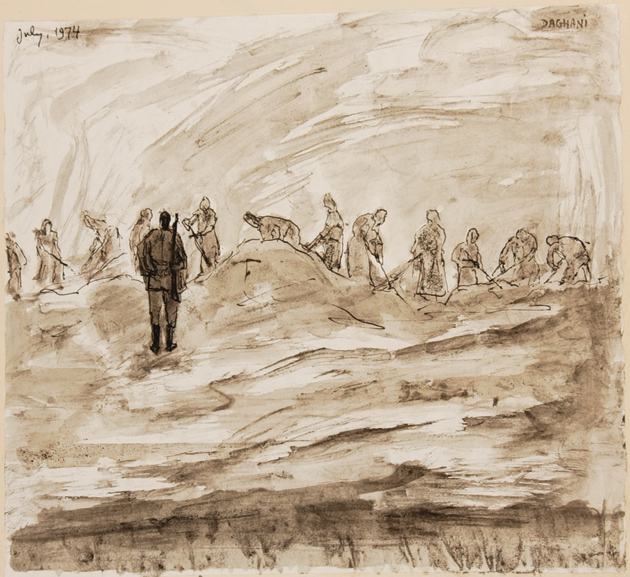
At the time of the film, he worked under the far more obscure Walter Gieseke, who probably through a confusion of names had been placed in charge of SS security for bridge, dam, and road construction projects in Ukraine, the most important of which was the German military highway called Durchgangsstrasse IV. With these pieces of the puzzle in place, Bennett was able to research the most historically important aspect of the book, namely the network of notorious slave labor camps strung along the entire length of the highway and the experiences of a tragically small number of survivors, particularly the Romanian Jewish painter Arnold Daghani, who was first deported from Bukovina to Transnistria by the Romanians and then seized by the Germans for slave labor in southern Ukraine.
Gieseke was too high-ranking to have bloodied his hands personally in the operation and then liquidation of the DGIV camps, and he ranked too low to have signed incriminating documents. He easily survived postwar investigations without indictment. Von Alvensleben, implicated in numerous crimes beyond this particular assignment, was convicted in absentia in Poland but escaped to Argentina. Daghani spent much of his postwar life seeking justice for the crimes of the DGIV camps but in vain.
Ellen Cassedy, the daughter of a secular American Jewish mother, tried to recover her Jewish roots through intensive study of Yiddish in Vilnius. She pursued a double quest: What could she discover about the role of her great-uncle as a ghetto policeman in the Siauliai ghetto and how could she deal with the various ways in which present-day Lithuanians are coping with their forgotten, repressed, selectively remembered, haunted, or even defended role in the Holocaust as a difficult chapter in their own history of occupation and suffering? Cassedy resists Lithuanian attempts to place Jewish and Lithuanian suffering “side by side”—the so-called double genocide in which Nazi killing of Jews and Soviet killing of Lithuanians are equated, while the role of Lithuanians as Holocaust perpetrators is either denied or defended as a justified reaction to alleged Jewish complicity in the two eras of Soviet occupation and terror (1940–1941 and post-1944).
Chastened by her own difficulties in researching the role of the ghetto police in Lithuanian, she listens to all the voices and perspectives of the Lithuanians with whom she speaks. She attempts to know and comprehend rather than judge. In the tortured landscape of Lithuanian history—what she calls “a cauldron seething with competing martyrdoms, hatreds, and resentments” characterized by “seemingly unbridgeable divides” and “radically disparate views of history”—Cassedy ultimately sides with an aging Holocaust survivor who returned to his native country and spoke at a local high school. Confronted with a young man in tears who confessed that his grandfather had been a killer of Jews and asked what he should do, the survivor embraced him and replied, “It is enough for you to understand.”

-
1
Eichmann in Jerusalem: A Report on the Banality of Evil (Viking, 1964), pp. 117, 125. ↩
-
2
Raul Hilberg, The Destruction of the European Jews (Quadrangle, 1961), especially pp. 14–17, 662–669. ↩
-
3
Raul Hilberg, The Destruction of the European Jews, (Holmes and Meier, 1985) p. 1038. ↩
-
4
Primo Levi, The Drowned and the Saved (Summit, 1988), pp. 36–69. ↩