
“It often seems to me very bizarre,” T.S. Eliot wrote, at the age of thirty-seven, to his older brother Henry, “that a person of my antecedents should have had a life like a bad Russian novel.” It’s probably Dostoevsky that Eliot had in mind here, about whom he had decidedly mixed feelings. In one of his London Letters for The Dial, written shortly before the publication of The Waste Land in the autumn of 1922, he observed that the Russian novelist had “an infinite capacity for taking no pains” with the technical aspects of fiction; on the other hand, he also conceded that Dostoevsky’s medical and emotional problems were the catalysts for his genius, suggesting that in his novels “epilepsy and hysteria cease to be defects of an individual and become—as a fundamental weakness can, given the ability to face it and study it—the entrance to a genuine and personal universe.”
What Eliot seems to be marveling at in his letter to Henry is the sheer unlikeliness of his journey from his comfortable Unitarian upbringing in St. Louis—with summers spent at the family holiday home in East Gloucester—to the extreme state of mind that found expression in The Waste Land, with its apocalyptic “hooded hordes swarming/Over endless plains,” its Gothic “bats with baby faces,” its horrifying glimpses into atrocity—“White bodies naked on the low damp ground,” its savage depictions of joyless sex, its unsparing portrayal of intolerable marital relations, its kaleidoscopic refractions of dysfunction and despair. These chunky tomes of his correspondence allow us to follow day by day, drop by harrowing drop, Eliot’s “rudely forced” metamorphosis into the poet of hysteria whose sufferings enabled him, like Dostoevsky, to find “the entrance to a genuine and personal universe.”
The word “personal,” however, was far from being a term of praise in Eliot’s critical vocabulary. He of course wanted his poetry to be “genuine,” or “echt,” to borrow the term Ezra Pound made use of to separate out the good bits from the bad bits on the drafts of The Waste Land; but to be personal was not what Eliot meant, not what he meant at all. Indeed, the ideal of the “impersonal” lay deep at the core of the aesthetic—and cultural and political—views that he propounded so magisterially in his criticism, and in many of the letters dispatched to his carefully chosen cadre of contributors to the magazine he edited, The Criterion, launched in October 1922, with financial backing from Lady Rothermere. Eliot summed up his concept of the impersonal most famously in his 1919 essay “Tradition and the Individual Talent”; there he observes that
the bad poet is usually unconscious where he ought to be conscious, and conscious where he ought to be unconscious. Both errors tend to make him “personal.” Poetry is not a turning loose of emotion, but an escape from emotion; it is not the expression of personality, but an escape from personality. But, of course, only those who have personality and emotions know what it means to want to escape from these things.
While the whole Tradition versus Individual or Classical versus Romantic debate that this essay played a significant part in kick-starting has now come to seem as spectral as Eliot’s unreal commuters flowing over London Bridge, the concept of “escape” is likely to loom insistently in the thoughts of anyone working their way through these volumes: letter after letter reveals Eliot suffering from overwork, exhaustion, aboulie (want of will), emotional derangement, influenza, severe toothache, and impending nervous breakdown. Periodically he reports doctors ordering him to the country, or abroad, to take a complete rest as the only means of staving off some unimaginably dire collapse. Impossibly demanding commitments loom on all sides. “If there were the sound of water only,” one keeps thinking, “Drip drop drip drop drop drop drop/But there is no water.” Occasionally a howl of despair escapes him: “In the last ten years,” he writes to John Middleton Murry in April 1925,
gradually, but deliberately—I have made myself into a machine. I have done it deliberately—in order to endure, in order not to feel….
And yet Eliot’s multifarious ailments and anxieties pale into insignificance when compared with those of his wife Vivien, whose relentless ill health and emotional and mental instability provide the dominant motif to swathes of his correspondence. If Eliot, like Dostoevsky, or his own Tiresias in The Waste Land, gained entry to his particular rhetorical world through weakness and hysteria, this portal was provided, in no small measure, by the woman whom he married after a courtship of not much more than two months, in June 1915. The match severely displeased his parents, his father in particular, though it delighted his new friend Ezra Pound. Pound was so eager to keep his prime discovery based in London that he urged the desirability of the union on both parties, and even wrote a long letter, included here, to Eliot’s father explaining the ins and outs of literary London, and the economic prosperity his protégé would soon be enjoying there.
Advertisement
Eliot aficionados have been kept waiting a long time for these letters, for reasons that have never been clearly explained. As his widow Valerie acknowledges in her introduction to Volume 1 (first issued in 1988, but since expanded with an extra two hundred newly discovered letters), although Eliot was on the whole inclined not to want his correspondence published, in his mellow old age he conceded that if Valerie herself would undertake the task, it wouldn’t be in defiance of his wishes.
The over-twenty-year delay between the first version of Volume 1 and these subsequent volumes rather encouraged the notion that a “smoking gun” lurked somewhere, and that the estate was suppressing it. Part of the fascination of Eliot’s poetry has always derived from its ability to suggest that, as in detective novels, of which he was an avid consumer, somewhere, inside or outside the poem, there lay buried a vital but elusive clue that, once discovered, would at last reveal all. No such revelation has emerged, though on occasions Eliot’s self-analysis does deploy terms that send a chill down the spine. The letter quoted above to Murry continues:
but it has killed V. In leaving the bank I hope to become less a machine—but yet I am frightened—because I don’t know what it will do to me—and to V.—should I come alive again. I have deliberately killed my senses—I have deliberately died—in order to go on with the outward form of living—This I did in 1915. What will happen if I live again? “I am I” but with what feelings, with what results to others—Have I the right to be I—But the dilemma—to kill another person by being dead, or to kill them by being alive? Is it best to make oneself a machine, and kill them by not giving nourishment, or to be alive, and kill them by wanting something that one cannot get from that person? Does it happen that two persons’ lives are absolutely hostile? Is it true that sometimes one can only live by another’s dying?
A footnote alerts us to Sweeney’s haunting speech in Sweeney Agonistes, the unfinished play with which Eliot was struggling in these years, about the man who once “did a girl in,” and then kept her “with a gallon of lysol in a bath.” Like The Waste Land, this dramatic fragment was clearly a way for Eliot to model his peculiar marital situation:
He didn’t know if he was alive and the girl was dead
He didn’t know if the girl was alive and he was dead
He didn’t know if they both were alive or both were dead
It is striking that Sweeney delivers himself of such thoughts not only to the play’s two flighty London flapper types, Dusty and Doris, but also to a group of visiting Americans, who explain to their hosts that while London is “a fine place to come on a visit,” they couldn’t live there: “London’s a little too gay for us/Yes I’ll say a little too gay.” One catches in the lines something of Eliot’s sense of the unbridgeable gap that had opened up between the reassuring, if “ungay,” America of his family (he embarked on the play a couple of years after a visit from his mother, his sister Marian, and his brother Henry), and the “bad Russian novel” into which his decision to marry Vivien and attempt to forge a literary career in London had plunged him.
The comprehensive—perhaps, one can occasionally feel, rather too comprehensive—policy underlying this edition means we get a full sense of Eliot’s antecedents. Volume 1’s opening pages are mainly occupied by a string of letters from his mother Charlotte to the headmaster of Milton Academy negotiating entrance for the academic year 1905–1906 for the sixteen-year-old Tom, as an alternative to starting immediately at Harvard. Mr. Cobb is informed of young Eliot’s “congenital rupture,” which required him to wear a truss from an early age, and of her purchase of a “low steamer trunk” in which she wants his clothes to be kept so that they’ll remain free of dust.
A request from Tom for permission to swim in a quarry near the academy elicits a wary demand for more information, since she has seen “quarry ponds surrounded by steep rock that looked dangerous,” while her husband Henry is worried lest Tom catch typhoid. “One must be so careful these days,” as Madame Sosostris would later put it. Eliot Senior’s attitude toward the changes afoot in society is neatly captured in a letter of March 7, 1914, to his brother, Thomas Lamb Eliot:
Advertisement
I do not approve of public instruction in Sexual relations. When I teach my children to avoid the Devil I don’t begin by giving them a letter of introduction to him and his crowd. I hope that a cure for Syphilis will never be discovered. It is God’s punishment for nastiness. Take it away and there will be more nastiness, and it will be necessary to emasculate our children to keep them clean.
It is often suggested that some kind of sexual ambivalence or repression lay at the heart of Eliot’s difficulties, and certainly his poetry dramatizes contrasting extremes of male sexuality, swinging from the virginal self-consciousness of J. Alfred Prufrock to the primitive vigor of Sweeney, or the hero of his long-running smutty epic, the black King Bolo, whose priapic antics were outlined in cringe-making letters to chums such as Wyndham Lewis, Ezra Pound, and Bonamy Dobrée. In 1927, in the last of these volumes, we find Eliot committing himself to a forbidding program of sanctity, chastity, humility, and austerity, yet at around the same period celebrating, in letters to Dobrée, King Bolo’s fecund powers in doggerel that would shame a hormonal schoolboy.
The inclusion of numerous letters by Eliot’s family and friends, and the extensive footnotes that excerpt liberally from missives received, as well as explicating all references and offering useful mini-biographies of every potential Criterion contributor Eliot ever contacted, mean these volumes provide an exhaustively detailed picture of the circumstances in which Eliot’s correspondence, and his criticism and his poems, were written. The decision also allows for a range of different perspectives on the Eliots’ problems.
Having spent a few weeks with Tom and Vivien in Italy in the spring of 1926, Henry furnished his younger brother with a trenchant, no-nonsense diagnosis of Vivien’s condition, which he concluded was so much playacting. Her “state of emotional anguish is self-induced,” he pronounces, “voluntarily and deliberately…. It is something which Vivien herself could put a stop to at any moment, by an effort of will.” Her hallucinations, her threats of suicide, were simply a means to
secure for herself the notoriety and attention which is meat and drink to her…. The climax of her satisfaction would be to suffer some fate, not extinction, and not too painful, which would be incontestably dramatic.
He urges Eliot either to ignore altogether her “bag of tricks,” or to show her “that the only impression they make on you is that of utter silliness and puerility.” A bracing view, to which Eliot seems not to have responded, preferring to consign her to the hands of a succession of medical “experts,” the most lethal of whom was a German quack called Dr. Karl Bernhard Martin; he prescribed a diet so radically restricted that Vivien ended up suffering severe malnutrition. Henry’s unpitying analysis, so at odds with—and perhaps provoked by—Eliot’s truly wondrous powers of solicitude in the years covered by these volumes, seems to have reflected the family’s general disapproval of Vivien. A letter written by Henry Senior just four days before his death in January 1919 notes approvingly that his youngest son is doing well in the bank, but curtly adds: “Wish I liked his wife, but I don’t.”
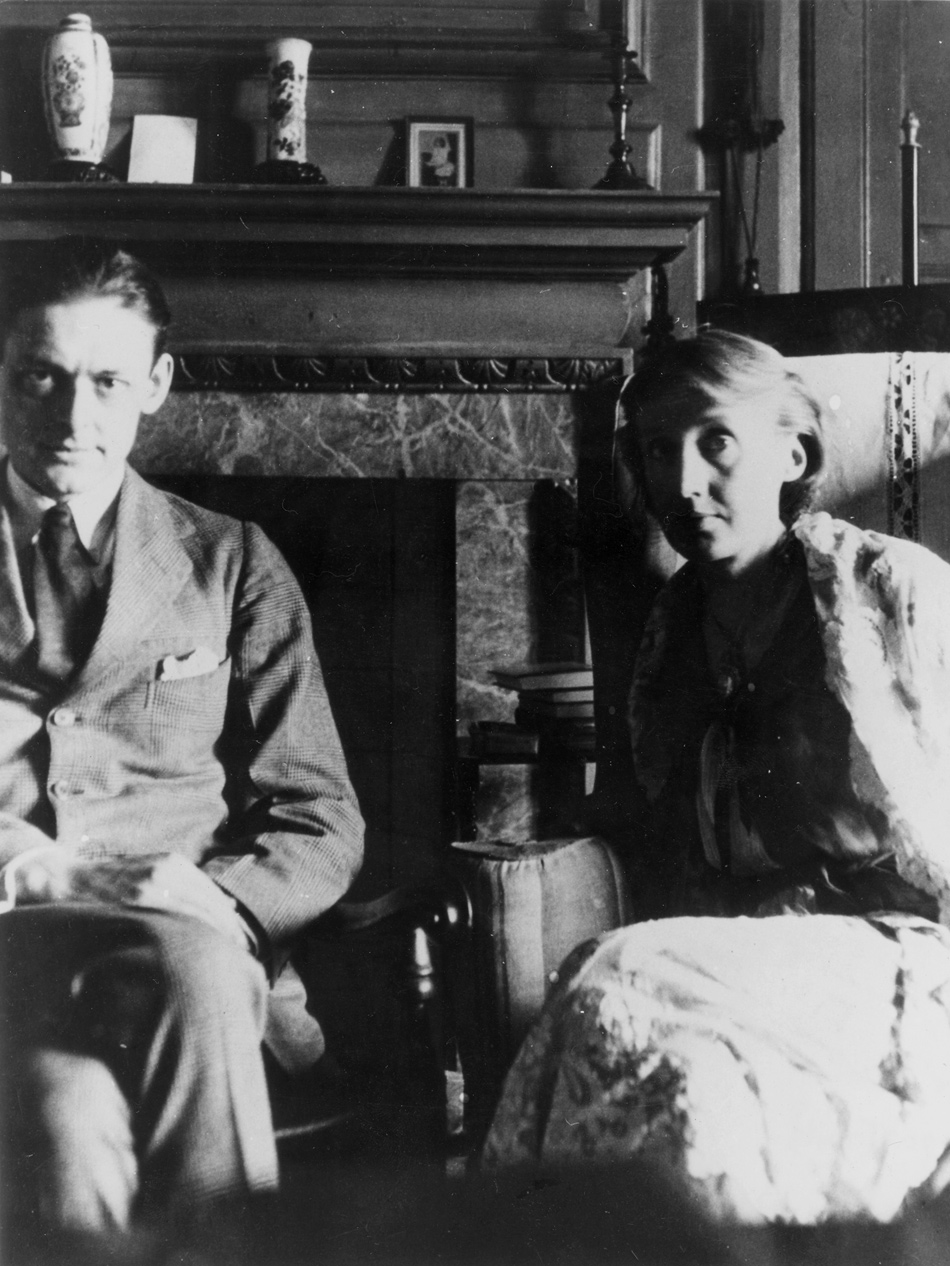
It was a great source of grief to Eliot that his father never lived to see his errant son make good. In his letters home he often works hard to impress with details of his steady upward progress through the echelons of the London literary world, and to pass on the frisson that he clearly felt at rubbing shoulders with well-born literary types in Bloomsbury salons: a typical bulletin to his mother of February 22, 1920, makes purposeful mention of Lady Ottoline Morrell, Lady Ida Sitwell, Virginia Woolf (“a daughter of Sir Leslie Stephen”), and Sydney Waterlow (“Lord Robert Cecil’s right hand man”).
Eliot’s movement away from his antecedents can be traced, then, through these letters, as occurring on a number of different levels. If his hasty marriage ended up leading him deep into the heart of a bad Russian novel, or perhaps a Gothic-y English one like Jane Eyre (which Eliot taught as a part of his 1918 extension lecture course—he thought it and Wuthering Heights “amazingly good stuff”), it also inaugurated his journey into the mores and conventions of the country whose nationality he would adopt officially in 1927. Virginia Woolf famously described him, in a letter to Clive Bell, as attired in “a four-piece suit,” and these letters show him assuming the language and views of High Toryism with often dismaying completeness.
His letters to newspaper editors can make particularly uncomfortable reading. On January 8, 1923, the Daily Mail printed a letter he’d written—perhaps partly in the hope of impressing its proprietor, Lord Rothermere, into offering him a job—commending its support of Italian Fascism, as well as the hard line the paper took on Edith Thompson, who was to be hanged the next day for her part in the murder by her lover, Frederick Bywaters, of her husband. “Nothing could be more salutary,” writes Eliot,
at the present time than the remarkable series of articles which you have been publishing on Fascismo [all, a footnote tells us, highly admiring ones]; these alone constitute a public service of the greatest value and would by themselves have impelled me to write to thank you.
On the Ilford murder your attitude has been in striking contrast with the flaccid sentimentality of other papers I have seen, which have been so impudent as to affirm that they represented the great majority of the British people.
“Disgusted of Tunbridge Wells,” he might have signed himself. Another draws to the public’s attention the dangers presented to motorists by charabancs traveling in convoy.
Pound, for one, didn’t buy it at all—and began addressing his friend as Old Possum, the implication being that Eliot, having suitably camouflaged himself in the trappings of English society, was simply lying low in the enemy camp. Eliot was willing enough, in his correspondence with Pound, to play along with the notion, and on occasion deployed suitably Uncle Remus–style lingo in letters and postcards to il miglior fabbro. But by 1928, when he defined himself in For Lancelot Andrewes as “classicist in literature, royalist in politics, and anglo-catholic in religion,” the process of assuming an English identity that we have watched gathering momentum over the previous thirteen years might be said to have completed itself.
It is of course possible to see Eliot’s championing of “classicism” as a possum-style attempt to obscure the unstable nature of his own inspiration, of the fact, as Randall Jarrell once brilliantly put it, that Eliot was “one of the most subjective and daemonic poets who ever lived, the victim and helpless beneficiary of his own inexorable compulsions, obsessions”; but his public espousal of royalism and Anglo-Catholicism can be taken as evidence that he himself felt he had now moved decisively beyond the Unitarian and American democratic traditions in which he’d been raised.
Eliot’s principal achievement, it is generally agreed, is his poetry, but one would hardly guess he composed verse at all from a random sampling of these volumes. It wasn’t that he was particularly unwilling to discuss “the intolerable wrestle/With words and meanings” in his letters, but that it seems that months and even years would pass without his attempting to clamber into the ring. In the course of the 870 pages of Volume 3, covering 1926 and 1927, he flickers into life as a poet just once, with the composition of “Journey of the Magi,” which, he tells Conrad Aiken, he wrote “in three quarters of an hour after church time and before lunch one Sunday morning, with the assistance of half a bottle of Booth’s gin.” (It provides the title of this review.)
Manuscript materials may in time reveal that Eliot was pursuing his primary vocation more purposefully than these letters suggest, and it would be particularly interesting to see any drafts relating to Sweeney Agonistes, on which he was at work for years, and which he seems to have imagined would be a decisive step beyond The Waste Land. In a somewhat surprising move he contacted Arnold Bennett (a novelist much pilloried by Modernists such as Woolf and Pound) for advice on writing what Bennett understood would be “a drama of modern life (furnished flat sort of people) in a rhythmic prose ‘perhaps with certain things in it accentuated by drum-beats.’” They met a number of times between 1923 and 1925, and Eliot was effusive in his thanks, reporting himself “tremendously encouraged” by Bennett’s advice after one session together in October 1924, and, as was his wont, rather overdoing the flattery, even insisting that Bennett’s guidance will make him “feel that the play will be as much yours as mine.”
After the relative deluge of poems, by Eliot’s slow standards, completed in the course of Volume 1, climaxing in the sprawling manuscript of The Waste Land and his excited negotiations with Pound over what should be cut from it and what should remain, Eliot’s poetic output slowed to a painful trickle. Editors beseeching him for new poems were sternly warned that he not only had nothing to offer them, but was unlikely to produce anything in the foreseeable future. While The Waste Land, in its four printings (in The Criterion in October 1922, in The Dial in November 1922, as a book from Boni and Liveright in New York in December 1922, and as a book from the Woolfs’ Hogarth Press in September 1923), was slowly but steadily conquering the literary world, and making Eliot the most respected and influential young poet of the time, he was spending his days working in Lloyds Bank, and devoting every scrap of his free time to editing The Criterion.
In the long run his editorship of this magazine led to his appointment as a director of Faber and Gwyer, under whose aegis it was relaunched as The New Criterion in January 1926. This appointment finally enabled Eliot to resign from Lloyds and embark on his extremely successful and financially secure career in publishing. As a gamble, then, it might be said to have paid off, but the years covered by Volume 2 of these letters, 1923–1925, present a grueling account of Eliot burning the candle at both ends, disentangling foreign debt by day, and firing off letters to such as Valéry and Cocteau and Gide (in very serviceable French) and Hugo von Hofmannsthal and Yeats and Gertrude Stein each evening and during weekends.
For those, such as Pound, who believed a poet as gifted as Eliot should spend as much of his time as possible writing poetry, the assumption of the enormous workload involved in running a respectable quarterly more or less single-handed, though with some help from Vivien, when she was well enough, and a part-time secretary, was simply baffling—and Pound didn’t think much of the results of Eliot’s labors either, characterizing The Criterion’s contributors as a “bunch of dead mushrooms.” Its circulation never rose much above eight hundred, it always ran at a loss, Eliot received no salary for editing it, and it consumed inordinate amounts of his time. It had, though, a polemical purpose.
While he liked to present the magazine as serenely above party politics, his overall hope was, as he put it to a prospective contributor, “to give to Toryism the intellectual basis with the illusion of which Socialism has so long deceived the young and eager.” His idea was to gather around him a band of the like-minded, with principles debated and agreed upon at monthly Criterion dinners. If not exactly disciples, writers and critics such as Herbert Read and Richard Aldington and Bonamy Dobrée were to an extent marshaled by Eliot into a phalanx that could be roughly relied upon to deliver Criterion doctrine; although when Aldington—who in later years would break decisively with Eliot—submitted a long, overenthusiastic essay on D.H. Lawrence, it was rejected on the grounds that it failed to “fall in with the general position of the Criterion,” a formulation frequently used in letters returning material that Eliot didn’t want to print. But perhaps what is most striking about the magazine, in these early years, is the exemplary thoroughness with which Eliot sought out contributions from a really extensive range of European writers, and attempted to cover intellectual developments not only in France, Germany, Italy, and Spain, but Holland, Russia, and Denmark—and even America.
Still, even the keenest fans of Eliot are going to find the great mass of Criterion business correspondence assembled in Volumes 2 and 3 of these letters hard going. Many were dictated to his secretary, and although crisply phrased, are essentially of no interest, making me wonder about the “minor letters” excluded from Volume 3 to keep the book to “a relatively manageable length.” Despite Eliot’s prestigious roll call of contributors, and his own brilliance as a review-essayist, The Criterion itself, while always high-minded, is not always that riveting. Its sponsor, Lady Rothermere, who had hoped for something a little more social and glitzy, frequently and frankly complained that it was boring, to which Eliot could do nothing but agree and apologize. And what imp of the perverse made him open the first issue with an essay by George Saintsbury on “Dullness”?
The magazine did, however, play a considerable role in Eliot’s emergence as the most authoritative literary and, to some, cultural spokesman of the day. When, much to his credit, he accepted Hart Crane’s “The Tunnel” (which would become Part VII of The Bridge) for publication, Crane excitedly fired off a letter to his patron, Otto Kahn, in which he described Eliot as “representative of the most exacting literary standards of our times,” and this acceptance as proof that Kahn was backing a winner. By 1927 Eliot is not quite yet the Pope of Russell Square, but he’s well on the way to becoming him.
Eliot’s success in reconfiguring notions of what constituted successful or valuable poetry can hardly be overestimated. His technical innovations were imitated by many of his verse-writing correspondents (slavishly by such as Conrad Aiken and Archibald MacLeish, creatively by such as Crane, Allen Tate, and of course Pound). More crucial for the success of the literary revolution that he fomented, however, was his presentation in his critical essays of his own work as the inevitable next step in the history of poetry. Three years before publishing The Waste Land Eliot had already described, in “Tradition and the Individual Talent,” the way a “new work of art” would alter “the whole existing order” of all previous works of art—which is exactly what happened in the years after 1922.
In the extraordinary reviews and essays he wrote between 1916—when he received his first commission, courtesy of an introduction by Bertrand Russell, for a piece in the International Journal of Ethics—and, say, his essay on Milton of 1936, Eliot transformed the genre of literary criticism more dramatically than any writer before him, or since. The charisma, the intelligence, the sophistication, the erudition, the feline but utterly compelling sensibility on display in these essays can make them at times seem like an elaborate literary seduction. Of course the vision of the canon they propound is a highly individual one: Milton bad, Donne good, Shelley very, very bad, Dante very, very good…. But Eliot’s rhetorical genius was such that his judgments came to seem to many not just a reflection of his own subjective tastes, but infallible verdicts, final and true: in other words “impersonal.”
Eliot’s assumption of the role of quasi-divine gatekeeper of the literary pantheon grows steadily more authoritative as these letters progress. With it comes a weariness that can at times register almost as post-traumatic calm; even when only in his late thirties Eliot speaks repeatedly not just of growing “old,” as he puts it in a letter of August 22, 1927, to his brother, but of having grown definitively “Old.” Like “impersonal,” “mature” is one of Eliot’s most fulsome terms of approbation, and the Eliot of, say, “Ash Wednesday” (1930), on which he would soon embark, figures himself maturely and serenely above the fray, an “agèd eagle” stretching his wings. But his friend and colleague Geoffrey Faber—the deus ex machina, one might say, who finally freed Eliot from his fetters to the bank—was worried by these ascetic tendencies; he felt that a certain element of the dogmatic was creeping into Eliot’s life, and imperilling him. In a brave and searching letter of September 15, 1927, Faber ventured some thoughtful criticisms:
It is not right that you should chain yourself to a routine—it will cramp your mind, & ultimately be fatal to you both as poet & critic, if for no other reason than that it will divorce you further & further from the common man. I cannot help at times suspecting that the difficulties are, to some extent, of your own forging.
Earlier in the letter Faber complains of the “excessive obscurity” of Eliot’s poetry—somewhat ironically given the contribution this excessively obscure work would eventually play in the financial success of his publishing venture—and asks, “Is it an unavoidable element in your poetry? or is it deliberate?”
The bon vivant Faber’s bluff, well-meaning, but also acutely probing questions ask us to ponder both the difficulty of Eliot’s poetry and the difficulties of his life. How “unavoidable” was it that a poet who had written, in 1915, a prose poem called “Hysteria” about a man who imagines himself being swallowed by a woman with whom he is having tea, to the point that he is “lost finally in the dark caverns of her throat, bruised by the ripple of unseen muscles,” should that year marry a woman who would induct him into “dark caverns” from which, as his letter to Murry put it, the only escape, it could at times seem, was to kill her or kill himself?
A secure and undifficult life as a professor of philosophy at Harvard was open to Eliot as late as 1919; it held, however, no appeal for him, as he makes clear in a letter to his old philosophy tutor, J.H. Woods, who had offered him a position in the department. In declining Eliot figures himself somewhat in the image of a Jamesian expatriate, like Lambert Strether of The Ambassadors, one who has grown addicted to the complexities of European society, however excruciating the pain they inflict, and would find life back in America insufferably dull. “I have acquired,” he informs Woods, “the habit of a society so different that it is difficult to find common terms to define the difference.”
Something in Eliot, in other words, sought difficulty, wanted, whatever the cost, blood shaking his heart, to raise the stakes, to exchange the unthreatening blandness of Unitarianism, and American culture at large, as he saw it, for something more complex and extreme: a vision, after much purgatorial suffering, of redemption in Heaven; or of fear, in a handful of dust, of damnation in Hell.