





Janet Malcolm was born in Prague. She was educated at the High School of Music and Art, in New York, and at the University of Michigan. Along with In the Freud Archives, her books include Diana and Nikon: Essays on Photography, Psychoanalysis: The Impossible Profession, The Journalist and the Murderer, The Purloined Clinic: Selected Writings, The Silent Woman: Sylvia Plath and Ted Hughes, The Crime of Sheila McGough, and Reading Chekhov: A Critical Journey. She wrote about the trial of Mazoltuv Borukhova, the mother of Michelle, in her book Iphigenia in Forest Hills, just out in paperback. Her collection Forty-One False Starts: Essays on Artists and Writers will be published in the spring of 2013.
She lives in New York.-
Michelle: Surviving in a Fixed World
December 20, 2012
-
The Fate of Michelle Malakova: ‘Oppositional Behavior’
December 6, 2012
-
What Happened to Michelle in Forest Hills?
November 22, 2012
-
Special Needs
April 7, 2011
-
Comedy Central on the Mall
December 9, 2010
-
Levin’s Moral Mowing
September 30, 2010
-
Thoughts on Autobiography from an Abandoned Autobiography
April 29, 2010
-
Capitalist Pastorale
January 15, 2009
A Girl of the Limberlost
by Gene Stratton-Porter
Freckles
by Gene Stratton-Porter
The Harvester
by Gene Stratton-Porter
Her Father’s Daughter
by Gene Stratton-Porter
The Keeper of the Bees
by Gene Stratton-Porter
Gene Stratton-Porter: Novelist and Naturalist
by Judith Reich Long
The Lady of the Limberlost: The Life and Letters of Gene Stratton-Porter
by Jeannette Porter Meehan
-
Burdock
August 14, 2008
-
Keaton’s Own Lens
December 6, 2007
-
Pandora’s Click
September 27, 2007
Send: The Essential Guide to Email for Office and Home
by David Shipley and Will Schwalbe
-
‘The Not Returning Part of It’
February 15, 2007
Wish I Could Be There: Notes from a Phobic Life
by Allen Shawn
-
Good Pictures
January 15, 2004
Diane Arbus Revelations
Catalog of the exhibition by Sandra S. Phillips, Elisabeth Sussman, Doon Arbus, Neil Selkirk, and Jeff L. Rosenheim
Diane Arbus: Family Albums
Catalog of the exhibition by Anthony W. Lee and John Pultz
-
Edward Weston’s Women
December 5, 2002
Margrethe Mather and Edward Weston: A Passionate Collaboration
by Beth Gates Warren
Through Another Lens: My Years with Edward Weston
by Charis Wilson and Wendy Madar
-
Nudes Without Desire
April 11, 2002
Earthly Bodies: Irving Penn’s Nudes, 1949–50
Catalog of the exhibition by Maria Morris Hambourg
Dancer: Photographs of Alexandra Beller by Irving Penn Catalog of the exhibition with an introduction by Anne Wilkes Tucker and an essay by Sylvia Wolf
-
Justice to J.D. Salinger
June 21, 2001
-
The Genius of the Glass House
February 4, 1999
Julia Margaret Cameron’s Women 1998-January 10, 1999; the Museum of Modern Art, New York, January 27-May 24, 1999; the San Francisco Museum of Modern Art, August 27-November 30, 1999.
an exhibition at the Art Institute of Chicago, September 19,, Catalog of the exhibition by Sylvia Wolf, by others
-
It Happened in Milwaukee
October 23, 1997
Feminist Accused of Sexual Harassment by Jane Gallop
-
Bellocq’s Women
March 6, 1997
-
The Real Thing
January 9, 1997
Bellocq: Photographs from Storyville, the Red-Light District of New Orleans reproduced from prints made by Lee Friedlander, Introduction by Susan Sontag, interviews edited by John Szarkowski
-
Aristocrats
February 1, 1996
Untitled by Diane Arbus
-
The Family of Mann
February 3, 1994
Immediate Family
by Sally Mann, afterword by Reynolds Price
-
A Matter of Life and Death
June 13, 1991
Wartime Lies by Louis Begley
-
Nothing But the Truth?
July 19, 1990
-
The Trial of Alyosha
June 14, 1990
Letters to Olga June 1979September 1982 by Václav Havel, translated by Paul Wilson
-
The Morality of Journalism
March 1, 1990
-
Down There on a Visit
April 28, 1988
Where the Spirits Dwell: An Odyssey in the New Guinea Jungle
by Tobias Schneebaum
-
What Maisie Didn’t Know
October 24, 1985
Deceived with Kindness: A Bloomsbury Childhood by Angelica Garnett
-
Getting It Wrong: An Exchange
May 9, 1985
-
The Unreliable Genius
March 14, 1985
Edmund Gosse: A Literary Landscape, 18491928 by Ann Thwaite
-
Talking to the Analyst: An Exchange
February 28, 1985
-
The Patient Is Always Right
December 20, 1984
Analysis of Transference, Vol. I: Theory and Technique by Merton M. Gill
Analysis of Transference, Vol. II: Studies of Nine Audio-Recorded Psychoanalytic Sessions by Merton M. Gill, by Irwin Z. Hoffman
-
Oversight
July 19, 1984
-
The Game of Lights
May 10, 1984
The Unbearable Lightness of Being by Milan Kundera, translated by Michael Henry Heim
-
School of the Blind
October 7, 1982
Vedi by Ved Mehta
-
Wolfe in Wolfe’s Clothing
December 17, 1981
From Bauhaus to Our House by Tom Wolfe
-
Free Associations: Collages
January 8, 2012
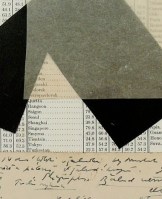
Last winter, I came into possession of the papers of an émigré psychiatrist who practiced in New York in the late 1940s and 1950s. The archive included a collection of manila envelopes, around six by ten inches, stuffed with folded sheets of thin paper covered with single-spaced typing: the notes the psychiatrist made after seeing patients (many of them fellow émigrés) in his office. As I studied the sheets with their inky typewriting and 60-year-old paper clips holding them together and leaving rust marks on the surface, my collagist’s imagination began to stir. I began to “see” some version of the collages on view here.
-
Comedy Central on the Mall
November 8, 2010
On October 31, Peter Clothier, a seventy-four-year-old author and retired professor, posted an entry on his blog, called The Buddha Diaries, about the wonderful day he and his wife Ellie had spent at the Jon Stewart and Stephen Colbert Rally to Restore Sanity and/or Fear on October 30 at the Mall in Washington, D.C., between noon and 3 PM. “We stood there trapped for a good two hours, surrounded by people who, like us, had showed up. We saw nothing, heard nothing of what was happening on the stage. It was great!” Clothier writes.
-
Thoughts on Autobiography from an Abandoned Autobiography
March 25, 2010
I have been aware, as I write this autobiography, of a feeling of boredom with the project. My efforts to make what I write interesting seem pitiful. My hands are tied, I feel. I cannot write about myself as I write about the people I have written about as a journalist. To these people I have been a kind of amanuensis: they have dictated their stories to me and I have retold them. They have posed for me and I have drawn their portraits. No one is dictating to me or posing for me now.